• العربية
  • فارسی
Brand
  • Iran Insight
  • Politics
  • Economy
  • Analysis
  • Special Report
  • Opinion
  • Podcast
  • Live TV
  • Iran Insight
  • Politics
  • Economy
  • Analysis
  • Special Report
  • Opinion
  • Podcast
  • Live TV
  • Theme
  • Language
    • العربية
    • فارسی
  • Iran Insight
  • Politics
  • Economy
  • Analysis
  • Special Report
  • Opinion
  • Podcast
  • Live TV
All rights reserved for Volant Media UK Limited
volant media logo

Iran oil workers protest pay conditions at offshore platforms, Assaluyeh

Sep 7, 2026, 17:35 GMT+1
Oil workers protesting their pay conditions on an offshore platform on Sept. 7, 2026.

Employees of Iran’s oil industry held protests Monday at offshore platforms operated by Pars Oil and Gas Company and in the southern energy hub of Assaluyeh, demanding changes to pay, taxes and benefits as US economic pressure weighs on Iran’s oil exports and wider economy.

Afkar-e Naft, a Telegram channel which reports on issues affecting permanent oil industry employees, said the demonstrations were part of protests held every Monday.

Images published by the channel showed workers at several offshore installations holding placards calling for the removal of salary caps, full payment of wages and benefits, fairer compensation and changes to the tax system for offshore employees.

“Full payment of wages and benefits,” read one placard, while another said, “Fair pay is our right, not an extra privilege.”

Other signs called for an overhaul of the wage system for operational oil workers and the removal of what protesters described as “unfair restrictions” on salary payments.

1 / 5
100%
1 / 5

Several workers also highlighted the conditions under which oil production has continued during the war. One placard read, “Uninterrupted production in a war zone,” while another referred to “uninterrupted production in border areas.”

The protesters are also seeking payment of outstanding compensation under Article 10 of the law governing the duties and powers of Iran’s Oil Ministry.

The so-called Article 10 back pay refers to accumulated payments employees say they are owed following implementation of provisions governing compensation and employment conditions for Oil Ministry personnel.

The protests come as Iran’s economy faces mounting pressure from the regional war and a US maritime blockade that was reimposed in mid-July. Satellite imagery reviewed by Iran International shows a sharp decline in visible vessel activity at Shahid Rajaee and Imam Khomeini, two of the country’s most important commercial ports, since the blockade resumed.

The impact has been particularly severe on Iran’s oil trade, a crucial source of government revenue and foreign currency. Kpler tanker-tracking data reviewed by Iran International showed Iranian crude loadings averaging about 287,000 barrels per day in August through Aug. 21, compared with roughly 2 million barrels per day before the war — a fall of about 85%.

Washington has simultaneously intensified its financial campaign against Tehran. On Aug. 24, the US Treasury launched Operation Economic Outcast, dubbed an “Economic D-Day,” saying it aimed to sever Iran’s remaining financial and commercial connections and increase the risks for foreign banks and companies doing business with Tehran. The campaign has since targeted financial channels in countries including the United Arab Emirates and Türkiye.

The pressure has coincided with a steep deterioration in household purchasing power. Iran’s rial has fallen to a record low of about 2.2 million to the US dollar this month, compared with roughly 958,000 a year earlier.

Official figures for July showed average annual inflation at around 62%, year-on-year inflation at 82% and food inflation at 134%, adding to the pressure on wages and living standards.

Most Viewed

Satellite images show Iran’s key ports falling quiet under US blockade
1
EXCLUSIVE

Satellite images show Iran’s key ports falling quiet under US blockade

2

London penthouses linked to Iran’s Supreme Leader put up for sale – Sunday Times

3

Iran has only 30 million barrels of oil left for China, Bessent says

4
ANALYSIS

Starlink next door could loosen Iran’s grip on internet

5

Iran doubles gasoline price amid fears of renewed unrest

Banner
Banner
Banner

Spotlight

  • Europe’s third-way ambitions on Iran give way to alignment with Washington
    ANALYSIS

    Europe’s third-way ambitions on Iran give way to alignment with Washington

  • The gamble behind US attacks on Iran’s oil tankers
    ANALYSIS

    The gamble behind US attacks on Iran’s oil tankers

  • Iran, where eggs are a better bet than cash
    PODCAST

    Iran, where eggs are a better bet than cash

  • Starlink next door could loosen Iran’s grip on internet
    ANALYSIS

    Starlink next door could loosen Iran’s grip on internet

  • Satellite images show Iran’s key ports falling quiet under US blockade
    EXCLUSIVE

    Satellite images show Iran’s key ports falling quiet under US blockade

  • Iran's appliance industry is collapsing, and so is the market it was built for
    INSIGHT

    Iran's appliance industry is collapsing, and so is the market it was built for

  • Satellite images show Iran’s key ports falling quiet under US blockade

    Satellite images show Iran’s key ports falling quiet under US blockade

•
•
•

More Stories

The gamble behind US attacks on Iran’s oil tankers

Sep 7, 2026, 03:56 GMT+1
•
Umud Shokri
100%
CENTCOM handout purporting to show Iranian tanker M/T Kylo sinking in the Gulf of Oman

US attacks on Iranian oil tankers could make it far harder and more expensive for Tehran to keep selling its crude, but the strategy carries a potentially much larger cost: turning the Persian Gulf’s energy infrastructure into an expanding battlefield.

The latest US strikes on three Iranian oil tankers mark a significant escalation in Washington’s economic campaign against Tehran, moving beyond sanctions and blockade to the physical destruction of vessels used to export Iranian oil.

US forces on September 5 disabled two tankers near Kharg Island and Jask and destroyed a third in the Gulf of Oman, according to US Central Command, which described the vessels as part of a “multibillion-dollar shadow network” supporting the IRGC and its regional partners.

The strikes followed Iranian ballistic missile attacks on US naval forces that caused no American casualties. CENTCOM commander Adm. Brad Cooper warned Washington was prepared to impose an “even higher economic cost” on Tehran.

The significance of the strikes lies less in the loss of three ships than in the change in tactics. Washington has spent years trying to make Iranian oil harder to sell through sanctions, restrictions on financial transactions and pressure on buyers and shipping networks. Since mid-July, the US naval blockade has added a physical barrier.

Now, the vessels themselves are becoming targets.

From financial to physical risk

The shift comes as Iran’s oil exports are already under severe pressure.

Ship-tracking data indicated Iranian crude loadings fell to roughly 220,000–255,000 barrels per day in August, from about 740,000 bpd in July and peaks close to 2 million bpd before the conflict.

For weeks, no meaningful Iranian crude cargoes were able to reach China through the Strait of Hormuz, leaving more oil in floating storage inside the Persian Gulf.

Iran has spent years building a shadow shipping network capable of operating around Western sanctions, relying on opaque ownership structures, reflagging, manipulation of vessel-tracking systems and ship-to-ship transfers to move crude, particularly to China.

Those methods are useful when the main challenge is avoiding financial sanctions or detection. They offer far less protection if the vessels themselves become military targets.

Sanctions forced Iran to find ships willing to evade Washington. The new strategy may force it to find ships and crews willing to risk being attacked.

That could make the shadow fleet more expensive and difficult to operate. Many of its tankers are aging vessels already working outside conventional Western insurance and maritime-service networks.

If owners, crews and operators come to regard Iranian-linked voyages as carrying a serious risk of attack, some may demand greater compensation or decide the trade is no longer worthwhile.

Washington cannot, however, simply eliminate the shadow fleet overnight. The network is dispersed and adaptable. Ships can change names, flags and ownership structures, while Tehran can alter loading patterns or move ship-to-ship transfers farther from areas dominated by US forces.

But every vessel lost imposes another cost. Iran must replace it, find another operator willing to accept the risk or leave more crude stranded in storage.

Floating storage offers only temporary relief. Oil held offshore does not generate revenue until it reaches a buyer, and prolonged disruption can eventually force producers to cut output as storage fills.

The question is therefore not whether three tanker strikes can dismantle Iran’s export system. They cannot. It is whether repeated physical losses can gradually undermine the commercial network that has allowed Tehran to keep selling oil despite years of sanctions.

A wider energy battlefield

That strategy carries an obvious risk: once Washington treats Iran’s oil-export system as a military target, Tehran has a stronger incentive to widen the energy battlefield.

Iran has already used attacks and threats against maritime traffic as a means of imposing costs on its adversaries. The Strait of Hormuz remains central to that strategy because of the enormous volumes of oil and liquefied natural gas that normally pass through it.

Further reducing Iranian export revenues could weaken Tehran’s ability to finance the IRGC and allied armed groups while increasing the economic cost of continued confrontation.

But direct attacks on tankers could also reinforce the Iranian leadership’s argument that compromise will not end US pressure and that imposing costs on regional energy flows is one of Tehran’s remaining forms of leverage.

That matters well beyond Iran.

Saudi Arabia and the United Arab Emirates have invested heavily in export routes that partially bypass Hormuz, including Saudi pipelines to the Red Sea and the UAE’s link to Fujairah. But those alternatives cannot fully replace normal flows through the Strait, while Kuwait and Iraq remain particularly dependent on the waterway.

Even without major damage to regional infrastructure, greater insecurity can raise war-risk insurance premiums, freight rates and other costs for commercial operators.

The tanker strikes therefore strengthen Washington’s leverage only if they can impose additional costs on Tehran without triggering a broader contest over the region’s energy infrastructure.

Physical attacks may hurt an Iranian oil-export system that has spent years learning to circumvent sanctions. But they also give Tehran stronger incentives to retaliate against the system through which its neighbors export their own energy.

The strategic gamble for Washington is therefore not simply whether tanker strikes can further squeeze Tehran’s oil revenues. It is whether Iran can be made to bear those costs without deciding that its adversaries’ energy exports should bear them too.

Iran doubles gasoline price amid fears of renewed unrest

Sep 7, 2026, 00:10 GMT+1
100%
File Photo: Drivers fill up their cars at a gas station in Tehran, Iran

Iran will double the price of gasoline bought outside subsidized quotas from Tuesday, pushing ahead with a politically sensitive increase as households struggle with rising prices and the country faces fuel shortages.

Government spokesperson Fatemeh Mohajerani said Sunday that the third-tier gasoline price would rise to 10,000 tomans per liter from 5,000 tomans, effective September 8.

Monthly subsidized allocations will remain unchanged, with motorists entitled to 60 liters at 1,500 tomans per liter and a further 50 liters at 3,000 tomans.

Mohajerani blamed current conditions and past policies for rising consumption, saying the increase was intended to maintain the balance between supply and demand and strengthen “national resilience.”

The decision comes as Iranian households contend with high inflation, a sharply weakened currency and rising costs for basic goods.

President Masoud Pezeshkian had signaled the increase in late August but gave no date for its implementation. Since then, Iranians have expressed concern that higher gasoline prices could feed through into transport costs and the prices of other goods.

Shortages add to pressure

The price rise comes amid growing strains on Iran’s gasoline supply.

Esmail Saqqab Esfahani, head of Iran’s Energy Optimization Organization, said last month that the country faced a daily gasoline deficit of around 14 million to 15 million liters.

The gap between consumption and production predates the war, but fighting and the US blockade have added to the strain, disrupting supplies when domestic production was already failing to keep pace with demand.

Mohajerani said all additional revenue generated by the increase would be spent on supporting household livelihoods, without specifying how the money would be distributed.

Hossein Samsami, a member of parliament’s Economic Commission, warned last month that raising gasoline prices under current conditions could be like a “spark in a powder keg.”

Memories of 2019

Gasoline prices are among the most politically sensitive economic issues in Iran.

A sudden increase in November 2019 triggered nationwide protests that quickly expanded into broader anti-government unrest.

Authorities imposed a near-total internet blackout and security forces carried out a deadly crackdown in which at least 1,500 people were killed, according to a Reuters investigation.

Iranian officials have shown concern that renewed economic grievances could again spill into the streets. Parliament speaker Mohammad Bagher Ghalibaf said last month that Iran’s enemies could seek to exploit public dissatisfaction over gasoline.

The increase leaves the government trying to curb a widening gap between gasoline consumption and domestic supply without adding to public anger over the cost of living.

Iran, where eggs are a better bet than cash

Sep 6, 2026, 22:24 GMT+1
•
Negar Mojtahedi
100%
File Photo: A worker sorts fresh eggs at a factory in Iran

When eggs can hold their value better than cash, an economy has entered dangerous territory. But that is exactly where Iran is.

Rapidly rising prices are forcing families to think less about what they can afford next year or next month and more about what they should buy today before their money loses more value tomorrow.

“If you are an average Iranian, you know what you can buy today. You might not buy tomorrow — and by tomorrow, I mean 24 hours later,” economist Ali Dadpay told Iran International’s Eye for Iran podcast. .

“This is an economy that right now saving in eggs makes more sense … than saving in tomans,” he said.

An egg now costs roughly 25,000 tomans. But the story is not its dollar value. It is how quickly the purchasing power of the toman is eroding. Money put aside today may buy noticeably less within days.

“You have to tell people the frustration, the anger, the feeling of inability to provide for one’s family or afford healthcare services, pay for prescription drugs,” Dadpay said.

Average monthly income is below $200, by his estimate, while housing consumes an increasingly large share of household earnings.

Meat and other proteins are disappearing from some families’ diets. Even damaged fruit, once bought by the poorest or given to the homeless, is increasingly becoming an option for ordinary households trying to stretch their money.

“We are not approaching an economic disaster,” Dadpay said. “We are in the middle of an economic disaster.”

Economic pain, political anger

The erosion of Iran’s middle class has been underway for years, but the pressure is accelerating. Saving itself has become less about building wealth than preserving purchasing power, with gold and foreign currency used to make sure today’s earnings can still pay for necessities weeks or months from now.

“This is an economy that has stopped to invest in its future,” Dadpay said.

The political question is what happens when years of impoverishment collide with shortages, unemployment and declining public services.

Iranian authorities appear increasingly concerned about that possibility. Officials have identified gasoline, unemployment and livelihoods as potential triggers for unrest.

Judiciary chief Gholam-Hossein Mohseni-Ejei has threatened a tougher response to renewed protests, while leaked Basij audio has exposed concerns about further unrest.

Strategic forecaster Kamran Bokhari cautioned against treating economic deterioration as evidence that political rupture is imminent. Economic misery alone does not bring down governments, particularly those with an extensive coercive apparatus.

“It’s a meltdown and we’re watching it in real time,” Bokhari said.

For now, people can still adapt. Stores open, supply chains continue to function and families cut spending, change what they eat and plan around what they can afford over the next few weeks rather than the next few years.

But adaptation has limits.

You cannot eat paper

Tehran can continue paying its forces, at least in nominal terms.

Iran is a large economy of roughly 90 million people, with extensive borders and black-market networks capable of keeping some goods moving. The government can prioritize spending and print more money.

What it cannot print is the food, medicine, fuel and other goods that money is supposed to buy.

“When there are not enough products in the society, when there is not enough bread and butter for people, then the money is not going to solve the problem,” Dadpay said. “It’s just paper. You cannot eat paper.”

That creates a problem for a government relying heavily on material benefits to maintain loyalty. A higher salary offers diminishing protection against discontent if inflation rapidly destroys its purchasing power or shortages mean there is less available to buy.

Gasoline captures the contradiction particularly well.

Iran possesses enormous oil and natural gas reserves, yet Iranians have faced fuel shortages and long lines at filling stations. Dadpay traces the problem partly to decades of cheap subsidized gasoline, inefficient domestic cars, fuel smuggling and limited competition.

For years, there was still enough wealth to keep that system functioning.

Dadpay compared it to dividing a cake. Different groups could continue receiving a piece even as the cake became smaller. Now, he said, “there is no cake.”

Few easy ways out

Even an easing of external pressure would not necessarily resolve the deeper problems.

Powerful economic networks tied to the IRGC have benefited from monopolies and restricted competition, while greater foreign investment and competition could threaten those interests.

For Bokhari, that helps explain why Iran’s crisis is about more than sanctions, war or access to money.

“The kind of reforms needed means that this regime will not be what it is today,” he said.

Neither economist nor forecaster is putting a date on political rupture. Economic deterioration can persist for years, and the Islamic Republic has repeatedly demonstrated its willingness to use force to contain unrest.

But the immediate crisis is less abstract. Families are getting poorer, shortages are adding to the strain and money itself is becoming increasingly unreliable as a store of value.

Dadpay’s measure of that decline is strikingly simple. “This is an economy that right now saving in eggs makes more sense … than saving in tomans.”

Iran has only 30 million barrels of oil left for China, Bessent says

Sep 6, 2026, 10:15 GMT+1
100%
US Treasury Secretary Scott Bessent speaks during a press conference in North Carolina on September 1, 2026.

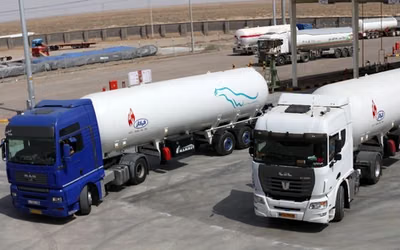
Iran has about 30 million barrels of crude oil remaining that China has not already purchased, and US sanctions and a naval blockade will soon prevent Tehran from supplying more, Treasury Secretary Scott Bessent said in an interview with Fox News.

“There’s probably only about 30 million barrels of Iranian crude oil left that China hasn’t bought,” Bessent said. “So that will run out soon, and there will be no problem with China buying because they have no product.”

Bessent described the pressure campaign, dubbed “Operation Economic Outcast,” as the largest effort to isolate a country economically and said Washington intended to “asphyxiate” Iran’s ruling establishment.

“The blockade is working like nothing we’ve ever seen, and the combination - everyone says sanctions don’t work - but I can tell you, blockade and sanctions are one of the most powerful one-two punches in the history of economic isolation,” he said.

Asked about his prediction that the Strait of Hormuz would become irrelevant to the oil industry within two years, Bessent said oil-producing countries around the Persian Gulf were developing “alternative pipeline routes that will no longer entail oil going through the Strait of Hormuz.”

  • US tanker attacks near Iran's shores widen from Jask to its oil heartland

    US tanker attacks near Iran's shores widen from Jask to its oil heartland

Bessent also rejected the suggestion that Iran controlled the waterway.

“The Iranian chokehold, to the extent they have one - and I can tell you, they do not have one - we are in control of the strait,” he said. “To the extent that they can threaten their neighbors, once we leave, that will not exist anymore.”

Iran’s Economy Ministry has established an “economic war” command center to coordinate and accelerate responses to economic problems caused by the conflict, deputy economy Minister Morteza Zamanian said on Sunday.

He acknowledged that higher energy prices caused by the conflict were affecting Americans but predicted that the shock would end and wage growth would continue.

“This war will end, and those will turn into real wage gains,” Bessent said.

He added that the administration expected the conflict to leave Iran unable to develop a nuclear weapon.

“I think we are going to get to the other side of this Iran conflict with a safer world, with an Iran that cannot have a nuclear weapon,” he said.

The United States imposed a naval blockade in July alongside expanded sanctions aimed at restricting Iran’s oil exports and cutting a key source of government revenue.

Iran’s Economy Ministry has, meanwhile, established an “economic war” command center to coordinate and accelerate responses to economic problems caused by the conflict, Deputy Economy Minister Morteza Zamanian said on Sunday.

The center will initially focus on problems affecting businesses, trade and financing within the ministry’s authority, while using government economic bodies to coordinate responses across agencies, he added.

London penthouses linked to Iran’s Supreme Leader put up for sale – Sunday Times

Sep 6, 2026, 07:36 GMT+1
100%
A man holds a portrait of Iran’s Supreme Leader Mojtaba Khamenei during a gathering in Tehran on June 8, 2026.

Two luxury London penthouses linked to Iran’s Supreme Leader Mojtaba Khamenei, bought for a combined £36 million, have been put up for sale, The Sunday Times reported.

The apartments are at 3a Palace Green, an exclusive development overlooking Kensington Palace and close to the official London residence of the Prince and Princess of Wales. Both properties include staff accommodation and private roof terraces, according to the report.

One is a five-bedroom duplex covering 3,944 square feet across the sixth and seventh floors. It was purchased for £19 million in 2016 but is now being offered for just under £12 million.

Knight Frank and Sotheby’s International Realty are jointly marketing the apartment. The listing describes it as “an exceptional duplex penthouse with staff accommodation and commanding unrivalled views across Kensington Gardens from one of London’s most prestigious addresses.”

The brochure does not identify its politically sensitive connections but notes: “Due to the property being in receivership, we do not have all of the material information for the property; therefore you should ensure you make all relevant inquiries,” the report said.

  • Khamenei's son built secret overseas property empire - Bloomberg

    Khamenei's son built secret overseas property empire - Bloomberg

The second penthouse occupies the seventh and eighth floors of the same building. It was bought for £16.75 million in 2014 and has also entered receivership.

Land Registry documents show that financial advisory firm Teneo was appointed as its receiver, the report said, adding that the apartment does not appear to have been publicly listed, leaving its asking price unknown.

Several prospective buyers are believed to have viewed the properties amid significant interest, according to The Sunday Times.

The registered owner of both apartments is Iranian banker Ali Ansari, whom the US Treasury sanctioned in July as a “key financier” for Khamenei. Washington said Ansari “oversees a sprawling global network of assets benefiting Iran’s leader, Mojtaba Khamenei, and other regime elites.”

  • US probes Iran’s Supreme Leader's money flows through Wall Street banks

    US probes Iran’s Supreme Leader's money flows through Wall Street banks

Ansari was previously sanctioned by Britain over allegations that he financed the Islamic Revolutionary Guard Corps. His British assets were frozen, and he was barred from entering the country. He is understood to deny wrongdoing.

The British government is believed to have authorized the sale of the two apartments after Ansari defaulted on their mortgages, according to The Sunday Times. The private lenders that financed the purchases appointed receivers to recover their money, although the amount originally borrowed is not known.

Any proceeds remaining after the lenders are repaid are expected to be frozen while Ansari remains under sanctions.

Neither Khamenei nor Ansari has been seen by employees at the Palace Green development since the apartments were purchased, the newspaper reported.

Since his father was killed in US-Israeli airstrikes in February, Mojtaba Khamenei has not been seen or heard publicly, leaving his condition and circumstances unclear.