People look out over Tehran from the Mellat Cinema Complex, with Milad Tower rising in the distance, October 19, 2026
Repeated economic and political crises are eroding Iranians' belief that their lives can improve, with official figures showing declining social capital, widespread perceptions of injustice and deepening distrust of the government.
Sara, a 40-year-old graphic designer, says she was satisfied with her personal life and optimistic about the future until a year or two ago. But losing her job after the 12-day war in June 2025, followed by January crackdown and another round of war have left her deeply pessimistic.
“Thinking about the future and planning for it causes severe anxiety not only for me but also for many people I know,” she said. “There is no hope because everything is extremely unstable, and any good news can be denied moments later.”
The sense of despair is also reflected in public commentary. Sociologist Amin Parvin wrote on X that repeatedly seeing expectations go unmet had replaced “the pleasure of being hopeful” with “living in despair.”
Economic uncertainty has become a persistent feature of everyday life. People with savings or assets worry about losing their value, while others struggle with the rising cost of food, rent and services.
Foreign currency exchange rates, gold and car prices—cars being widely regarded as investment assets in Iran—frequently rank among the most-read topics on Iranian news websites, sometimes attracting more attention than reports about war and negotiations.
Food prices, which fluctuate alongside exchange rates, are another major focus.
Inequality grows
At a recent seminar on social hope in Iran, Mehdi Malmir, a sociology professor at Shahid Beheshti University, presented figures indicating a substantial decline in public satisfaction over the past two decades.
According to Malmir, social satisfaction stood at about 76% in 2000, while 15% expressed absolute dissatisfaction. By 2023, satisfaction had fallen to 49.8%, while dissatisfaction had risen to nearly 40%.
Indicators relating to welfare, the economy and what he described as the moral condition of society had also declined, he said.
Malmir warned that growing poverty and inequality could further undermine hope. People need to see their circumstances improving and believe upward mobility remains possible, he said, adding that available statistics offered little evidence this was happening.
At the same meeting, sociologist Ensieh Jalalvand pointed to repeated protests, declining electoral participation and the spread of emigration across increasingly broad sections of society.
People need to see that their concerns are heard and can lead to tangible change, she said. “The issue is establishing a genuine mechanism through which people can be heard and acknowledged.”
The reformist newspaper Shargh similarly argued that hope depends on people seeing the future as at least partly predictable, believing rules apply equally and trusting that their efforts today can improve their lives tomorrow.
Official figures
The 2025 National Social Capital Report, prepared by the Interior Ministry's Social Affairs Organization and published in June, found that Iran's social capital index fell from 43.5% in 2015 to 36.6% in 2025.
The report found that 75% of respondents were dissatisfied with what they perceived as a lack of justice in society. Three-quarters felt they lived amid discrimination, inequality and the preferential distribution of opportunities through patronage.
The survey covered the period from early 2025 until the outbreak of the 12-day war in June of that year.
Sixty percent of respondents said they had no hope that conditions would improve, while the same proportion said they could no longer tolerate additional economic pressure, according to the findings cited by the Rouydad24 news website.
Rouydad24 said the consequences included the mass emigration of skilled workers, capital flight and a shift from productive activity toward short-term speculation.
The report also pointed to widespread dissatisfaction with the country's political direction. Seventy percent of respondents said changes to the country's overarching policies were necessary to improve their satisfaction.
Mohammad Bat’haei, a deputy interior minister and head of the Social Affairs Organization, described the findings as a serious warning.
The decline in social capital at the national level, reflecting citizens' trust in the country's governing system and institutions, was more pronounced than declines at intermediate and local levels, Bat’haei said.
For Sara, such questions are less abstract. Having once expected her life to improve, she now finds planning for the future itself a source of anxiety.
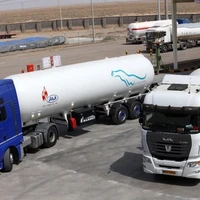
File photo: LPG tanker trucks at a Fergas International facility in Iran.
Iran's LPG exports have collapsed since the US naval blockade began in mid-July, leaving Tehran to find domestic uses for millions of tons of propane and butane that would normally be sold abroad.
Iran has shipped only 4.1 million barrels of LPG, equivalent to around 350,000 tons, since the blockade began, Reuters reported, citing informed sources and shipping data.
Data from Kpler and Vortexa obtained by Iran International show the figure was around 30 million barrels, or 2.6 million tons, over the same period last year.
Vortexa and Kpler estimate Iran's LPG exports in 2025 at between 10.5 million and 11 million tons, worth more than $5 billion.
Iranian Chamber of Commerce data show exports of 9 million tons of propane and butane worth $4.35 billion during the Iranian financial year that ended on March 20, 2026.
The figures cover different periods and may also reflect differences in methodology, but both point to the scale of Iran's LPG exports before the war.
War impact
A document from Iran's National Iranian Oil Products Distribution Company obtained by Iran International last year shows that the country's oil refineries produced around 2.4 million tons of LPG, half of which was consumed domestically and the remainder exported.
The South Pars gas processing facilities, serving Iran's largest gas field, produced around 7 million tons, with the rest coming from other gas facilities and petrochemical plants, mainly in Assaluyeh and Mahshahr.
In total, Iran produced around 13 million tons of LPG last year, about 80% of which was exported. Under normal conditions, domestic demand is below 2 million tons annually.
Iran has cut crude oil production since the halt in oil exports. According to OPEC estimates, daily output fell from around 3.26 million barrels in 2025 to 1.96 million barrels in September, a decline of about 40%.
The war has also affected Iran's other major sources of LPG. Israel targeted gas processing units at South Pars as well as petrochemical plants in Assaluyeh and Mahshahr.
Iranian officials say the initial loss of 230 million cubic meters of South Pars gas production has since narrowed to around 100–130 million cubic meters as damaged units returned to operation.
The head of Iran's National Petrochemical Company says around 60% of damaged petrochemical units have also been rebuilt and returned to operation.
Based on these figures, Iran's LPG production may have fallen by around 20–25% since the war, bringing annual output to roughly 10 million tons, comparable to 2020 levels.
But production has fallen far less sharply than exports, potentially leaving Iran with millions of tons of surplus LPG.
Lessons from 2020
Iran faced a similar, though less severe, problem at the height of US sanctions in 2020.
Kpler and Vortexa data show LPG exports that year were less than half last year's level, while Iranian official statistics indicate domestic consumption rose about 2.5-fold to around 5 million tons, roughly half of production.
Even then, Iran continued exporting LPG, shipping 4.4 million tons in 2020 and 5.8 million tons in 2021.
With seaborne exports now sharply curtailed, Tehran could again divert more propane and butane to domestic use, including limited injection into the national gas network or use as fuel by industries and power plants equipped to burn LPG.
That could help ease Iran's recurring winter gas shortages and reduce the need to burn fuel oil, or mazut, at power plants and industrial facilities, a major source of air pollution.
There are limits to how much LPG Iran can absorb at home. Substitution depends on technical constraints, available infrastructure and domestic demand.
Even if some of the surplus can be redirected domestically, a prolonged blockade could deprive Iran of an LPG export trade worth around $5 billion annually before the war, compounding the much larger loss of oil export revenue.
A woman waits behind the entrance door of the German branch of the Bank Saderat Iran in the northern German town of Hamburg / File Photo
Germany’s financial regulator BaFin said on Thursday that Bank Saderat Iran’s Hamburg branch had lost its banking license and must be wound up. The branch, which operated in Hamburg and Frankfurt, is no longer allowed to conduct banking business.
BaFin revoked the license on November 5, 2025, citing persistent legal violations that the bank had failed to remedy. A 2023 special audit found serious shortcomings in its business organization, and the bank had been inactive for more than six months.
BaFin also cited sanctions against the institution, saying German banking law therefore presumes its managers to be unreliable, regardless of whether they personally engaged in misconduct.
BaFin orders branch wound up
BaFin ordered the wind-down on June 11, 2026. The liquidation order became final on July 15, according to the regulator. The bank later withdrew legal action against the measure on September 23, and a Hamburg court appointed Berlin-based FUW Treuhand Project Management GmbH as liquidator on September 30.
The withdrawal of the banking license had already become final on December 8, 2025.
The bank mainly handled and financed Iran-related exports, including payment services, letters of credit, lending, guarantees and investments. It had 13 employees and assets of €62.4 million at the end of 2025. Customer deposits total about €200,000.
Deposits remain subject to sanctions restrictions
BaFin said there is currently no deposit compensation event, meaning Germany’s deposit guarantee system has not been triggered. Access to funds is restricted under EU sanctions, however, and the liquidator can make payments only with authorization from the Bundesbank’s Financial Sanctions Service Center.
BaFin said the existing deposits would instead be dealt with as part of the liquidation of the branch.
Iranian banks remain under scrutiny in Germany
The decision comes as Iranian banks operating in Germany face heightened scrutiny under renewed EU sanctions and increased US pressure on Tehran’s overseas financial network.
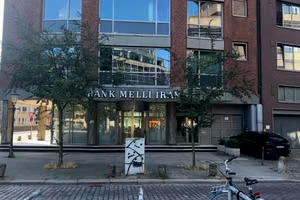
Bank Melli Iran’s Hamburg branch remains open despite being covered by EU sanctions, Germany’s Foreign Ministry told Iran International in August.
The ministry said at the time that the sanctions applied to Bank Melli and its German branch, but did not say whether Berlin was considering closing the operation.
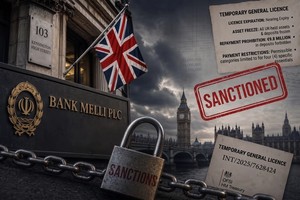
The issue gained attention after US Treasury Secretary Scott Bessent launched “Operation Economic Outcast” and called for every Bank Melli branch abroad to be shut. Germany said it remained in contact with Washington and other partners over further measures against Iran but gave no indication that a decision had been made on Bank Melli’s Hamburg branch.
Bank Melli and Bank Saderat are separate institutions, and BaFin’s action against Bank Saderat was based on German banking-law requirements as well as the sanctions applying to the bank.
Iranian lawmakers and military officials attend a parliamentary session to confirm Mehrdad Akhlaghi as Iran’s new defense minister, October 17, 2026
Iranian leaders raised the conditions for negotiations with the United States and issued fresh warnings of a wider military response on Wednesday, even as signs persisted that Tehran was leaving room for diplomacy.
President Masoud Pezeshkian said threats and sanctions must be lifted in practice before conditions for negotiations could be established, while Revolutionary Guards spokesman Hossein Mohebbi said Iran would launch offensive operations against any country that attacked it as part of a shift toward asymmetric warfare.
An unnamed senior security official also told state-run Press TV that Iran was prepared for an all-out war and would respond “without restraint” to renewed attacks or assassinations.
The rhetoric coincided with high-level discussions in Tehran. Iranian media reported Wednesday that Parliament Speaker Mohammad Bagher Ghalibaf had met Supreme Leader Mojtaba Khamenei to discuss the latest military and economic developments in the confrontation with the United States and Israel.
The meeting also addressed strengthening Iran's national capabilities, maintaining social cohesion, tackling economic difficulties and “advancing relations with strategic partners,” according to the reports.
Yet diplomatic channels remain active. Russian President Vladimir Putin told US envoy Steve Witkoff on Wednesday that there was still room for diplomacy over Iran and that an agreement with Tehran was needed, according to the Kremlin.
The competing signals leave open whether Tehran is raising the price of a negotiated pause or preparing for another phase of confrontation.
Talk of a negotiated pause
The conservative daily Jomhouri Eslami reported, citing “informed sources,” that discussions mediated by Qatar and Pakistan could take place this week around a framework for halting military clashes and securing reciprocal concessions.
The report followed Pakistani Field Marshal Asim Munir's visit to Tehran on Tuesday and came amid a flurry of diplomatic activity involving Russia and other regional powers.
According to Jomhouri Eslami, the framework would seek to halt military clashes, address outstanding disputes and sequence concessions in a way that reduced the risk of fighting resuming.
The newspaper said it expected that “the region will not see an escalation of tensions under current conditions.”
The prominence given to the prospect of an agreement by a conservative establishment newspaper is notable at a time when Iranian officials publicly deny that substantive nuclear negotiations with Washington are under way.
Sobh-e No, a newspaper aligned with Parliament Speaker Ghalibaf, also linked renewed discussion of talks to diplomatic contacts involving Pakistan and Russian Foreign Minister Sergei Lavrov, who visited Tehran on Tuesday.
The newspaper reported on a Russian proposal for a joint Iranian-Russian-Chinese initiative concerning the Strait of Hormuz, although Tehran has continued to insist on maintaining its authority over the waterway.
The Pezeshkian administration's Iran newspaper argued that the country's security depended on exercising sovereignty over the strait rather than sharing responsibility with outside powers.
“To preserve our security, we have no option but to exercise sovereignty over the Strait of Hormuz,” it wrote.
That position points to one of the difficulties facing any potential agreement: Tehran wants the Strait of Hormuz and broader maritime security addressed alongside the conflict, while Washington has continued to prioritize Iran's nuclear program.
Pressure in the other direction
Hardline lawmaker Hassan Nataj called for Supreme Leader Khamenei to reconsider the religious prohibition on nuclear weapons in response to the conflict.
“We should ask the Supreme Leader to revise the fatwa prohibiting nuclear weapons in light of the current situation,” he told the Didban Iran website.
The comments come amid a wider debate among Iranian politicians and commentators over whether the country's nuclear posture still provides sufficient deterrence against further US or Israeli attacks.
The simultaneous emphasis on diplomacy and escalation does not establish which course Tehran ultimately intends to pursue.
But the pattern has become clearer: diplomatic channels remain open while Iranian officials publicly raise the conditions for negotiations and stress that renewed attacks could bring a broader military response.
Russian Foreign Minister Sergei Lavrov and his Iranian counterpart Abbas Araghchi during talks in Tehran, October 20, 2026.
Russian President Vladimir Putin discussed Iran with US envoy Steve Witkoff on Wednesday and offered Moscow’s help, shortly after Foreign Minister Sergei Lavrov visited Tehran as Russia seeks a role in efforts to end the Iran-US conflict.
The meeting adds to signs that Moscow is positioning itself as both an ally of Tehran and a potential intermediary with Washington as diplomatic efforts remain deadlocked over Iran’s nuclear program and the sequencing of commitments.
Earlier this month, Putin said Russia was prepared to do everything it could to help resolve the crisis and subsequently conveyed Tehran’s position to US President Donald Trump. Neither the contents of the message nor Washington’s response was made public.
In Tehran on Tuesday, Iranian Foreign Minister Abbas Araghchi said the two countries had “never” worked as closely as they do now, while Lavrov described Iran’s cause as “just” and said Russian specialists who left the Bushehr nuclear power plant during the war were gradually returning.
Yet Iranian media and commentators questioned how much Moscow could achieve as an intermediary given the fundamental differences between Tehran and Washington.
Tabnak, a news website considered close to Supreme National Security Council Secretary Mohsen Rezaei, said Moscow could help by conveying messages, consulting with both capitals and supporting a political solution, but cautioned that no mediator could overcome the underlying disagreements on its own.
“As long as fundamental disagreements over the terms of an agreement persist, no mediator can guarantee success,” it wrote, citing differences over the sequencing of negotiations and the scope of commitments.
The reformist outlet Rouydad24 said there was little evidence Moscow had brought a comprehensive plan capable of breaking the deadlock.
“What has so far been presented by official Iranian and Russian sources points less to a ‘grand peace plan’ than to the continuation of Russia’s traditional role as a facilitator of dialogue,” it wrote.
Uranium emerges as key obstacle
A central obstacle in the diplomatic impasse is Iran’s stockpile of uranium enriched to 60%.
Russian officials, including Deputy Foreign Minister Sergei Ryabkov, have indicated that Moscow is prepared to receive the stockpile, a move that could address one of the central concerns surrounding Iran’s nuclear program.
Tehran, however, has rejected the idea of transferring its enriched uranium abroad and denied that nuclear negotiations with Washington are under way.
The position was reiterated during Pakistani army chief Asim Munir’s visit to Tehran on Tuesday. Rezaei told Munir that none of Iran’s enriched material would leave the country, describing it as a national asset intended for domestic use.
Before Lavrov’s arrival, conservative political activist Ali Gholhaki claimed Russia had been partly persuaded by an Iranian proposal, advanced when Ali Larijani was secretary of the Supreme National Security Council, to establish a framework for transferring uranium enriched to 60%.
But following the visit, Gholhaki said Lavrov had produced no tangible result and had left “without any particular achievement.”
The conservative newspaper Khorasan argued that negotiating over Iran’s enriched uranium could increase rather than reduce the danger of another attack.
It argued that while Iran did not possess a nuclear deterrent, its stockpile of highly enriched uranium itself acted as a form of deterrence by raising the risks of further US escalation.
Mohammad-Sadegh Alizadeh, a journalist interviewed by the conservative Farhikhtegan newspaper, said Tehran’s immediate priority should instead be ending the war on terms acceptable to Iran.
“Whether the Russians have agreed to accept Iran’s 440 kilograms of uranium enriched to 60% is a secondary issue to be addressed later,” he said. “First, the question of ending the war must be settled.”
Doubts over Moscow’s interests
Doubts about Russia’s intentions extend beyond whether it can bridge the divide between Tehran and Washington.
Reformist journalist Ahmad Zeidabadi argued that Iranian decision-makers should nevertheless welcome any Russian initiative capable of stopping another war.
“Russian interference is an evil, of course, but compared with the prospect of another war, it is the lesser evil,” he wrote on Telegram.
Commentator Mehran Tabatabaei argued that Moscow’s approach to Iran remained subordinate to its negotiations with Washington over Ukraine.
“Russia will not take any positive steps until it resolves the Ukraine issue and obtains the concessions it wants from the United States over Ukraine,” he wrote.
Journalist Mohammad Aghazadeh offered a starker assessment, saying failure by Lavrov to make progress would suggest diplomacy itself was approaching a dead end.
“Either the current state of uncertainty will continue, or an intense war will begin,” he wrote, “one that will probably not be as easy to end as it is to start.”
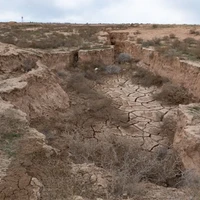
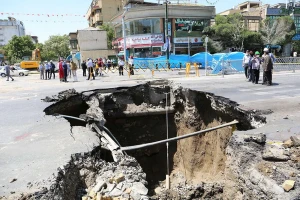
Land in parts of Iran’s southeastern Kerman province is sinking by as much as 40 centimeters a year, with ground fissures advancing toward villages, homes and orchards, according to data cited on Wednesday by the semi-official Mehr news agency.
Mehr, citing Iran’s Geological Survey, said some of the highest rates were recorded across the plains of Rafsanjan, Anar, Zarand and Sirjan, where annual subsidence was estimated at between 30 and 40 centimeters.
Several villages have already been affected, with cracks and fissures reaching areas close to residential buildings and agricultural land, the report said.
Groundwater depletion drives the damage
Excessive extraction of groundwater is the main driver of the subsidence, according to Mehr, with repeated droughts, declining rainfall, water-intensive farming and thousands of deep and semi-deep wells adding to pressure on underground reserves.
As groundwater is removed, underground soil layers compress and the surface sinks. That compaction is often irreversible, meaning the ground may not recover even if aquifers are later replenished.
Climate change and poor water management have added to the problem, the report said.
Ali-Asghar Zakeri Harandi, Kerman province’s deputy governor for development affairs, said continued depletion of groundwater was threatening infrastructure, farmland and settlements and could damage the province’s long-term development prospects without urgent action.
Farms, roads and villages at risk
The effects go beyond falling ground levels.
Subsidence can crack buildings, damage roads and energy pipelines and alter the structure of agricultural soil. Continued degradation can increase salinity and leave farmland less productive or, in some cases, unsuitable for cultivation.
That is particularly significant in southern Kerman, an important agricultural region where millions of tonnes of produce are grown annually.
Mehr said continued subsidence could threaten rural livelihoods and, over time, contribute to migration from affected settlements.
Iran’s Geological Survey said in September that the area affected by land subsidence nationwide had expanded tenfold over eight years, with previously separate subsidence zones beginning to merge in some areas.
A report by parliament’s research center cited earlier this year estimated that around 39 million people, nearly half of Iran’s population, live in areas already affected by subsidence or at risk of its spread.
The report put the affected area at about 185,000 square kilometers, roughly 11% of the country, encompassing more than 380 cities and 9,200 villages.
Tehran also among worst-affected areas
Although Kerman is recording some of the country’s fastest rates of sinking, Tehran province is among the most extensively affected.
Around 1,630 square kilometers of Tehran province, about 12.5% of its area, is experiencing subsidence, according to the parliamentary research cited earlier this year.
The most exposed areas include the Varamin plain, parts of southwestern Tehran and the cities of Eslamshahr, Shahriar and Malard.
The capital’s increasing reliance on groundwater has added to the risk. Parliamentary research found that underground sources now provide a significantly larger share of Tehran’s water than they did at the start of the previous decade.
Deep wells add to pressure
Iranian officials have repeatedly linked the problem to uncontrolled groundwater extraction.
Ali Beitollahi, a researcher at the Road, Housing and Urban Development Research Center, said in July that Iran had 1,450 wells deeper than 300 meters and identified excessive pumping as one of the main factors worsening subsidence.
Recent incidents have illustrated the risks in urban areas. Vehicles have fallen into ground collapses in cities including Neyshabur and Isfahan, while officials have also raised concerns about damage to roads, railways, utility networks and historic sites.
Officials call for lower groundwater use
Mehr said curbing groundwater extraction was the most immediate step needed to slow the crisis.
The measures it cited included closing illegal wells, enforcing limits on pumping, shifting agriculture toward less water-intensive crops, expanding greenhouse farming and improving irrigation efficiency.
Reusing treated wastewater and, over the longer term, desalinating seawater have also been proposed as ways to reduce pressure on freshwater reserves.
But because much of the underground compaction is irreversible, experts say slowing further subsidence is more realistic than restoring land that has already sunk.