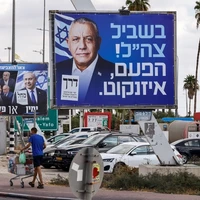
Mohsen Rezaei, secretary of Iran's Supreme National Security Council, was interviewed by the state television .
Iran has signalled a sharper military posture after threatening US warships and energy interests, while seeking to extend its control of shipping beyond the Strait of Hormuz.
The escalation marks a potentially significant shift in Iran’s approach to the conflict. Iranian officials and hardliners are increasingly describing a strategy that goes beyond defending Iranian territory or simply maintaining the Strait’s closure, seeking instead to impose costs on US forces and economic interests across the region.
The shift followed a series of tit-for-tat attacks involving Iranian and US-linked shipping. On Saturday, Iran’s Revolutionary Guards (IRGC) said it had fired ballistic missiles at a US aircraft carrier and destroyer. Washington said none of the missiles hit the vessels.
After US forces attacked three Iranian oil tankers, US Defence Secretary Pete Hegseth warned that any further Iranian attacks on American ships would be met with the destruction of Iranian oil tankers. Tehran subsequently said the Revolutionary Guards had targeted three tankers traveling through what it called unauthorized routes in the Strait of Hormuz and three US-linked vessels elsewhere.
“The rules of the game have changed”
The exchanges have fuelled increasingly explicit threats from senior Iranian officials.
Mohammad-Bagher Ghalibaf, Iran’s parliament speaker and head of its negotiating team with the United States, said after the attacks that Washington needed to understand that “the rules of the game have changed” and that any future attack on “Iran’s interests and security” would face “a faster, heavier and more painful response.”
On Monday, Ghalibaf escalated his warning by threatening US oil and gas companies in the region. Responding to Hegseth’s threat to sink Iranian oil tankers if Iran attacked American ships, he wrote: “The oil and gas chain here is sprawling, accessible, and exposed. American oil and gas companies across these waters and facilities share that exposure. Strike our assets and you get struck. We’ve already proven it. Ask the bases that are no longer viable.”
Ebrahim Rezaei, a member of parliament’s National Security and Foreign Policy Committee, said Iran would henceforth respond forcefully to US naval vessels, equipment, destroyers and bases “anywhere.” He claimed Iranian missiles had become more advanced and intelligent than they were a year ago, increasing their ability to strike American warships. He concluded that the side that would eventually have to back down would be “the Americans.”
Mojtaba Zarei, another member of the parliamentary security committee, similarly warned that the withdrawal of US warships from the range of Iranian ballistic missiles would not end the confrontation. “This is not defence; it is decisive entry into a military confrontation,” he wrote, describing the new policy as one based on “pre-emptive operations” aimed at breaking the economic blockade.
The widening confrontation has also prompted warnings that attacks on tankers could open a much more dangerous phase of the conflict.
Heshmatollah Falahatpisheh, a former chairman of parliament’s National Security and Foreign Policy Committee, warned that attacks on Iranian tankers could trigger retaliation against Iran’s energy infrastructure. “The attack on the tankers is the prelude to setting fire to Iran’s energy and civilian infrastructure,” he wrote.
“What we are seeing is not war, but the killing of a nation and a civilisation,” Falahatpisheh added. “A regional initiative is needed to bring an end to the bloodshed and fire.”
New mechanism for controlling commercial traffic
At the same time, Tehran appears to be developing a more elaborate mechanism for controlling commercial traffic around Hormuz.
Mohsen Rezaei, secretary of Iran’s Supreme National Security Council, said on state television on Sunday night that Iran considered the Strait closed and said it would establish a new “prohibited zone” outside the waterway. The zone would begin at the US blockade line and extend into parts of the Persian Gulf, with ships entering it to reach the Strait potentially subject to sanctions.
Rezaei stressed that Iran had not decided to sink oil tankers, citing the environmental consequences for the region. He also claimed that Iran had, for the first time, tested an anti-ship missile directly over a US warship.
Rezaei said Iran and Oman had also agreed on maps for a new shipping corridor through the Strait of Hormuz, which he said should be signed in the coming days. He said Iran would only commit to keeping the Strait open once the United States ended what Tehran calls sabotage, threats and attacks against Iran.
On Monday, Rezaei said Washington had received a “clear warning” from Iran’s new missiles and that economic warfare would be met with a maritime exclusion zone extending across the Persian Gulf to the US blockade perimeter. He said Iran’s operational posture toward US warships and bases had been “fundamentally recalibrated.”
Washington disputes Tehran’s description of the maritime balance. The White House said Monday that the Strait of Hormuz remained open and under US control, while the US military said it had redirected 94 commercial vessels, disabled three and boarded two as of Sept. 7 while enforcing the blockade.
Rezaei’s comments were interpreted by Nour News, a website close to the Supreme National Security Council, as evidence that Iran’s strategy was moving from restricting traffic through the Strait to establishing rules governing which vessels could pass through it.
Hardline analyst Mostafa Najafi described the emerging policy as a three-layer strategy: establishing an Iran-Oman middle corridor to manage traffic through Hormuz, entering an offensive phase against the US fleet, and imposing a sanctions-based prohibited zone between the blockade line and the Strait.
“In other words, Tehran, rather than simply closing or opening Hormuz, is defining a new equation for controlling traffic, deterrence and economic warfare,” Najafi wrote.
That approach may reflect the limits of Iran’s ability to sustain a conventional confrontation at sea.
Mohammad Ghaedi, an international relations lecturer at George Washington University, told Iran International that political considerations and Tehran’s relationships with countries such as China, India and Pakistan made it difficult or undesirable for Iran to fire on all oil tankers. The proposed sanctions regime, he said, could provide an alternative to attacking them directly.
Ghaedi nevertheless warned that Iran could eventually expand its attacks to smaller shuttle vessels that carry oil from Abu Dhabi to supertankers outside the Strait, which Iran has so far largely avoided targeting.
Hardliners push for escalation
The emerging strategy has been welcomed by some hardliners, who see attacks on US warships as evidence that Iran is overcoming its defensive posture.
Hardline commentator Nezameddin Mousavi said the missile attack sent “two clear messages”: that Iran’s missile technology had advanced to the point where US warships were now “easy prey for ballistic missiles,” and that Iran would not allow President Donald Trump to play “cat and mouse” until the November elections. “The blockade must be broken,” he wrote.
Javad Mirgalouye-Bayat went further, arguing that an attack on US warships was a political decision equivalent to extensive bombing of Tel Aviv or an attack on US territory. He said Iran should be prepared for a response “at the level of using a tactical nuclear bomb” and argued that effective attacks on warships were necessary to change the equation of the war.
But the increasingly aggressive rhetoric has also exposed a broader concern among some Iranians: whether Tehran has the military capacity to sustain the escalation it is threatening.
One social-media user warned that starting an oil-tanker war without a functioning navy would be reckless, arguing that Iran no longer had even a frigate capable of protecting tankers at sea. The user also questioned Iran’s ability to defend its own energy infrastructure if it began attacking energy facilities in the Persian Gulf.
Another critic accused the government of celebrating a failed operation after losing three tankers without hitting its intended targets, arguing that Tehran was effectively telling its adversary: “Make concessions or I will suffer more defeats.”
That criticism highlights the central risk facing Iran’s new strategy. Expanding the confrontation may allow Tehran to demonstrate that the cost of attacking Iran extends beyond Iranian territory. But each additional target also creates opportunities for a stronger US military response.
The strategy therefore appears to rest on a difficult calculation: that Iran can raise the economic and military costs for Washington without triggering a level of retaliation that its weakened military and economic infrastructure cannot absorb.
The emphasis on a prohibited maritime zone, sanctions on vessels and threats against regional energy infrastructure suggests Tehran is trying to find a middle ground between reopening Hormuz and indiscriminately attacking commercial shipping. But the more Iran seeks to enforce its new rules, the greater the risk that isolated incidents at sea will develop into a wider regional confrontation.
The result is a potentially more volatile phase of the conflict. Iran is no longer presenting the closure of Hormuz simply as a defensive response or a bargaining chip. Increasingly, officials are portraying control of maritime traffic, attacks on US forces and pressure on regional energy infrastructure as parts of a broader offensive strategy designed to break the economic blockade.
Screengrabs from videos shared on social media from the attack on Iraqi students in Semnan on Sept. 6, 2026.
Iraq’s Foreign Ministry called for legal action against those behind an attack on Iraqi students in Iran’s Semnan province after a confrontation reportedly triggered by unconfirmed allegations that several Iraqi students assaulted an Iranian woman.
Iraq’s Foreign Ministry said Monday it was following the attack by “a group of Iranian citizens” with “utmost concern” and was coordinating with Iranian authorities to investigate the incident. Foreign Minister Fuad Hussein ordered the Iraqi embassy in Tehran to examine the circumstances surrounding the violence.
Iranian judicial authorities said two people involved in the confrontation had been identified, while investigations were continuing to identify others.
Baghdad Today, citing its correspondent in Semnan, reported that more than 150 people attacked accommodation used by Iraqi students at Semnan University, entered the compound and beat students, leaving several seriously injured.
[@portabletext/react] Unknown block type "telegram", specify a component for it in the `components.types` prop
The outlet said some Iraqi students remained inside the building as the crowd prevented them from leaving. Police arrived and sought to stop the violence but made no arrests, according to the report.
Videos circulating on social media showed disturbances inside the residence and a crowd gathered outside.
Conflicting accounts of what triggered violence
Iranian news website Rouydad24 said some local reports claimed the confrontation began after Iranian students alleged that several Iraqi students, described in those accounts as affiliated with Iraq’s Popular Mobilization Forces, or Hashd al-Shaabi, had forcibly taken an Iranian woman into the residence.
Social media users also alleged that several Iraqi students had sexually assaulted an Iranian female student, triggering the attack on their accommodation.
No official source has confirmed the allegation, and neither Iranian nor Iraqi authorities have said that sexual assault caused the confrontation.
Semnan University said the incident occurred outside a privately operated residence housing international students and that authorities were investigating its origin.
“There was no confrontation or clash between Iranian students and international students in this incident,” the university said.
Iraq’s ambassador to Tehran, Yasser Abdulzahra, described the episode as a “misunderstanding and verbal altercation” involving Iraqi students that escalated into an assault, according to Iraq’s state news agency.
He said an embassy delegation was sent to the university and stressed that Baghdad would not tolerate attacks on Iraqi students. He also urged Iraqi students to respect Iranian social norms and demonstrate “discipline, academic awareness and mutual respect.”
The Iraqi Foreign Ministry welcomed measures taken by Iranian authorities to protect the students and transport them safely to their university for examinations, but called for legal action against the attackers and safeguards to prevent similar incidents.
Iranian judiciary identifies two people
Mohammad Sadegh Akbari, chief justice of Semnan province, said two people involved in the confrontation had been identified and summoned by police.
He described the incident as a clash between “a number of citizens and some Iraqi students” and said judicial and law enforcement authorities were continuing their investigation.
Akbari also accused what he called “hostile media” of publishing accounts inconsistent with preliminary findings but did not say which claims he was disputing.
The incident comes amid broader debate over the growing number of foreign students in Iran. Science Minister Hossein Simayi Sarraf said in August that more than 50,000 Iraqis were studying at Iranian institutions, more than 95% of them at postgraduate level.
On Saturday evening, Semnan’s Friday prayers leader, Morteza Motiei, said the presence of large numbers of foreign students in the province should not be treated solely as an academic matter and called for a “cultural framework” to accompany it.
He said economic and social issues associated with foreign students had created challenges across Semnan province and required a broader approach.
In 2024, the University of Tehran announced an increase in the admission of members of Hashd al-Shaabi, the Iranian-backed Shiite militia in Iraq, without the need for entrance exams.
Theinflux of the Hashd al-Shaabi members into Iranian universities, particularly the University of Tehran where admission for Iraqis has doubled, is part of a broader plan, the University’s president said at the time.
Tensions over Iraqi students have surfaced before. In October 2025, students and residents in Hamadan protested after an Iraqi student was accused of harassing a female student at Bu-Ali Sina University. Protesters also complained about students they said were affiliated with Hashd al-Shaabi.
Iranian security forces later prevented another planned gathering, while Hamadan prosecutors described the harassment allegation as unproven and warned protesters against unauthorized demonstrations.
A worker adjusts European Union and U.S. flags at the EU Commission headquarters in Brussels, November 11, 2013.
The Trump administration may be overstating Europe’s formal role in its “Economic D-Day” campaign against Iran, but years of economic and political convergence have increasingly aligned Europe with Washington.
The European Union has welcomed additional economic pressure on Tehran, including through the US-led Operation Economic Outcast, but has not formally endorsed every element of Washington’s strategy.
Yet the distinction over formal alignment conceals a more consequential reality: since the United States withdrew from the nuclear agreement in 2018, Europe has increasingly behaved as Washington’s junior partner on Iran.
This alignment predates the current war. Since the late 2000s, Europe has increasingly substituted declaratory diplomacy for autonomous action, defending multilateralism and dialogue while adapting in practice to US policy.
This gap became particularly evident after Trump’s withdrawal from the JCPOA and reimposition of US sanctions on Iran in 2018: despite European opposition, the blocking statute and INSTEX failed to sustain meaningful trade, as almost every major European company abandoned Iran to preserve access to the US market.
This choice was economically rational. The US market and financial system are vastly more important to European companies than Iran. The international dominance of the dollar enables Washington to impose sanctions with effects far beyond US territory.
European banks, insurers, shipping companies and industrial groups remain highly exposed to US regulators and financial markets. Whatever the official position of their governments, companies have overwhelmingly prioritized continued access to the United States over commercial opportunities in Iran.
The weakness of direct EU-Iran trade should not obscure Europe’s remaining economic significance. According to the European Commission, trade in goods between the EU and Iran amounted to €3.7 billion in 2025, comprising €2.97 billion in EU exports to Iran and €760 million in imports from Iran.
This left the EU a significant trading partner for Iran, even though Iran accounted for only around 0.1 percent of EU exports.
These figures also underestimate indirect commercial links. European products reach Iran through Türkiye and, above all, the United Arab Emirates, which serves as a crucial platform for re-exports.
Stronger US pressure on Ankara, Dubai-based traders, logistics companies and regional banks would therefore affect European-origin goods even when European firms have no direct contractual relationship with an Iranian buyer.
“Economic D-Day” is not directed solely against Iran: it is designed to force Iran’s remaining commercial intermediaries to choose between Tehran and access to the US financial system.
Europe’s gradual alignment also has a political and diplomatic dimension. In August 2025, following unsuccessful talks with Tehran, France, Germany and the United Kingdom triggered the UN “snapback” mechanism with US support.
UN sanctions were restored on September 28, prompting the EU to reimpose its own nuclear-related economic and financial restrictions the following day. The EU formally reimposed those measures on September 29.
After the deadly repression of the January 2026 protests, the EU went further, formally designating the Islamic Revolutionary Guard Corps as a terrorist organization in February and imposing additional sanctions targeting human rights violations, Iran’s missile and drone programs, and Iranian operations on European soil.
This convergence has since extended to the multilateral arena. In September 2026, the United States and the E3 began pressing for an International Atomic Energy Agency Board of Governors resolution reporting Iran to the UN Security Council for the first time in 20 years.
The push has further deepened the confrontation over inspections: IAEA Director General Rafael Grossi said on September 7 that Tehran had told the agency it would not cooperate until there was progress in broader political negotiations, while Iran warned it would take reciprocal action if the resolution was adopted.
Grossi said the agency was receiving no information and had been told Iran would not cooperate without progress in broader political negotiations.
The proposed referral would mark a significant escalation in the nuclear standoff and further narrow the space for Europe’s long-standing ambition to pursue a third way between Washington and Tehran.
The war launched by the United States and Israel on February 28, 2026 initially generated considerable European frustration. European leaders had not been consulted or even properly warned by their principal ally, despite their earlier coordination with Washington over the snapback process.
They called for restraint and respect for international law while expressing concern about the regional and economic consequences of the offensive.
But this dissatisfaction did not produce an autonomous European strategy. Europe lacked the military capabilities, economic leverage and political unity needed to shape the conflict.
The decisive talks involved Washington, Tehran and regional intermediaries such as Pakistan, Oman and Qatar. European governments remained largely peripheral, even as they condemned Iranian attacks against neighboring countries and commercial vessels.
The current hardening of the European position should therefore also be understood in the context of transatlantic relations and the war in Ukraine. For European leaders, preserving US support for Ukraine and preventing a strategic rapprochement between Washington and Moscow remain overriding priorities.
Iran offers them a potential means of demonstrating their usefulness to the Trump administration. By cooperating with Washington on sanctions, nuclear restrictions and regional security, Europeans hope to facilitate dialogue with an administration whose disengagement from Ukraine is their greatest strategic fear.
This calculation resembles the strategy adopted by several European governments at the beginning of Trump’s second presidency: concede or cooperate on secondary issues to preserve US engagement on the issue considered existential for European security. Iran is thus treated partly as a bargaining instrument within the transatlantic relationship.
This does not mean that European and US objectives are identical. Most European governments remain wary of regime-change strategies, uncontrolled military escalation and the humanitarian consequences of comprehensive sanctions.
They continue to emphasize diplomacy and international law and have not formally subscribed to Washington’s campaign of total isolation. The Trump administration is consequently overstating Europe’s political endorsement.
Yet the practical difference is narrower than European rhetoric suggests. Europe’s declaratory autonomy cannot compensate for its financial dependence, limited military capabilities and reliance on the United States for its own security.
Nor can European governments fully control the commercial decisions of private companies, which overwhelmingly prioritize access to the US market and the dollar-based financial system over limited opportunities in Iran.
Washington may therefore be exaggerating when it says that Europe has joined “Economic D-Day.” But since 2018, the structural alignment it describes has become increasingly difficult to deny.
CENTCOM handout purporting to show Iranian tanker M/T Kylo sinking in the Gulf of Oman
US attacks on Iranian oil tankers could make it far harder and more expensive for Tehran to keep selling its crude, but the strategy carries a potentially much larger cost: turning the Persian Gulf’s energy infrastructure into an expanding battlefield.
The latest US strikes on three Iranian oil tankers mark a significant escalation in Washington’s economic campaign against Tehran, moving beyond sanctions and blockade to the physical destruction of vessels used to export Iranian oil.
US forces on September 5 disabled two tankers near Kharg Island and Jask and destroyed a third in the Gulf of Oman, according to US Central Command, which described the vessels as part of a “multibillion-dollar shadow network” supporting the IRGC and its regional partners.
The strikes followed Iranian ballistic missile attacks on US naval forces that caused no American casualties. CENTCOM commander Adm. Brad Cooper warned Washington was prepared to impose an “even higher economic cost” on Tehran.
The significance of the strikes lies less in the loss of three ships than in the change in tactics. Washington has spent years trying to make Iranian oil harder to sell through sanctions, restrictions on financial transactions and pressure on buyers and shipping networks. Since mid-July, the US naval blockade has added a physical barrier.
Now, the vessels themselves are becoming targets.
From financial to physical risk
The shift comes as Iran’s oil exports are already under severe pressure.
Ship-tracking data indicated Iranian crude loadings fell to roughly 220,000–255,000 barrels per day in August, from about 740,000 bpd in July and peaks close to 2 million bpd before the conflict.
For weeks, no meaningful Iranian crude cargoes were able to reach China through the Strait of Hormuz, leaving more oil in floating storage inside the Persian Gulf.
Iran has spent years building a shadow shipping network capable of operating around Western sanctions, relying on opaque ownership structures, reflagging, manipulation of vessel-tracking systems and ship-to-ship transfers to move crude, particularly to China.
Those methods are useful when the main challenge is avoiding financial sanctions or detection. They offer far less protection if the vessels themselves become military targets.
Sanctions forced Iran to find ships willing to evade Washington. The new strategy may force it to find ships and crews willing to risk being attacked.
That could make the shadow fleet more expensive and difficult to operate. Many of its tankers are aging vessels already working outside conventional Western insurance and maritime-service networks.
If owners, crews and operators come to regard Iranian-linked voyages as carrying a serious risk of attack, some may demand greater compensation or decide the trade is no longer worthwhile.
Washington cannot, however, simply eliminate the shadow fleet overnight. The network is dispersed and adaptable. Ships can change names, flags and ownership structures, while Tehran can alter loading patterns or move ship-to-ship transfers farther from areas dominated by US forces.
But every vessel lost imposes another cost. Iran must replace it, find another operator willing to accept the risk or leave more crude stranded in storage.
Floating storage offers only temporary relief. Oil held offshore does not generate revenue until it reaches a buyer, and prolonged disruption can eventually force producers to cut output as storage fills.
The question is therefore not whether three tanker strikes can dismantle Iran’s export system. They cannot. It is whether repeated physical losses can gradually undermine the commercial network that has allowed Tehran to keep selling oil despite years of sanctions.
A wider energy battlefield
That strategy carries an obvious risk: once Washington treats Iran’s oil-export system as a military target, Tehran has a stronger incentive to widen the energy battlefield.
Iran has already used attacks and threats against maritime traffic as a means of imposing costs on its adversaries. The Strait of Hormuz remains central to that strategy because of the enormous volumes of oil and liquefied natural gas that normally pass through it.
Further reducing Iranian export revenues could weaken Tehran’s ability to finance the IRGC and allied armed groups while increasing the economic cost of continued confrontation.
But direct attacks on tankers could also reinforce the Iranian leadership’s argument that compromise will not end US pressure and that imposing costs on regional energy flows is one of Tehran’s remaining forms of leverage.
That matters well beyond Iran.
Saudi Arabia and the United Arab Emirates have invested heavily in export routes that partially bypass Hormuz, including Saudi pipelines to the Red Sea and the UAE’s link to Fujairah. But those alternatives cannot fully replace normal flows through the Strait, while Kuwait and Iraq remain particularly dependent on the waterway.
Even without major damage to regional infrastructure, greater insecurity can raise war-risk insurance premiums, freight rates and other costs for commercial operators.
The tanker strikes therefore strengthen Washington’s leverage only if they can impose additional costs on Tehran without triggering a broader contest over the region’s energy infrastructure.
Physical attacks may hurt an Iranian oil-export system that has spent years learning to circumvent sanctions. But they also give Tehran stronger incentives to retaliate against the system through which its neighbors export their own energy.
The strategic gamble for Washington is therefore not simply whether tanker strikes can further squeeze Tehran’s oil revenues. It is whether Iran can be made to bear those costs without deciding that its adversaries’ energy exports should bear them too.
Starlink terminals becoming available in newly legal markets on Iran’s doorstep could make the Islamic Republic’s internet shutdowns harder to enforce, potentially lowering the cost of equipment that has become an increasingly important route around government blackouts.
Within six weeks, two of Iran’s neighbors have opened their markets to the satellite internet service. Iraq authorized Starlink on July 17. The United Arab Emirates granted it a 10-year general license on Aug. 28, and public sales began on Sept. 3.
SpaceX reportedly waived subscription fees for terminals operating inside Iran during the January 2026 internet shutdown, leaving access to the illegal hardware itself as one of the main obstacles.
Until now, Starlink terminals reaching Iran have largely had to pass through black-market supply chains involving multiple intermediaries. Legal sales in two nearby countries could shorten those chains, increase the supply of terminals and ultimately drive down prices inside Iran.
A standard Starlink kit now sells for around $400 in the UAE. At the end of August, the same model was selling for around $2,100 on Iran’s black market, while the smaller Starlink Mini was selling for around $1,850, according to data collected by Starlink4Iran.
During the January shutdown, the price of a standard kit surged to around $3,000, while the Mini reached around $2,300.
The premium reflects more than profit. Equipment entering Iran passes through intermediaries facing the risks of confiscation and punishment, along with the costs of moving devices covertly across the border.
Legal markets next door will not eliminate those risks. But they could reduce the number of intermediaries involved and make terminals cheaper and more plentiful.
A new route from Iraq
The potential impact is particularly significant in Iraq, which shares a long land border with Iran and has extensive trade and passenger traffic with its neighbor.
Ahmad Ahmadian, an internet freedom activist and director of the nonprofit Holistic Resilience, which works to expand Iranian access to Starlink, said Erbil has already been an important source of communications equipment reaching Iran through informal channels.
Legalization could broaden that network to include traders and people who regularly travel between the two countries, he said.
During periods such as Arbaeen, the annual Shiite pilgrimage when millions of travelers move between Iran and Iraq, thoroughly inspecting everything they carry becomes more difficult, Ahmadian said.
Ahmadian expects some travelers to bring Starlink equipment into Iran for their own use or resale. The devices, he said, could even become a kind of “souvenir” brought back from Iraq.
The smaller Starlink Mini could prove particularly attractive. Roughly the size of a laptop, it is easier to transport than a standard dish, although its official availability in Iraq has yet to be confirmed.
There are still significant obstacles to an Iraqi Starlink market.
The license was issued by Iraq’s Communications and Media Commission, but the Communications Ministry says it has not signed a separate agreement with SpaceX and has raised objections over pricing and routing traffic through Qatar.
The Kurdistan Region has separate regulations, and as of early September no final agreement with SpaceX had been announced.
According to Iraqi officials, around 40,000 unauthorized terminals were already operating in the country before the license was issued, reportedly serving around 200,000 people, including government and security users.
Regulatory disputes may therefore slow the development of the legal market, but they are unlikely to eliminate an existing network of sellers, installers and users.
The UAE offers another potential source.
Starlink equipment was already available in Dubai’s free-trade zones before the general license was issued, and some terminals in Iran have previously been sourced there through intermediaries. Legal public sales could make the equipment easier to obtain.
One dish, many users
More terminals inside Iran would not necessarily benefit only those wealthy enough to buy one.
Some Starlink owners already share their connections with other users, including through VPN and other circumvention services.
Tools such as NasNet Connect can use Iran’s own National Information Network, or NIN, to connect users to a local gateway whose route to the international internet is provided by Starlink. That matters because Iranian authorities have repeatedly cut access to the global internet during periods of unrest and crisis while leaving the NIN and approved domestic services functioning.
A user’s connection to the local gateway can therefore still travel over Iranian telecommunications infrastructure, while the gateway’s route to the outside world exits through Starlink, beyond conventional international connections controlled by the state.
For relatively light uses such as messaging and web browsing, a single terminal can potentially support around 20 to 30 users, according to Ahmadian. Video calls, streaming and large downloads substantially reduce that number.
There is also a financial incentive.
Dish owners can sell VPN or other internet access to recover their costs or even generate income. If cheaper hardware reduces the initial investment, more terminals could potentially become gateways for groups of users rather than individual connections.
None of this makes such networks invisible. Iranian authorities can attempt to identify servers and dishes, disrupt communications and interfere with satellite signals.
But a growing number of privately operated connections would make the task of sealing Iran off from the international internet more complicated.
Free, for now
There is another important limitation: a Starlink terminal bought legally in Iraq or the UAE is not guaranteed to work once brought into Iran.
SpaceX retains control over which terminals are activated and whether they remain connected. It reportedly waived subscription fees for terminals operating in Iran during the January 2026 blackout but did not say how long the arrangement would last.
Ahmadian said active terminals in Iran have continued to operate without subscription charges in recent months. Some accounts previously disconnected for non-payment have also been restored, he said.
It remains unclear whether that policy will continue indefinitely or whether newly arrived terminals bought in Iraq or the UAE will automatically receive free service.
Using Starlink also carries significant personal risk inside Iran. The Islamic Republic considers the equipment illegal and has sought to disrupt satellite connections, locate terminals and punish users.
Nor can satellite internet come close to replacing Iran’s conventional internet infrastructure. Even if black-market prices fall substantially, the hardware will remain beyond the reach of many households.
But for journalists, activists, businesses and families who have lived through repeated internet shutdowns, Starlink increasingly serves as something different: a backup route to the outside world when Tehran cuts conventional connections.
The arrival of legal Starlink markets in Iraq and the UAE does not take Iran’s internet kill switch out of the government’s hands. But it could mean fewer doors close when the switch is thrown.
Fire and smoke rise during what U.S. Central Command (CENTCOM) says are strikes on Iranian oil carriers, at an unknown location in this screengrab taken from a handout video released on September 5, 2026.
US forces struck three Iranian oil tankers on Saturday, including two near Iran’s coast and one off Kharg Island deep in the western Persian Gulf, roughly 300 miles northwest of Hormuz, a few days after similar attacks on two NITC tankers off Jask.
US Central Command said it “permanently disabled” the M/T Downy off Kharg Island and M/T Stark 1 near Jask after the Islamic Revolutionary Guard Corps launched ballistic missiles toward a US aircraft carrier and guided-missile destroyer. The American warships evaded the attacks and no US personnel were harmed, CENTCOM said.
A third tanker, the unladen M/T Kylo, also known as Noxen, was destroyed in the Gulf of Oman after its crew was directed to abandon ship, the CENTCOM statement said.
Tasnim, a news agency affiliated with the IRGC, reported that an Iranian oil tanker was struck by the US military near Kharg Island on Saturday morning, saying there were no casualties.
Citing an Iranian state television reporter in Jask, Tasnim also reported US attacks on two tankers in waters near the city and said one of them was carrying oil.
Iran’s Foreign Ministry condemned US attacks on Iranian oil tankers in the Persian Gulf and Gulf of Oman as illegal and a “war crime,” warning that Washington and its allies would bear responsibility for the consequences of any continued attacks.
The statement came after US Defense Secretary Pete Hegseth threatened to destroy and sink Iranian oil tankers if Tehran continues attacking US Navy vessels.
The Saturday strikes extended a pattern that appears to have moved increasingly close to Iran’s shoreline.
TankerTrackers.com said Saturday that National Iranian Tanker Company vessels Sinopa and Hawk had also been struck “a few days ago” off Jask in the Gulf of Oman. CENTCOM has not publicly identified those vessels as targets.
TankerTrackers said Sinopa and Hawk appeared to contain some oil cargo when they were struck off Jask.
Iran’s oil heartland
Saturday’s attack on Downy pushed that activity much farther west.
Kharg Island lies about 16 miles off Iran’s coast in the northern Persian Gulf and roughly 300 miles northwest of the Strait of Hormuz. Before the war, around 90% of Iranian crude exports passed through the island, making it the country’s principal oil-export hub.
The proximity to Kharg is particularly notable after months of US threats involving the island.
American forces previously struck military targets there while leaving its oil facilities untouched, and President Donald Trump has repeatedly raised the possibility of seizing Kharg or attacking its infrastructure. Days before Saturday’s strike, Trump posted an AI-generated video depicting explosions at the island’s oil facilities. No such attack had occurred at the time.
Saturday’s strike targeted a tanker rather than Kharg’s terminals, storage tanks or pipelines, but brought US military action into waters immediately surrounding the oil hub.
'You have 3 minutes to clear the crew'
Near Jask, an exclusive video obtained by Iran International captured warnings issued by the US military to Stark 1 shortly before it was hit.
The footage, filmed aboard a nearby vessel, records three messages over VHF radio.
“Motor Tanker STARK 1, this is the United States military aircraft. I am preparing to fire at your stern. You have 3 minutes to clear the crew from the stern of your ship. Over,” an American voice says in the first warning.
A second warning reduces the deadline to one minute. In the final message, the aircraft says: “This was your final warning... get into your lifeboats and abandon the ship immediately.”
Between the transmissions, crew members can be heard speaking in Persian and Urdu. One asks whether the captain and his deputy are at their posts and is told the captain is still asleep.
TankerTrackers said Stark 1 was struck off Kooh Mobarak near Jask after loading crude at the Jask Oil & Gas Terminal a few days earlier.
CENTCOM portrayed Saturday’s operation as direct retaliation rather than routine enforcement of the US maritime blockade.
“Let the message to the IRGC be clear: If you shoot at two of our ships, we will impose an even higher economic cost — taking out three of yours,” CENTCOM commander Adm. Brad Cooper said.
“We will not hesitate to defend American forces, and if necessary, destroy Iran’s limited and exposed oil fleet.”