Nine out of ten shun marriage, parenthood in Iran International poll
Nine in 10 respondents to an Iran International Instagram poll said they did not want to marry or have children under Iran’s economic, social and political conditions, according to results gathered from about 100,000 participants.
More than 12,000 people also commented on the poll, with financial pressure, job insecurity, housing costs and concerns about children’s futures emerging repeatedly among the reasons given for putting off marriage or parenthood.
Some respondents said they wanted to marry or have children but lacked the financial or social conditions to do so. Others pointed to divorce and unsuccessful marriages as reasons for avoiding marriage.
Men accounted for 68% of respondents and women for 32%. The largest age group was 25 to 34, representing 40.3% of participants, followed by people aged 35 to 44 at 29.2%.
An Iranian couple, with the woman wearing a wedding dress, walk along a street in Tehran.
Nine in 10 respondents to an Iran International Instagram poll said they did not want to marry or have children under Iran’s economic, social and political conditions, according to results gathered from about 100,000 participants.
More than 12,000 people also commented on the poll, with financial pressure, job insecurity, housing costs and concerns about children’s futures emerging repeatedly among the reasons given for putting off marriage or parenthood.
Some respondents said they wanted to marry or have children but lacked the financial or social conditions to do so. Others pointed to divorce and unsuccessful marriages as reasons for avoiding marriage.
Men accounted for 68% of respondents and women for 32%. The largest age group was 25 to 34, representing 40.3% of participants, followed by people aged 35 to 44 at 29.2%.
Respondents aged 18 to 24 made up 13.3%, while those aged 45 to 54 accounted for 9.8%.
Economic pressures weigh on family plans
Many respondents linked their reluctance to start families to the cost of everyday life, according to an examination of comments submitted with the poll.
Some wrote that meeting their own expenses had become difficult enough and that supporting a spouse or child was beyond their financial means. Others said they remained interested in marriage or parenthood but could not afford either.
Iran has faced years of high inflation and a steep decline in the value of its currency, eroding household purchasing power and making housing and other basic costs harder to meet.
The economic strain has been compounded by international sanctions and government policies at home and abroad, with their contribution to Iran’s economic problems a subject of continuing political debate.
Personal experiences of divorce and unsuccessful marriages also appeared repeatedly in the responses. Some participants described marriage under present conditions as a “high-risk decision.”
A man and a woman sit on a bench in Tehran.
Others who were already married said they had decided against having children because of economic and social conditions. Respondents also cited mistrust and difficulty finding a suitable partner.
A smaller number expressed support for marriage or having children.
Parents question children's prospects
Concerns about the conditions in which children would grow up formed another major strand of the responses.
Some said they wanted children but were unwilling to bring them into a society where they feared they could face poverty, inflation, electricity shortages, insecurity and an uncertain future.
A number used much stronger language, describing having children under present circumstances as a “crime” or a “betrayal” of the child because parents could not guarantee an adequate quality of life or future.
Iran faces severe environmental challenges including air pollution, groundwater depletion, forest fires and wider ecosystem degradation. Experts have linked such problems to a combination of poor policymaking, weak environmental protections, corruption and insufficient resources.
Political outlook feeds pessimism
Some respondents connected their decisions directly to Iran’s political and social conditions and their expectations for the country’s future.
Years of economic hardship have coincided with repeated waves of anti-government protests and deadly crackdowns, alongside restrictions on political and social freedoms.
For some participants, those pressures appeared to have turned decisions about marriage and parenthood into a broader judgment about what kind of future is possible in Iran.
The scale and substance of the responses point to a question facing many of them: not simply whether they can afford to build families, but whether they see a future in which they want to do so.
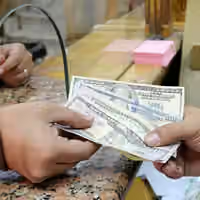
Iranian rials and US dollars are exchanged in Tehran. (File photo)
Iranians described deepening financial hardship and questioned whether economic pressure can change government policy as the dollar hit a historic 2 million rials, extending the currency's sharp decline on Sunday.
The US dollar reached 2 million rials on Iran's open market, crossing a threshold it had approached rapidly in recent days.
“We saw revolution, war, sanctions, rising prices and hardship,” one person told Iran International. “Now that we are over 50, we worry about our children, their jobs, their future, education, university and marriage costs. Pressure from outside, pressure from inside. How much can one endure?”
The dollar stood at around 1.865 million rials at the beginning of last week, putting its rise at more than 7% in less than a week. It has more than doubled from around 958,000 rials during the same period last year.
The British pound climbed above 2.72 million rials, while the euro approached 2.34 million rials. Rates can vary between sources because open-market trading is informal and fragmented.
Iranians describe pressure from all sides
The currency's latest fall comes days after US President Donald Trump announced what he called the “most crushing economic operation ever taken against any country,” warning of unprecedented economic isolation and consequences for countries whose financial institutions, businesses or government entities continue providing Tehran with an economic lifeline.
“Oil smuggling, swap lines, cash transfers, exchange houses, ship registries, front companies – it all needs to stop NOW,” Trump wrote on Truth Social, calling on US allies to join the campaign.
Messages sent to Iran International in response to a question about US economic pressure largely focused on the burden borne by ordinary people rather than its effect on the Islamic Republic.
“Iran has been under sanctions for nearly 50 years and the Islamic Republic is still governing,” one person said. “These measures do not work. They only leave the Iranian people poorer and hungrier, without medicine, healthcare or housing.”
Others questioned whether greater economic pressure could force authorities to change course.
“I don't think the government will come under pressure because it covers its budget deficit from people's pockets,” another respondent said. “The tip of the sanctions spear is aimed directly at the people; healthcare, nutrition, education and sports are all at risk.”
Rial's decline compounds daily hardship
Market participants point to high inflation, growing demand for foreign currency, declining foreign-exchange revenues and concern over sanctions as factors driving demand for dollars.
Political uncertainty, disruption to regional oil exports and the deadlock between the Islamic Republic and the United States have added to inflation expectations.
The currency slide comes alongside electricity and water shortages that have disrupted production and daily life. Further rial depreciation can raise the cost of imported raw materials and essential goods, adding to pressure on household budgets.
Some Iranians who contacted Iran International argued that economic pressure would be more effective if directed at assets held abroad by officials and their relatives.
“When they can freeze the foreign accounts of officials and their children, then you can call it pressure on the government,” one respondent said. “Seize their assets.”
Messages sent to Iran International after the death of its 37-year-old presenter Farahnaz Espad have mixed personal tributes with reflections on exile, repression and hopes for political change among Iranians at home and abroad.
Espad died on Aug. 17 after a two-year battle with cancer. Born on March 11, 1989, she had worked with Iran International for eight years before stepping away from media work two years ago because of her illness.
“Farahnaz, beautiful daughter of Iran, we thank you for all the moments when your voice was a refuge and hope for the people,” one person wrote in a message sent to Iran International, adding that her name and kindness would remain alive in people’s hearts.
Iran’s domestic media is tightly controlled by the state, while independent journalists face censorship, arrests and restrictions. Many journalists have left the country, and Persian-language media based abroad have continued to serve audiences inside Iran despite efforts by authorities to block access to their broadcasts and websites.
The messages and videos sent after Espad’s death reflected not only grief over a familiar journalist, but also wider feelings of separation, exile and repeated loss among Iranians.
One person described Espad as a “kind and capable presenter” whose death felt like losing a member of their own family, “like a sister.”
Another said the news had left them “shaken” after years of watching the work of an “honorable and professional” journalist.
For others, her death evoked the experience of separation from Iran.
One person wished Espad’s family patience and wrote: “Hoping for a day when no one is forced to live in exile, far from their loved ones.”
Another wrote: “Hoping that nothing bad ever happens again to any of my compatriots. Hoping for good days. Long live Iran.”
A message from Firuzkuh, east of Tehran, connected Espad’s death with hopes for political change.
“Once again, another person has left us without seeing the freedom of Iran and the Iranian people,” it said.
Others called Espad a “daughter of Iran” and remembered her as compassionate toward the Iranian people, courageous and sincere, saying her work would not be forgotten.
A person from the northeastern city of Mashhad offered condolences to Espad’s family and colleagues and wrote: “Her honorable voice will remain in our memories.”
Another, from the northern city of Amol, described her as “a fighting, kind and selfless woman” and wished her eternal peace.
One message placed Espad’s death in the context of executions, killings and repeated loss in Iran, saying that losing her in exile felt no less painful to them than losing those killed during anti-government protests.
For many of those who wrote in, Espad’s death became intertwined with a wider sense of loss among Iranians at home and abroad, shaped by exile, repression and years of political upheaval.
The tributes were ultimately as much about what Espad represented to those who watched her as they were about her years on air: a connection to a country from which many Iranians have been separated, and hopes for changes that some fear they may never live to see.
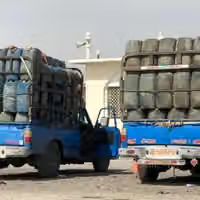
Gas stations in parts of Tehran closed after running out of fuel Wednesday, while motorists elsewhere in the Iranian capital waited up to an hour to fill their tanks amid mounting fears of a fuel price hike, locals told Iran International.
“I went to three gas stations to fill up and all three were closed,” one Tehran resident told Iran International on Wednesday. “One of them had put up a banner saying, ‘We have no gasoline.’”
Another resident said: “Today I spent about an hour in line for gasoline. Many gas stations had no fuel.”
Another Tehran resident said the Interior Ministry had ordered traffic police to crack down on older cars and motorcycles and impound them.
“They have said these vehicles should remain in impound lots for a month so that fuel consumption can be reduced this way,” the resident said.
The accounts come as Iran faces mounting pressure on fuel supplies, with domestic production struggling to keep pace with demand as a US naval blockade on Iranian maritime traffic disrupts fuel imports that previously helped cover the country’s domestic shortfall.
Esmail Saqab Esfahani, head of Iran’s Energy Efficiency Organization, said Saturday that the country faced a daily gasoline shortfall of around 14 million to 15 million liters.
Hossein Samsami, a member of parliament’s Economic Committee, warned Monday that raising gasoline prices amid current economic pressures could trigger widespread unrest, likening it to “a spark in a powder keg.”
Iranian officials have grown increasingly concerned about the prospect of renewed protests, while seeking to cast public discontent as being fueled by foreign adversaries.
Parliament Speaker Mohammad-Bagher Ghalibaf said Tuesday that the enemy was seeking “riots, assassinations and separatist activities” and intended to “exploit” any potential dissatisfaction over gasoline.
Concerns over methanol-blended gasoline
Plans to blend methanol into gasoline have also raised concern among Iranians, with locals telling Iran International they were uneasy about the fuel’s safety and its potential impact on vehicles and public health.
The concerns come against a backdrop of longstanding questions over fuel quality in Iran and previous reports that authorities used non-standard chemical compounds to help offset gasoline shortages.
Vahid Ghanei-Fard, CEO of the Persian Gulf Star Refinery, Iran’s largest gasoline producer, said Tuesday that a pilot project to produce methanol-based gasoline had been successful, with methanol accounting for 3% of the blend.
He said the fuel met “national and international standards” and that the use of methanol had helped raise the refinery’s daily gasoline output to around 49 million liters.
Saadatollah Molavi, an Iran-based refinery expert and frequent energy commentator, told IMNA, an Isfahan municipality-affiliated news agency, that methanol could play a role in easing Iran’s fuel shortage.
But Molavi warned against treating it as a long-term solution without assessing costs, efficiency, gas consumption and infrastructure needs, suggesting the blend may offer only a temporary fix rather than a sustainable answer to Iran’s fuel deficit.
Last May, the London-based independent research group Iran Open Data reported in May 2025, citing a confidential Oil Ministry document, that authorities had used hazardous and contaminated chemical compounds outside the conventional refining process to increase gasoline supplies.
The report described the practice as widespread and systematic and said it was aimed at compensating for the country’s gasoline shortfall.
Concerns over the quality of Iran’s gasoline are longstanding. In January 2023, Dariush Golalizadeh, an official with the Department of Environment, said only 38% of gasoline produced in the country met Euro 4 and Euro 5 standards.
Crowds take part in anti-government protests in Tehran in January 2026.
Seven months after the January massacre, Iranians answering an Iran International call-out describe lives still bent around it: sleep and nerves that never recovered, friendships remade or broken, politics hardened, and a future they struggle to picture.
For many, life now divides in two: before January, and after. The same images return again and again in their accounts: the sound of gunfire, the people killed beside them, the friends and children who went out to protest and never came home.
“Time stopped for me after January 9,” one respondent wrote. “My life was divided into before and after the protests, and I never became the person I was before,” another said.
The responses vary widely. Some describe depression, recurring nightmares, anger and an inability to return to ordinary routines. Others say the experience made them more politically engaged and more determined to join future protests.
Together, they offer a picture of an upheaval whose consequences for some participants and witnesses have extended from the streets into private life.
‘All those scenes keep playing like a film’
Descriptions of psychological distress were among the most frequent responses.
One person who said they witnessed young people being killed described recurring nightmares, depression, crying at night and a sense that there was no future.
“I can no longer walk with a good feeling on streets where blood was spilled or do the everyday things I used to do,” the respondent wrote.
Another described being unable to escape the memories.
“I could never return to normal life. All those scenes keep playing in front of my eyes like a film – those streets and the faces of people who were dying.”
For some, particular dates have themselves become reminders. One said seeing the numbers 8 and 9, corresponding to the dates of the protests, now causes their heart rate to rise.
Others described guilt over having survived.
“Every day, I have to answer to my conscience for breathing,” one person wrote.
The effects described went beyond grief. Some said their relationship with ordinary pleasures, familiar streets and even other people had changed.
“I don't make fun of young people anymore,” one wrote. “I realized that anyone, regardless of their job, style or appearance, can be a Kaveh the Blacksmith against Zahhak.”
The reference draws on two figures from Persian mythology: Kaveh, a blacksmith who leads a revolt, and Zahhak, a tyrannical ruler.
Anger repeatedly accompanied grief in the responses, with some saying executions, rising prices and what they see as continuing injustice had deepened rather than diminished it.
“At first I was very happy, then angry and hopeless, and then hopeful,” one wrote. “Now I am waiting and angry, with flames of suppressed anger; sometimes hopeless and sometimes hopeful. But we know we have to go to the end.”
Another wrote: “Those two nights ended, but a piece of me broke away and remained alone somewhere.”
Yet despair was not the only consequence described. Some said January had made them more willing to take risks and participate again.
“I became braver and more determined to achieve freedom,” one person wrote.
“Other than some of my hair turning grey, the biggest change is that I have prepared myself to repay my debt with the next call,” another said, referring to a future call for protests.
For these respondents, the memories of January have become a reason to continue rather than withdraw.
Politics enters personal relationships
Some responses described a shift in political understanding, including greater attention to the Islamic Republic's institutions, propaganda and political currents.
“January made me understand the propaganda system of this regime and its operatives,” one person wrote. “My political knowledge increased greatly. I learned about left and right. I understood how I was being played and why this regime has lasted 47 years.”
Political divisions have also entered friendships and family relationships.
One described the biggest change simply as: “Cutting ties with fence-sitting relatives and friends!”
For some, the reaction of people around them to protesters being killed, the crackdown and arguments about Iran's political future became a new measure for deciding which relationships to maintain.
Others described the opposite effect: a stronger sense of connection with fellow Iranians.
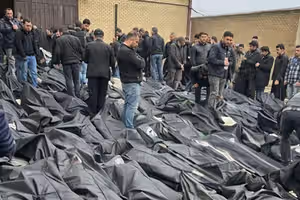
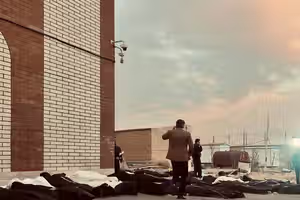
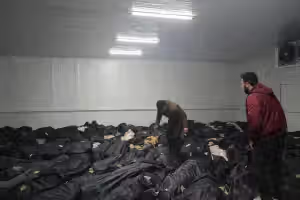
Bodies wrapped in blankets lie outside Alghadir Hospital in eastern Tehran following anti-government protests in January 2026.
“In one sentence, I am proud of my Iranian compatriots because on January 8 and 9 we stood together,” one wrote.
Another cited the “courage, strength and self-sacrifice of a nation” as one of the enduring impressions of the protests.
‘We are alone’
Several said January also changed their expectations of foreign powers and whether outside intervention could alter Iran's future.
“We are alone and should not hope for any power to save us or bring us freedom, except through our own efforts,” one person wrote.
For others, grief, anger and political determination now coexist rather than replacing one another.
“The January protests changed something in me forever,” one respondent wrote. “Since that day, I have become angrier, more wounded and more depressed, but I have not been broken.”
For those who sent responses to Iran International, January remains more than a date marking a political confrontation. It has become a dividing line in their own lives – separating who they were before the protests from who they became afterward.