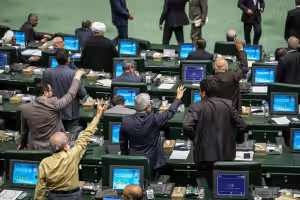
Iranian lawmakers on Sunday, August 16, approved the general principles of the "Plan to Counter the Infiltration of Intelligence Services and Foreign Governments or Institutions" by 183 votes in favor, four against and five abstentions.
The vote means parliament approved the proposal in principle but has not yet approved its individual articles or penalties. The publicly available version contains 19 articles, though lawmakers have said the details have not been finalized.
Majid Ansari, President Masoud Pezeshkian's vice president for legal affairs, said on Wednesday that the cabinet had reviewed the proposal in October last year, and sent its formal opposition to parliament because of what he described as fundamental problems in its provisions.
"The government's official position is opposition to this proposal," Ansari told the state-run IRNA news agency.
Government cites rights concerns
Ansari said the proposal conflicted with several constitutional principles covering citizens' rights, fundamental rights and individual freedoms, and in some cases was also inconsistent with Sharia law.
He said the measure would sharply restrict academic contacts between Iranian universities, researchers and specialists and institutions abroad.
"To achieve the country's important scientific goals, we must work to facilitate communication and the exchange of scientific information, but the provisions of this proposal will create serious restrictions on the country's scientific growth and development," he said.
Ansari said researchers, doctors and academics need ties with international institutions to prevent their work from becoming stagnant and warned that broad restrictions on contacts could push more specialists to leave Iran.
"If every type of contact and communication faces restrictions and is criminalized by law, naturally they will prefer to migrate and carry out their scientific and research activities in a free environment," Ansari said.
Government says existing laws are enough
The Pezeshkian government said Iran already has laws and security agencies with powers to deal with foreign intelligence activity and does not need new legislation in its current form.
Ansari said any new legislation should instead be prepared with the participation of the government and judiciary and submitted as a government bill after legal, judicial, social and political review.
He called on parliament to remove the proposal from its agenda or subject it to a more detailed two-stage review, saying its broad criminal provisions required input from the judiciary.
Draft restricts foreign contacts
The publicly available draft extends beyond acts normally associated with espionage and covers a wide range of contacts between Iranians and foreign individuals and institutions.
One provision would require individuals, private companies and state bodies to notify authorities and receive written permission from the Foreign Ministry, or an Iranian embassy or consulate abroad, before contacts with foreign embassies, offices or non-Iranian organizations inside or outside Iran.
The draft provides limited exemptions for matters including civil registration and personal-status issues. Violations could result in fines and restrictions on social rights.
Another article would ban providing information, reports or statistics to foreign intelligence services, non-Iranian groups or institutions, or foreign nationals without permission from the Intelligence Ministry. It provides for prison terms and, in some cases, a permanent ban from the job through which the information was obtained or supplied.
The draft would also make sending photographs, video, audio or other data to non-Iranian media or people engaged in media work outside Iran punishable by prison.
Interviews or other communication with some US- or Israeli-funded media would also be punishable by prison, while interviews with other foreign media would have to be reported to an Intelligence Ministry system.
Foreign visitors and academic ties
The proposal also contains restrictions affecting foreign nationals in Iran.
Foreigners who enter or remain in Iran without completing required legal procedures could be deported and fined the equivalent of 10,000 euros.
Foreign nationals who entered legally but carried out cultural activities deemed contrary to national security or the state's general policies could face the same penalties. Other offenses committed by foreign nationals in Iran could carry penalties one degree more severe than otherwise prescribed.
The Intelligence Ministry would also be required to publish each year a list of foreign governments, universities and institutions approved for scholarships, grants, academic agreements, conferences and other scientific cooperation.
Scientific cooperation with universities or institutions not on that list, as well as sending medical, research or archaeological samples to them, could result in a prison sentence.
Supporters say measure is needed after wars
Mohammad Saleh Jokar, a lawmaker from Yazd and head of parliament's Internal Affairs and Councils Committee, defended the need for stronger measures against infiltration but said the details of the proposal had not yet been finalized.
Jokar said Iran had suffered major damage from infiltration before and during what he called the 12-day war with Israel and the US last year and the 40-day war with the US this year, adding that foreign adversaries had used different channels to collect information.
He said the assassinations of a number of Iranian commanders and officials were linked to infiltration and said hostile networks inside Iran had used messages, money, weapons and other resources to pursue their objectives.
Jokar said parliament needed to identify and close routes used for infiltration, whether they involved a physical or virtual presence inside the country.
But he also said the proposal's individual provisions required detailed consideration by lawmakers and rejected suggestions that the currently circulating text had been finalized.
Legal scholar warns of vague offenses
Mohsen Borhani, a prominent legal scholar and faculty member at the University of Tehran's law school, also sharply criticized the proposal.
Borhani said its wording was vague and could put the freedom of citizens, academics, political and social activists and artists at risk.
He pointed to language in the draft covering acts such as "showing a dark image of the country," promoting what authorities consider "anti-Islamic culture," taking part in courses deemed incompatible with Iranian culture and making policy proposals considered contrary to the state's fundamental interests.
The draft provides penalties for some cultural activity carried out under foreign direction, including permanent restrictions on some artistic work, and provides prison sentences for some educational courses and workshops involving specified foreign institutions.
Article 1 also provides lengthy prison terms for some policy or legislative proposals made under foreign direction if authorities determine they damaged national security, fundamental state interests, public trust or electoral participation.
Borhani said such broad wording could allow selective enforcement and urged the government, the Science Ministry, the Culture Ministry and other institutions to oppose the measure.
Criticism spreads on social media
Some Iranian social media users also reacted with alarm after parliament's Sunday vote, focusing on the proposal's restrictions on education, media contacts and links with the outside world.
"The biggest point in the proposal is that it lays the groundwork for closing off scholarships for Iranian students," one user on X wrote.
Another user described the measure as "cutting ties with the world on the path to turning Iran into North Korea," saying the proposal could bring media, scientific and civil contacts with foreign institutions under tighter security control.
"Welcome to the world's largest prison," another user wrote, pointing to proposed prison terms for interviews with some US media and restrictions on contact with foreign embassies without government permission.
The posts reflected concern among some social media users that the proposal could sharply restrict academic, media and civil contacts with organizations outside Iran. They do not represent a scientific measure of Iranian public opinion.
The draft remains subject to change. Parliament's vote on Sunday approved only its general principles, and lawmakers have not yet approved the individual articles or penalties contained in the publicly available text.