• العربية
  • فارسی
Brand
  • Iran Insight
  • Politics
  • Economy
  • Analysis
  • Special Report
  • Opinion
  • Podcast
  • Live TV
  • Iran Insight
  • Politics
  • Economy
  • Analysis
  • Special Report
  • Opinion
  • Podcast
  • Live TV
  • Theme
  • Language
    • العربية
    • فارسی
  • Iran Insight
  • Politics
  • Economy
  • Analysis
  • Special Report
  • Opinion
  • Podcast
  • Live TV
All rights reserved for Volant Media UK Limited
volant media logo
ANALYSIS

Iran’s missing fuel: Can border smuggling explain it all?

Umud Shokri
Umud Shokri

Senior visiting fellow, George Mason University

Aug 29, 2026, 05:25 GMT+1
File Photo: Vehicles loaded with fuel containers near Iran’s border, where small-scale cross-border trafficking is the most visible face of a much larger fuel-smuggling economy.

Iran’s large-scale fuel losses appear to go beyond the smuggling cited by officials in Tehran, with evidence pointing to organized diversion within the country’s fuel distribution system.

Iranian officials repeatedly say around 20 million liters of fuel are smuggled out of the country every day, costing Iran between $4 billion and $5.2 billion a year. But the figure is far less precise than it is often presented.

Official statements generally refer to “fuel,” not gasoline alone, and include diesel and other petroleum products. In July 2026, Keramat Veys-Karami, head of the National Iranian Oil Products Distribution Company (NIOPDC), said gasoline was less vulnerable to smuggling than diesel and identified transport allocations as a major source of leakage.

The government has not published the refinery, depot, tanker, customs and station-level data needed to show that 20 million liters physically disappear from the regulated system each day. Without a product-by-product balance, the figure cannot be treated as a measured flow of smuggled gasoline.

Its dollar value is equally uncertain. Twenty million liters a day amounts to 7.3 billion liters a year. Valuing that at $4 billion assumes a loss of about 55 cents per liter; a $5.2 billion estimate puts it at 71 cents. Officials rarely explain whether those figures represent replacement costs, forgone subsidy value, foreign black-market prices or smugglers’ revenue.

What the numbers show

Data released after the war reveal a strained gasoline balance, but do not account for smuggling on the scale claimed.

NIOPDC reported that between March and mid-July 2026, Iranian refineries produced around 109 million liters of gasoline a day, with another 12 million liters supplied through blending. Average consumption stood at 129 million liters.

In late June and early July, daily distribution rose to 134.5 million liters, partly because of increased road travel and Iran’s aging vehicle fleet.

Fuel-card data reveal another problem with interpreting headline numbers. Before the three-tier pricing reform introduced in December 2025, NIOPDC was loading the equivalent of 172 million liters a day in entitlements onto fuel cards belonging to 32 million eligible vehicles, even though actual consumption was around 131 million liters.

The reform reduced those entitlements to about 135 million liters a day and was followed by a six-percent fall in consumption.

But the original gap did not mean that more than 40 million liters of fuel were physically disappearing each day. It was a gap between theoretical entitlements and actual consumption—an important distinction when assessing the scale of diversion.

Establishing how much fuel actually disappears requires comparing refinery dispatches with depot receipts, tanker movements and station-level sales, rather than treating unused or inflated card allocations as physical fuel.

The border-province problem

One argument for the scale of gasoline smuggling focuses on allocations to provinces along or near Iran’s borders. But no published NIOPDC series located for 2025–2026 verifies the claim that Kerman, Hormozgan, Kurdistan and Sistan and Baluchestan together receive 17.5 million liters a day.

Nor can their “normal” demand reliably be put at 14–15 million liters without data on vehicle registrations, fuel-card transactions, agricultural demand and interprovincial traffic.

Available evidence shows why population alone is a poor measure of legitimate demand. Kerman consumed 586 million liters of gasoline during the summer of 2025, equivalent to around six million liters a day, making it one of Iran’s five largest provincial consumers.

In July 2026, the government approved an additional 20-liter third-tier quota for private vehicles in Kerman, Hormozgan and Sistan and Baluchestan, citing long distances and inadequate public transportation.

The provincial figures therefore raise a question rather than provide an explanation. If verified allocations exceed plausible consumption by only a few million liters a day, much of the claimed national leakage must occur elsewhere, or consist of diesel and other fuels rather than gasoline.

An organized supply chain

There is considerably firmer evidence for large-scale organized smuggling and diversion.

Pakistani traders and transporters told RFE/RL in May 2026 that at least six million liters of Iranian gasoline and diesel were entering Pakistan each day. A leaked Pakistani intelligence report identified around 2,000 vehicles and 1,300 boats involved in the trade and described payments moving through hawala networks.

That points to a substantial and organized cross-border economy. But even the six-million-liter estimate accounts for less than one-third of the 20 million liters Iranian officials say are smuggled daily—and it includes both gasoline and diesel.

Evidence from inside Iran points more clearly to the organized networks behind large-scale diversion.

In November and December 2025, judicial officials in Hormozgan said an investigation known as the Toofan case had uncovered 35 interconnected smuggling networks that allegedly moved more than four billion liters of fuel over several years. Authorities opened cases against 753 people described as major participants.

These remain judicial allegations rather than final findings. But the scale and structure described by investigators point to something considerably larger than subsistence smuggling by residents of impoverished border communities.

Where does the fuel disappear?

One of the strongest official clues lies further upstream, in the way fuel allocations are administered.

NIOPDC says around 60 million liters of diesel are allocated to transport operators every day through electronic waybills and acknowledges that inaccurate information about end users creates opportunities for diversion.

The evidence therefore points not to a single route or group of smugglers but to overlapping channels: manipulated fuel entitlements, transport documentation, bulk tanker movements, maritime trafficking and informal payment networks.

That does not establish that Iran’s official estimate of 20 million liters smuggled each day is wrong. It shows that authorities have not published the data necessary to establish what those millions of liters consist of or where they leave the regulated system.

Answering that question would require depot balances, tanker GPS records, station-level sales and provincial allocation data. Until those are published, attributing 20 million liters of daily smuggling chiefly to border communities risks mistaking the visible final carriers for the organized supply system that makes diversion on such a scale possible.

Most Viewed

Iran sentences woman detained during January protests to death
1

Iran sentences woman detained during January protests to death

2

Iran's Bank Melli remains open in Germany despite sanctions

3
ANALYSIS

War or deal? Rezaei begins to define Iran’s price

4

Man from Supreme Leader's empire takes the helm of Iran’s biggest online retailer

5
INSIGHT

Tehran debates austerity as US targets sanctions lifelines

Banner
Banner
Banner

Spotlight

  • Iran’s oil exports near zero as Persian Gulf flows recover
    PODCAST

    Iran’s oil exports near zero as Persian Gulf flows recover

  • Iran or the dollar? US makes an example of Banque Misr
    ANALYSIS

    Iran or the dollar? US makes an example of Banque Misr

  • War or deal? Rezaei begins to define Iran’s price
    ANALYSIS

    War or deal? Rezaei begins to define Iran’s price

  • Three mediators in three days seek path back to Iran-US talks
    INSIGHT

    Three mediators in three days seek path back to Iran-US talks

  • ‘State-sponsored theft’: UN representative calls out rising seizures from Iran’s Bahá’ís

    ‘State-sponsored theft’: UN representative calls out rising seizures from Iran’s Bahá’ís

•
•
•

More Stories

Iran or the dollar? US makes an example of Banque Misr

Aug 28, 2026, 20:50 GMT+1
•
Mohamad Machine-Chian
100%
A customer exchanges U.S. dollars to Egyptian pounds in a foreign exchange office in central Cairo, Egypt December 27, 2016

The US has opened a new front in its economic campaign against Iran by threatening to cut a major third-country bank out of the dollar system over alleged involvement in Tehran’s shadow-banking network.

The US Treasury on Friday labeled Banque Misr’s UAE branches a “financial institution of primary money laundering concern” and proposed cutting them off from the dollar system, marking the first Section 311 action against a third-country bank under Washington’s new Operation Economic Outcast.

The Treasury’s Financial Crimes Enforcement Network (FinCEN) estimates that between January 2024 and June 2026, Banque Misr UAE processed approximately $1.8 billion in transactions for 103 companies it assesses are potentially part of the Islamic Republic’s “shadow banking” network.

The department described the bank as “a critical node for the Iranian regime’s access to US dollars” and said its customers included front companies working for Iran’s Ministry of Defense and Armed Forces Logistics and the Revolutionary Guards, as well as a company described in media reports as a money-laundering conduit for Mojtaba Khamenei.

“We also warned that Iran’s enablers cannot continue to enjoy access to the US dollar and the global financial system,” Treasury Secretary Scott Bessent said. “Banque Misr UAE decided to find out the hard way.”

The move is the first use of Section 311 under Operation Economic Outcast, which Bessent announced on August 24 with the stated aim of cutting off the Iranian government’s revenue streams worldwide.

Unlike conventional sanctions, however, the FinCEN action involves no asset freezes.

Cutting off the dollar

Section 311 of the USA Patriot Act allows the Treasury to designate a foreign financial institution as being of “primary money laundering concern” and impose special measures restricting its access to the US financial system.

In Banque Misr UAE’s case, FinCEN has proposed the most severe option, known as the fifth special measure.

The measure would not only close the bank’s three direct correspondent accounts with US financial institutions. American banks would also be required to prevent Banque Misr UAE from accessing dollars indirectly through intermediary foreign banks.

The proposal is subject to a 30-day public comment period after publication in the Federal Register before it can be finalized.

The measure applies only to Banque Misr’s five UAE branches — two in Dubai and one each in Abu Dhabi, Sharjah and Ras Al Khaimah. The bank’s Cairo-based parent and operations in other countries are excluded.

Iran-linked transactions

FinCEN named three Banque Misr UAE customers as examples of the activity behind its action.

UAE-based Alpa Trading FZCO conducted more than $32 million in transactions and, according to FinCEN, procured goods on behalf of Iran’s defense ministry and the Revolutionary Guards.

Naba Alzaki Raw Materials Trading LLC processed more than $29 million and was identified as a front for the Iran-based Khandan Exchange. Midas Oil Trading DMCC conducted more than $1 million in transactions and has been described in media reports as a money-laundering conduit for Mojtaba Khamenei.

Of the $1.8 billion in potentially Iran-linked transactions identified by FinCEN, roughly $520 million was processed in the 12 months to June 2026, a period covering the war and tightening US sanctions.

FinCEN described the proportion of suspected Iranian activity relative to the size of Banque Misr UAE as “concerningly high.”

The agency has previously said it identified about $9 billion in potential Iranian shadow-banking activity moving through US correspondent accounts in 2024 alone.

The network relies on exchange houses inside Iran and front companies registered in third countries, particularly the UAE and Hong Kong, to turn revenue from sanctioned Iranian exports into usable currency.

A growing bank

Banque Misr UAE’s audited accounts show that its business was expanding during the period in which FinCEN alleges it became a conduit for Iran’s shadow-banking network.

Total assets rose 11% in 2025 to 23.4 billion dirhams ($6.4 billion), customer deposits increased 9% to 19.1 billion dirhams and loans jumped 60% to 8.8 billion dirhams.

The accounts also show the importance of trade finance to its business. Its books carry more than 1.3 billion dirhams in letters of guarantee and 3.6 billion dirhams in undrawn credit commitments.

Losing dollar correspondent access would therefore strike directly at a business heavily involved in cross-border trade finance, even without freezing any of its assets.

The bank appears well capitalized, with a capital adequacy ratio of 24.7%, well above the UAE central bank’s 10.5% minimum. The immediate threat is therefore not insolvency but the viability of parts of a business dependent on international currency settlement and trade finance.

Banque Misr is Egypt’s second-largest bank and is fully owned by the Egyptian state. That makes Washington’s decision to target its UAE operations particularly significant as the US seeks to persuade foreign financial institutions to stop facilitating Iranian trade.

The move nevertheless stops short of targeting larger financial institutions, particularly major Chinese banks involved in financing Iranian trade, a step Washington has so far avoided amid concerns over wider financial disruption and retaliation.

By threatening a state-owned bank belonging to a major Arab partner with exclusion from the dollar system, Washington is setting out the potential cost for third-country institutions that continue handling business it considers part of Iran’s shadow-banking network.

The warning is now explicit: institutions dealing with Tehran may increasingly have to weigh that business against their access to the dollar.

War or deal? Rezaei begins to define Iran’s price

Aug 28, 2026, 18:30 GMT+1
•
Behrouz Turani
100%
Iran's security chief and former IRGC commander Mohsen Rezaei

Mohsen Rezaei on Friday set out four Iranian conditions for an agreement with the United States, another sign that the former IRGC commander who once championed an “offensive doctrine” may be moving from advocating war to contemplating a deal at the right price.

Rezaei named an end to the regional war, lifting the blockade of Iranian ports, compensation and sanctions relief as Iran’s core conditions. He said the demands had been compiled in response to requests from mediators.

Rezaei has served since August 10 as secretary of the Supreme National Security Council and is also the Supreme Leader’s representative on the body, giving his remarks greater institutional weight than those of an individual political or military figure.

Whether the conditions constitute a formally approved negotiating mandate, however, remains unclear. Rezaei’s description suggests an ongoing process of defining Iran’s negotiating position rather than the presentation of final instructions to negotiators.

Since taking over the SNSC, Rezaei has increasingly emerged as one of the principal voices through which Iran’s security establishment frames diplomacy.

The council brings together senior military, intelligence and government officials alongside representatives of the Supreme Leader, who holds ultimate authority over major national security decisions.

Back to MoU

That makes the evolution of Rezaei’s language significant. His movement from advocating an “offensive doctrine” to discussing the terms of a possible agreement has not amounted to an embrace of accommodation with Washington.

But diplomacy is increasingly appearing in his rhetoric as an instrument of Iranian strategy rather than something inherently at odds with it.

Only days ago, Rezaei told Pakistan’s Field Marshal Asim Munir that Washington needed to change its behavior and take practical steps to implement the Islamabad MoU. Iranian media, including Press TV, quoted him as saying the United States should return to the June agreement.

That was notable because the Islamabad MoU provided a framework for de-escalation: ending hostilities, reopening the Strait of Hormuz and moving toward a broader agreement.

President Masoud Pezeshkian has also defended the MoU as the best available path while emphasizing adherence to the Supreme Leader’s policy.

Friday’s demands do not necessarily reverse that position. Rather, they fit an evolving sequence in Rezaei’s public stance: initial rejection of the MoU, movement toward reviving the June framework and now a willingness to discuss negotiations while attaching a higher price to them.

Tactical shift

There is an echo here of Donald Trump’s own approach to the conflict. The US president has moved between military pressure, diplomacy, rejection of the MoU, economic pressure and renewed suggestions that an agreement remains possible.

Both sides appear to be using uncertainty itself as leverage: escalating, reopening the door and then raising the terms for walking through it.

That does not mean Rezaei is consciously emulating Trump. But his recent statements suggest a similarly transactional approach in which apparently contradictory positions can coexist.

Negotiations remain possible, while threats and maximal demands are used to improve the terms on which they might take place.

For Rezaei, this represents a change in tactics rather than ideology. He has not abandoned the hardline worldview that has defined much of his political career, nor do his statements yet signal a broader Iranian pivot toward accommodation with Washington.

More significant may be the evolution of the role he is now playing. The former IRGC commander is no longer simply warning against compromise; he is beginning to define its price.

Iranians are selling their own graves to pay for living

Aug 28, 2026, 13:58 GMT+1
•
Saman Rahmatian
100%
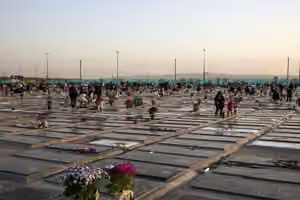
A view from Tehran's Behesht-e Zahra cemetary

Dying has become one of the costs Iranians can no longer meet. Burial plots are advertised at years of wages, families are selling the graves they had reserved for themselves, and some are taking their dead to villages where burial is still free.

A review of grave listings in Tehran found a three-tier plot in sections 39 and 72 of Behesht-e Zahra, the vast cemetery on the southern edge of the capital where Iran's war dead and the founder of the Islamic Republic are buried, offered at 30 billion rials, about $15,000. Tiered graves are stacked burials sold as a single right, allowing several family members to be interred in one plot over time.

The official 2026 tariff for reserving the same three tiers in that part of the cemetery is 3.47 billion rials, roughly $1,740. The asking price in the listings is more than eight and a half times the state rate.

Set against wages, the figures become clearer. Iran's minimum base wage is about 166 million rials a month, around $83. The advertised grave is equivalent to more than 180 months of that wage: a worker on the minimum would have to save every rial for more than fifteen years, spending nothing at all, to reach the asking price. Even the official tariff comes to nearly 21 months of wages.

The market is not confined to the capital. At the Bagh-e Ferdows cemetery in Kermanshah, listings reach 34 billion rials, about $17,000. Two-tier graves at the Saheb al-Zaman cemetery in Kerman are advertised at up to 20 billion rials, some $10,000, and plots at 10 billion rials, around $5,000, appear in Karaj and Yazd.

In Mashhad, family tombs at Behesht-e Reza are priced at up to 18 billion rials, roughly $9,000, and published reports have put burial inside the shrine of Imam Reza, the holiest Shia site in Iran and a place many families regard as a religious privilege, at as much as 14 billion rials, about $7,000.

The bill for a last farewell

A grave is only one of the costs of dying. Transporting the body, ritual washing and the shroud, the burial itself, the headstone, a mosque, flowers, catering and the ceremonies each carry a separate charge.

Under Tehran's official 2026 tariff, basic services run from hundreds of thousands to several million rials. A private hearse costs 50 million rials, about $25, for the first three hours.

Adding the grave, cemetery services, a temporary headstone, a mosque or hall, flowers, catering and other costs, a burial and urban funeral for around 100 people can come to between 1.2 and 1.8 billion rials, roughly $600 to $900. A more expensive plot, a costlier stone, a full meal or several ceremonies can push it far higher.

For many families, though, the question is not whether to buy an expensive grave or an elaborate headstone. It is how to pay for an ordinary burial at all, a cost that pushes them to shrink the ceremonies, drop the traditional third-day and seventh-day gatherings, or find somewhere cheaper to bury their dead.

What has actually changed

Prices inside Behesht-e Zahra vary by zone and section, and the state rates rise every year. In rials the climb is steep: three tiers in the older sections cost 825 million rials in 2022 against 3.47 billion today, a fourfold increase.

Measured in dollars, though, the official price has barely moved. It was worth about $1,700 in 2022 and about $1,740 now, because the city council raises the tariff by a fraction of what the currency loses each year. What has collapsed is the ability to pay: Iran's minimum wage has fallen from more than $230 a decade ago to around $83.

  • Names of some Iran protest victims vanish from Tehran cemetery database

    Names of some Iran protest victims vanish from Tehran cemetery database

That gap between a suppressed official price and what the market will bear is where the private trade lives. The cemetery's managing director said in 2023 that grave sales are the organization's main source of income, that capacity was running out and three new cemeteries were planned, and that each national identity number was now limited to a single plot, a rule introduced to stop what he called brokering and the emergence of "grave sultans." Such brokering, he acknowledged, exists.

Cemetery officials also dispute the highest figures in circulation. A previous managing director said the most expensive grave ever sold there had gone for a fraction of the sums now advertised. The listings reviewed for this report are advertisements placed by private sellers, not transactions recorded by the cemetery.

When a burial right becomes an asset

Iran International contacted three people who had advertised graves for sale in Tehran and Kermanshah, presenting itself as a prospective buyer. None is named here.

One, in Tehran, was selling an unused tier of his father's grave, a space the family had kept for his mother.

"Thank God our mother is alive, and right now we need this money more," he said.

In Kermanshah, another seller had listed his mother's grave, in Bagh-e Ferdows for about 40 years. He counted its position near the car park among its advantages, and said that whenever a buyer needed it, he would come to complete the transfer once the money had been paid, so that the grave could be given to them as a "gift."

  • Iran crackdown reaches cemeteries as graves of slain protesters defaced

    Iran crackdown reaches cemeteries as graves of slain protesters defaced

A third seller in Kermanshah had bought a plot beside his brother's years earlier, intending to be buried next to him. He has put it up for sale. Finding a grave in Bagh-e Ferdows has become difficult, he said, but the money matters more for now: he is still alive, and he would rather use it for what his children need than worry about how easily they will be able to visit him later.

In this market, even a place kept to lie beside a father, a mother or a sibling can lose out to something more urgent: the money a family needs today.

Graves at auction

Burial rights are not only offered as assets in private listings. Court enforcement records show they can be seized and auctioned to settle debts.

In 2022, a single tier of a grave in section 36 of Behesht-e Zahra was put up for auction. In June 2025, so was a grave in section 62 of Bagh-e Ferdows in Kermanshah.

Open trade in graves is not permitted in many Iranian cemeteries, and transfers of burial rights are supposed to go through official channels. In Tehran, the right of use must be registered through the Behesht-e Zahra organization.

The restrictions have not ended the market. Listings continue to appear, and some transfers are dressed as gifts, as the Kermanshah seller described.

The result is a market with almost no transparency: there is no comprehensive official record of how many such deals are done, no clarity on the prices finally paid, and no certainty that a right advertised in a listing can lawfully be transferred at all.

The migration of the dead

Another consequence is visible in the villages around some Iranian cities.

Reports from areas near Mashhad and Gorgan describe urban families moving the bodies of relatives to village cemeteries, where burial is free or cheap, to reduce costs.

One described a rise in city families turning up at rural graveyards. In another village, residents built a fence around the cemetery to stop outsiders being buried there.

Similar accounts have emerged from other cities. There are no official figures, but the cases suggest the price of a grave is now capable of redrawing the geography of burial.

Prices are not driven by inflation alone. Older cemeteries are running short of capacity, families want to be buried alongside relatives, and the religious standing of certain sites carries a premium of its own.

The pressure works in both directions at once: one family drives a body out of the city to save money while, in the same period, a burial plot in an old cemetery becomes an asset worth the equivalent of years of work.

Mourning under financial and security pressure

For some families the difficulty of burial is not only economic.

Reporting on those killed in protests and on people executed in Iran shows that the release of a body, the place of burial and even the holding of a funeral can fall under the control of security institutions. In some cases that pressure has come with a demand for money.

  • Pay for bullets: How Iran pressures families after killing protesters

    Pay for bullets: How Iran pressures families after killing protesters

The family of Babak Pourmazaheri, a 37-year-old protester killed in Alborz province, received his body after three days and a payment of 4 billion rials, about $2,000.

In the case of Jamshid Momeni, 16 billion rials, roughly $8,000, was demanded for the return of his body; when the family said they could not pay, they were asked instead to present him as a "martyr of the state."

In the case of Esmail Fekri, the family was not told where he had been buried, and a security officer demanded 1.5 billion rials, some $750, to reveal the location of the grave.

Here the cost of death is no longer the price of a plot and a ceremony. Money has become entangled with control over the body, the burial and the right to grieve.

Two sides of the market

In a market where a burial right can be worth years of wages and can be auctioned to settle a debt, some families are selling the very place they had kept for themselves or their relatives, in order to pay for living.

In Kermanshah, a man bought a grave beside his brother's years ago. He has now put it up for sale.

He says he needs the money for his children more than he needs somewhere to be buried.

Tehran debates austerity as US targets sanctions lifelines

Aug 28, 2026, 00:58 GMT+1
•
Behrouz Turani
100%
A motorcyclist checks his phone on a street in Tehran, with a banner depicting Iran’s slain Supreme Leader Ali Khamenei visible in the background, August 26, 2026

As Washington targets the financial and trading networks Iran has used to withstand years of sanctions, economists and analysts in Tehran are debating how much more economic hardship the country can absorb to survive a prolonged economic war.

The latest US pressure goes beyond broad restrictions on oil exports, increasingly targeting middlemen, front companies, financial channels and other mechanisms Tehran has relied on to keep foreign currency and goods flowing under sanctions.

Ehsan Movahedian, an international affairs analyst, described the approach as an attempt to choke Iran’s access to foreign currency, fuel inflation and deepen internal economic instability.

Other analysts writing in the moderate outlets Fararu and Donya-ye Eghtesad argue that with those traditional workarounds under growing pressure and no comprehensive alternative in place, Tehran may increasingly be forced to turn inward: tightening budgets, reducing subsidies, rationing scarce resources and curbing consumption.

But austerity presents the government with its own political dilemma. Measures that conserve resources and help Iran withstand sanctions would also transfer more of the cost of the confrontation to a population already struggling with inflation and utility shortages.

Iranian governments have long been wary of abruptly reducing subsidies for precisely that reason. A sudden increase in gasoline prices in November 2019 triggered nationwide protests that were met with a deadly crackdown, leaving authorities acutely aware of the political risks attached to measures that sharply increase household costs.

President Donald Trump and Treasury Secretary Scott Bessent have made clear that economic pressure will remain central to Washington’s Iran strategy.

In Tehran, the campaign is broadly perceived as an attempt to force capitulation rather than genuine negotiations, even though President Masoud Pezeshkian has repeatedly said the two sides must eventually resolve their differences through talks.

Former diplomats Fereydoun Majlesi and Jalal Sadatian describe the current trajectory of Iran-US relations as one of strategic ambiguity and economic attrition, with neither an imminent diplomatic breakthrough nor a clear route out of the confrontation.

That uncertainty has sharpened disagreement over whether diplomacy can relieve the economic pressure before Tehran is forced to impose still greater costs at home.

Former ambassador Mohsen Pakaeen argued that the recent stream of regional mediators visiting Tehran was focused on the wrong capital.

The obstacle, he said, was Washington’s insistence on Iranian capitulation without offering credible concessions, meaning mediators seeking a breakthrough should concentrate their efforts on the United States.

Hardline voices, including the editor of the ultraconservative daily Kayhan, reject talks under economic pressure and push for a more confrontational posture capable of raising the costs for the United States and its regional partners.

The disagreement leaves Tehran confronting two related calculations: whether it can economically outlast Washington’s pressure campaign, and how much domestic hardship it can impose in doing so.

For advocates of greater economic resilience, austerity could preserve scarce government resources while buying Tehran time. But analysts also warn that the same measures could weaken domestic stability and ultimately undermine the negotiating position they are intended to protect.

China offers Iran its most important external economic lifeline, but also an uncertain one.

Majlesi and other observers argue that intensified US enforcement against buyers of Iranian goods increasingly overlaps with Washington’s wider economic competition with Beijing.

China remains crucial to Iranian trade, but Tehran cannot determine how much economic or political risk Beijing will ultimately accept on its behalf.

That leaves Iran with few easy alternatives. Informal trading networks can soften sanctions, regional diplomacy may eventually produce negotiations and austerity can stretch limited resources, but none provides a clear exit from a prolonged economic confrontation.

Austerity may therefore buy Tehran time, but not necessarily leverage. But the question is not only how long Iran’s economy can withstand Washington’s pressure, but how much more pressure its government believes Iranian society can bear.

Man from Supreme Leader's empire takes the helm of Iran’s biggest online retailer

Aug 27, 2026, 14:30 GMT+1
•
Hooman Abedi
100%
Workers at a Digikala fulfillment center in Iran process and prepare orders for delivery.

Two years ago the editor of Iran's most hardline newspaper said management of the country's biggest online retailer would "fortunately" pass to those who serve the state. It is now chaired by a former spokesman for the supreme leader's business empire.

Hojjat Niki-Maleki identifies himself on LinkedIn as chairman of Digikala Group, having joined the board as a representative of Harakat Aval, the investment arm of the mobile operator MCI. An official company filing lists him as a board member without specifying the chairmanship.

The change dates to June 10 but became public only when the formal notice was published this week, according to the Iranian technology outlet Digiato.

Niki-Maleki previously headed communications for the Execution of Imam Khomeini's Order, commonly known as Setad, a conglomerate built largely on property confiscated after the 1979 revolution, controlled by the office of the supreme leader and under US sanctions. He also spent more than four years on MCI's board.

100%
Hojjat Niki-Maleki

His earlier work was in hardline media. He ran Afsaran, an online platform that promoted anti-Western messaging and the authorities' concept of a cultural "soft war."

His social media history also shows an affinity with the military establishment: in January 2020 he posted a photograph of himself seated beside Qasem Soleimani, then commander of the Revolutionary Guards' Quds Force, on an aircraft.

"I told him I was the son of a martyr, and his respect for me doubled," he wrote, describing Soleimani embracing him at an airport. "The sweet taste of my conversation with Haj Qasem is still with me."

Hojjat’s father, Hossein Niki-Maleki, was a member of the security team aboard Iran Air Flight 655, which was shot down by the United States in 1988.

100%
A social media post by Hojjat Niki-Maleki shows him seated next to Qassem Soleimani on a plane.

Boycott calls

The appointment prompted calls on Persian-language social media to stop shopping at Digikala, with critics pointing to his Setad connection, his politics and his role promoting Iran's domestic Covid-19 vaccine.

"Do not buy from Digikala. This is something you can do," one user wrote on X, arguing that purchases would ultimately help finance Revolutionary Guards missiles and drones.

Another framed the appointment as part of a wider expansion of state-linked influence over the company.

100%
Workers handle packages at a Digikala warehouse in Iran.

Much of the criticism returned to the vaccine. Niki-Maleki worked for Setad when its pharmaceutical arm developed CovIran Barekat, the domestically produced Covid-19 vaccine that authorities promoted during the pandemic, and he repeatedly used his own accounts to publicize its production and effectiveness.

That program became politically charged after the late Supreme Leader Ali Khamenei barred imports of American and British vaccines in January 2021. Critics argued that relying on domestic production delayed access to sufficient doses while Iran struggled to vaccinate its population, and some hold the officials who promoted it responsible for deaths that followed, a charge they have never accepted.

"He used to come here every day two years ago and hashtag that there would soon be good news and we would make a coronavirus vaccine," one user wrote.

About 150,000 people died from the pandemic across Iran, one of the heaviest official tolls in the region. Turkey, with a population of similar size, recorded roughly 100,000. Saudi Arabia reported fewer than 10,000 and the United Arab Emirates around 2,400. What each of those countries did have was early access to Western vaccines, the ones Iran's Supreme Leader had ruled out.

100%
Hojjat Niki-Maleki receives a COVID-19 vaccine during a clinical trial in Iran.

A pattern, not an appointment

The reaction reflects something larger than one board seat: a sequence of events that has moved Iran's most prominent private technology company steadily closer to the state.

Digikala was founded in 2006 by the brothers Hamid and Saeid Mohammadi and grew into the country's dominant online marketplace, the most recognizable business to emerge from Iran's private technology sector.

The pressure began in the summer of 2023, when police sealed its offices after photographs circulated of female employees without compulsory hijab.

In February 2024, the judiciary filed charges over products it said insulted Islamic sanctities, after users circulated images of mugs sold on the site bearing the name Fatemeh Zahra, the daughter of the Prophet Mohammad. The company's chief executive, Masoud Tabatabai, was arrested on the order of the security prosecutor's office and released hours later pending further appearances. Pro-government vigilantes painted threatening messages on the company's building.

That same month, Hossein Shariatmadari, editor of Kayhan and Khamenei's representative at the newspaper, said management of digital companies such as Digikala and the ride-hailing platform Snapp would "fortunately" be transferred to those "who serve the state."

Negotiations over a stake in Digikala also began in that period. They concluded this spring, when Harakat Aval, MCI's venture capital arm, bought 40 percent of Digikala Group in cash, taking over the holding of the venture firm Sarava Pars along with parts of other shareholdings.

The agreed valuation was 300 trillion rials, about $146 million at current market rates, in what the company called the largest investment in the history of Iran's digital economy.

Digikala said the founders would retain 22 percent and two of five board seats, along with executive management, business strategy and the selection of senior managers, and that no single shareholder would control the company.

MCI's own ownership is the point critics return to. Iran's largest mobile operator is a subsidiary of the Telecommunication Company of Iran, privatized in 2009 in a sale to a consortium widely reported to be linked to the Revolutionary Guards.

Niki-Maleki's appointment points to a wider shift in Iran's digital economy: the steady expansion of state-linked institutions into businesses built as private enterprises – which is also why a prediction made in a hardline newspaper in 2024 reads today less like a threat than a schedule.