• العربية
  • فارسی
Brand
  • Iran Insight
  • Politics
  • Economy
  • Analysis
  • Special Report
  • Opinion
  • Podcast
  • Live TV
  • Iran Insight
  • Politics
  • Economy
  • Analysis
  • Special Report
  • Opinion
  • Podcast
  • Live TV
  • Theme
  • Language
    • العربية
    • فارسی
  • Iran Insight
  • Politics
  • Economy
  • Analysis
  • Special Report
  • Opinion
  • Podcast
  • Live TV
All rights reserved for Volant Media UK Limited
volant media logo

Iran campaign urges people to fund sacrifice of 10,000 sheep for Khamenei’s health

Aug 19, 2026, 20:56 GMT+1
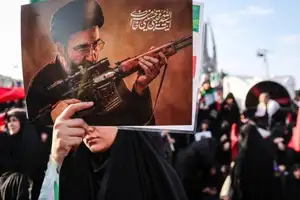
An Islamic Republic supporter holds a picture of Supreme Leader Mojtaba Khamenei

A campaign by pro-establishment religious groups in Iran is asking people to help fund the ritual slaughter of 10,000 sheep as a religious offering for Supreme Leader Mojtaba Khamenei’s health, with each animal priced at 250 million rials, or about $132.

The campaign says it is being carried out with the participation of Heyat-e Gharar, a religious group active on the Iranian messaging platform Eitaa. Donations are being collected through accounts belonging to the Qom-based Hazrat Khadijeh Institute, a religious charity that organizes collective animal sacrifices and meat distribution.

The campaign website describes the initiative as a nazr, a religious vow or offering made for a particular purpose. In this case, it takes the form of qorbani, the ritual slaughter of an animal as an act of religious devotion dedicated to Khamenei’s health.

Donors can cover the full 250 million-rial cost of a sheep, about $132, or contribute smaller amounts collectively. At the advertised price, 10,000 sheep would cost 2.5 trillion rials, or about $1.32 million.

Abdolkarim Abedini, a former representative of the Supreme Leader in Qazvin province and former Friday Prayer leader of Qazvin, has also urged people to participate. In a video, he called for 10,000 sheep to be sacrificed for Khamenei’s health and to ward off what he called the “Zionist-American enemy,” urging people to “hurry” to take part.

Locals question campaign amid economic hardship

The campaign has drawn criticism from Iranians who told Iran International they questioned why the public should fund it amid severe economic pressure and high food prices.

“Why would I sacrifice a sheep for Mojtaba when I haven’t been able to afford lamb myself for years?” one person wrote to Iran International.

A Tehran resident said they had received a text message about the campaign several days earlier.

“A few days ago, we received a text saying they were collecting an offering for the Leader’s health and that we should send money for 10,000 sheep,” the resident told Iran International. “Why should the money come from the people?”

The campaign comes amid continued uncertainty over Khamenei’s health and whereabouts. He was reportedly seriously injured in the Feb. 28 US-Israeli strike that killed his father and predecessor, Ali Khamenei, and has not appeared in public since becoming Supreme Leader.

Khamenei has not delivered a public speech or interview since taking office, and no new authenticated photograph, video or audio recording of him has been released. His public communications have instead consisted of written statements attributed to him.

Most Viewed

Canada deports former Iranian official linked to 2019 protest crackdown
1

Canada deports former Iranian official linked to 2019 protest crackdown

2

Iran weighs attacks on military targets in Europe – FT

3
ANALYSIS

The 60-day deadline is over. Now what does Trump do with Iran?

4
INSIGHT

Forced to serve in the IRGC, now fighting to stay in Canada

5
OPINION

For Iranian journalists, exile can last a lifetime

Banner
Banner
Banner

Spotlight

  • Luxury Tehran property asking prices surpass Munich and Sydney

    Luxury Tehran property asking prices surpass Munich and Sydney

  • For Iranian journalists, exile can last a lifetime
    OPINION

    For Iranian journalists, exile can last a lifetime

  • Seven months on, January protests still shape Iranians’ lives
    VOICES FROM IRAN

    Seven months on, January protests still shape Iranians’ lives

  • Forced to serve in the IRGC, now fighting to stay in Canada
    INSIGHT

    Forced to serve in the IRGC, now fighting to stay in Canada

  • Iran’s ‘infiltration’ bill sparks backlash over sweeping reach

    Iran’s ‘infiltration’ bill sparks backlash over sweeping reach

  • To survive maximum pressure, Iran kept pumping and broke its oil company
    ANALYSIS

    To survive maximum pressure, Iran kept pumping and broke its oil company

•
•
•

More Stories

Tehran gas stations run dry as fuel price hike fears mount

Aug 19, 2026, 16:09 GMT+1
100%
A general view of a gas station, Tehran, Iran.

Gas stations in parts of Tehran closed after running out of fuel Wednesday, while motorists elsewhere in the Iranian capital waited up to an hour to fill their tanks amid mounting fears of a fuel price hike, locals told Iran International.

“I went to three gas stations to fill up and all three were closed,” one Tehran resident told Iran International on Wednesday. “One of them had put up a banner saying, ‘We have no gasoline.’”

Another resident said: “Today I spent about an hour in line for gasoline. Many gas stations had no fuel.”

Another Tehran resident said the Interior Ministry had ordered traffic police to crack down on older cars and motorcycles and impound them.

“They have said these vehicles should remain in impound lots for a month so that fuel consumption can be reduced this way,” the resident said.

The accounts come as Iran faces mounting pressure on fuel supplies, with domestic production struggling to keep pace with demand as a US naval blockade on Iranian maritime traffic disrupts fuel imports that previously helped cover the country’s domestic shortfall.

Esmail Saqab Esfahani, head of Iran’s Energy Efficiency Organization, said Saturday that the country faced a daily gasoline shortfall of around 14 million to 15 million liters.

Hossein Samsami, a member of parliament’s Economic Committee, warned Monday that raising gasoline prices amid current economic pressures could trigger widespread unrest, likening it to “a spark in a powder keg.”

Iranian officials have grown increasingly concerned about the prospect of renewed protests, while seeking to cast public discontent as being fueled by foreign adversaries.

Parliament Speaker Mohammad-Bagher Ghalibaf said Tuesday that the enemy was seeking “riots, assassinations and separatist activities” and intended to “exploit” any potential dissatisfaction over gasoline.

Concerns over methanol-blended gasoline

Plans to blend methanol into gasoline have also raised concern among Iranians, with locals telling Iran International they were uneasy about the fuel’s safety and its potential impact on vehicles and public health.

The concerns come against a backdrop of longstanding questions over fuel quality in Iran and previous reports that authorities used non-standard chemical compounds to help offset gasoline shortages.

Vahid Ghanei-Fard, CEO of the Persian Gulf Star Refinery, Iran’s largest gasoline producer, said Tuesday that a pilot project to produce methanol-based gasoline had been successful, with methanol accounting for 3% of the blend.

He said the fuel met “national and international standards” and that the use of methanol had helped raise the refinery’s daily gasoline output to around 49 million liters.

Saadatollah Molavi, an Iran-based refinery expert and frequent energy commentator, told IMNA, an Isfahan municipality-affiliated news agency, that methanol could play a role in easing Iran’s fuel shortage.

But Molavi warned against treating it as a long-term solution without assessing costs, efficiency, gas consumption and infrastructure needs, suggesting the blend may offer only a temporary fix rather than a sustainable answer to Iran’s fuel deficit.

Last May, the London-based independent research group Iran Open Data reported in May 2025, citing a confidential Oil Ministry document, that authorities had used hazardous and contaminated chemical compounds outside the conventional refining process to increase gasoline supplies.

The report described the practice as widespread and systematic and said it was aimed at compensating for the country’s gasoline shortfall.

Concerns over the quality of Iran’s gasoline are longstanding. In January 2023, Dariush Golalizadeh, an official with the Department of Environment, said only 38% of gasoline produced in the country met Euro 4 and Euro 5 standards.

Pezeshkian admin says infiltration bill violates rights, could drive brain drain

Aug 19, 2026, 14:23 GMT+1
•
Niloufar Goudarzi
100%

President Masoud Pezeshkian's government has formally opposed a bill aimed at countering foreign intelligence infiltration, saying it violates citizens' rights, restricts academic ties and could accelerate the emigration of Iranian experts and researchers.

Iranian lawmakers on Sunday, August 16, approved the general principles of the "Plan to Counter the Infiltration of Intelligence Services and Foreign Governments or Institutions" by 183 votes in favor, four against and five abstentions.

The vote means parliament approved the proposal in principle but has not yet approved its individual articles or penalties. The publicly available version contains 19 articles, though lawmakers have said the details have not been finalized.

Majid Ansari, President Masoud Pezeshkian's vice president for legal affairs, said on Wednesday that the cabinet had reviewed the proposal in October last year, and sent its formal opposition to parliament because of what he described as fundamental problems in its provisions.

"The government's official position is opposition to this proposal," Ansari told the state-run IRNA news agency.

Government cites rights concerns

Ansari said the proposal conflicted with several constitutional principles covering citizens' rights, fundamental rights and individual freedoms, and in some cases was also inconsistent with Sharia law.

He said the measure would sharply restrict academic contacts between Iranian universities, researchers and specialists and institutions abroad.

"To achieve the country's important scientific goals, we must work to facilitate communication and the exchange of scientific information, but the provisions of this proposal will create serious restrictions on the country's scientific growth and development," he said.

Ansari said researchers, doctors and academics need ties with international institutions to prevent their work from becoming stagnant and warned that broad restrictions on contacts could push more specialists to leave Iran.

"If every type of contact and communication faces restrictions and is criminalized by law, naturally they will prefer to migrate and carry out their scientific and research activities in a free environment," Ansari said.

  • Iran’s new infiltration bill could make ordinary contact a crime

    Iran’s new infiltration bill could make ordinary contact a crime

Government says existing laws are enough

The Pezeshkian government said Iran already has laws and security agencies with powers to deal with foreign intelligence activity and does not need new legislation in its current form.

Ansari said any new legislation should instead be prepared with the participation of the government and judiciary and submitted as a government bill after legal, judicial, social and political review.

He called on parliament to remove the proposal from its agenda or subject it to a more detailed two-stage review, saying its broad criminal provisions required input from the judiciary.

Draft restricts foreign contacts

The publicly available draft extends beyond acts normally associated with espionage and covers a wide range of contacts between Iranians and foreign individuals and institutions.

One provision would require individuals, private companies and state bodies to notify authorities and receive written permission from the Foreign Ministry, or an Iranian embassy or consulate abroad, before contacts with foreign embassies, offices or non-Iranian organizations inside or outside Iran.

The draft provides limited exemptions for matters including civil registration and personal-status issues. Violations could result in fines and restrictions on social rights.

Another article would ban providing information, reports or statistics to foreign intelligence services, non-Iranian groups or institutions, or foreign nationals without permission from the Intelligence Ministry. It provides for prison terms and, in some cases, a permanent ban from the job through which the information was obtained or supplied.

  • Iran’s intelligence mocked by allies and foes over 'secret' Israel files

    Iran’s intelligence mocked by allies and foes over 'secret' Israel files

The draft would also make sending photographs, video, audio or other data to non-Iranian media or people engaged in media work outside Iran punishable by prison.

Interviews or other communication with some US- or Israeli-funded media would also be punishable by prison, while interviews with other foreign media would have to be reported to an Intelligence Ministry system.

Foreign visitors and academic ties

The proposal also contains restrictions affecting foreign nationals in Iran.

Foreigners who enter or remain in Iran without completing required legal procedures could be deported and fined the equivalent of 10,000 euros.

Foreign nationals who entered legally but carried out cultural activities deemed contrary to national security or the state's general policies could face the same penalties. Other offenses committed by foreign nationals in Iran could carry penalties one degree more severe than otherwise prescribed.

The Intelligence Ministry would also be required to publish each year a list of foreign governments, universities and institutions approved for scholarships, grants, academic agreements, conferences and other scientific cooperation.

Scientific cooperation with universities or institutions not on that list, as well as sending medical, research or archaeological samples to them, could result in a prison sentence.

Supporters say measure is needed after wars

Mohammad Saleh Jokar, a lawmaker from Yazd and head of parliament's Internal Affairs and Councils Committee, defended the need for stronger measures against infiltration but said the details of the proposal had not yet been finalized.

Jokar said Iran had suffered major damage from infiltration before and during what he called the 12-day war with Israel and the US last year and the 40-day war with the US this year, adding that foreign adversaries had used different channels to collect information.

He said the assassinations of a number of Iranian commanders and officials were linked to infiltration and said hostile networks inside Iran had used messages, money, weapons and other resources to pursue their objectives.

Jokar said parliament needed to identify and close routes used for infiltration, whether they involved a physical or virtual presence inside the country.

But he also said the proposal's individual provisions required detailed consideration by lawmakers and rejected suggestions that the currently circulating text had been finalized.

  • Iran’s ‘infiltration’ bill sparks backlash over sweeping reach

    Iran’s ‘infiltration’ bill sparks backlash over sweeping reach

Legal scholar warns of vague offenses

Mohsen Borhani, a prominent legal scholar and faculty member at the University of Tehran's law school, also sharply criticized the proposal.

Borhani said its wording was vague and could put the freedom of citizens, academics, political and social activists and artists at risk.

He pointed to language in the draft covering acts such as "showing a dark image of the country," promoting what authorities consider "anti-Islamic culture," taking part in courses deemed incompatible with Iranian culture and making policy proposals considered contrary to the state's fundamental interests.

The draft provides penalties for some cultural activity carried out under foreign direction, including permanent restrictions on some artistic work, and provides prison sentences for some educational courses and workshops involving specified foreign institutions.

Article 1 also provides lengthy prison terms for some policy or legislative proposals made under foreign direction if authorities determine they damaged national security, fundamental state interests, public trust or electoral participation.

Borhani said such broad wording could allow selective enforcement and urged the government, the Science Ministry, the Culture Ministry and other institutions to oppose the measure.

Criticism spreads on social media

Some Iranian social media users also reacted with alarm after parliament's Sunday vote, focusing on the proposal's restrictions on education, media contacts and links with the outside world.

"The biggest point in the proposal is that it lays the groundwork for closing off scholarships for Iranian students," one user on X wrote.

Another user described the measure as "cutting ties with the world on the path to turning Iran into North Korea," saying the proposal could bring media, scientific and civil contacts with foreign institutions under tighter security control.

"Welcome to the world's largest prison," another user wrote, pointing to proposed prison terms for interviews with some US media and restrictions on contact with foreign embassies without government permission.

The posts reflected concern among some social media users that the proposal could sharply restrict academic, media and civil contacts with organizations outside Iran. They do not represent a scientific measure of Iranian public opinion.

The draft remains subject to change. Parliament's vote on Sunday approved only its general principles, and lawmakers have not yet approved the individual articles or penalties contained in the publicly available text.

An Iranian film broke every taboo. Viewers say society broke them first

Aug 19, 2026, 11:39 GMT+1
•
Hooman Abedi
100%
A scene from Bidad. Courtesy of the Karlovy Vary International Film Festival.

An Iranian film made in defiance of the censors reached YouTube last week, and the argument it started was not the one its makers might have expected: many viewers are asking not whether Bidad goes too far, but whether it goes far enough for the country it depicts.

For some viewers, Soheil Beiraghi's fourth feature puts a recognizable Iran on screen for the first time in years: women without mandatory hijab, men and women embracing, underground music, and a young singer who refuses to accept that her voice cannot be heard.

Others reached almost the opposite conclusion, arguing that the film trails the society it means to portray, or that its accumulation of drugs, alcohol, sex and broken relationships pulls focus from what Iranians are actually living through.

"I watched the film. The story is deeply moving, and it reflects what we are living through as a society," one user wrote on Iran International's Instagram page, praising its defiance of taboos while criticizing some of its dialogue and pacing.

Another called it simply "behind society," arguing that Iranians now have "much, much more serious" concerns than the ones on screen.

The split has turned a film into an argument about something larger than cinema: the widening distance between what Iran's censors forbid, what filmmakers can now show by ignoring them, and what audiences already consider ordinary life.

100%
A scene from Bidad. Courtesy of the Karlovy Vary International Film Festival.

When the street becomes the stage

Bidad follows Seti, played by Sarvin Zabetian, an aspiring singer whose ambitions collide with the restrictions on women's voices.

"You can't hear my voice," she protests to a music teacher early in the film, and is told that female singers may not be louder than the men accompanying them.

Seti refuses the compromise. She ends up singing in the street, where passers-by film her and circulate the clips, turning her into an emblem of a generation increasingly willing to take in public what official institutions withhold.

  • Made without permission: how Iran’s underground cinema owned 2025

    Made without permission: how Iran’s underground cinema owned 2025

Making the film carried a price. Security agents raided the production office and seized equipment and recorded material, and Beiraghi and several cast and crew members faced prosecution.

The director received a prison sentence later converted into a fine; Zabetian and Leili Rashidi, who plays Seti's mother, were also sentenced, while other defendants were acquitted.

The film went on to win the Special Jury Prize at the Karlovy Vary International Film Festival before its release online.

Have the taboos already changed?

For some Iranian viewers, the value of Bidad lies in showing what approved cinema has never managed to.

"Just the fact that they weren't wearing scarves or headscarves at home was very good," one Instagram commenter wrote, describing the film as all the more bitter for being drawn from life. Another called it the "reality of our lives as women" in Iran.

Others questioned whether those images still transgress anything. One wrote that the film addresses concerns belonging to an earlier phase of Iranian society and has failed to keep pace with what people now demand.

Mohammad Abdi, a writer and film critic, places Bidad within Iran's underground cinema but argues that Beiraghi has gone further than his peers by abandoning the compromises censorship imposes.

"The important point is that, when it comes to the government, the film stops compromising and speaks very directly about a generation that is tired and is taking its demands to the street," Abdi told Iran International.

He rejected suggestions by some commenters that the film reflects a reformist outlook, pointing to Seti's journey from negotiating within the rules to carrying her demand into the open.

"The film is actually about moving beyond reformism," Abdi said. "She goes through all these tests until she finally concludes that reformism no longer has meaning and that she has to stand against the regime in the street."

100%
A scene from Bidad. Courtesy of the Karlovy Vary International Film Festival.

A harsher line of criticism concerns how the film draws those who break the rules. One commenter objected to the prominence of alcohol, marijuana, sex and dysfunctional relationships, warning that such choices risk tying musicians and dissenters to social disorder in viewers' minds.

The Hollywood Reporter read the same world differently, describing a film populated by "rebels and outcasts" and arguing that Seti is far from alone in it: the picture follows one singer, but its wider significance lies in placing her among a growing number of young Iranians pushing back against limits on personal expression.

A related complaint appeared on X, where one user praised the film for its recognizable picture of Iranian life but wrote that it tries to carry too many injustices at once. Sexual harassment, a subplot in which Seti's mother is coerced into sex with an interrogator to secure her detained daughter's release, and Seti getting her period in custody were all unnecessary, the commenter argued.

That debate captures the unusual bind Bidad finds itself in: escaping censorship let it cross lines that approved cinema cannot, but crossing them no longer looks radical to audiences whose own lives changed faster than the rules did.

100%
A scene from Bidad. Courtesy of the Karlovy Vary International Film Festival.

Two generations meet

The same divide runs inside the film, through Seti's relationship with a nameless older man played by Amir Jadidi, who asks to be called only "Bebin," or "Look."

Tattooed, frequently high and seemingly emptied of his old ideals, he stands against Seti's determination to force her way into public life, Abdi said.

Their intimate but unconventional relationship becomes an encounter between two generations: one carrying the weight of disillusionment, the other unwilling to accommodate restrictions.

  • Iran releases songstress after brief arrest over concert without hijab

    Iran releases songstress after brief arrest over concert without hijab

The film's singing voice ties the fiction to the present. Its vocal tracks feature Parastoo Ahmadi, who has faced prosecution for performing without mandatory hijab.

In June, a court in Qom sentenced Ahmadi and eight musicians and crew members to 74 lashes each, a two-year ban on artistic work and a two-year travel ban over her 2024 Caravanserai Concert.

Bidad was made outside official channels because the Iran it shows cannot exist within the rules of approved cinema. Its reception online has exposed a second gap: some viewers celebrate the sight of those rules being broken, while others ask why the screen is still catching up with a society that broke them first.

Luxury Tehran property asking prices surpass Munich and Sydney

Aug 19, 2026, 11:07 GMT+1
•
Hooman Abedi
100%
A luxury house in northern Tehran

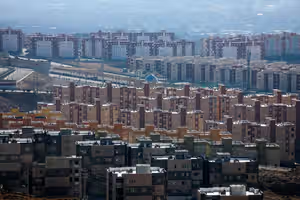
Some luxury apartments in northern Tehran are being advertised above the price of central Munich or Sydney: 25 billion rials, about $13,228, per square meter, according to Farhikhtegan newspaper, which examined the listings.

Eleven of 16 properties examined in the affluent neighborhoods of Aghdasiyeh and Elahiyeh were advertised above 10 billion rials ($5,291) per square meter, the Iranian daily said on Wednesday.

It has to be noted that the Tehran figures are sellers' asking prices for a small selection of high-end properties, not completed transactions, while the international figures represent broader city-center apartment prices.

Average asking prices across Tehran were around 2.3 billion to 2.5 billion rials ($1,217-$1,323) per square meter, with completed sales likely to be lower than advertised prices, Farhikhtegan said.

Monthly salaries for many Iranian workers are commonly put at around 200 million to 250 million rials, equivalent to roughly $105 to $132.

100%
A luxury house in northern Tehran

Multimillion-dollar properties in northern Tehran

A 500-square-meter property in Aghdasiyeh was advertised at 15 billion rials ($7,937) per square meter, giving it a total asking price of around 7.5 trillion rials ($3.97 million), according to the newspaper.

Another property measuring 600 square meters was offered at 18 billion rials ($9,524) per square meter, or approximately 10.8 trillion rials ($5.71 million).

  • Tehran rents hit three times many workers’ monthly pay

    Tehran rents hit three times many workers’ monthly pay

An 850-square-meter residential property marketed for redevelopment carried an asking price of 22 billion rials ($11,640) per square meter, putting the entire property at about 18.7 trillion rials ($9.89 million).

Prices in the sample climbed further in Elahiyeh. A 2,000-square-meter property marketed for redevelopment was advertised at 25 billion rials ($13,228) per square meter, equivalent to about 50 trillion rials ($26.46 million).

A 510-square-meter unit in a residential tower carried the same per-square-meter price, taking its total asking price to roughly 12.75 trillion rials ($6.75 million).

Tehran luxury prices overtake selected global cities

Farhikhtegan separately estimated luxury residential property in northern Tehran at $13,369 per square meter and compared that figure with average apartment prices across 30 cities.

Munich stood at $13,217 per square meter and Sydney at $13,067, according to the comparison. Shenzhen followed at $12,947, Taipei at $12,922 and Luxembourg at $12,793.

The Tehran estimate draws on luxury properties in some of the capital's most expensive neighborhoods, while the international figures cover broader city-center apartment markets.

International data focused specifically on luxury housing paints a different picture.

Knight Frank's Wealth Report 2026 defines prime property as the most desirable and expensive homes in a market, generally representing the top 5% by value.

Its data show that $1 million bought 42.1 square meters of prime residential property in Sydney at the end of 2025, implying a value of about $23,800 per square meter. The equivalent figures were about $30,400 in London, $29,500 in New York and $16,100 in Dubai.

Those figures put northern Tehran's listings in a different context. At an open-market exchange rate of around 1.89 million rials to the dollar, a property advertised at 25 billion rials per square meter was equivalent to about $13,228, below the prime residential values recorded by Knight Frank in Sydney, London, New York and Dubai.

The contrast highlights how Tehran can appear more expensive than Sydney when selected high-end listings in the Iranian capital are compared with average city-center apartments abroad, but cheaper when measured against Sydney's prime residential segment.

Tehran is not included in Knight Frank's international prime residential index, meaning no standardized ranking between the Iranian capital and the cities covered by its data is available.

  • Skyrocketing rents push Iranians back to parents’ homes, shared housing

    Skyrocketing rents push Iranians back to parents’ homes, shared housing

Dollar pricing reaches high-end property market

The rial's depreciation has also led some owners of expensive properties to advertise rents or sale prices directly in dollars, Farhikhtegan said.

  • Dollar-pegged pizza in Tehran points to a different kind of regime change

    Dollar-pegged pizza in Tehran points to a different kind of regime change

Previous listings cited by the newspaper included furnished apartments offered for monthly rents of roughly $1,100 to $4,200, with some landlords seeking dollar payments to limit the erosion of rental income as the rial loses value.

100%
A luxury house in northern Tehran

However, most residential sales and rental agreements remain denominated in Iran's currency.

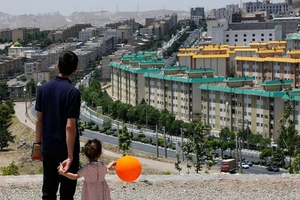
The growing divide between incomes and housing costs has reshaped living arrangements for some Iranians, pushing tenants to cheaper cities or Tehran’s outskirts, back into their parents’ homes, or into shared apartments to split expenses.

Iran weighs attacks on military targets in Europe – FT

Aug 19, 2026, 07:56 GMT+1
100%
A police officer closes the entrance of RAF Akrotiri, a British sovereign base in Cyprus, which was hit by a drone overnight on March 2, 2026.

Iran has considered attacking military targets in Europe if US President Donald Trump escalates the war, the Financial Times reported on Wednesday, citing two insiders.

Iranian forces had assessed possible strikes against US assets in southeastern Europe, including Bulgaria, which approved the use of Bezmer Air Base by US refueling aircraft last month, the sources said.

Cyprus, where a British air base was hit by a drone in March, was also identified as a potential target for retaliation against a renewed US offensive, according to one of the sources.

Iran’s forces had separately examined attacks on subsea fiber-optic cables in the Strait of Hormuz if the conflict intensified, according to the report.

One source said Tehran was preparing to expand the war if Trump acted on threats to attack Iranian infrastructure. The other said Iran would place “no limits” on its response to US military action.

The sources described last month’s strike on a US base in Jordan, which killed three American service members, as Tehran’s most accurate long-range attack to date and evidence of its ability to hit targets farther afield.

“This was also a message to Europe: it can receive missiles, so it should know where it should stand in this war,” the first insider said. “A very big mistake, such as hitting our infrastructure, could make the war go beyond the region and reach Europe.”

Iran has not publicly confirmed the reported plans.

Military analysts told the FT that Iran could target US assets in southern and southeastern Europe with medium-range ballistic missiles, but questioned their accuracy and Tehran’s stockpile of longer-range weapons.

  • Rezaei named Iran’s top security chief and Khamenei representative

    Rezaei named Iran’s top security chief and Khamenei representative

  • All Mojtaba's men: Old guard shapes Iran’s new order

    All Mojtaba's men: Old guard shapes Iran’s new order

Iran’s recent elevation of hardliners to senior security and military posts has also deepened expectations within Tehran of renewed conflict, according to the report.

Referring to Mohammad Bagher Ghalibaf, Tehran’s chief negotiator, and Mohsen Rezaei, Iran’s top security chief, the second insider said Iran “is sending a clear message that if you don’t reach an agreement with Ghalibaf, you have to deal with Rezaei.”

“The message is: ‘Don’t be mad, because I’m madder than you are.’”

Meanwhile, negotiations over reopening the Strait of Hormuz remained stalled and Trump said there were no talks scheduled with Tehran.