US Army seeks 17 bunkers in Israel, Saudi, Lebanon amid Iran threats - report
U.S. Air Force personnel take part in a training exercise at Prince Sultan Air Base in Saudi Arabia on June 24, 2022. (File photo: U.S. Air Force/Staff Sgt. Noah J. Tancer)
The US Army is urgently seeking contractors to build 17 reinforced concrete bunkers in Israel, Saudi Arabia and Lebanon to protect American and coalition troops from missile and drone attacks, Military Times reported Monday.
According to an Army procurement notice posted Friday, the project calls for 10 bunkers in Israel, five in Saudi Arabia and two in Lebanon, replacing existing personnel shelters made from converted shipping containers.
“Due to elevated regional force protection conditions, there is an urgent, high-priority requirement to replace nonstandard personnel protection shelters,” the Army said in the notice.
The military said the objective was to protect US and coalition service members operating in potentially hostile environments across the US Central Command's area of responsibility.
The project follows Iranian missile and drone attacks on US military installations across the Persian Gulf that have killed at least 23 American personnel, according to the report.
Among the incidents was a March 2026 drone strike on an Army command post at Kuwait's Port of Shuaiba that killed six US service members. Subsequent reports alleged that the facility lacked adequate protection against aerial attacks.
The Army said the bunkers would be installed at five primary military sites, including one in Israel and two each in Saudi Arabia and Lebanon. Their exact locations were not disclosed.
Each bunker will consist of three reinforced concrete sections, steel entrance doors and protective concrete barriers, with additional sandbags along the exterior walls and at least 18 inches of overhead cover.
The Army wants construction completed within 45 days of issuing the task order and expects to give contractors just three days to submit price quotations.
“Due to extreme operational urgency (soldiers currently at risk using non-standard containerized shelters), the subsequent solicitation is anticipated to have an expedited 3-day quote turnaround window,” the notice stated.
The Army is seeking construction and engineering firms capable of mobilizing immediately in the three countries, with responses due by November 25.
A CCTV camera is seen in a street in Tehran, Iran, April 9, 2023.
A senior Revolutionary Guards commander acknowledged extensive intelligence infiltration across Iran's military, intelligence and government institutions, saying surveillance technology has made it virtually impossible to remain hidden.
"Enemy infiltration has occurred at high levels. There is infiltration even within the Revolutionary Guards, the Intelligence Ministry, state broadcasting and various government institutions. This infiltration is sometimes direct and sometimes indirect," Mohammad Jafar Asadi, a former deputy inspector of the Khatam al-Anbiya Central Headquarters, told Defa Press outlet.
Asadi said Israel could use its influence in European countries to obtain passports and identity documents for operatives, allowing them to enter Iran disguised as tourists or businesspeople.
His remarks follow two wars lasting 12 and 40 days, during which dozens of senior Islamic Republic officials, including Revolutionary Guards commanders, were killed, raising questions about the extent of intelligence penetration within Iran's security establishment.
Foreign Minister Abbas Araghchi acknowledged in a July 19 interview that US and Israeli knowledge of scheduled meetings at a government complex on February 28, the first day of the 40-day war, pointed to a security breach that may remain unresolved.
Araghchi said the infiltration could extend beyond access to classified information to influence government decision-making and its psychological environment.
The New York Times previously reported that the operation that killed Ali Khamenei and other senior Islamic Republic officials involved close intelligence cooperation between Israel's Mossad and the CIA.
Surveillance systems leave nowhere to hide
Mobile phones, surveillance cameras and digital records have become powerful intelligence-gathering tools, Asadi said, describing how artificial intelligence can process footage from cameras installed along streets and inside shops and homes.
Information collected through electronic prescriptions, fuel purchases and airline bookings can also be used to track individuals, he added.
Mohammad Jafar Asadi, a former deputy inspector of the Khatam al-Anbiya Central Headquarters
"We ourselves are providing services and information, and we can no longer say there is anywhere left to hide," Asadi said, adding that control over some of the systems and their hardware rests with outside parties.
The Islamic Republic has itself used surveillance equipment to monitor citizens and suppress protests.
The Financial Times reported on June 8, citing an informed source, that Iranian authorities installed additional surveillance cameras during the December 2025-January 2026 uprising to monitor protesters.
Israel subsequently used footage from those cameras to identify Basij militia personnel stationed at checkpoints during the latest war, the source said.
Revolutionary Guards member abducted and questioned
Asadi also described the abduction and interrogation of a Revolutionary Guards member inside Iran, saying the kidnappers had been paid to seize the man under the pretext that he owed money.
"One of our Guards members was abducted with a sack over his head and taken to a house as someone who owed money. From inside that house, direct contact was established with Tel Aviv," Asadi said.
The abducted Guards member was later blindfolded and taken to a desert area in Varamin, near Tehran, where his captors threatened to shoot him if he moved within two hours, according to Asadi.
The man began shouting after approximately 10 to 15 minutes and eventually escaped, Asadi said, without identifying the individual or specifying when the abduction occurred.
Previous accounts have described Mossad operatives interrogating individuals linked to the Revolutionary Guards inside Iran.
In April 2022, Israeli media reported the interrogation of Mansour Rasouli in Iran. Iran International subsequently identified Rasouli as a member of a network linked to the Revolutionary Guards tasked with assassinating an Israeli in Turkey, an American general in Germany and a journalist in France.
In July 2022, Iran International reported that Mossad operatives had interrogated Revolutionary Guards official Yadollah Khedmati inside Iran for several hours, obtaining information about weapons transfers to Syria, Iraq, Lebanon and Yemen.
Asadi's account adds to disclosures by senior Iranian officials about the scale of intelligence penetration within the Islamic Republic, including vulnerabilities in the security institutions responsible for protecting its leadership.
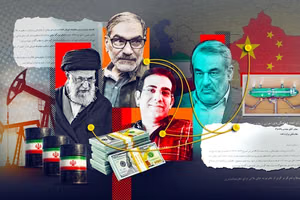
File photo of Mohammad Hossein Shamkhani, son of Iran's slain security chief Ali Shamkhani
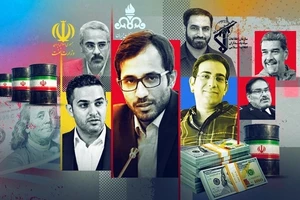
Iran's state-linked shipping company sold a damaged container vessel for less than $6 million to a firm owned by the sons of a senior Iranian official, raising questions over asset sales and shareholder interests, an Iranian news outlet reported Monday.
The Shahraz vessel was sold to Admiral, a company owned by the sons of Ali Shamkhani, a former secretary of Iran's Supreme National Security Council who was killed in Israeli attacks, and returned to commercial service after repairs costing several million dollars, Rouydad24 reported on November 16.
"Each of these cases raises serious questions about decision-making, pricing, the selection of buyers or recipients, the financial recording of transactions and the responsibility of managers," Rouydad24 wrote.
The website called for the publication of transaction documents and financial assessments to establish whether the sales served the interests of shareholders in the publicly listed Islamic Republic of Iran Shipping Lines (IRISL).
Damaged vessel sold below $6 million
The Shahraz container ship ran aground near the Singapore Strait on May 11, 2020, sustaining extensive hull damage.
The vessel was subsequently sold to Admiral for less than $6 million after incurring salvage and maintenance costs, Rouydad24 reported.
The outlet said the ship's recoverable scrap value may have exceeded its sale price, while shareholders received insufficient information about salvage expenses and insurance compensation.
Admiral subsequently spent several million dollars repairing Shahraz before returning it to commercial operations.
Rouydad24 questioned why IRISL had not undertaken the repairs itself and whether the vessel's commercial viability had been assessed before its sale.
It also sought details on whether the transaction involved a public auction or direct negotiations, how the buyer was selected and whether conflicts of interest existed.
Shamkhani shipping network faces US sanctions
Hossein Shamkhani, a son of Ali Shamkhani, has operated internationally under the aliases Hugo Hayek and Hector.
The US Treasury Department announced on July 14 that it was intensifying efforts to disrupt his network over shipping activities that circumvent US sanctions.
The network remains a major participant in Iranian oil exports and has expanded into container shipping and global commodities trading, according to the Treasury Department.
The measures followed earlier US sanctions against Shamkhani and much of his financial and shipping network in July 2025 and April 2026.
Bloomberg reported in August 2024 that the Dubai-based Milavous Group, where Shamkhani is a senior executive, had generated billions of dollars trading commodities from Iran, Russia and other countries.
A confidential document obtained by Iran International on November 9 showed that Shamkhani had long dominated Iranian oil sales in the United Arab Emirates and used a vessel purchased with an Iranian government loan to transport Russian oil.
Iran International has also detailed an oil trading network linked to Revolutionary Guards intelligence, including a confidential letter from Shamkhani to Supreme Leader Ali Khamenei.
Fuel sales raise shareholder questions
IRISL continued supplying fuel to Admiral from its international operations allocation for a period after selling Shahraz, Rouydad24 reported.
The website said supplying fuel to a potential commercial competitor was not necessarily a violation, but questioned the pricing, revenue, authorizations and economic rationale.
"In a publicly listed company, the company's resources and commercial capacities must be used in accordance with its economic interests," Rouydad24 wrote.
The report called for disclosure of the sale proceeds received, Admiral's ultimate beneficial owners and any potential conflicts of interest involving those who approved the transaction.
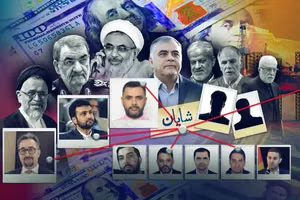
The questions follow Iran International investigations into oil trading networks involving relatives of senior Islamic Republic officials, including the son of former Revolutionary Guards commander Mohsen Rezaei and relatives of two ministers.
Reports of organized corruption involving politically connected figures have drawn public anger as Iranians face mounting economic pressure and difficulties affording basic necessities.
The Shahraz transaction has renewed questions over the management of state-linked commercial assets and whether their sale benefits shareholders or politically connected buyers.
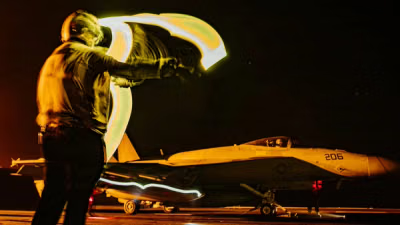
F/A-18 Super Hornet fighter jets prepare for takeoff aboard the USS George Washington aircraft carrier. (CENTCOM/X)
A third US aircraft carrier arrived in the Middle East Sunday, joining forces enforcing a blockade of Iranian ports, while Treasury Secretary Scott Bessent warned of a historic economic collapse in Iran, predicting a 25 percent contraction over the coming year.
The USS Theodore Roosevelt entered the US Central Command's area of operations on Sunday, ABC News reported, citing a US official. It joined the USS George H.W. Bush and USS George Washington, which have been operating in the Arabian Sea.
The naval deployment comes as Washington maintains economic pressure on Tehran. Bessent told Fox News on Sunday that Iran's economy could contract by 25 percent over the coming year.
“So this is one of the fastest collapses in history,” he said.
The remarks echoed a warning Bessent made in an interview with Iran International last month.
“I would predict that from March of '26 until March of '27, the economy would contract more than 25 percent, which is more than the Soviet Union contracted after its collapse,” he told Iran International on October 26.
Reuters reported Saturday that President Donald Trump was considering holding off on further strikes unless Iran or Yemen's Iran-backed Houthis launched new provocations. Saudi Crown Prince Mohammed bin Salman and Turkish President Tayyip Erdogan had urged him not to resume attacks, according to the report.
The risk of renewed fighting remains, however. Bahrain, home to the US Navy's Fifth Fleet, said its air defenses intercepted several Iranian aerial attacks Sunday, while the IRGC claimed to have targeted a US radar installation with six drones. The claimed strike was not independently confirmed.
Two days earlier, the US military said it had intercepted two drones without damage, rejecting a separate Iranian claim that it had struck an American early-warning radar.
Israel has also continued consultations with Washington over Iran. Mossad chief Roman Gofman returned from talks with senior US officials, Israeli outlet Ynet reported, while Axios said Prime Minister Benjamin Netanyahu had sought discussions about renewed strikes.
In Tehran, Parliament Speaker Mohammad Bagher Ghalibaf warned Sunday that another US attack could widen the conflict.
“If the Americans make a mistake this time, the geography of the battle will be determined by the capabilities and will of our armed forces,” he said.
Iranian Foreign Minister Abbas Araghchi is expected to visit Oman on Tuesday for talks with his counterpart, according to state media. Oman has previously mediated between Tehran and Washington.
Former military chief Gadi Eisenkot, Israeli Prime Minister Benjamin Netanyahu, heads of parties and other Israeli officials gather for a family photo on the day of the inauguration of Israel's 26th parliament, at the Knesset in Jerusalem, November 10, 2026.
Opposition to the Islamic Republic will remain a point of consensus in Israel regardless of who forms its next government, according to Israeli-American journalist and Iran analyst Emily Schrader.
"It's not a partisan issue in Israel," she told Iran International's Kambiz Tavana. "No one in the mainstream, from left to right, wants the Islamic Republic to continue."
Prime Minister Benjamin Netanyahu's bloc won 53 of the Knesset's 120 seats in last month's election. Although opposition leader Gadi Eisenkot's Yashar party won fewer seats than Netanyahu's Likud, Eisenkot emerged with broader parliamentary support and was tasked by President Isaac Herzog with forming a government.
Schrader said the outcome reflected domestic grievances rather than Netanyahu's record against Iran and its allies.
"Netanyahu internationally and Netanyahu domestically are very, very different equations," she said, adding that most Israelis respect how he handled the war with Iran and the fight against Hezbollah, including the pager operation.
She pointed instead to anger over the hostage negotiations, Netanyahu's corruption trial and the absence of a state commission of inquiry into the failures of Oct. 7.
Asked whether an Eisenkot government would be softer on Tehran, she said representatives of Yashar had told her they support regime change.
"If there is a unity government that would see Eisenkot and Netanyahu together, most likely we're not going to see a lot of policy changes," she said. "Probably a very similar approach to Iran, which I think will be the case anyway."
The bigger domestic change, she said, could come over the drafting of ultra-Orthodox men into the army, one of the main election issues.
Emily Schrader, an Israeli-American journalist and Iran analyst, speaks in an interview with Iran International's Kambiz Tavana in Washington DC on Nov. 13, 2026
'That's how desperate they are'
Schrader said the world had failed to grasp the desperation of Iranians living under the Islamic Republic.
"The Iranian public is in such a state of crisis, in such a state of desperation, that there were people who wanted their country to be bombed," she said. "Not their country, but the IRGC and the regime. But that's how desperate they are."
She criticized the UN General Assembly's Nov. 11 vote to elect Iran to its Committee for Programme and Coordination, with 144 votes, for a three-year term starting in January.
The vote came, she said, "after they massacred at least 40,000 of their own people in the streets in two days."
"Why is this not being spoken about? On what planet is that a normal thing to do?" she said, adding that the Islamic Republic was now significantly weaker, creating an opening for Iranians even if it survived.
US President Donald Trump told radio host Hugh Hewitt on Nov. 12 that it "would be a defeat" if Iran's rulers were still in power when he leaves office. Schrader said she was "cautiously optimistic" about relief for Iranians.
She said both the Trump administration and Netanyahu's government now felt pressure to deal with Iran following their respective elections, pointing to Trump's remarks to reporters the day after the US midterms, when he was asked whether Republicans had lost because of the Iran war.
Speaking to reporters on Nov. 4, after Democrats won control of both chambers of Congress, Trump said it was "largely true" that the war had hurt Republicans because it "drove the gasoline up a little bit," but added that "if I had to do it again, I'd have to do it again," Newsweek reported.
Accounts posing abroad
Schrader also addressed a recent online dispute with Persian-language accounts that accused her of working against Netanyahu during the Israeli election campaign.
She alleged that some accounts presenting themselves as users in Germany and Britain were actually operating from inside Iran during the internet shutdown.
"There were some things that were true mixed in with things that weren't true, which is a very classic tactic that we've seen from the IRGC," she said.
She acknowledged she had explained the debate over monarchy and democracy poorly, but said the two were "not mutually exclusive."
"When it comes to Iran, it's not up to me. It's up to the Iranian people," she said.
"It really breaks my heart to see how the Iranian people are crying out for help," Schrader said. "There are teenagers willing to die to free their country, for the hope of freeing their country."
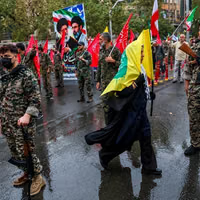
A government-organized Janfada mobilization gathering held in Iran in October 2026.
Iran’s Revolutionary Guards are expanding a campaign built around sacrifice for the homeland into a route for military training and Basij paramilitary recruitment, giving a force associated with decades of domestic repression a broader patriotic appeal.
The Janfada initiative — roughly meaning someone willing to sacrifice their life — presents participation as service to Iran. Its development raises a question: how far can the authorities use national loyalty to attract recruits who might otherwise hesitate to join the Islamic Republic’s security institutions?
On November 2, Hassan Hassanzadeh, commander of the Guards’ Tehran corps, said the first Janfada brigade had been organized, completed supplementary training and received equipment. Speaking at the opening of a training center in Tehran’s Tajrish Square, he said the unit was preparing for practical exercises and specialist shooting-range training.
The announcement marked a further step toward turning a public mobilization campaign into organized military units.
A new route into the Basij
Launched on March 28 by the Guards-linked Baqiyatallah cultural and social headquarters, Janfada initially invited volunteers to participate in defense, security and relief activities during the war with the United States and Israel.
By September, organizers were announcing plans for 1,000 national resistance battalions. Training programs subsequently included firearms handling, urban defense and rescue skills.
Ali Kowsari, the Basij’s deputy for training, has said participants who complete supplementary courses can join the organization’s combat structure. Esmail Faraji, its deputy for operations, has said the campaign attracted volunteers who had not previously belonged to the Basij, although the scale of that recruitment has not been independently established.
The distinction matters because the Basij, a paramilitary organization subordinate to the Revolutionary Guards, combines military mobilization with ideological organization and domestic security. Its network extends through neighborhoods, universities, schools and workplaces, and its members have participated in successive protest crackdowns.
A campaign emphasizing defense of the country could therefore provide a more accessible entry point than direct recruitment under the Basij name. Joining a course presented as preparation to protect Iran may carry different associations from joining an institution identified with policing dissent.
That remains an interpretation of the campaign’s appeal, rather than proof of its organizers’ intentions or success. Available evidence does not establish how many participants are new recruits, how many were already Basij members, or whether the patriotic message has broadened support beyond existing government loyalists.
National defense and domestic control
The campaign’s public presentation has combined national solidarity with explicit loyalty to the leadership.
At the September 18 Janfada parade in Tehran, participants included Basij members, uniformed volunteers and children. The event began with a declaration of allegiance to Khamenei, while President Masoud Pezeshkian described it as a display of national cohesion.
That combination illustrates how the campaign places defense of Iran alongside support for the political system.
Its activities also extend beyond preparation for an external attack. Campaign spokesman Sassan Zare said in September that Janfada provided training related to urban and public security, while responsibility for deploying volunteers at checkpoints rested with the relevant security bodies.
Those overlapping functions make the campaign relevant to domestic control, although they do not establish that every participant will undertake security duties or be deployed against protesters.
A Syrian parallel, with limits
Syria offers a comparison in how governments organize loyalist forces under the language of national defense.
During Bashar al-Assad’s rule, pro-government militias and neighborhood committees were incorporated into the National Defense Forces. Research by the Institute for the Study of War describes Iranian and Hezbollah assistance in formalizing the force along a model resembling the Basij, including training recruits.
The comparison has limits. Syria involved the consolidation of existing militias during a civil war. Janfada is presented as a recruitment and training campaign connected to institutions that remain in place. There is no evidence here that the Basij has been dissolved or formally renamed.
The more defensible argument is that Janfada offers the existing security structure an additional public identity and recruitment channel. Its language emphasizes sacrifice for the country; its training pathways lead toward institutions whose responsibilities also include preserving the Islamic Republic.
Whether that approach can repair the Basij’s reputation remains unproven. What commanders’ announcements demonstrate is a growing effort to turn patriotic participation into organized manpower.