Iranian protestors met with security forces during January uprisings.
As Iran confronts military pressure abroad and mounting economic strain at home, signs are emerging that the Islamic Republic is increasingly turning its attention to another potential threat: renewed unrest on its own streets.
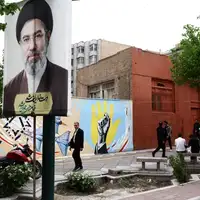
While veteran hardliners are returning to key positions overseeing forces responsible for domestic repression, cobblestones are being ripped out of historic pedestrian areas and replaced with asphalt.
Municipal officials have described the work as traffic management, but Iran International reporter Mehdi Sepahvand’s reporting suggests it could make the areas easier for security forces to penetrate and control during unrest.
Analysts say the developments, against a backdrop of uncertainty over the country’s new leadership, suggest the state is thinking beyond the current war to the possibility of another confrontation at home.
The return of Hossein Taeb, one of the Islamic Republic’s most feared security figures, to command the Basij is perhaps the clearest signal.
Omid Memarian, a senior Iran analyst at the think tank DAWN, said Taeb’s return shows the state is prioritizing control of the population.
Photo of Hossein Taeb
‘An undeclared coup’
“They are very much nervous, concerned about people and their demands,” Memarian told Eye for Iran, adding that the leadership understands “the domestic situation can explode at any moment.”
Taeb, Memarian said, was brought back not to reconcile with Iranians, but to consolidate loyalists and signal that authorities are prepared to “crush any dissent.”
For Kamran Bokhari, a senior resident fellow at the Middle East Policy Council and strategic forecaster, the reshuffle raises a more fundamental question: who is making these decisions?
With Iran’s new Supreme Leader remaining unseen and unheard publicly, Bokhari questioned the extent of his authority and argued that a small group within the security establishment may effectively be running the system.
“The point is who is making these appointments?” he said.
Bokhari went further, describing the emerging arrangement as an “undeclared coup” by the Revolutionary Guards, in which he believes the IRGC is consolidating authority while preserving the appearance of a functioning constitutional system.
Jason Brodsky, policy director at United Against Nuclear Iran, offered a different reading, seeing a diffusion of power in the absence of a visible Supreme Leader capable of imposing decisions across the system.
Survival is not stability
Former CIA Iran specialist Mark Fowler said the Islamic Republic has absorbed severe military damage without collapsing.
“Surviving is winning for the Iranian regime right now,” Fowler told Iran International’s Eye for Iran.
But survival does not mean stability. With Washington seeking to intensify economic pressure, Fowler said there was no single inflation rate or economic threshold at which unrest became inevitable.
“It’s just a question of who cries uncle first,” he said.
Authoritarian governments can tolerate considerable hardship among their populations because their leadership is insulated from much of it, Fowler said.
“They’re more than happy to allow people to suffer,” he added.
Economic hardship does not automatically produce revolt. But the longer it persists, the more consequential the state’s ability to contain discontent becomes.
Beneath people’s feet
Perhaps the most striking sign cited by those who see preparations for future unrest can be found not in the leadership compound, but beneath people’s feet.
In central Tehran, cobblestones are being removed from historic pedestrian areas and replaced with asphalt.
The changes affect parts of central Tehran around District 12 and the Grand Bazaar, historically an important center of political mobilization, as well as areas near universities where students have repeatedly participated in protests.
Cobblestones can be dislodged and used as projectiles. Pedestrian streets also contain bollards, benches, trees and restaurant tables that can impede motorcycles and security vehicles while giving protesters places to congregate or seek cover.
Turning them into vehicle-accessible thoroughfares could change that equation.
“By changing these pedestrian zones into thoroughfares for cars, they are actually paving the way for swift action during protests,” Sepahvand said.
The changes, he added, create “plain sight and direct shooting range” for security forces.
Sepahvand said authorities have also put pressure on restaurants and gathering places where Iranians, including women appearing without mandatory hijab, have carved out small spaces of social freedom.
Those spaces allow communities to form, he said, something authorities understand can eventually translate into collective action.
“The government is sure that they are going to be facing more and more protests,” Sepahvand said.
The Islamic Republic is bringing veterans of repression back into senior positions, positioning the Basij for a greater domestic role and, according to Sepahvand’s reporting, altering public spaces in ways that could make future protests easier to suppress.
The Islamic Republic has survived the war so far. Its next test may come not from across its borders, but from the streets at home.
A headline strap on Iranian state TV on August 14 announces an agreement between the ministries of health and "khavarejeh," Kharijite affairs, instead of "kharejeh," foreign affairs. The difference is one letter.
One extra letter on Iranian state TV turned Abbas Araghchi into the minister of the Kharijites, the sect that abandoned Shia Islam's first imam and killed him, prompting some Iranians to read it as the broadcaster's latest shot at the man negotiating with Washington.
The setting was routine government business: a signing ceremony between two ministries, with footage showing Araghchi alongside Health Minister Mohammad-Reza Zafarghandi. The headline strap announced an agreement between the ministries of health and, in Persian, khavarejeh, Kharijite affairs, instead of kharejeh, foreign affairs. The difference is a single letter vav. A screenshot was circulating within minutes.
Within hours, the strap was a national argument. "Abbas isn't the foreign minister anymore. He's the minister of the Kharijites now," one widely shared post said of the man leading Iran's talks with Washington.
Another user drew the lineage: "Zarif was America's foreign minister. This one turned out to be the Kharijites'." Mohammad Javad Zarif, the architect of the 2015 nuclear deal, spent years being mocked with that title by the broadcaster's favorite guests; to many, the strap was the same insult upgraded, from serving the enemy to heresy.
The reformist daily Etemad asked the question on everyone's screen: "Mistake or mischief?" One viral post refused the innocent reading outright: "With this budget, this many staff, editors, broadcast supervisors and layer after layer of managers, you don't get to say 'it was a typo.'" The post tagged Peyman Jebelli, the broadcaster's hardline chief.
The name Kharijites means "those who went out," and the story behind it is Islam's first civil war, remembered as the First Fitna. In 657 AD, at the Battle of Siffin, followers of Imam Ali, the first imam of Shia Islam, pressed him to accept arbitration with his rival Muawiya rather than fight on. When the arbitration went badly, the same men turned on Ali for accepting it, declared that "judgment belongs to God alone," walked out of his camp and made war on him. Ali crushed them at Nahrawan; three years later, a Kharijite assassin's poisoned blade killed him at prayer.
In the Islamic Republic's political language, no insult reaches deeper. "Kharijite" means the traitor within, the pious-faced insider who deserts the rightful leader, the author of fitna, the sedition that splits the faithful.
The late supreme leader Ali Khamenei's own commemorations dwelt on Nahrawan as the hardest of Ali's wars, fought against old companions whose foreheads were calloused from prayer, and his loyalists spent the years after the 2009 protests hanging the word on the opposition.
One user reached for exactly that memory this week, asking a government supporter: "So does your definition cover 2005 and 2009 as well?"
The alibi written into the alphabet
The typo has a linguistically respectable defense, which is part of what makes the episode so perfectly Iranian. Persian preserves a silent vav in a handful of ancient words, a fossil of pronunciation lost a thousand years ago: "sister" is written khvahar but said khahar. A typist's hand trained on those spellings could, in theory, plant the ghost letter in kharejeh on autopilot.
The defenders made that case. "It's a typo, not sabotage. Stop making a mountain out of a molehill," one wrote. Another blamed simple ignorance, at the establishment's expense: "Pure illiteracy at the mullahs' broadcaster. They figured if 'sister' takes the silent vav, 'foreign' must take one too."
The skeptics' answer was the broadcaster's record, which is where the story stops being about spelling.
A seminar, then a knife fight
What happened next may be the most Iranian part of all: the country fell into a theological flame war over the year 657, conducted in quote-tweets, as a proxy for a live question of war and peace.
One camp insisted the label fits the diplomats. "The Kharijites were the negotiation camp. That's the historical record," one post read. Another cast Araghchi in an even older role: "He's standing right where Amr ibn al-As stood, and his caliph is Muawiya," a reference to the silver-tongued arbitrator who outfoxed Ali's side at the table.
The rival camp threw the word back across the aisle. "The Kharijites were the ones pushing the imam into talks with the devil, and when it all went wrong, they blamed the imam," one wrote, a reading with a sharp contemporary edge, since hardline media have spent recent weeks portraying Supreme Leader Mojtaba Khamenei as having opposed the negotiating process that produced the Islamabad agreement.
Another user completed the thought: "The Kharijites were inside Ali's own government. They kept pressuring him to negotiate, and when the whole thing blew up, they said: we had nothing to do with it."
Others turned the word on the broadcaster's own patrons: "If anyone here fits the Kharijites, it's Jalili and his gang. Extremism is all they've got." A government supporter fired back: "If only you people read some history. The Kharijites were the ones with no seat at the table, endlessly kicking at the government of the day to get one. Exactly like you."
And beneath the seminar, a threat. One account declared "the Kharijites' coup is near," amplifying a post that urged toppling President Masoud Pezeshkian's government before, it said, the government topples the system.
The broadcaster with a record
The reason so few Iranians extend the benefit of the doubt is that the strap did not appear on a neutral screen.
The Islamic Republic of Iran Broadcasting is run by Jebelli and his cultural deputy Vahid Jalili, the brother of Saeed Jalili, the hardline politician who styles his circle a shadow government, and it has spent months in open warfare with the state's own diplomats.
In recent weeks alone, the broadcaster censored Pezeshkian's disclosure that the late supreme leader had privately ordered officials to negotiate with Washington while publicly ruling talks out; cut short a live interview with parliament speaker and chief negotiator Mohammad Bagher Ghalibaf; ignored a formal order from its own supervisory board to stop censoring senior officials; and answered a complaint from Araghchi with a sneer that it could not give him "24/7 coverage."
The timing gives the letter a forward edge. Jebelli's five-year term expires within weeks, and whether the new supreme leader reappoints the current management has become an early test of the postwar balance between the war camp and the talks camp.
A one-letter insult to the chief diplomat, aired on Jebelli's channels while his renewal hangs in the balance, is either spectacular carelessness or a message about who does not fear the outcome.
One establishment, two masks
A caution belongs here, and some Iranians supplied it themselves. The fight between the broadcaster and the diplomats is real enough to produce casualties, but the moderate-versus-hardliner frame is also the Islamic Republic's most exportable fiction; every actor in this drama supports the system, and the menace of one camp has always been useful to the bargaining of the other.
As one user put it: "It's an open division of labor. America and Israel attack from the outside, the Ahmadinejad crowd and the shadow government undermine from the inside."
A typo that cannot be proven deliberate is the perfect weapon for a factional war that cannot be proven real.
In Persian, the silent vav is written but never pronounced. On Iranian state television, it was the only letter that spoke.
From left: Tara Farhangian, Yaser Azadeh and Homa Teymouri, and Mahmoud Ghanbari-Rad.
Iranian courts have handed down a new wave of prison terms and other punishments against protesters, activists and citizens accused of national security offenses, as the judicial crackdown that followed January’s nationwide protests continues months later.
At least six people were sentenced in five cases reported by the Human Rights Activists News Agency (HRANA) on Wednesday and Thursday, with punishments ranging from eight months to 10 years in prison. One 21-year-old student was also sentenced to flogging and exile.
Rights groups have documented thousands of arrests since January and raised repeated concerns over denial of access to lawyers, torture and coerced confessions.
Iran Human Rights said in July that more than 70 January protesters were facing execution in Isfahan Central Prison alone, while HRANA reported in June that authorities in Zahedan had issued verdicts against 111 people detained during the protests.
Couple sentenced together
Homa Teymouri and her husband, Yaser Azadeh, who were arrested at their home during the January protests, have each been sentenced to five years in prison, HRANA reported, citing United Students.
Branch 15 of the Tehran Revolutionary Court convicted Teymouri of “assembly and collusion against national security” and also imposed a two-year travel ban, a two-year prohibition on social media activity and confiscation of her phone. HRANA said Azadeh also received five years but did not specify the charges or court branch.
Teymouri holds a master’s degree in political thought from Tarbiat Modares University and Azadeh a master’s in Western philosophy from Shahid Beheshti University.
Student given prison, lashes and exile
Tara Farhangian, a 21-year-old physical education student arrested during the January protests, was sentenced in Qorveh to one year in prison, 31 lashes and two years of exile in Zabol, according to HRANA, citing Kolbar News.
A criminal court convicted her of “disrupting public peace and order” and “resisting officers,” while the Revolutionary Court separately fined her 120 million tomans for “propaganda against the regime” and “assembly and collusion to commit a crime against national security.”
Farhangian, who studies at Hamedan University, had previously been released on bail.
Ten years over ‘message to foreign media’
Leila Moallemi, a Mashhad resident held in Vakilabad Prison, has been sentenced to 10 years over information she allegedly provided to a media outlet outside Iran during the war, HRANA reported.
A source close to her family said the case concerned a voice message and information she sent to the outlet. HRANA said the precise charges and judicial branch remained unclear. Moallemi was arrested on May 28.
Her case comes amid heightened pressure on people accused of providing information to foreign media or governments during the conflict. HRANA documented 40 political and security-related executions between March 18 and June 3.
Two years for Tehran IT specialist
Mahmoud Ghanbari-Rad, a 40-year-old network security specialist held in Greater Tehran Prison, was sentenced to two years for “assembly and collusion against national security,” HRANA reported.
Ghanbari-Rad was arrested at his Tehran home in May and initially held in Evin Prison. HRANA said he was denied access to a lawyer during part of his detention.
In a call from prison, he rejected the case against him and said he had been pressured to accept the charges.
Sentenced over prison writings
Civil rights activist Mehdi Mahmoudian was sentenced in absentia to eight months for “propaganda against the regime,” based on writings he produced in prison that were subsequently published.
Mahmoudian, who has previously served time on the same charge, was arrested again on January 31 after signing a statement and released on bail the following month.
He faces a separate hearing before another branch of the Tehran Revolutionary Court on September 27.
Crowds gather in front of Fardis Cinema during protests in Alborz province on Jan uary 9, 2026. A fire burns nearby as smoke rises over the area.
Security forces used cultural venues and medical clinics as firing positions, ammunition stores and sites for holding bodies during Iran's January 2026 protest crackdown in Alborz province, according to material reviewed by Iran International.
The accounts and materials focus on January 8 and 9, when anti-government protests were taking place across Iran and large crowds took to the streets in several cities in Alborz, a province bordering the capital. Security forces responded with live fire in several areas, according to witnesses.
Verified footage, eyewitness testimony and information gathered from several cities across the province describe security operations inside medical facilities, bodies left in streets and the removal of corpses in municipal garbage trucks.
Iran International could not independently corroborate every account or casualty figure because of communications restrictions and the lack of unrestricted access. The details in this report are therefore based on testimony and information from local sources.
Cultural sites turned into firing posts
In Fardis, a city west of the capital, a public library was converted into an ammunition store and staging point, while schools and mosques were used as gathering places for armed personnel, residents said.
Security forces were deployed at a traffic police building adjacent to the city's main cinema, using tear gas, stun grenades and live ammunition against protesters, according to testimonies.
On the evening of January 9, shooters took positions on the cinema roof and surrounding buildings and opened fire on crowds below, multiple sources said.
Forces began firing in bursts around 10 p.m. without appearing to select individual targets, one resident said, describing elderly men in the streets who had been struck by live ammunition or pellets.
Bodies were kept inside the cinema for two days before being removed, several others said. Security personnel also forced residents to delete footage they had recorded.
Gunfire from government buildings
Similar patterns emerged elsewhere in Alborz, where security forces fired from or near government and police buildings.
In Hashtgerd, a city about 70 kilometers west of the capital, forces used Kalashnikov and G3 rifles as well as DShK heavy machine guns. Some of the shooting came from an area containing the local governor's office and police headquarters, local sources said.
Twelve-year-old Sana Tosangi was killed by direct gunfire on January 9 after two bullets struck her in the back and head near government buildings, people familiar with her death said. Shooters were also positioned on the governor's office and a nearby shopping center.
In Meshkin Dasht, special police units used loudspeakers to tell residents that conditions were calm before opening fire after people emerged from their homes.
In Eshtehard, gunfire was reported near a police station and governor's office. A truck carrying bodies was later taken to a largely abandoned cemetery as the number of dead increased, local sources said.
In another part of Alborz, cranes were used to destroy access points to alleys, making it harder to move between the main road, residential streets and medical facilities.
Clinics raided, bodies found bound
Medical facilities in Fardis also came under security control.
The morgue at one clinic quickly reached capacity, while security forces entered another medical facility and detained staff members and wounded protesters. Witnesses said security forces shot some wounded protesters inside the clinic.
Security personnel also took jewelry and personal belongings from wounded or dead women, several people who described events at the facilities said.
“The basement of the clinic was full of bodies,” one resident told Iran International.
Another clinic refused to admit some wounded people, information gathered by Iran International showed.
Iran International's verification team used visual and audio analysis and matched architectural features across submitted footage to identify the dental section of another clinic as the location where some of the images were recorded.
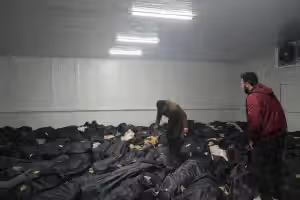
The footage shows bodies inside the medical facility, including several people whose hands and feet were bound. Three people identified by sources as members of the same family were among the dead visible in the footage.
Bodies removed in garbage trucks
Bodies were also left in streets after the shooting, according to testimony from the area.
Plainclothes personnel traveling in vehicles without license plates left bodies in pairs at alley entrances and forced passing drivers at gunpoint to transport corpses, several residents said.
One said that when people contacted the municipality about bodies in the streets, an employee responded by comparing the corpses to garbage.
The testimony and verified footage reviewed by Iran International describe the use of civilian and government infrastructure across Alborz during the January crackdown, from cultural venues and administrative buildings to medical facilities, while restrictions on independent access continue to hinder a full accounting of the deaths.
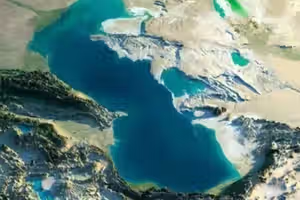
The Caspian Sea is falling by as much as 20 centimeters a year and stands at its lowest level in two centuries, an Iranian environment official said, a warning that lands just as Tehran reopens the argument over how to divide a sea that is shrinking on all five of its owners.
Mohammad Reza Kan’ani, head of the Environmental Protection Department in the northern province of Mazandaran, said Thursday that the Caspian’s water level was declining by around 10 to 20 centimeters annually, attributing much of the decline to rising temperatures, climate change and increased evaporation.
The Caspian’s water temperature had risen by about 1.5 degrees over the past two decades while evaporation had increased by an estimated 10% to 15%, he added.
Kan’ani warned that continued retreat of the shoreline could have serious consequences for coastal infrastructure, local economies and ecosystems dependent on the Caspian, including wetlands.
About 25% of the Caspian’s water comes from precipitation and 75% from rivers, Kanani said, with the Volga – which flows through Russia into the northern Caspian – accounting for the overwhelming majority of river inflow.
Shina Ansari, head of Iran’s Department of Environment, gave an even broader measure of the retreat this week, saying the Caspian’s level had fallen by around two to 2.5 meters over the past decade.
She described the decline as one of the region’s most serious environmental challenges and said reduced river inflows, alongside climate change, were contributing to the crisis.
Without cooperation among the five Caspian littoral states – Iran, Russia, Azerbaijan, Kazakhstan and Turkmenistan – the consequences could extend to ports, coastal communities and the wider ecosystem, Ansari warned.
The environmental warnings come as the Caspian has returned to the center of political debate in Iran over the government’s effort to ratify the 2018 Convention on the Legal Status of the Caspian Sea.
Hossein-Ali Haji-Deligani, deputy chairman of parliament’s Article 90 Committee, criticized what he called the government’s rush to approve the convention, saying this week that it could effectively reduce Iran’s share from 20% to between 3.5% and 5%.
The 2018 convention does not assign Iran – or any of the five littoral states – a fixed percentage of the Caspian or its seabed. Instead, it establishes territorial waters and fishing zones while leaving seabed boundaries to be negotiated between neighboring states.
Iran’s southern seabed boundaries with Azerbaijan and Turkmenistan therefore remain unresolved.
The frequently cited figure of 20% was a post-Soviet Iranian negotiating position based on dividing the Caspian equally among its five littoral states, rather than a previously established treaty entitlement.
Nor did the earlier Iran-Soviet treaties formally grant Iran 50% of the Caspian. Agreements concluded in 1921 and 1940 established a bilateral Iran-Soviet legal regime, including equal navigation rights and exclusive arrangements between the two countries, but did not divide the sea or its seabed into equal territorial halves.
After the Soviet Union collapsed in 1991, four former Soviet republics emerged as independent Caspian states. Russia subsequently reached agreements with several of them to divide northern seabed resources along modified median lines, while Iran resisted that approach and pushed for an equal 20% division if the seabed was to be partitioned.
Iran ultimately signed the five-state legal-status convention in 2018, but the agreement deliberately left the final division of seabed sectors unresolved. Tehran also stressed at the time that the method for drawing baselines – an important issue because Iran’s concave southern coastline can disadvantage it in maritime delimitation – remained to be negotiated.
The current ratification debate therefore does not amount to a parliamentary vote assigning Iran a specific percentage of the Caspian. The more consequential question is whether Tehran should fully commit to the five-state framework before its own seabed boundaries and the baseline methodology have been settled.
Pollution adds to pressure on a shrinking sea
The falling water level is only one of several environmental threats facing the Caspian.
Iranian environmental officials have also warned of mounting pollution, shrinking fish stocks and destruction of coastal habitats.
Touraj Sadeghi, head of marine ecosystem protection at the Gilan provincial environmental department, told ISNA that untreated municipal and industrial sewage, waste dumping, petroleum leaks, excessive agricultural fertilizers and pesticides, and illegal fishing were among the main sources of environmental degradation.
Many cities along Iran’s Caspian coast still lack adequate municipal wastewater treatment systems, he said, while rivers carry thousands of tons of domestic, industrial and oil-related pollution into the sea each year.
Such pollution reduces water quality, damages natural habitats and contributes to deaths among fish and bird populations, Sadeghi said.
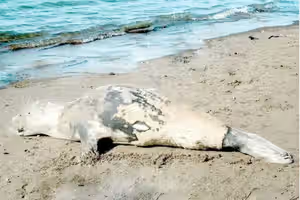
The Caspian supports distinctive wildlife including sturgeon, Caspian seals and migratory birds, but Iranian officials warn that the combination of pollution, habitat degradation and a rapidly retreating shoreline is increasingly threatening the resilience of the ecosystem.
Iranian authorities have sealed at least 42 cafés, restaurants, shops, sports clubs and other businesses across the country in the past three weeks, over compulsory hijab rules and what officials describe as violations of Islamic norms.
The figure is based on individual closure cases reported separately by state media and rights groups.
The closures were reported in at least 17 cities, including Tehran, Mashhad, Yazd, Kerman, Ardabil and Birjand, and affected cafés and restaurants, women's gyms, shops and a cultural center.
In just three weeks, the number of closures has already reached about 22% of the 191 cases HRANA documented over the entire previous Iranian calendar year.
Cafés, shops and gyms targeted
Among the latest cases, an optician in Qaen was sealed on Wednesday after authorities said customers and employees had failed to comply with compulsory hijab rules.
The Yin Yang café in Khomein was sealed over what authorities described as "improper hijab" and Instagram content, while a women's clothing store called Shabnam Maison in Kerman was also shut.
A café-restaurant in Tehran's Velenjak district was sealed a day earlier. Authorities in Ardabil also closed three coffee shops and arrested 16 people in connection with the businesses.
Hossein Salari, Ardabil's deputy prosecutor, said inspections of cafés would increase and authorities would act against shops selling clothing that he described as contrary to Islamic law or harmful to "public chastity."
Three cafés in Mashhad, Bojnourd and Birjand were sealed on August 10. Authorities also shut the Zhovan café in Minudasht on August 9 and the Arghavan café-bookstore in Mashhad on August 5.
The enforcement has extended beyond cafés. Two sports clubs in Borujerd were sealed by judicial order on August 4, while authorities shut a Shahr-e Ketab bookstore in Babol the same day.
Four women's sports clubs were also sealed in Yazd, while authorities in Abadeh shut five businesses and arrested a café operator.
In Dezful, the local prosecutor announced the closure of 15 cafés and hookah lounges on July 23.
Enforcement rises sharply in Mashhad
Authorities have used terms including failure to observe compulsory hijab, "violations of norms," failure to observe "Islamic standards," and promotion of indecency to explain the closures.
Some businesses have also faced other accusations. Authorities in Ardabil cited alleged gambling and promotion of corruption among the reasons for closing three cafés.
One café in Mashhad was cited for issues including failing to list matcha on its price list and selling cakes and desserts without required health certification. Police described the alleged violations at four women's gyms in Yazd only as "disciplinary offenses."
Official figures from Mashhad point to a sharp rise in closures.
Mohsen Sayadi, the city's head of trade inspection and supervision, said authorities sealed 104 businesses during the first four months of the current Iranian year, which began on March 21, compared with five during the same period a year earlier - an increase of about twentyfold.
Friends gathered at a cafe in Tehran to watch a match together.
Pressure extends to social media
The enforcement has also extended online.
HRANA said that between July 11 and August 1, authorities sealed at least 23 businesses, blocked or seized at least 72 social media pages and accounts, and required the operators of 21 pages to publish statements pledging compliance.
Those affected included bloggers, content creators, athletes, artists, fashion and beauty workers, online businesses, travel agencies and cafés.
HRANA also reported that authorities had identified and removed 56 Instagram pages in Qazvin and deleted 3,258 pieces of content from social media pages belonging to 32 businesses in Rasht.
Businesses face wider pressure
The closures come as businesses are also struggling with falling purchasing power and broader economic pressure.
Iranian authorities have previously sealed businesses that joined strikes, supported anti-government protests or did not enforce compulsory hijab, including during the 2022 Woman, Life, Freedom protests and demonstrations earlier this year.
Many Iranian women have increasingly appeared in public without the mandatory headscarf since 2022, while authorities have continued to use business closures and action against social media accounts to enforce compulsory hijab rules.