Iran-linked ships go dark over Persian Gulf internet cables after threats - FT
Vessels at the Strait of Hormuz, as seen from Musandam, Oman, October 12, 2026.
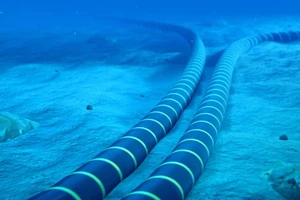
Ships linked to Iran looped, loitered and went dark over undersea internet cables in the Gulf of Oman in the weeks after Tehran threatened the region’s digital infrastructure, the Financial Times reported on Friday. One of them had been boarded by US Marines in May.
At least four vessels tracked by the maritime analytics firm Windward took unusual routes and lingered over cable corridors off Oman in October, the FT said. Three were tankers under US sanctions. The fourth was a small Iranian fishing boat with no known owner.
The ships sailed normally “until they reached a specific cable corridor, and only then slowed, looped, turned back, loitered or went dark,” Windward told the newspaper. That behavior “fits the profile of mapping the cable routes, or placing charges or mines on them while dark,” it said.
86 hours in the dark
The most striking case is Celestial Sea, an Iran-flagged products tanker sanctioned by the United States last year and boarded by US Marines in the Gulf of Oman in May on suspicion of trying to run the American blockade.
On October 14 it drifted in a loop for more than four hours beside the 2Africa cable, which will connect Persian Gulf states to Europe and the east coast of Africa, according to Windward’s October 29 report, on which the FT’s story is based. The next day it switched off its transponder inside the 2Africa and Bay of Bengal Gateway corridors off Sohar. It stayed dark for 86 hours and reappeared nine nautical miles away, made a U-turn over the second cable and anchored. It was empty the whole time.
A second sanctioned tanker, a gas carrier loaded with about half a million barrels of Iranian LPG, left the same anchorage for Malaysia on October 23. Ten hours out, it slowed over 2Africa, turned 180 degrees back toward Oman and went dark. Five days later it had not reappeared. A loaded ship with a buyer waiting has no cargo reason to do that, Windward said.
The third, a crude tanker operated by Iran’s state tanker company, loitered at under one knot for about ten days in Iranian waters between Jask and Chabahar, within a few miles of four cable routes, switching off its tracking repeatedly, once for 33 hours.
The fishing boat
The fourth vessel is the odd one. A 34-meter Iranian fishing-support boat whose beneficial owner has been unknown since last year drifted at under half a knot along the Europe India Gateway and Transworld cables between October 21 and 26, in waters it had never entered in two years of tracking. Then it sailed north into Iranian waters and went dark.
Fishing in Iranian waters requires a state license, Windward noted, and the Revolutionary Guards’ navy has organized fishermen and their boats into a naval Basij that its commander has called a shadow navy. Iran has used civilian hulls as intelligence platforms before: the cargo ships Saviz and Behshad fed targeting data to the Houthis off Yemen, and on October 6 US forces destroyed an Iranian-linked dhow in the Gulf of Oman that CENTCOM said was watching American warships.
The threats that came first
The ships’ movements tracked a run of Iranian warnings. On October 12 Mohsen Rezaei, secretary of the Supreme National Security Council, said “data centers and artificial intelligence facilities will be destroyed” if the war resumes. On October 19 the Guards’ spokesman, Hossein Mohebbi, said seven cables ran under the Strait of Hormuz and that “new targets and new weapons shall be unveiled.” On October 21 the Guards’ political deputy, Yadollah Javani, said the cables would be hit in retaliation for attacks on Iranian infrastructure.
Two days later, two senior Iranian security officials told Iran International that Tehran had detailed plans to target the cables if the United States and Israel attacked again, and would try to prevent repairs to prolong any outage. That was the day the gas carrier turned around.
Who would feel it
Iraq, Kuwait, Bahrain and Qatar depend entirely on cables under the strait for their international connectivity, the FT reported, citing TeleGeography. The cables’ owners include Meta, Vodafone, Orange, AT&T, Verizon, BT and China Mobile.
Masha Kotkin of the Center for Strategic and International Studies told the FT that damage would slow financial transactions and disrupt cloud computing in Persian Gulf states that are betting on digital business to diversify from oil. Threats alone had already halted construction on several cable projects, she said.
Iran International reported last month that the strait carries less than one percent of the world’s international bandwidth and that the main Europe-Asia routes run through the Red Sea, so an attack would hurt Iran’s neighbors far more than the global internet.
The experts the FT consulted held back from conclusions. Sidharth Kaushal of the Royal United Services Institute said the maneuvers could be coincidence but that “Iran might be trying to demonstrate its capacity to damage undersea infrastructure if there is a war.” Jon Pentreath, a retired Royal Navy rear admiral, said almost any vessel could be fitted to lay mines. Celestial Sea’s owner did not respond to the FT.
Three of the four ships were still dark when Windward published. Where they reappear, it said, will show whether the cables were the destination or a stop on the way.
FILE PHOTO: Turkey's Foreign Minister Hakan Fidan, Pakistan's Deputy Prime Minister and Foreign Minister Mohammad Ishaq Dar and Saudi Arabia's Foreign Minister Prince Faisal bin Farhan Al Saud leave after a committee meeting of Mecca defence pact in Riyadh, Saudi Arabia, October 5, 2026. Turkish Foreign Ministry/Handout via REUTERS/File Photo
Turkey's approval of a defense pact with Saudi Arabia and Pakistan has paved the way for military support to Riyadh amid attacks by Iran-backed Houthis, though deploying Turkish troops would still require separate parliamentary approval.
Turkey's parliament approved the Mecca Joint Defense Agreement on Thursday by 279 votes to 119, completing a major legislative step toward Ankara's participation in a security arrangement that treats an attack on one member as an attack on all three.
The agreement, signed in August, provides for intelligence sharing, military coordination, joint deterrence and defense industry cooperation. It does not automatically authorize Turkish troop deployments, which would require separate parliamentary approval.
The pact builds on an earlier Saudi-Pakistani defense agreement and reflects Riyadh's efforts to diversify its security partnerships amid the wider conflict involving Iran, the United States and Israel.
Although the pact predates the latest attacks on Saudi Arabia by Iran-backed Houthis, those attacks have given its collective-defense commitments more immediate significance.
Houthi attacks put defense commitments to the test
The three countries agreed during consultations in Riyadh in September to implement collective-defense measures, including arrangements for the rapid deployment of agreed military forces and capabilities to Saudi Arabia.
The decision came as fighting intensified in Yemen, with Houthi forces launching missile and drone attacks against Saudi targets and Riyadh resuming military operations against the group.
The Houthis have described some of their attacks as retaliation for Saudi airstrikes in Yemen. Reuters reported in September, citing Iranian and regional sources, that Iran's Revolutionary Guards had helped direct a Houthi offensive along Yemen's Red Sea coast and that Tehran had encouraged further attacks on Saudi Arabia.
Yemen's internationally recognized government made further allegations this week, accusing Iranian and Hezbollah personnel of directly helping manage Houthi military operations.
Interior Minister Ibrahim Ali Haidan said Tuesday that 14 members of Iran's Revolutionary Guards and seven Lebanese Hezbollah experts were involved in planning operations, developing missile and drone capabilities, and coordinating attacks on international shipping.
Haidan said decisions were made in Tehran and announced in Sanaa, accusing Iran of moving beyond financing, arming and training the Houthis to directly supervising their military activities.
Iran's Foreign Ministry denied Thursday that Iranian military experts were operating in Yemen. Hezbollah rejected the allegations Wednesday, saying it had no personnel working with the Houthis and describing the accusations as baseless.
The allegations and denials come as Saudi Arabia weighs how to respond to Houthi attacks and what military assistance it could receive from its new defense partners.
Turkish officials have indicated that Ankara's contribution would initially focus on equipment, intelligence and weapons systems, Reuters reported. Defense Minister Yasar Guler has said Turkey does not envisage its troops engaging in combat or offensive operations against the Houthis.
Opposition lawmakers warned during Thursday's parliamentary debate that the agreement could draw Turkey into regional wars. Government representatives said any troop deployment would require separate parliamentary approval, according to the Associated Press.
Defense partners keep diplomatic channels with Tehran open
Despite their expanding military cooperation, Saudi Arabia, Turkey and Pakistan have also pursued direct talks with Iran in an effort to prevent another regional escalation.
Saudi Defense Minister Khalid bin Salman, Pakistani army chief Asim Munir and Turkish intelligence chief Ibrahim Kalin met Iranian officials in Tehran on October 26 to discuss ways to prevent renewed regional fighting.
Saudi Arabia said the visit was intended to open negotiating channels and prevent renewed military escalation.
The discussions took place as Washington and Tehran remained divided over terms for ending their confrontation, including sanctions, the US naval blockade of Iranian ports and the future of shipping through the Strait of Hormuz.
Turkish and Pakistani officials have maintained that the Mecca agreement is defensive and is not directed against Iran or any other country.
For Ankara, the immediate question remains how much practical military support it will provide Saudi Arabia. The defense agreement establishes a collective commitment, but the scope of any Turkish deployment and its role in the confrontation with the Houthis have yet to be determined.
U.S. President Donald Trump and U.S. Secretary of Defense Pete Hegseth salute as members of the military carry the transfer case of U.S. Army, at Dover Air Force Base in Dover, Delaware, U.S., July 22, 2026.
Iranian hardliners are calling for continued pressure on Washington following the US midterm elections, arguing that the war has exacted a political price on Republicans but that Democratic gains offer little prospect of a change in US policy toward Tehran.
The argument featured prominently on Iranian state television on Thursday, where commentators urged Iran to maintain its leverage through the Strait of Hormuz, warning that easing pressure could allow the United States to continue its naval blockade even after the war formally ends.
Supreme Leader Mojtaba Khamenei dismissed hopes that changes in the balance of power in Washington could lead to a softer American approach.
In a message published Wednesday to mark Iran's National Day of Fighting Global Arrogance, Khamenei described as "seriously mistaken" those who retain "even the slightest hope for a change in behavior or shifts in political parties and factions" in the United States.
He warned that even a limited inclination toward surrender would weaken the government's domestic support and encourage further American demands.
Keeping up the pressure
Vahid Khazab, a regular panellist on the state television programme Be Vaght-e Iran (Iran Time), said Democrats were unlikely to oppose the US naval blockade of Iran on principle.
"I have not heard anyone come forward and say that a naval blockade is wrong," he said. "They would not oppose a blockade unless it became costly too."
Khazab argued that Iran should keep the Strait of Hormuz completely closed to make the US naval blockade as costly for Washington as the war itself, warning that the blockade's continuation could effectively prolong the conflict even after hostilities formally end.
The remarks reflected an argument among hardline commentators that Tehran should preserve its economic and strategic leverage rather than interpret the Democratic victories as an opening for compromise.
Claiming a political victory
Senior Iranian officials and pro-establishment media have portrayed the Democrats' gains as a consequence of the political and economic costs of the war.
Mohsen Rezaei, secretary of Iran's Supreme National Security Council, wrote on X that Iran had inflicted a strategic defeat on Trump on the battlefield and in the Strait of Hormuz, as well as a political defeat in Washington.
The hardline newspaper Javan, affiliated with the Islamic Revolutionary Guard Corps, declared that "Iran won the election in America," describing the Democratic victory as a political aftershock of Trump's conduct of the war.
Khazab pointed to rising gasoline, diesel and fertiliser prices, arguing that the war had contributed to Republican losses in agricultural states such as Iowa and Kansas.
"What caused the high prices of gasoline, diesel, and chemical fertilizers?" he asked. "Was it Trump's personality? Was it Trump's corruption and that of his sons? Was it Elon Musk? No, it was the war."
The programme's presenter said the significance of the elections lay not in a Democratic victory but in "the defeat of the Republicans because of the policies they adopted" toward Iran.
No expectations of Democrats
The commentators also warned against repeating what they regarded as misplaced optimism following Joe Biden's victory over Trump in 2020.
Nima Akbarkhani, another regular panellist, criticised reformists who had expected Biden to restore the 2015 nuclear agreement after Trump withdrew from it in 2018. Although Biden returned the United States to several international agreements abandoned by Trump, his administration did not rejoin the nuclear deal.
"Why didn't he return to the JCPOA?" Akbarkhani asked, referring to the agreement by its formal abbreviation. "Because they were telling themselves that this was once again the time to enter new negotiations and secure further concessions."
Mohammad Saleh Jowkar, a member of parliament, echoed Khamenei's warning in comments to the Mehr News Agency.
"It is absolutely unacceptable for some to assume that the arrival of the Democrats, a change in the composition of the US Senate or House of Representatives, or political developments in that country have created conditions for negotiations and concessions," he said.
Khazab added that the US elections were worth examining, if only because "understanding the enemy's camp is essential," he said.
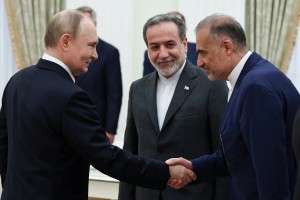
Russian President Vladimir Putin meets Iranian security council chief Mohsen Rezaei in Moscow, Russia, November 5, 2026. Sputnik/Alexei Babushkin/Pool via REUTERS
Iran stepped up diplomatic efforts on Thursday, submitting a new nuclear proposal to Washington, seeking Russian support and reaching out to regional powers a day after President Donald Trump's party suffered a sweeping defeat in the US midterm elections.
Tehran sent Washington a nuclear proposal through Qatar, Reuters reported, citing a senior Iranian official who said any discussion of its contents would depend on the United States first meeting Iran's seven demands.
The official said Washington was reviewing the proposal.
Trump has acknowledged that the war contributed to Republican losses in Tuesday's elections, while Democratic leaders have vowed to use their new congressional majorities to push for an end to military operations against Iran.
For Tehran, the election results have raised the prospect of negotiating with a politically weakened president, although Iranian officials continue to insist on concrete concessions before relaxing their grip on the Strait of Hormuz.
Putin offers support for ending war
Iran's Supreme National Security Council Secretary Mohsen Rezaei travelled to Moscow, where he delivered a message from Supreme Leader Mojtaba Khamenei to Russian President Vladimir Putin.
Rezaei told Iranian state television that Khamenei had wanted the message conveyed to Putin as soon as possible. He did not disclose its contents.
According to Rezaei, Putin condemned US and Israeli attacks on Iran, including strikes on its nuclear facilities, and offered Russian assistance in ending the war.
"He believed this was an unjust war and that it should end as soon as possible," Rezaei said. "He said, 'We are ready to cooperate in any way we can to help end the war.'"
Rezaei said Putin welcomed recent consultations among four regional countries in Tehran and supported a security framework that would exclude outside powers.
"Like our Chinese friends, we believe there should be regional arrangements and that foreign countries should not interfere in the region's security," Rezaei quoted Putin as saying.
Rezaei's involvement may also indicate a willingness among influential figures in Iran's security establishment to explore a negotiated settlement.
The New York Times reported, citing two Iranian officials and an American official, that Rezaei had privately expressed openness to discussing Iran's nuclear programme.
According to the report, he has been involved in negotiations with Qatari mediators alongside Foreign Minister Abbas Araghchi and Parliament Speaker Mohammad Bagher Ghalibaf.
Regional diplomatic outreach
Araghchi also held separate telephone conversations Thursday with his counterparts from nine countries, including Saudi Arabia, Qatar, Turkey, Oman and the United Arab Emirates, according to Iranian state media.
The calls, which also included Pakistan, Jordan, Kuwait and Cyprus, focused on regional developments and efforts to end the war.
The breadth of the diplomatic activity suggests that discussions extend beyond Iran's foreign ministry to senior figures in its security and political establishment, although Tehran's willingness to compromise remains unclear.
The central obstacle is the sequence of concessions. Iran wants Washington to meet its demands before substantive nuclear discussions can proceed, while the United States has yet to indicate whether it will accept those conditions.
A man walks past a display of Iran's Kheibar Shekan ballistic missile in Tehran.
Russia agreed to supply Iran with 90 helicopter-mounted launchers for precision-guided missiles widely used by Russian forces in Ukraine, the Financial Times reported on Thursday, revealing another dimension of Moscow's military cooperation with Tehran.
The previously unreported order adds to evidence of Russian assistance to Iran's military, including a secret program to help Tehran develop supersonic cruise missiles that could potentially threaten US Navy vessels in the Persian Gulf.
A Russian defense industry production schedule covering 2024 and 2025, obtained by the FT, identified an export order for 90 APU-L launchers from a buyer designated "K-10," a code used by Russia's state arms exporter to refer to Iran.
The documents did not establish whether the launchers were ultimately delivered.
Precision-guided weapons used in Ukraine
The launchers are designed to carry Russia's light multipurpose guided missile, known as LMUR or Izdeliye 305, a precision weapon capable of striking moving targets.
The missile entered Russian military service in 2022 and has since been widely used in Ukraine. An operator can guide it during flight, allowing adjustments to its target.
According to the US Army's Worldwide Equipment Guide, APU-L launchers are designed for Russia's Mi-28 attack helicopters and can carry two missiles each.
Iran has already acquired Russian Mi-28 helicopters. In November 2023, Iranian officials announced that arrangements for their delivery had been finalized. Images appearing online in January 2026 subsequently showed an Mi-28 at an aviation facility in Tehran, according to the FT.
The production documents were provided to the newspaper by Dallas Analytics, a Ukrainian private intelligence organization.
A May 2024 letter from Russian missile manufacturer Vympel warned another defense bureau that delays in supplying launcher components could jeopardize several contracts.
Russia also helped Iran develop supersonic cruise missiles
The latest report follows a September FT investigation revealing that Russia had secretly assisted Iran in developing supersonic cruise missile technology through a program codenamed C430L.
According to leaked Russian correspondence, travel records and military patents reviewed by the newspaper, the program began in 2023 and continued during this year's war involving Iran, the United States and Israel.
The project focused on developing a ramjet propulsion system capable of sustaining missile flight at several times the speed of sound, potentially reducing the time available for US and allied air defenses to respond.
"For the Iranians, this would give them a qualitatively new strategic weapon system that could threaten US Navy vessels," Jim Lamson, a former CIA military analyst specializing in Iran, told the FT.
Iran had built and flight-tested the propulsion system, but the newspaper found no evidence that a Russian-assisted supersonic cruise missile had entered operational service.
Russian engineers reportedly traveled repeatedly to Iran and later analyzed Iranian flight-test data, advising on fuel systems, combustion stability, air intake and engine design.
"This is the transfer of a highly strategically sensitive military technology from Russia that the Iranians have wanted to acquire for decades," Fabian Hinz, a senior analyst at Conflict Armament Research, told the FT in September.
Military cooperation deepens during Iran war
The launcher agreement and missile development program illustrate different aspects of Russian assistance to Tehran, ranging from supplying military equipment to transferring specialized technical knowledge.
The FT has also reported that Russia agreed to supply Iran with Verba shoulder-fired air defense systems.
The relationship has developed in both directions. Iran previously supplied Russia with Shahed attack drones used in Ukraine and helped Moscow establish domestic production.
Western intelligence officials told the FT that Moscow and Tehran had strengthened their military partnership further during this year's conflict in the Middle East, despite US President Donald Trump's assertion that Russia was doing "very little, if anything" to assist Iran.
"It is indicative of Russia's willingness to continue supplying Iran despite its own wartime demands and with far less concern about western objections than in the past," Nicole Grajewski, a scholar at the Carnegie Endowment for International Peace, told the newspaper.
Limits to Moscow's involvement
Despite growing cooperation, analysts cautioned against overstating Russia's role in the ongoing conflict.
Hanna Notte, Eurasia program director at the James Martin Center for Nonproliferation Studies, said Moscow was balancing its support for Iran against its relationships with Washington and other countries in the Middle East.
"Russia still has certain red lines when it comes to its involvement in this war," Notte told the FT.
"Which is why the support it has provided to Iran is operationally helpful but is not the game changer in this war."
US President Donald Trump and Vice President JD Vance take part in ceremonies in commemoration of the Memorial Day holiday, at Arlington National Cemetery in Arlington, Virginia, US.
US Vice President JD Vance blamed the war with Iran for Republicans' sweeping midterm election defeats, including the loss of both chambers of Congress, as President Donald Trump weighed renewed military strikes against Tehran or a negotiated settlement to end the conflict.
"The reason we lost is the war," Vance wrote on X.
"If you'd like to argue it was worth it, that losing the Senate for the next 6 years was worth it, then do so," Vance wrote on Wednesday. "But everyone knows why we lost. And any honest conversation about where we go from here must start there."
Trump acknowledged that the war had contributed to the election setbacks but defended his decision to attack Iran, saying he would make the same choice again.
Trump defends Iran war
Speaking to reporters on Wednesday, Trump said Vance's assessment was "largely true," pointing to the rise in gasoline prices following the conflict.
"We had no choice. You can't let Iran have a nuclear weapon," Trump said.
Asked when he would end the war, Trump replied: "Whenever I wanted to. But it's got to be done right, because they can't have a nuclear weapon."
In comments to The Wall Street Journal, Trump said "Iran was a piece of it," referring to the Republican losses, but reiterated that the military campaign was necessary.
Vance, who has been involved in negotiations with Tehran, also praised advice to seek a diplomatic resolution to the conflict.
The Wall Street Journal reported that Vance had opposed the war from the outset, despite publicly defending the administration's military actions.
US officials debate renewed strikes on Iran
Senior US officials are debating whether to escalate military operations against Iran or continue applying economic pressure while pursuing negotiations, according to reports by The Wall Street Journal and Axios.
The Journal reported on Wednesday that some officials were advocating an escalation of strikes, while the administration had spent weeks discussing the war's impact on the elections and whether to publicly acknowledge continuing military operations against Iran.
Axios reported that the US military was completing preparations for a possible resumption of major combat operations, including deploying additional military assets to the region.
Other senior officials favor maintaining the naval blockade of Iranian ports and economic sanctions while assessing whether Tehran is prepared to reach an agreement.
CIA Director John Ratcliffe and Treasury Secretary Scott Bessent are among those advocating continued economic and military pressure rather than an immediate return to large-scale strikes, according to Axios.
Trump has not announced a decision on whether to expand the military campaign.
Qatar seeks agreement to avert renewed fighting
The discussions in Washington come as Qatar continues efforts to secure US and Iranian approval for a proposal aimed at preventing another major escalation and potentially restarting direct negotiations.
According to Axios, Qatari mediators are working to obtain support from both sides for a draft agreement, with the possibility of direct talks in the coming days.
Vance has been among the senior officials advising Trump to pursue an agreement with Iran, warning privately about the consequences of prolonging the war, the report said.
The mediation effort has yet to produce a breakthrough. Iranian and US officials remain divided over key issues, including Tehran's nuclear program, sanctions and arrangements involving the Strait of Hormuz.
Trump's administration is also considering maintaining its current approach of a naval blockade and economic pressure without immediately resuming large-scale military operations.
Trump backs defense secretary amid scrutiny of Iran campaign
Trump also defended Defense Secretary Pete Hegseth on Wednesday as questions emerged over whether the administration might change its military leadership following the election.
Asked whether he was considering replacing Hegseth, Trump said: "No, I think he's doing a very good job."
Reuters reported that some Trump advisers had discussed the possibility of replacing Hegseth, who has been a prominent supporter of the war against Iran.
Democratic lawmakers, who won control of both chambers of Congress, have indicated that they intend to investigate the Pentagon's handling of the Iran conflict.
The Defense Department said Hegseth remained committed to serving through the end of Trump's term and defended the legality of its operations.
With no agreement yet reached between Washington and Tehran, the administration continues to weigh renewed strikes, sustained economic pressure and diplomatic efforts to end the conflict.