In the video, Afsaneh Chatrenoor, a national team forward and four-time top scorer of Iran's women's league, faces Gholamhossein Mohseni-Ejei, the cleric who runs the judiciary. She recites her sporting record and asks him to intervene so that she can be formally employed, so that there is something for her when the football ends.
In a normal country, an athlete's livelihood is not the judiciary's business, and no one petitions a security official for a paycheck. The scene works differently in Iran, where basic rights are routed out of ordinary channels and reissued as favors, dependent on the recommendation, the intercession, the mercy of an official.
A woman footballer is first stripped of what makes an athletic career a career: professional contracts, job security, broadcast rights, media coverage, a visible future. Then, for a fraction of what was taken, she must sit before power and ask.
No one expects a footballer to become a dissident against a state that has answered protest with mass executions. But there is a long distance between fighting the system and petitioning it for mercy, and the space between those two points is where the rest of her team now lives.
The one who spoke
Zahra Alizadeh chose a different point on that line. When security forces massacred protesters in January, the forward announced she was leaving the national team in protest. Within hours, her post vanished from Instagram, amid reports of security threats against players and their families and pressure to delete anything that read as dissent.
Alizadeh was no fringe squad member. In the qualifiers that sent Iran to the Women's Asian Cup in Australia, she scored against Bhutan and set up a goal against Singapore. She was never called up again, and within months she walked away from football altogether.
The message to every woman still in the squad was unambiguous: the right to play lasts exactly as long as the silence about the killing does.
The ones who left, and the ones brought back
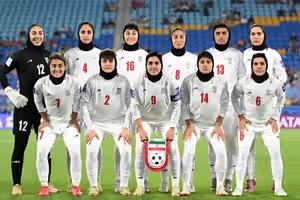
Weeks later in Australia, the quiet broke. Seven members of the traveling party moved to seek humanitarian protection, a walkout confirmed at the time by Iran International, with US President Donald Trump publicly urging Canberra to take them in.
Five reversed course and flew home. The reversal is not simple to read: it happened in an atmosphere of dread, fear for families in Iran, the watchful presence of federation security officers, and reports of pressure both direct and oblique, with threats attributed to the Revolutionary Guards.
Neither staying nor returning, as the circumstances stood, can honestly be called a free choice.
What the government did next completed the picture. The returned players were paraded at Tehran's Valiasr Square, presented as proof of love of homeland and the collapse of what officials called the asylum plot. The crisis became a pageant.
The star nobody recognized
One moment from that pageant deserves to outlive it.
Golnoush Khosravi, herself a national team player and one of the figures in the Australia episode, was handed a microphone and sent into the crowd at a state rally to ask people what they thought of the women's team and the affair she had been part of. The answers were warm.
People thanked the returned players, said they loved them, said they were proud of them.
Not one of them recognized the national team player holding the microphone.
That is the Islamic Republic's relationship with women's football, compressed into a single scene: a state that buses in crowds to celebrate players it has spent decades making invisible.
Women's matches are almost never broadcast; photography is restricted; the players compete in mandated full cover.
The country's champions can walk any street unrecognized, and when the government finally needed their faces for its own story, it discovered the erasure had worked too well.
In its pageant, the player is not an athlete with an identity, a record and professional rights; she is a prop for a narrative, thanked on camera by people who do not know that the woman interviewing them is on the team.
The invisibility of the women who play has an older twin in the women who watch. Stadiums have been closed to female fans since shortly after the 1979 revolution, a ban that took the life of Sahar Khodayari, the fan who set herself on fire in 2019 facing prison for sneaking into a match, and that has since eased only in small, revocable concessions extracted under FIFA pressure.
The ledger abroad
Meanwhile, the world keeps collecting what Iran discards. Taekwondo fighter Kimia Alizadeh, once the country's only female Olympic medalist, left declaring herself one of millions of oppressed Iranian women and won Olympic bronze for Bulgaria. Chess players Sara Khadem, Mitra Hejazipour and Dorsa Derakhshani now play for Spain, France and the United States. This month, weightlifter Yekta Jamali, who left as a teenage medal prospect, was named best lifter of the German Bundesliga final, according to Persian-language media reports.
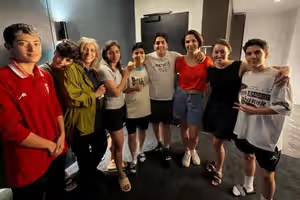
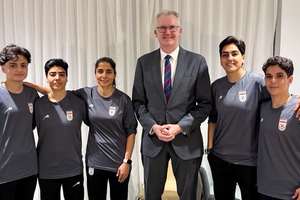
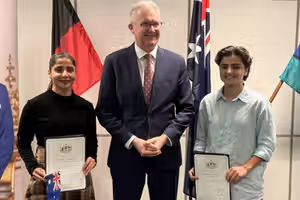
And on Wednesday, in Brisbane, Fatemeh Pasandideh, 22, and Atefeh Ramezanisadeh, 34, the two who did not board the plane home, received Australian citizenship at a ceremony attended by Home Affairs Minister Tony Burke.
Both now train with Brisbane Roar's women's side, and their passports make them eligible, one day, to play for the country that took them in.
"This citizenship is more than a certificate; it is a symbol of hope, safety and the opportunity to build a new future," Ramezanisadeh wrote. Pasandideh remembered "those who lost their lives or remain in prison."
Four roles, no future
One was erased for a sentence of protest. Some left home without the chance to say goodbye. Some came back and were placed inside a propaganda frame. And one, the best striker in the country, sat before the head of the judiciary and asked for a job.
These are not the same choices, and the women who made them do not bear the same responsibility. But they are all products of one structure, a system that recognizes only a few roles for a woman who plays football: silent, exiled, an instrument on a stage, or a supplicant before power.
What appears in none of these frames is the thing itself: an independent athlete whose success could buy her dignity, security and a future in her own country.
Chatrenoor says she does not regret coming home. Pasandideh is 22, with a passport, a club and a career ahead of her. Same team, same tournament, one flight's difference.