• العربية
  • فارسی
Brand
  • Iran Insight
  • Politics
  • Economy
  • Analysis
  • Special Report
  • Opinion
  • Podcast
  • Iran Insight
  • Politics
  • Economy
  • Analysis
  • Special Report
  • Opinion
  • Podcast
  • Theme
  • Language
    • العربية
    • فارسی
  • Iran Insight
  • Politics
  • Economy
  • Analysis
  • Special Report
  • Opinion
  • Podcast
All rights reserved for Volant Media UK Limited
volant media logo

Pezeshkian says Afghanistan, Pakistan blocked attempted incursions into Iran

Aug 8, 2026, 17:05 GMT+1

Iranian President Masoud Pezeshkian said attempts were made during the 40-day war to attack Iranian border posts in the northwest and southeast and send forces into the country, but neighboring states acted to prevent incursions.

“Both Afghanistan and Pakistan deployed groups to control the situation and made clear that no one would be allowed to enter Iran from their territory and create unrest inside the country,” Pezeshkian said, speaking to reporters Saturday.

He also said Iran had responded to attacks launched from US bases in neighboring countries, saying Tehran could not allow attacks from another country’s territory to go unanswered.

Most Viewed

US imposes new Iran sanctions as officials say Hormuz deal is near
1

US imposes new Iran sanctions as officials say Hormuz deal is near

2

Mecca pact ties three Sunni powers together as Iran-backed attacks loom

3
PODCAST

Ending Iran war could expose regime to its greatest threat yet, experts say

4
ANALYSIS

US miscalculated Iran’s resilience and hurt deal prospects, expert says

5
INSIGHT

What the Pentagon learned from the Iran war

Banner
Banner
Banner

Spotlight

  • US miscalculated Iran’s resilience and hurt deal prospects, expert says
    ANALYSIS

    US miscalculated Iran’s resilience and hurt deal prospects, expert says

  • What the Pentagon learned from the Iran war
    INSIGHT

    What the Pentagon learned from the Iran war

  • Iran hardliners push renewed hijab crackdown despite widespread defiance

    Iran hardliners push renewed hijab crackdown despite widespread defiance

  • A Khamenei in-law is openly recruiting to replace the Islamic Republic

    A Khamenei in-law is openly recruiting to replace the Islamic Republic

  • Executions in Isfahan renew calls to end German city partnership

    Executions in Isfahan renew calls to end German city partnership

  • Iran's energy crisis is political, not seasonal
    ANALYSIS

    Iran's energy crisis is political, not seasonal

•
•
•

More Stories

What the Islamic Republic does to its women footballers

Aug 8, 2026, 13:25 GMT+1
•
Raha Pourbakhsh
100%
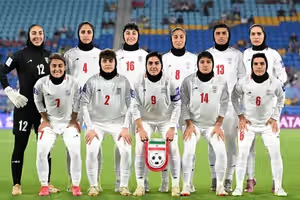
A file photo of the Iranian national football team in Australia

Late last month, Iran's finest striker sat across from the country's judiciary chief and asked him to help her find a job. Last week, two of her former teammates became Australian citizens. Between those two scenes lies everything the Islamic Republic offers its sportswomen.

In the video, Afsaneh Chatrenoor, a national team forward and four-time top scorer of Iran's women's league, faces Gholamhossein Mohseni-Ejei, the cleric who runs the judiciary. She recites her sporting record and asks him to intervene so that she can be formally employed, so that there is something for her when the football ends.

In a normal country, an athlete's livelihood is not the judiciary's business, and no one petitions a security official for a paycheck. The scene works differently in Iran, where basic rights are routed out of ordinary channels and reissued as favors, dependent on the recommendation, the intercession, the mercy of an official.

A woman footballer is first stripped of what makes an athletic career a career: professional contracts, job security, broadcast rights, media coverage, a visible future. Then, for a fraction of what was taken, she must sit before power and ask.

No one expects a footballer to become a dissident against a state that has answered protest with mass executions. But there is a long distance between fighting the system and petitioning it for mercy, and the space between those two points is where the rest of her team now lives.

The one who spoke

Zahra Alizadeh chose a different point on that line. When security forces massacred protesters in January, the forward announced she was leaving the national team in protest. Within hours, her post vanished from Instagram, amid reports of security threats against players and their families and pressure to delete anything that read as dissent.

Alizadeh was no fringe squad member. In the qualifiers that sent Iran to the Women's Asian Cup in Australia, she scored against Bhutan and set up a goal against Singapore. She was never called up again, and within months she walked away from football altogether.

The message to every woman still in the squad was unambiguous: the right to play lasts exactly as long as the silence about the killing does.

The ones who left, and the ones brought back

Weeks later in Australia, the quiet broke. Seven members of the traveling party moved to seek humanitarian protection, a walkout confirmed at the time by Iran International, with US President Donald Trump publicly urging Canberra to take them in.

Five reversed course and flew home. The reversal is not simple to read: it happened in an atmosphere of dread, fear for families in Iran, the watchful presence of federation security officers, and reports of pressure both direct and oblique, with threats attributed to the Revolutionary Guards.

  • Iran pressuring women footballers who defected in Australia to return

    Iran pressuring women footballers who defected in Australia to return

  • Iran women’s football team kept under tight security in Kuala Lumpur

    Iran women’s football team kept under tight security in Kuala Lumpur

Neither staying nor returning, as the circumstances stood, can honestly be called a free choice.

What the government did next completed the picture. The returned players were paraded at Tehran's Valiasr Square, presented as proof of love of homeland and the collapse of what officials called the asylum plot. The crisis became a pageant.

The star nobody recognized

One moment from that pageant deserves to outlive it.

Golnoush Khosravi, herself a national team player and one of the figures in the Australia episode, was handed a microphone and sent into the crowd at a state rally to ask people what they thought of the women's team and the affair she had been part of. The answers were warm.

  • Inside the dramatic escape of Iranian women footballers seeking asylum

    Inside the dramatic escape of Iranian women footballers seeking asylum

People thanked the returned players, said they loved them, said they were proud of them.

Not one of them recognized the national team player holding the microphone.

That is the Islamic Republic's relationship with women's football, compressed into a single scene: a state that buses in crowds to celebrate players it has spent decades making invisible.

Women's matches are almost never broadcast; photography is restricted; the players compete in mandated full cover.

The country's champions can walk any street unrecognized, and when the government finally needed their faces for its own story, it discovered the erasure had worked too well.

In its pageant, the player is not an athlete with an identity, a record and professional rights; she is a prop for a narrative, thanked on camera by people who do not know that the woman interviewing them is on the team.

The invisibility of the women who play has an older twin in the women who watch. Stadiums have been closed to female fans since shortly after the 1979 revolution, a ban that took the life of Sahar Khodayari, the fan who set herself on fire in 2019 facing prison for sneaking into a match, and that has since eased only in small, revocable concessions extracted under FIFA pressure.

The ledger abroad

Meanwhile, the world keeps collecting what Iran discards. Taekwondo fighter Kimia Alizadeh, once the country's only female Olympic medalist, left declaring herself one of millions of oppressed Iranian women and won Olympic bronze for Bulgaria. Chess players Sara Khadem, Mitra Hejazipour and Dorsa Derakhshani now play for Spain, France and the United States. This month, weightlifter Yekta Jamali, who left as a teenage medal prospect, was named best lifter of the German Bundesliga final, according to Persian-language media reports.

And on Wednesday, in Brisbane, Fatemeh Pasandideh, 22, and Atefeh Ramezanisadeh, 34, the two who did not board the plane home, received Australian citizenship at a ceremony attended by Home Affairs Minister Tony Burke.

  • Iran women’s footballers who sought asylum become Australian citizens

    Iran women’s footballers who sought asylum become Australian citizens

Both now train with Brisbane Roar's women's side, and their passports make them eligible, one day, to play for the country that took them in.

"This citizenship is more than a certificate; it is a symbol of hope, safety and the opportunity to build a new future," Ramezanisadeh wrote. Pasandideh remembered "those who lost their lives or remain in prison."

Four roles, no future

One was erased for a sentence of protest. Some left home without the chance to say goodbye. Some came back and were placed inside a propaganda frame. And one, the best striker in the country, sat before the head of the judiciary and asked for a job.

These are not the same choices, and the women who made them do not bear the same responsibility. But they are all products of one structure, a system that recognizes only a few roles for a woman who plays football: silent, exiled, an instrument on a stage, or a supplicant before power.

What appears in none of these frames is the thing itself: an independent athlete whose success could buy her dignity, security and a future in her own country.

Chatrenoor says she does not regret coming home. Pasandideh is 22, with a passport, a club and a career ahead of her. Same team, same tournament, one flight's difference.

Iran moves to ratify Caspian Sea pact with seabed rights still unsettled

Aug 8, 2026, 11:20 GMT+1
•
Maryam Sinaiee
100%

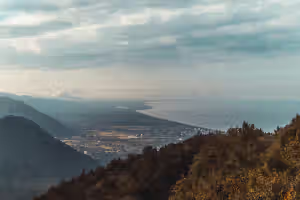
Iran is moving to ratify the Caspian treaty it left dormant for seven years, choosing the depths of a war to settle the status of its one quiet frontier, and reopening the oldest wound in its modern diplomacy: the belief that Tehran signed away half a sea.

President Masoud Pezeshkian's government has sent the 2018 Convention on the Legal Status of the Caspian Sea to parliament for ratification, ending years in which the treaty sat untouched and reviving a charged argument over the country's historical rights, energy interests and position in the strategically vital basin.

The convention, signed by the leaders of Iran, Russia, Azerbaijan, Kazakhstan and Turkmenistan in the Kazakh port of Aktau in August 2018, takes effect only once all five littoral states ratify it. The other four completed the process long ago. Tehran, alone, held back.

The charge that shadows the bill is older than the bill itself: a belief, widely held in Iran and rooted in readings of its 1921 and 1940 treaties with Moscow, that the country was entitled to half the Caspian and stands to end up with barely a tenth.

The convention in fact allocates no national shares at all, but the ghost of the fifty percent has trailed every Iranian discussion of the sea since Aktau.

The timing sharpens the argument. The move lands in the middle of a war that has set Iran's southern coast under nightly strikes and closed the Strait of Hormuz, leaving the Caspian corridor to Russia carrying an outsized share of the country's commerce and its strategic weight.

What the treaty actually does is narrower than either its champions or its critics suggest.

It defines the Caspian as a "special and unique landlocked body of water," placing it outside the UN Convention on the Law of the Sea. Each coastal state receives 15 nautical miles of fully sovereign territorial waters and a further 10 nautical miles of exclusive fishing rights, with the remaining surface designated a shared navigation zone.

The wealth, however, is postponed. Article 8 leaves ownership and delimitation of the seabed and its oil and gas to "bilateral or multilateral agreements between the states concerned."

Russia, Kazakhstan and Azerbaijan have largely settled their boundaries in the sea's north; the lines involving Iran, Azerbaijan and Turkmenistan remain unresolved, tangled in the complexity of dividing energy-rich waters.

A century-old dispute over Iran's share

Before the Soviet collapse, the Caspian was governed by the 1921 and 1940 treaties between Tehran and Moscow, which recognized equal navigation and fishing rights but drew no maritime boundaries.

The Soviet breakup turned two littoral states into five, and Iran has argued since that the sea should be divided equally, 20 percent to each.

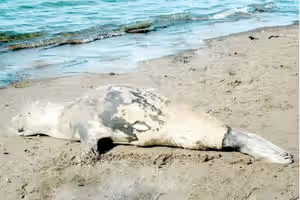
  • Caspian seals face extinction threat as deaths continue

    Caspian seals face extinction threat as deaths continue

  • Iran warns a quarter of Caspian Sea could dry up in 20 years

    Iran warns a quarter of Caspian Sea could dry up in 20 years

Russia, Kazakhstan and Azerbaijan instead adopted a modified median-line method, a formula that, because of Iran's concave coastline, would shrink Tehran's share of the sea and its bed to roughly 11 to 13 percent. Iran has never accepted that division.

The government's case: a sealed northern flank

The government presents ratification as completing the Caspian's legal framework, deepening cooperation among the littoral states and, above all, keeping outside powers away.

Officials point to Article 3, which bars the armed forces of non-coastal countries from the Caspian, as the convention's central security prize, a provision long championed by both Tehran and Moscow.

  • Iran says Caspian Sea a foreign policy priority on par with Persian Gulf

    Iran says Caspian Sea a foreign policy priority on par with Persian Gulf

Defa Press, an outlet affiliated with Iran's armed forces, wrote that the clause would "turn Iran's northern borders into a secure region, far removed from scenarios of foreign military intervention," at a moment when the country faces pressure along its southern and western frontiers.

The critics' case: ratifying before the real negotiation

Opponents argue parliament is sequencing the deal backwards: locking in the framework before the seabed, where the money lies, has been divided.

They note that the northern states have already parceled out much of the seabed and pressed ahead with oil and gas development, while fields shared with Iran, including Alborz, remain in limbo.

  • Ukraine's Iran ship strike was more about messaging than a new front, analysts say

    Ukraine's Iran ship strike was more about messaging than a new front, analysts say

Dariush Safarnejad, an international affairs analyst, told the Revolutionary Guards-linked Javan newspaper that lawmakers should return the bill to the government, since supplementary agreements that were meant to be completed within six months of the 2018 signing have never been finalized.

Approving the convention without them, he warned, "could provide other Caspian states with legal grounds in the future and influence the security, political and geopolitical dynamics of the Caspian region."

Shoaib Bahman, an international relations analyst focused on Eurasia, told the same paper that ratifying before the seabed boundaries are set would "effectively reduce Iran's legal leverage in future negotiations and could undermine its claim to a 20% share of the Caspian Sea."

Pipelines, corridors and the Turkic map

The critics' second front is Article 14, under which undersea pipelines require the consent only of the states whose sectors they cross, not all five. Bahman argued the clause could open the way for eastern Caspian producers to export oil and gas directly toward Europe, eroding Iran's transit position.

Mehdi Seif-Tabrizi, a Russia specialist, offered a more measured reading to the news website Fararu. Iran's 15 miles of territorial waters and 10 miles of fishing rights are guaranteed, he said, and "the real dispute concerns the seabed and subsoil," not the surface percentages that dominate the public argument.

  • As Caspian states pursue energy growth, Iran watches

    As Caspian states pursue energy growth, Iran watches

Yet he shares the strategic worry: that the long-discussed Trans-Caspian pipeline from Turkmenistan or Kazakhstan to Azerbaijan could finally be built.

"That could strengthen Azerbaijan's position and, in turn, reinforce the Zangezur corridor and the so-called Turkic World project," he said. "If Iran ratifies the convention, it would remove one of the most important legal obstacles to implementing those projects."

The opposition joins the attack

Criticism has come from beyond the establishment's factions. Exiled Prince Reza Pahlavi wrote on X that ratifying the agreement without the Iranian people's mandate and without "a clear and comprehensive guarantee of Iran's historic rights" is "deeply concerning and constitutes a serious threat to Iran's national interests."

Iran's rights in the Caspian, he added, "are not negotiable, nor can they be relinquished. Any action that undermines these rights will be recorded in the historical memory of the Iranian nation, and those responsible will ultimately be held accountable by the people of Iran."

Saeed Ghasseminejad, a senior Pahlavi adviser, went further, alleging that Hassan Rouhani's government had already "ceded Iran's share of the Caspian Sea" and that Pezeshkian and parliament speaker Mohammad-Bagher Ghalibaf now seek to "legalize and make that concession permanent."

He called the move "the biggest surrender of Iran's land and waters to foreign powers since the Qajar-era humiliations."

Cleric summoned after calling to replace Islamic Republic with ‘Islamic government’

Aug 8, 2026, 09:14 GMT+1
100%

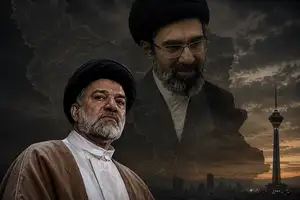
Iranian cleric Mohammad-Bagher Kharrazi was summoned to the Special Clerical Court after calling for the Islamic Republic to be replaced by a more hardline “Islamic government” and outlining plans to mobilize a 250,000-strong network capable of surrounding government sites.

Judiciary spokesperson Asghar Jahangir said on Saturday that legal proceedings began immediately after Kharrazi's recent remarks and that he had now been summoned to the court, which handles cases involving members of the clergy.

“Immediately after his recent remarks, legal action was initiated to prosecute him,” Jahangir said, adding that Kharrazi's case was under criminal investigation and further details would be released after the proceedings.

‘Islamic Republic doesn't work anymore’

In a video released this week, Kharrazi said the Islamic Republic had “reached a stage where, in this form, it simply doesn't work anymore” and said his organization had already drawn up plans for replacing it with an “Islamic government.”

Kharrazi, who heads the Hezbollah of Iran organization, said his group had produced 60 volumes of plans covering state institutions and had maintained what he described as a “shadow government.”

He also outlined a recruitment drive intended to build a nationwide network of 250,000 supporters, saying it could “surround all the ministries” and converge on Tehran following a single announcement.

  • A Khamenei in-law is openly recruiting to replace the Islamic Republic

    A Khamenei in-law is openly recruiting to replace the Islamic Republic

“Mr. Khamenei and the government must understand that a 250,000-strong organization stands ready to move,” he said.

Kharrazi also attacked President Masoud Pezeshkian, calling him a “buffoon” who “understands nothing,” and said his government “will not reach its end.”

Claims about Khamenei

Kharrazi is tied by marriage to Iran's ruling family: his sister is married to Masoud Khamenei, a brother of Supreme Leader Mojtaba Khamenei.

He has also presented himself as a longtime confidant of the new supreme leader, saying he has known him for four decades and held numerous private meetings with him. In his latest remarks, Kharrazi said Mojtaba Khamenei's thinking was “far more radical than his father's.” His accounts of private conversations and the supreme leader's views cannot be independently verified.

The leader's office had already publicly rejected earlier remarks Kharrazi attributed to Mojtaba Khamenei, including that Pezeshkian's next resignation would be accepted, describing them as unauthenticated and false.

Ending Iran war could expose regime to its greatest threat yet, experts say

Aug 7, 2026, 22:08 GMT+1
•
Negar Mojtahedi
100%
Iran's President Masoud Pezeshkian (left), Parliament Speaker M.B. Ghalibaf, and Judiciary Chief Mohseni-Ejei attend a funeral ceremony for slain Supreme Leader Ali Khamenei in July 2026.

Ending the Iran war could expose the Islamic Republic to one of its greatest vulnerabilities, experts say, as Tehran confronts a battered post-war economy that may strain its ability to finance the institutions underpinning its rule.

From a strictly economic perspective, former US Treasury official and sanctions strategist Miad Maleki says the greater danger to the regime may emerge once the fighting stops and it must govern a country burdened by soaring inflation, reconstruction costs and years of economic decline.

"If the conflict ends today, then you're going to see the economic effect of the war doing its work," Maleki told Eye for Iran.

"That would be very scary if I was an Iranian regime official, having to face the reality of a post-war economy."

Maleki argues Iran is already inside what he describes as a "tipping zone," where years of inflation, currency depreciation and economic mismanagement have steadily eroded purchasing power.

The question, he says, is no longer simply whether the government can continue paying salaries, but whether those salaries still buy enough to sustain loyalty.

"The salary might keep coming," he said. "You just won't be able to afford very basic needs."

The scale of that pressure is reflected in official consumer-price data.

In June, food and non-alcoholic beverage prices were nearly 134% higher than a year earlier, while prices for oils and fats rose about 278% and meat about 172%, according to data from the Statistical Center of Iran.

Those increases squeeze not only ordinary households, counterterrorism and security specialist Roger Macmillan argues, but also lower-ranking members of the Basij, IRGC conscripts and their families—people drawn from the same society on which the state relies to maintain internal security and suppress dissent.

"The real question isn't how much damage a bomb can do," he said. "It's what happens when the money stops moving."

Iran's financial center of gravity

Military pressure has dominated discussion of Iran for months, with much of the debate centered on missile stockpiles, drone production and how long it might take Tehran to rebuild its military capabilities.

Macmillan argues that focus overlooks something more fundamental.

"They are built to absorb military pressure," he said. "But are they able to absorb payroll pressure?"

His argument is not that economic pressure alone will weaken the regime. Rather, he says policymakers should focus on disrupting the broader financial ecosystem that allows the Islamic Republic to function, from government payrolls to military-linked economic networks.

"We need to be looking at the financial center of gravity, which is not just the payroll but also the military bonyads," he said.

Bonyads are powerful quasi-official foundations that expanded after the 1979 Islamic Revolution, with some of the largest developing extensive holdings in sectors including banking, construction, manufacturing, agriculture and energy.

Major foundations enjoy significant economic privileges and limited public oversight, and several are overseen by or closely connected to institutions under the Supreme Leader.

Some have also served as important patronage networks and maintained extensive economic links with Iran's political and security establishment.

For Macmillan, the question is not simply how much revenue those networks generate. It is whether they can continue supporting rank-and-file security forces if inflation keeps eroding wages while the government takes on the additional burden of rebuilding a post-war economy.

"What we need to look at is how we can remove the will, shatter the cohesion and the will of the foot soldiers from the Basij and from the IRGC, and separate them from the state," he said.

The argument represents a different way of thinking about pressure on Iran.

Rather than asking only how much military capability can be destroyed, Macmillan and Maleki argue policymakers should also consider how much financial strain the Islamic Republic can absorb before maintaining the institutions that enforce its rule becomes increasingly difficult.

Peace itself could reduce some war-related economic pressures, particularly if it improves trade conditions or is accompanied by sanctions relief. But Maleki argues it would also force Tehran to confront accumulated economic problems while meeting the costs of reconstruction.

For him, that may be precisely where the regime is most vulnerable.

"The most punishing thing they can do to this regime is send it back to govern Iran in a state of peace and face the reality they had to kill their way out of," Maleki said.

US imposes new Iran sanctions as officials say Hormuz deal is near

Aug 7, 2026, 21:49 GMT+1
100%
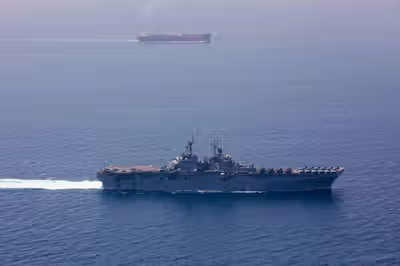
The Wasp-class amphibious assault ship USS Kearsarge (LHD 3) transits the Strait of Hormuz.

The United States imposed fresh sanctions targeting Iran’s financial networks Friday even as US officials said progress had been made toward a deal with Tehran over the Strait of Hormuz and it could be clinched as early as the weekend.

The US Treasury targeted currency exchange houses, shell companies and financial facilitators that Washington said helped Iran move hundreds of millions of dollars through the international financial system.

The State Department said the measures targeted networks Iran used to access oil revenue, evade sanctions and move funds through front companies.

It added that the new sanctions were intended “to cut the financial lifelines that sustain Iran’s ruling elite.”

The statement said Washington would continue targeting banks, exchange houses and other facilitators it says Iran uses to move funds and evade sanctions.

Despite the new sanctions, US officials insist that progress has been made in talks over the Strait of Hormuz.

There has been progress between Oman and Iran over the strait and a deal is expected soon, Reuters reported Friday, citing a US official.

The official said the US would lift its blockade of Iranian ports once an agreement was announced to restore commercial shipping through the strait without impediments.

Bessent says ceasefire could come soon

US Treasury Secretary Scott Bessent separately said a 30- to 60-day ceasefire agreement with Iran could come “shortly, maybe even today, tomorrow,” adding that a deal could reopen the Strait of Hormuz and bring energy prices down.

Bessent also said the strait would “never” return to the way it was, saying Iran had used or tried to use it as a choke point.

“What we are going to see over the next two years, the strait is going to become irrelevant. It is going to become just another body of water,” Bessent said.

He added that “more than 50 or 70%” of the energy currently moving through the strait would instead go through underground pipelines.

Earlier Oman proposal

The latest progress follows weeks of talks between Iran and Oman over a new arrangement for commercial shipping through the Strait of Hormuz.

Iran had earlier rejected an Omani proposal for a 50-50 arrangement dividing the inbound and outbound routes between the two sides, saying it did not sufficiently address Tehran’s security concerns.

Tehran instead proposed that one shipping lane run entirely through Iranian territorial waters and part of the other also pass through Iranian waters, allowing Iran to maintain oversight over traffic in both directions.

US actions would remain performance-based and tied to Iran’s implementation of its commitments, the US official told Reuters.