US imposes new Iran sanctions as officials say Hormuz deal is near
The Wasp-class amphibious assault ship USS Kearsarge (LHD 3) transits the Strait of Hormuz.
The United States imposed fresh sanctions targeting Iran’s financial networks Friday even as US officials said progress had been made toward a deal with Tehran over the Strait of Hormuz and it could be clinched as early as the weekend.
The US Treasury targeted currency exchange houses, shell companies and financial facilitators that Washington said helped Iran move hundreds of millions of dollars through the international financial system.
The State Department said the measures targeted networks Iran used to access oil revenue, evade sanctions and move funds through front companies.
It added that the new sanctions were intended “to cut the financial lifelines that sustain Iran’s ruling elite.”
The statement said Washington would continue targeting banks, exchange houses and other facilitators it says Iran uses to move funds and evade sanctions.
Despite the new sanctions, US officials insist that progress has been made in talks over the Strait of Hormuz.
There has been progress between Oman and Iran over the strait and a deal is expected soon, Reuters reported Friday, citing a US official.
The official said the US would lift its blockade of Iranian ports once an agreement was announced to restore commercial shipping through the strait without impediments.
Bessent says ceasefire could come soon
US Treasury Secretary Scott Bessent separately said a 30- to 60-day ceasefire agreement with Iran could come “shortly, maybe even today, tomorrow,” adding that a deal could reopen the Strait of Hormuz and bring energy prices down.
Bessent also said the strait would “never” return to the way it was, saying Iran had used or tried to use it as a choke point.
“What we are going to see over the next two years, the strait is going to become irrelevant. It is going to become just another body of water,” Bessent said.
He added that “more than 50 or 70%” of the energy currently moving through the strait would instead go through underground pipelines.
Earlier Oman proposal
The latest progress follows weeks of talks between Iran and Oman over a new arrangement for commercial shipping through the Strait of Hormuz.
Iran had earlier rejected an Omani proposal for a 50-50 arrangement dividing the inbound and outbound routes between the two sides, saying it did not sufficiently address Tehran’s security concerns.
Tehran instead proposed that one shipping lane run entirely through Iranian territorial waters and part of the other also pass through Iranian waters, allowing Iran to maintain oversight over traffic in both directions.
US actions would remain performance-based and tied to Iran’s implementation of its commitments, the US official told Reuters.
Turkish President Tayyip Erdogan, Saudi Crown Prince Mohammed bin Salman, and Pakistan's Prime Minister Shehbaz Sharif pose after signing a joint defence agreement in Mecca, Saudi Arabia, August 7, 2026.
Saudi Arabia, Turkey and Pakistan signed a mutual defense pact in Mecca on Friday that never once named a threat, and within hours Iranian officials and clerics had named it for them, mocking the agreement and promising that "the roar of our missiles" will reach its signatories.
The Mecca Joint Defense Agreement, signed as Crown Prince Mohammed bin Salman hosted Turkish President Recep Tayyip Erdogan and Pakistani Prime Minister Shehbaz Sharif, declares that an armed attack on any of the three will be treated as an attack on all.
A Turkish official called the pact "purely defensive," directed at no specific actor and open to other countries in the region.
The signatories' combined weight explains the attention. Turkey fields NATO's second-largest military, Saudi Arabia is one of the world's top oil exporters and home to Islam's holiest sites, and Pakistan is the only nuclear-armed Muslim state.
The pact caps nearly a year of negotiations and builds on last year's Saudi-Pakistani defense agreement, under which some 8,000 Pakistani troops, fighter jets and an air-defense system have already deployed to the kingdom.
The timing needs little decoding. Since the war began on February 28, Iran and its allies have struck US bases and civilian infrastructure across Saudi Arabia, Kuwait, Bahrain, Qatar, the United Arab Emirates, Oman and Jordan, shut the Strait of Hormuz to most shipping, and, through the Houthis, declared a naval embargo on Saudi ports in the Red Sea.
For Riyadh, three years of regional war have also raised a harder question: whether the American security umbrella it built its plans on still opens.
Turkish President Tayyip Erdogan, Saudi Crown Prince Mohammed bin Salman, and Pakistan's Prime Minister Shehbaz Sharif, accompanied by their ministers of Foreign Affairs and Defence, pose after signing a joint defence agreement in Mecca, Saudi Arabia, August 7, 2026.
Tehran answers the question nobody asked
The pact's statement avoided Iran's name. Tehran filled the silence itself.
"The Saudis should know that a paper agreement with Turkey and Pakistan will not bring them security, just as years of one-way nursing of the Americans brought them none," Ebrahim Rezaei, a member of the Iranian parliament's national security committee, wrote on X. "Correct your policies so you no longer need to go begging for security."
The clerical establishment was blunter. "Borrowed security and begging America for security will not save you," Alireza Arafi, the Friday prayer leader in Qom, told regional governments.
"As long as you are with the enemies of Islam and Iran, the roar of our missiles will threaten you."
In Ahvaz, another Friday preacher said Iran was working to extend its missiles' range to 15,000 kilometers so that "the American people, too, will see what it is like to be left in blood and destruction."
For a pact its authors insisted was aimed at no one, the replies arrived from one address.
Riyadh braces, Baghdad moves
The agreement was signed against specific and immediate warnings. A Saudi official told CNN the kingdom is preparing for coordinated attacks on energy facilities, ports and airports by Iraqi militias and Yemen's Houthis "in the very near future," under the guidance of Iran's Revolutionary Guards, citing intelligence that included tracked meetings between militia and Guards personnel and movements of drones and missiles.
Baghdad, unusually, is moving against the same groups. An Iraqi government official told Iran International the country is "on the verge of delivering the final blow" to Iran-backed militias, with intelligence indicating planned operations not only against Saudi Arabia but against Kuwait, Jordan and Syria.
Iraq's armed forces said a security plan is underway to foil any attack on the kingdom, and troops have been ordered to prevent Iraqi territory from being used for missile and drone launches at neighbors.
The warnings follow a week in which the Houthis struck two Saudi tankers in the Red Sea and hit Najran's airport, wounding 11 civilians, including a four-year-old child.
Reporting by Asharq al-Awsat and Israeli media describes a joint Houthi-Iraqi operations room established at Jurf al-Sakhr, the militia stronghold south of Baghdad.
A deal Tehran wants, on terms it dictates
The day's other track ran through Muscat.
Iran's parliament confirmed the framework of an understanding with Oman has been agreed, and lawmaker Ahmad Bakhshayesh Ardestani described its logic with unusual candor: Iran is negotiating with America "in Oman's name," he said, over an arrangement that would leave the strait's management in Iranian hands and charge passing ships a tariff of 7 percent of cargo value, split three-quarters to Tehran and a quarter to Muscat.
President Donald Trump sounded confident and noncommittal at once. "It's obvious they don't want to be hit. They want to make a deal. So, we'll see," he said, adding that gasoline prices would rise only if he had to "do another hit" on Iran.
The Wall Street Journal reported that Arab mediators doubt Iran's diplomats have the authority to deliver any Hormuz deal they sign, as hardliners accuse the negotiating team of giving too much away.
That doubt, in the end, is what Friday's ceremony in Mecca was about. Three of the region's heaviest states have concluded that whatever emerges from the talks, the threat that closed the strait and burned their ports will outlast the paperwork, and they intend to face it attached to one another rather than waiting, separately, for Washington.
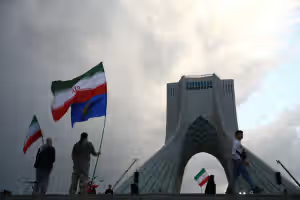
A banner with a threat against President Trump's life is displayed beneath missiles during a state-organized event in Tehran's Azadi Square, Iran, July 30, 2026
A return to the pre-war status quo between Iran and the United States now appears out of reach for both sides, despite their competing claims of victory.
The negotiations under way are no longer about restoring the relationship that existed before the war, but about finding a new equilibrium that neither side fully trusts.
After two months of naval confrontation, Washington wants Iran to reopen the Strait of Hormuz, while Tehran wants the United States to lift restrictions on its commercial shipping. Neither side publicly acknowledges why they fought so long against what increasingly appear to have been their own strategic and economic interests.
That mutual recognition has created an opportunity for diplomacy, but not necessarily confidence in it.
Iran and Oman announced Wednesday that they had agreed on the geographical coordinates of a proposed commercial shipping corridor through the Strait of Hormuz and were finalizing a joint statement.
The Associated Press, citing two regional officials, reported that Iranian and Omani negotiators had completed a draft agreement and were awaiting final approval from Supreme Leader Mojtaba Khamenei.
CNN, citing a senior Persian Gulf official familiar with the talks, said the chances of reaching a broader US-Iran agreement by Friday remained only "50:50," despite President Donald Trump's repeated predictions that a breakthrough was imminent.
Diplomacy without trust
The fragility of the process is increasingly reflected inside Iran itself.
A member of Iran's negotiating team told reporters in Oman on Wednesday that one of the remaining obstacles was Trump's repeated threats to attack Iran if diplomacy failed.
Accepting a compromise under those circumstances, Iranian officials argue, would expose negotiators to accusations from domestic rivals that they had capitulated under military pressure.
Former chairman of parliament's Foreign Relations and National Security Committee, Heshmatollah Falahatpisheh, warned the same day that the current pause in hostilities had created only a narrow diplomatic window.
If negotiations collapse or stall, he argued, the confrontation is likely to spread beyond the military sphere into the region's civilian economy, trade and security infrastructure.
Former foreign minister Mohammad Javad Zarif echoed those concerns, warning that continued closure of the Strait of Hormuz risked creating a broader regional and international consensus against Tehran, turning one of Iran's principal sources of leverage into a growing strategic liability.
Temporary pause
The debate inside Iran suggests that neither supporters nor opponents of diplomacy expect the current process to produce a durable settlement.
Across state media and security-aligned outlets, the negotiations are presented less as the beginning of a new relationship with Washington than as a tactical pause made possible by regional mediation, particularly Oman, and the temporary framework established under the Islamabad memorandum.
Official messaging continues to reject any suggestion of direct bargaining or political concession to Washington. I
nside Iran's political establishment, resistance to negotiations extends across ultra-hardline factions, conservative clerical institutions and parts of the Revolutionary Guards, all deeply skeptical of engagement with the United States.
For those groups, flexibility over Hormuz or Iran's nuclear program risks weakening deterrence rather than strengthening security.
That institutional skepticism helps explain why every sign of diplomatic progress is accompanied by warnings that the process could quickly unravel.
For both Washington and Tehran, the talks increasingly appear driven less by renewed trust than by recognition that neither side can afford another prolonged confrontation. Whether that recognition proves strong enough to overcome deep political distrust remains the central question.
An Iranian state-owned bank has frozen accounts belonging to the National Iranian Oil Company over outstanding debt obligations, the IRGC-affiliated Fars news agency reported on Wednesday.
The action by Bank of Industry and Mine (BIM) comes despite domestic statutory provisions extending NIOC’s debt repayment deadlines through the end of the current Iranian fiscal year in March 2027, Fars reported, without giving the size of the debt or saying when the accounts were frozen.
The bank is a government-owned lender that mainly finances industrial and mining projects.
The apparent mismatch between the repayment timetable and the freezing of the accounts was not explained by Fars.
NIOC, overseen by Iran's Ministry of Petroleum, sits at the center of the country's energy industry, managing much of its oil exploration, production and exports and providing a major source of revenue.
Later on Wednesday, an NIOC financial official told the Tasnim news agency that the company had been in a dispute with Iran's tax authorities over electronic reporting requirements.
Morteza Rouhi, a tax official in NIOC's financial management division, said state-budgeted companies such as NIOC hold some information they are not permitted to disclose, including details related to oil exports, while tax rules require companies to register sales and transactions electronically.
“The oil and economy ministers held a meeting, after which the president’s legal office intervened and ordered a halt to enforcement. We now have no concerns about the National Iranian Oil Company’s accounts being frozen,” Rouhi said.
Fars said the accounts were frozen over debt but also pointed in the same report to financial restrictions previously imposed on NIOC by the US Treasury. The bank itself was sanctioned in 2018.
The reference is notable because Washington's restrictions on NIOC have themselves been tied to the company's relationship with the Revolutionary Guards.
The US Treasury determined in 2012 that NIOC was an agent or affiliate of the Islamic Revolutionary Guard Corps and in 2020 designated the company under counterterrorism authorities over what it said was NIOC's support for the IRGC's Quds Force.
NIOC is nevertheless formally overseen by Iran's Ministry of Petroleum and sits at the heart of the state economy, managing much of the country's oil production and exports.
The account freeze therefore puts a domestic financial restriction on a government-controlled company whose international financial finances have been affected by its links to the IRGC, as described by the US Treasury.
The action also comes as the war and negotiations with Washington have made divisions among Iran's centers of power increasingly public.
Those divisions do not fall neatly between the government and the IRGC. President Masoud Pezeshkian and officials involved in diplomacy, including Foreign Minister Abbas Araghchi and Parliament Speaker Mohammad Bagher Ghalibaf, have faced pressure from hardline lawmakers, media and political groups opposed to concessions to Washington.
Ghalibaf, himself a former senior IRGC commander, has faced criticism from ultra-hardliners over his role in negotiations. Lawmakers have also stepped up pressure on Araghchi to disclose details of the US talks, with one senior lawmaker saying this week that parliamentarians were gathering material for a possible impeachment effort against the foreign minister.
The divisions have also surfaced among pro-government supporters mobilized on the streets during the war, a constituency sometimes referred to as the "meydan," or field.
Ghalibaf has emphasized the authorities' role in that mobilization, saying officials called supporters onto the streets after news of former Supreme Leader Ali Khamenei's death because they feared the situation could otherwise take a “different turn”.
Some of those gatherings later became platforms for opposition to negotiations and criticism of Ghalibaf, Araghchi and other officials involved in talks with Washington, turning a show of establishment support into another source of pressure over diplomacy.
Araghchi has suggested that foreign intelligence operations could exploit such internal vulnerabilities.
In a recent interview, he said they could seek not only to gather information but also to influence Iran's decision-making and shape its psychological environment and public perceptions.
The NIOC account freeze has not been linked to those political disputes. But it comes as the strains of war, US sanctions and renewed diplomacy increasingly expose tensions among the government, security establishment and other centers of power within the Islamic Republic.
Prospects for reopening the Strait of Hormuz remained uncertain Tuesday as Washington said an agreement could come by Wednesday, while Tehran linked normal shipping to transit fees, sanctions relief, security guarantees and an end to the US naval blockade.
At the center of the negotiations is a proposed arrangement under which ships would enter the Persian Gulf through an Iranian-controlled route and leave through a route controlled by Oman.
Whether Iran could collect service or transit fees remains a key point of dispute, with Washington opposing any charges.
Iran is also seeking a role in monitoring vessels leaving the Persian Gulf. A senior Iranian source involved in the negotiations told Reuters that Tehran wanted control over inbound traffic and oversight of outbound ships, including the ability to intervene if necessary. Oman would clear departing vessels after notifying Iran, the source said.
The Wall Street Journal, citing regional mediators, said Iranian diplomats initially welcomed the proposed division of the routes because it preserved some authority for Tehran.
Iran has also demanded the right to collect transit fees, potentially shared with Oman, alongside guarantees against renewed attacks, relief from oil sanctions and an end to the US blockade.
The United States and regional governments rejected the proposed fees and sought assurances that Iran and its proxy groups would not threaten their territories, according to the report. The dispute leaves the sides divided over whether the strait should reopen before Washington offers concessions or only after Tehran’s wider conditions are met.
The latest proposal has yet to receive a formal response from the Revolutionary Guards, the Wall Street Journal reported. Some IRGC officials told mediators they would reject any agreement that did not recognize Iran’s claim to control the strait, while mediators have questioned whether Iranian diplomats have sufficient authority to finalize a deal.
Separately, Tehran indicated that an Iran-Oman shipping arrangement would not by itself restore normal traffic.
The IRGC-affiliated Fars News reported, citing a source close to Iran’s negotiating team, that the waterway would not fully reopen unless the United States halted its attacks and fulfilled Iran’s conditions.
Despite those differences, US Treasury Secretary Scott Bessent said an agreement could be reached as early as Wednesday. Secretary of State Marco Rubio also said discussions with Iran and Oman had made progress but had not yet produced a final deal.
The diplomatic push continued despite a fresh maritime incident Tuesday, when a cargo vessel was hit by an unknown projectile off Oman. The United Kingdom Maritime Trade Operations did not identify those responsible, but the attack underscored the continuing risks to commercial shipping while negotiations remained unresolved.
A soldier stands guard beside the Cosco Wellington, the first container ship to depart after the inauguration of the China Pakistan Economic Corridor port in Gwadar, Pakistan November 13, 2016.
Iran is exploring using two of Pakistan’s ports to keep trade moving amid the US blockade of its own ports, a senior Iranian official said on Tuesday.
Mohammad-Ali Dehghan Dehnavi, head of Iran’s Trade Promotion Organization, said Karachi and Gwadar could serve as hubs for re-exporting Iranian goods to third countries. He said Pakistan could also supply Iran with essential goods and industrial raw materials.
The comments came during a visit to Islamabad alongside Iranian Industry, Mine and Trade Minister Mohammad Atabak for bilateral trade talks.
Pakistan and Iran said they would work toward increasing trade to $10 billion, advancing a free trade agreement and removing barriers involving customs, border logistics and cargo movement.
Iranian and Pakistani officials attend a bilateral trade meeting in Islamabad, Pakistan, Aug. 4, 2026.
Pakistan emerged as a key mediator after US-Israeli strikes on Feb. 28 triggered the Iran war and Tehran largely closed the Strait of Hormuz. When Pakistan-hosted US-Iran talks ended without a breakthrough on April 13, President Donald Trump ordered a blockade of maritime traffic entering and leaving Iranian ports.
The blockade ended on June 18 under an interim agreement mediated by Pakistan but was reinstated on July 14 after the deal began to unravel and fighting resumed.
Traffic through the Strait of Hormuz remains severely restricted. Kpler data showed only six vessels — three tankers and three bulk carriers — passed through the waterway on Monday, down from seven on Sunday, with all six using the route through Iranian waters.
On April 22, the US president said the naval blockade was costing Iran $500 million a day, while the War Department estimated that Tehran had lost $4.8 billion in oil revenue by May 1.
A Friday report by The Telegraph said the United States and Israel are weighing a possible land blockade of Iran to deepen its economic isolation, as President Trump reportedly believes the naval blockade in the Strait of Hormuz has achieved all it can.
Trump discussed the proposal with Israeli Prime Minister Benjamin Netanyahu during their meeting in Washington last Tuesday, alongside several other military and non-military options, according to the report.
A senior Israeli official suggested sealing Iran’s land routes to prevent goods from entering or leaving the country, saying such pressure could produce unpredictable consequences.
Iran shares extensive land borders with Iraq, Turkey, Afghanistan, Pakistan, Turkmenistan, Azerbaijan and Armenia.