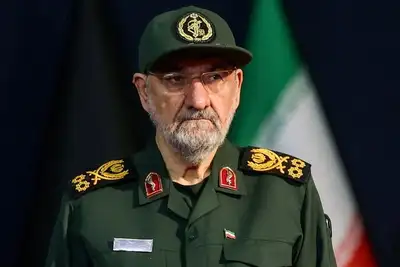
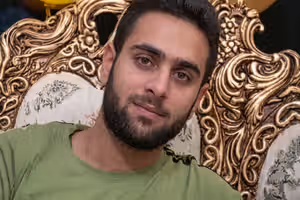
From top left: Ali Zaghi, Mehdi Zarif and Mohammad Zanganeh; from bottom left: Najmeh Amini and Vahid Khedrikhah.
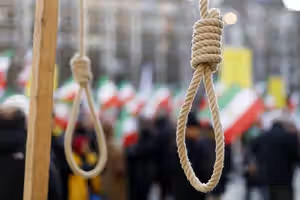
Five people detained over Iran’s nationwide January protests have been sentenced to death or are at risk of receiving death sentences in the northeastern city of Mashhad and nearby Shandiz, sources familiar with their cases told Iran International.
Mohammad Zanganeh, Mehdi Zarif and Ali Zaghi have been sentenced to death, while Najmeh Amini and Vahid Khedrikhah face charges that could carry capital punishment, sources told Iran International.
The five cases come amid a sharp escalation in Iran’s use of capital punishment against people detained during the January unrest. The UN human rights chief says at least 56 people have been executed on national security-related charges since March 19, including 27 in protest-linked cases.
Najmeh Amini: Facing capital charges over Instagram stories
Amini, a 23-year-old accounting student, was arrested in Mashhad on February 2 over several protest-related Instagram stories.
Sources said she was beaten and arrested while shopping at a market in the city.
She was held in police custody for two days and forced to confess, according to the sources.
Hengaw reported that Amini faces charges including moharebeh, or “waging war against God,” and collaboration with Israel, accusations that could carry the death penalty.
Amini has been denied access to a lawyer throughout her detention and is being held in Mashhad’s Vakilabad Prison.
Mohammad Zanganeh: Prison sentence followed by death ruling
Zanganeh, a 24-year-old protester, is at risk of execution after the Mashhad Revolutionary Court issued a new notice sentencing him to death.
He has gone on hunger strike in Vakilabad Prison in protest against the ruling.
Sources told Iran International that the court, presided over by Judge Hadi Mansouri, recently notified Zanganeh that he had been sentenced to death.
The same court had previously sentenced him in June to three years, six months and one day in prison on charges including acting against internal and external security, chanting slogans against the Islamic Republic, insulting religious sanctities, calling for protests and unrest, damaging public property and setting fire to a banner of former supreme leader Ali Khamenei.
Sources said his condition in prison is “extremely concerning.”
Before recently being allowed to communicate outside the prison, Zanganeh had been held incommunicado for five months, during which his family had received no information about him.
He was denied access to a lawyer and other basic rights as a prisoner throughout that period, sources told Iran International.
Mehdi Zarif: Death sentence imposed under espionage law
Zarif, a 21-year-old dental technician from Shandiz, is at risk of execution after Iran’s Supreme Court upheld his death sentence, a source familiar with his case told Iran International.
He was arrested at his home on February 14 and, after a period in solitary confinement, suffered a heart-related medical complication during questioning, which the source attributed to pressure exerted by interrogators.
Zarif is currently being held in Mashhad’s Vakilabad Prison.
The source said Branch Five of the Mashhad Revolutionary Court, presided over by Judge Yazdankhah, sentenced him to death under legislation introducing harsher penalties for espionage, cooperation with Israel and collaboration with states deemed hostile to Iran’s national security.
The Supreme Court upheld the ruling, and Zarif’s lawyer was denied access to the full judgment and the case documents, according to the source.
Ali Zaghi and Vahid Khedrikhah
Zaghi has been sentenced to death in connection with the January protests, sources told Iran International.
He was arrested on January 12 in Shandiz, a city near Mashhad. No further details about his case were available.
Khedrikhah, a 32-year-old from Mashhad who is being held in Vakilabad Prison, is at risk of being sentenced to death, informed sources told Iran International.
Khedrikhah, who lost both parents at the age of 12, was taken to a friend’s home for treatment after being wounded in the side on January 9.
Security forces went to the house on January 19 and arrested him, the sources said.
According to the sources, he faces charges of “leading the protests” and moharebeh, or “waging war against God,” the latter of which can carry the death penalty.
Use of death penalty against protest detainees
UN human rights chief Volker Türk said on Thursday that executions and death sentences had risen sharply since March, with more than 100 other people facing national security-related charges that could carry the death penalty.
Mai Sato, the UN special rapporteur on human rights in Iran, echoed Türk’s alarm, pointing to a persistent pattern of executing people, including protest participants, on security-related charges.
“The purpose of these executions is to control society by instilling fear through lethal force,” she said.
President Masoud Pezeshkian drew angry reactions from Iranians after rejecting higher estimates of those killed in Iran's January protests and calling those who cite such figures "traitors" in an interview published on Wednesday.
Pezeshkian described the protests as a "riot" and accused people abroad of falsely inflating the death toll.
"Those sitting abroad who present themselves as intellectuals and scholars, yet say 30,000 or 40,000 people were killed, are dishonorable and traitors," he said in the video interview.
His remarks prompted a wave of criticism from citizens who sent messages to Iran International, with many accusing the president himself of bearing responsibility for the killings.
"Mr. Pezeshkian, this is disgraceful. Stop lying and have some shame," one said. "Your hands are stained with the blood of tens of thousands of Iranian protesters. Curse all of you killers and the remaining figures of the Islamic Republic."
Others argued that even the official death toll acknowledged by his administration warranted accountability.
Crowds take part in anti-government protests in Tehran in January 2026.
"Sitting there and saying 3,000 people were killed – first of all, this is not about the number," one citizen from Arak said. "Even if it were those 3,000 people you admit were killed, you should answer for every single one of them."
Another viewer wrote that if Iran had "a normal government," Pezeshkian should face punishment simply for acknowledging that thousands had been killed.
"So if, by your own account, 3,000 people were killed, that's acceptable?" another message read.
Government figures disputed
In mid-February, Pezeshkian's office published a list containing the names of 2,986 people it said were killed during the January protests, saying it had been compiled using data from the Legal Medicine Organization and cross-checked with the National Organization for Civil Registration.
The figure is far below Iran International's editorial board estimate of at least 36,500 people killed during the crackdown. Several international media outlets have also cited similar estimates.
Pezeshkian has repeatedly accused protesters of carrying out armed attacks and sabotage.
In his latest interview, he again described protesters as having been armed by US President Donald Trump, referred to the crackdown as an "incident" and said demonstrations had turned into a "riot" in which "difficult events" occurred.
One person responded by invoking a Quranic verse.
"If your memory serves you, the Quran you probably believe in says killing one innocent person is like killing all humanity," the message read. "Yet you speak about 3,000 deaths as though nothing important happened."
Another accused the president of contradicting earlier official accounts.
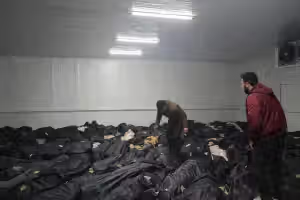
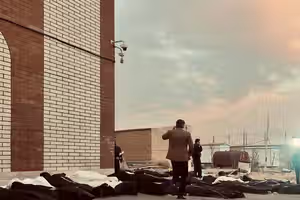
Bodies wrapped in blankets lie outside Alghadir Hospital in eastern Tehran following anti-government protests in January 2026.
"It is interesting that you say terrorists killed the victims, yet you become angry at those who say the real figure is 40,000 and call them traitors," he wrote. "That amounts to admitting that the terrorists you blamed were actually yourselves."
Activists challenge official narrative
Human rights activist and former political prisoner Mehdi Mahmoudian also criticized Pezeshkian's remarks.
"Please explain who killed the several thousand people whose deaths you yourself do not deny, and what those responsible for this crime should be called," Mahmoudian wrote.
Separately, critics resurfaced comments by Mojtaba Lotfi, a cleric and former aide to the late Grand Ayatollah Hossein Ali Montazeri, who argued that the government's casualty list had been censored.
Referring to his hometown of Najafabad, Lotfi wrote that local records indicated at least 30 victims from the city had been omitted from the official list, suggesting the government's figures were incomplete.
Iran has intensified its repression of ethnic minorities, particularly Kurdish and Baluch communities, through arbitrary arrests, enforced disappearances and executions, a group of UN human rights experts said on Thursday.
The experts said at least 24 members of the Baluch minority and 22 members of the Kurdish minority had been executed in 2026, with many more at imminent risk of execution.
“Iran’s ethnic minorities must be able to live in safety and dignity, free from discrimination,” the experts said in a statement.
Kurds are concentrated mainly in western and northwestern Iran, while many of Iran's Baluch population live in the southeastern province of Sistan-Baluchistan. Both predominantly Sunni communities have long faced political, economic and security pressure from the Shiite-led authorities, according to rights groups.
“Reports point to a significant increase in arbitrary arrests, and what appears to be politically motivated sentences,” the experts said, adding that members of ethnic minorities were often detained under broadly defined national security charges.
The experts said a 2025 law expanding the definition of espionage, along with offenses including moharebeh, or “enmity against God,” efsad-fil-arz, or “spreading corruption on earth,” and baghi, or armed rebellion against the Islamic Republic, had been used particularly against Kurds.
They described the laws as “a tool to repress dissent.”
Thursday’s warning comes a day after UN human rights chief Volker Türk said Iran had executed at least 56 people on national security-related charges since March 19, including 27 in cases linked to protests earlier this year.
Türk said executions and death sentences had risen since March and that more than 100 other people faced similar charges and the death penalty.
The figures follow a series of executions in recent weeks involving young people detained over the January protests.
Iranian authorities executed 20-year-old Arvin Kheirkhah at Shahroud prison on Saturday after he was sentenced to death over his involvement in the protests, according to information obtained by Iran International.
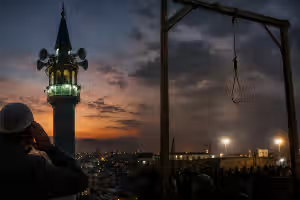
Days earlier, authorities hanged Amirhossein Safari and Abolfazl Sepahi in Isfahan’s Alikhani Square. They were among 12 young men sentenced to death in a case stemming from protests there in January.
A group of UN human rights experts led by Mai Sato, the UN Special Rapporteur on the situation of human rights in Iran, had urged Tehran to halt executions in the Isfahan case, citing concerns about closed proceedings, alleged ill-treatment and the use of confessions broadcast on state television.
Türk urged Iranian authorities to halt all executions and move towards abolishing the death penalty.
Iranian President Masoud Pezeshkian rejected reports that tens of thousands of people were killed in the January protest crackdown, accusing those publishing higher death tolls of misleading the public.
In an interview published on Thursday, Pezeshkian acknowledged that thousands had been killed but rejected estimates putting the toll at 30,000 to 60,000.
“Some media outlets and journalists said that 40,000 or 60,000 people were killed in Iran,” Pezeshkian said.
He said authorities responded by publishing names and national identification numbers of those they said had been killed and inviting people to provide names that were missing.
“But those sitting outside the country, presenting themselves as concerned, informed and sometimes as intellectuals and academics, turned a figure of around 3,000 into 30,000 or 40,000 and misled public opinion,” he said.
Pezeshkian described those behind the higher estimates as “cowards” and “traitors to the country.”
Trump figure rejected
Pezeshkian also rejected US President Donald Trump's account of the crackdown.
Trump said at a NATO summit in Ankara in July that Iranian authorities had killed 54,000 protesters and argued that the scale of the killings had prevented demonstrators from overthrowing the Islamic Republic.
“They can’t take over because they’re dead. They killed them,” Trump said at the time.
Pezeshkian said Trump had acknowledged that protesters had received outside support, accusing Washington of seeking to exploit unrest inside Iran.
“Trump himself explicitly said that they had armed these people and supported them, so it was clear what their objective was,” Pezeshkian said.
Trump's comments cited above, however, described the protesters as unarmed and Iranian security forces as having machine guns.
Pezeshkian acknowledged that some of those involved in the protests had legitimate grievances and that innocent people had been caught up in the violence.
“We had problems, and we still have them,” he said. “Some people were legitimately raising their problems, but another group wanted to use this environment to pursue their sinister objectives.”
He also acknowledged failures in the authorities' handling of the unrest.
“Because we were not sufficiently prepared to manage the situation, many people were harmed,” Pezeshkian said. “Many young people lost their lives and others lost parts of their bodies.”
“We should not have allowed things to reach this point,” he added.
Iran International reported in January that more than 36,500 people were killed by security forces during the January 8-9 crackdown, based on classified documents, field reports and accounts from medical workers, witnesses and victims' families reviewed by its Editorial Board.
The figure included information from internal Iranian government and security documents.
Remarks draw backlash
Pezeshkian's comments prompted criticism from government opponents and some Iranians who challenged both his death toll and his description of people reporting higher figures as traitors.
Mehdi Mahmoudian, a human rights activist and former political prisoner, called on Pezeshkian to explain responsibility for the deaths that the president himself acknowledged.
“Please explain who killed those several thousand people whose deaths you yourself do not deny, and what should the perpetrators of this crime be called?” Mahmoudian wrote on X.
A previously published account by dissident cleric Mojtaba Lotfi was also recirculated following Pezeshkian's remarks. Lotfi said local checks in his hometown of Najafabad had identified at least 30 names missing from the government's list of those killed, arguing that the official count was incomplete.
Iran International also received messages from citizens disputing Pezeshkian's account and criticizing his comments, with some saying that disagreements over the final number did not justify the killing of protesters.
Freiburg is a university city in southwestern Germany, file photo
The public execution of two protesters in Isfahan has renewed calls for the German city of Freiburg to end its 25-year twinning with the Iranian city, with activists arguing the partnership lends legitimacy to a state punishing dissent with death penalty.
The demands follow the executions of Amirhossein Safari and Abolfazl Sepahi in Isfahan's Alikhani Square in late July. Witnesses reported clashes between security forces and people who gathered to protest the hangings.
Freiburg, a university city in southwestern Germany, is the only municipality in the country to maintain a formal partnership with an Iranian city. Iranian activists have long argued that the arrangement, established in 2000, legitimizes the Islamic Republic despite its human rights record.
Mayor Martin Horn has rejected those arguments. Speaking to Frankfurter Rundschau in June, he said, "We as a city do not conduct foreign policy," adding that shutting the door on Isfahan would undermine engagement with ordinary Iranians.
"People are reaching out to the West, and we slam the door shut? That is exactly the opposite of what we should be doing."
‘Nothing against Isfahan’
Germany-based dissident Mina Ahadi, who led a successful international campaign against Iran's practice of public stoning, said the latest executions had fundamentally changed the debate.
"I have been protesting for a long time against this twin-city partnership between Freiburg and Isfahan because it is, in reality, a relationship with the state structures of the Islamic Republic," she told Iran International.
"I therefore support the numerous protests and demands to end this partnership—especially in light of the current tragedy in Isfahan: the public execution of two young people and the threat of the death penalty facing further individuals in this city."
Ahadi said ending the partnership would not be directed against the people of Isfahan but would instead demonstrate solidarity with Iranians confronting state repression.
"It would be a sign of support for the people in Iran, who themselves are victims of the policies of the Islamic Republic," she said.
‘Unjustifiable’
Behrouz Asadi, spokesperson for Woman Life Freedom Germany, likewise argued that the partnership had ceased to function as a neutral cultural exchange.
"The twin-city partnership between Freiburg and Isfahan has clearly shown in recent years that it is not an apolitical cultural exchange," he said. "As long as the Islamic Republic controls the exchange, such a partnership primarily serves its propaganda and grants legitimacy to its networks—not to the people of Isfahan."
He said recent executions, alongside the imprisonment of activists and members of the Baha'i community, made it increasingly difficult to justify maintaining the relationship.
"The people of Isfahan have taken to the streets for freedom, democracy and human dignity," Asadi said. "
Many have suffered prison, torture or even death for it. It is not justifiable toward them to maintain a partnership that creates the impression that normal cultural exchange with this regime is possible."
Defense of human rights
The debate has also drawn attention to Baden-Württemberg's antisemitism commissioner, Michael Blume, whom some critics accuse of failing to challenge the Freiburg-Isfahan partnership. Blume did not respond to repeated requests for comment from Iran International.
The partnership has faced criticism before. In 2010, the German city of Weimar ended its relationship with Shiraz after Iranian officials visiting Germany refused to visit the Buchenwald concentration camp memorial.
For campaigners, however, the executions in Isfahan have raised the stakes beyond a long-running dispute over municipal diplomacy.
They argue the question is no longer whether cultural engagement remains desirable, but whether maintaining official ties with an Iranian municipality can be reconciled with a rapidly deteriorating human rights situation.
“Verbal distancing is no longer enough,” said Asadi. “Anyone who takes human rights seriously must draw consequences. That is why I demand the termination of the twin-city partnership with Isfahan.”
The coffin of Iranian-German dissident Jamshid Sharmahd is covered with white flowers during his funeral service.
Six years after Iranian-German dissident Jamshid Sharmahd vanished during a trip to the United Arab Emirates, many questions surrounding his abduction, imprisonment and death in the custody of the Islamic Republic remain unresolved.
Marking the anniversary of his disappearance, Iran International has released the investigative documentary I'm Fine, I'll Call You!, directed by Ardavan Roozbeh.
Drawing on official documents, digital evidence and interviews with Sharmahd's family, legal team, international officials and political figures, the film reconstructs one of the Islamic Republic's most controversial intelligence operations—from his disappearance in the UAE to his death in Iranian custody.
In August 2020, Sharmahd, an Iranian-German citizen and US resident, disappeared while traveling through the United Arab Emirates.
Days later, Iran's Ministry of Intelligence announced it had captured him in what it described as a "complex operation" and transferred him to Iran—an act his family, legal team and human rights organizations have described as an extraterritorial abduction and a violation of international law.
As spokesperson for the Kingdom Assembly of Iran (Anjoman-e Padeshahi Iran), Sharmahd was accused by the Islamic Republic of involvement in the 2008 bombing of the Seyyed al-Shohada Hosseiniyeh in Shiraz.
He and his family consistently denied the allegations.
During his detention, Iranian state television aired what it said were confessions by Sharmahd, while rights groups repeatedly warned they may have been obtained under torture or coercion.
His case quickly became one of the clearest examples of what human rights organizations describe as the Islamic Republic's campaign of transnational repression.
Iran International journalist Ardavan Roozbeh, director of the documentary I'm Fine, I'll Call You!, stands beside the coffin of Iranian-German dissident Jamshid Sharmahd during his funeral service.
Germany and the United States repeatedly called for his release, while the European Parliament condemned Iran's treatment of Sharmahd in several resolutions.
Diplomatic pressure, however, failed to prevent either his death sentence or his death in custody.
In October 2024, Iranian authorities announced Sharmahd's death. Conflicting official accounts, the lack of independent access to his case and unanswered questions surrounding his final months in prison have fueled continuing demands from his family and legal representatives for an independent investigation and accountability.
More broadly, the Sharmahd case has become emblematic of the Islamic Republic's use of cross-border intelligence operations, the targeting of political opponents abroad and the use of national security prosecutions as instruments of state policy.
By reconstructing the events leading from Sharmahd's disappearance to his death, I'm Fine, I'll Call You! examines how one of Iran's most consequential transnational operations unfolded, and why key questions surrounding the case remain unresolved.