Houthis say they attacked 'Saudi military deployments' in Yemen
Yemen’s Iran-aligned Houthis said on Thursday they had carried out missile and drone attacks on “Saudi military deployments” in Marib and Hadramout.






A cleric tied by marriage to Iran's ruling family has declared the Islamic Republic obsolete, telling followers that a shadow government already exists and urging them to build a 250,000-strong network to replace the system with an "Islamic government."
The roughly five-minute video of Mohammad-Bagher Kharrazi, released Wednesday, shows the head of the Hezbollah of Iran organization addressing a religious gathering, the kind of mosque pulpit from which much of Iran's clerical politics is conducted. What he delivered from it was not a sermon but an organizational plan.
"Before Mr. Saeed Jalili ever said 'I make the shadow government,' we had formed the shadow government, and we still have it... We have 60 thick volumes of plans covering the smallest details of every organ and institution," Kharrazi said, brushing aside the hardline politician who popularized the term.
"We have prepared plans for implementing the guardianship system, even for how to convert the Islamic Republic into an Islamic government. We have the organization and the planning. But because this transition has not happened, they are taking the Islamic Republic from us”
The Islamic Republic, he told the crowd, "has reached a stage where, in this form, it simply doesn't work anymore."
What separates the video from ordinary hardline grievance is that Kharrazi laid out numbers, methods and targets.
Each follower, he said, should recruit 17 people, and each of those another 17. "If we do this and organize at least 250 people in every city, with a thousand cities that makes 250,000 people," he said.
He offered to bankroll the first gathering himself, "at Hezbollah's own expense," promised a meeting of one hundred thousand, and told the audience the network would "surround all the ministries." The crowd answered with a salavat, the blessing on the Prophet that in such gatherings signals assent.
At another point he set the threshold at 530 organizers per city, a figure drawn not from arithmetic but from devotion: in the abjad letter-numerology cherished in his circles, he ties the number to the name of Fatemeh, the Prophet's daughter. The two figures do not reconcile, and may not be meant to.
He then described the endgame: "With one announcement, everyone comes to Tehran, and that single announcement will finish the work. Mr. Khamenei and the government must understand that a 250,000-strong organization stands ready to move."
The government of President Masoud Pezeshkian, he assured his listeners, "will not reach its end. Have no doubt."
Kharrazi's case against the republic half of the Islamic Republic was delivered as a roll call. "Why should Mr. Hashemi win a vote in this country? Why should Mr. Ahmadinejad win a vote in this country? Why should Mr. Rouhani win a vote? Why should Mr. Pezeshkian win a vote?" The list, spanning nearly every president of the past four decades, implied that the office itself, not its occupants, is the error.
For the current occupant he reserved open abuse, calling Pezeshkian "this buffoon" who "understands nothing," and cursing the physician he blamed for promoting him: "God damn the accursed Marandi, Khamenei's doctor, who foisted Pezeshkian on the nation."
He damned the Guardian Council for approving such candidates, a complaint carrying its own footnote: the same council disqualified Kharrazi himself when he tried to run for president in 2013.
The faithful, he complained, have been reduced to carrying other men's loads. "Hezbollahi forces in this country have become pack mules," he said.
"What business do we have being pack mules for Ghalibaf, who understands nothing of the religion of Islam?"
The video's most consequential claims concern the man Kharrazi presents as his patron. Describing "forty years of friendship, not mere acquaintance, and numerous private meetings," he told the crowd that the new supreme leader wants what he wants: "Mojtaba's thinking is far more radical than his father's."
He offered what he framed as an insider's history: that Mojtaba Khamenei was cast out of his father's office for three years by its late deputy chief of staff, confined to his home and reduced to ferrying intelligence letters, with even some of his circle pushed away.
Kharrazi claimed credit for protecting the movement through that period: "They wanted to tear out Hezbollah by the roots. I did not let them."
None of these accounts can be independently verified, and they describe a man who has not been seen or heard in public since his selection five months ago.
The claims also come with a fresh credibility problem attached. Only days earlier, the leader's office publicly branded Kharrazi's previous quotations of Mojtaba Khamenei, that Pezeshkian's next resignation after 28 attempts would be accepted, as unauthenticated and false, warning that such material "serves the objectives of the ill-wishers and sworn enemies of the Iranian nation." Pezeshkian denied the resignation as well.
Kharrazi's response to that rebuke may be the most revealing sentence he has produced.
In a statement styled like a senior cleric's communique, he said he accepts the denial "out of respect" for the late and current leaders, "but we hope that after the important coming changes in those offices, this denial will still stand."
The changes he has in mind are not abstract. In the same week, Kharrazi announced that the new leader intends to remove Mohammad-Bagher Zolghadr as secretary of the Supreme National Security Council and hand the post to Mohsen Rezaei, his military aide.
"They are going to replace Mr. Zolghadr, and Mr. Mohsen Rezaei will take his place," he said, adding that Foreign Minister Abbas Araghchi has been told he has no right to intervene in the negotiations. A man rebuked for speaking in the leader's name answered by announcing the leader's next appointments.
Kharrazi, 65, is as embedded in the Islamic Republic's aristocracy as a cleric can be. His father, Ayatollah Mohsen Kharrazi, sits in the Assembly of Experts; his uncle, Kamal Kharrazi, ran Iran's diplomacy for years and headed its Strategic Council on Foreign Relations until died from injuries sustained in recent Israeli airstrikes in April; his brother Sadegh is a veteran diplomat; his sister is married to Masoud Khamenei, another of Ali Khamenei's sons.
Reuters has reported that the Nobitex cryptocurrency exchange, sanctioned by Washington for helping the Revolutionary Guards evade sanctions, belongs to the Kharrazi family.
His own record is a catalogue of the spectacular. In his 2013 presidential bid he promised to lift sanctions within months, to recover "the territories separated from Iran," from Tajikistan to Azerbaijan, without a drop of blood, and to triple the value of Iran's crashed currency, vowing to bring the dollar from above 3,000 tomans back down to 1,000.
The Guardian Council struck him from the ballot, and even before it did, the Hezbollah coordination council of East Azarbaijan province publicly disowned his group, accusing him of misusing the movement's name and the leader's, and reminding him that by the leader's own explicit guidance, any private quotation attributed to him is to be considered untrue. Thirteen years later, the leader's office is issuing him the same reminder about a different Khamenei.
In clips that went viral this year, he proposed building a nuclear bomb and detonating it in the Atlantic to send a tsunami toward the American coast, and mused about igniting a race war inside the United States.
He studied under Mohammad-Taghi Mesbah-Yazdi, the late theorist whose school long argued that the republic's elections were a concession to be outgrown, which is to say the manifesto is not his invention, only its loudest current recital.
The puzzle is not what Kharrazi said but what it means that he can keep saying it. In a state that imprisons filmmakers and poets for far less, a man has now twice in one week put words in the supreme leader's mouth, insulted the president on camera and announced a plan to encircle the ministries, without a knock on his door.
However it is read, the collision at the heart of the video is documented on both sides. The government's own leaked polling shows a society that has drifted decisively from clerical rule, with barely nine percent wanting things to stay as they are. The loudest organizing energy inside the system, on this week's evidence, wants to move the opposite way.
One reading is that the leader's office will now be forced to do more than issue denials, and that Kharrazi's next video will be his last.
A second is bleaker for the system: that there is no functioning leader capable of silencing anyone, and the in-law is filling a vacuum with his own voice.
A third, voiced in exile commentary, is that Kharrazi is not speaking for the present leadership at all but building a following for the day the question of who leads is reopened, including a future in which his own brother-in-law's household sits closer to the throne.
Under any of the three, the fact stands: five months into the new reign, the most detailed public plan for ending the Islamic Republic has come not from its opponents but from inside its founding family's circle, and it points toward more theocracy, not less.
President Masoud Pezeshkian drew angry reactions from Iranians after rejecting higher estimates of those killed in Iran's January protests and calling those who cite such figures "traitors" in an interview published on Wednesday.
Pezeshkian described the protests as a "riot" and accused people abroad of falsely inflating the death toll.
"Those sitting abroad who present themselves as intellectuals and scholars, yet say 30,000 or 40,000 people were killed, are dishonorable and traitors," he said in the video interview.
His remarks prompted a wave of criticism from citizens who sent messages to Iran International, with many accusing the president himself of bearing responsibility for the killings.
"Mr. Pezeshkian, this is disgraceful. Stop lying and have some shame," one said. "Your hands are stained with the blood of tens of thousands of Iranian protesters. Curse all of you killers and the remaining figures of the Islamic Republic."
Others argued that even the official death toll acknowledged by his administration warranted accountability.
"Sitting there and saying 3,000 people were killed – first of all, this is not about the number," one citizen from Arak said. "Even if it were those 3,000 people you admit were killed, you should answer for every single one of them."
Another viewer wrote that if Iran had "a normal government," Pezeshkian should face punishment simply for acknowledging that thousands had been killed.
"So if, by your own account, 3,000 people were killed, that's acceptable?" another message read.
Government figures disputed
In mid-February, Pezeshkian's office published a list containing the names of 2,986 people it said were killed during the January protests, saying it had been compiled using data from the Legal Medicine Organization and cross-checked with the National Organization for Civil Registration.
The figure is far below Iran International's editorial board estimate of at least 36,500 people killed during the crackdown. Several international media outlets have also cited similar estimates.
Pezeshkian has repeatedly accused protesters of carrying out armed attacks and sabotage.
In his latest interview, he again described protesters as having been armed by US President Donald Trump, referred to the crackdown as an "incident" and said demonstrations had turned into a "riot" in which "difficult events" occurred.
One person responded by invoking a Quranic verse.
"If your memory serves you, the Quran you probably believe in says killing one innocent person is like killing all humanity," the message read. "Yet you speak about 3,000 deaths as though nothing important happened."
Another accused the president of contradicting earlier official accounts.
"It is interesting that you say terrorists killed the victims, yet you become angry at those who say the real figure is 40,000 and call them traitors," he wrote. "That amounts to admitting that the terrorists you blamed were actually yourselves."
Activists challenge official narrative
Human rights activist and former political prisoner Mehdi Mahmoudian also criticized Pezeshkian's remarks.
"Please explain who killed the several thousand people whose deaths you yourself do not deny, and what those responsible for this crime should be called," Mahmoudian wrote.
Separately, critics resurfaced comments by Mojtaba Lotfi, a cleric and former aide to the late Grand Ayatollah Hossein Ali Montazeri, who argued that the government's casualty list had been censored.
Referring to his hometown of Najafabad, Lotfi wrote that local records indicated at least 30 victims from the city had been omitted from the official list, suggesting the government's figures were incomplete.
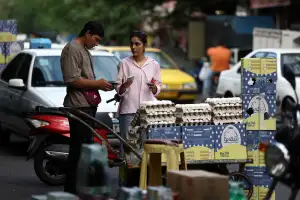
Petty thefts of basic food items are becoming a symbol of Iran's economic hardship, according to a newspaper investigation published on Wednesday that linked supermarket shoplifting to inflation and shrinking purchasing power.
Unlike the corruption scandals that have long dominated headlines in Iran, the report by Jahan-e Sanat focuses on thefts measured not in billions of rials but in loaves of bread, packages of cheese and cuts of meat.
It argues that cases involving everyday groceries are increasingly reflecting economic distress rather than simple criminality.
"There are no billions of tomans, no gold, no luxury villas," the newspaper wrote. "Sometimes it is only a can of cheese, a loaf of bread or a few simple food items."
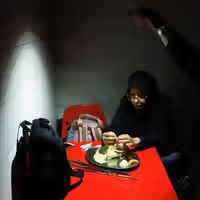
Days before Jahan-e Sanat published its report, CCTV footage from outside a minimarket at night in the northern city of Babolsar spread widely across Persian-language social media.
The footage appears to show a woman wearing a black chador approaching a display of boxed goods outside the shop. After pausing beside the display and glancing around, she appears to pick up one of the boxes before walking away.
Exactly what prompted the woman's actions remains unknown. But for many Iranians, the clip became less about one apparent shoplifting than about the growing struggle to afford everyday necessities.
"May God never let anyone feel ashamed in front of their family," one user wrote.
"This is what happens when prices keep rising. We live in a country rich in oil and gold, yet the government cannot provide for 87 million people," another commented.
"People simply cannot afford to buy things anymore because prices have become so expensive," another wrote.
Others pleaded with whoever shared the footage not to expose the woman's identity.
"Who would steal a few groceries unless driven by poverty and hunger? God help them," one commenter wrote.
"Maybe she had no money to buy food for her children. The shopkeeper should have protected her dignity instead of exposing her," another said.
Some comments contrasted the apparent theft with what they described as large-scale corruption, arguing authorities should focus on powerful figures accused of enriching themselves rather than people taking everyday necessities.
The sympathy expressed online echoed account gathered by Jahan-e Sanat from a supermarket employee who described an apparent increase in customers taking inexpensive food items.
Behind the supermarket shelves
Amirhossein, an employee at a large supermarket chain, told the newspaper he had witnessed several such incidents during the past 10 months.
He recalled seeing a woman place two tubs of cheese into her handbag during a busy period before leaving without paying. In another case, he said, security camera footage later showed a man leaving with butter, cakes and pastries concealed beneath his coat.
Staff also stopped a customer who had eaten packaged cakes inside the store and hidden the empty wrappers before trying to leave, according to the employee.
Perhaps most surprising, Amirhossein said, was a regular customer who was caught taking a package of meat.
"I think poverty is the main reason," he told Jahan-e Sanat. "You cannot judge everyone the same way, but when someone steals a simple item, they are probably under enormous pressure. Sometimes, if what was taken has little financial value, we don't pursue it because we think the person's circumstances may have brought them to this point."
'A crisis of livelihoods'
Sociologist Mostafa Abroshan said reports of thefts involving bread, dairy products and other essentials should be viewed in the context of Iran's prolonged economic difficulties.
"Thefts of basic goods, especially food and other necessities, reflect disruptions in economic structures and the declining ability of households to meet their basic needs," he told the newspaper.
"This does not justify theft, but it shows that people's behavior must be understood within its social context."
Abroshan said inflation, declining purchasing power and job insecurity had left many households struggling to afford essential goods.
"A society in which stealing bread, milk or rice becomes more common is facing a crisis of livelihoods and social justice more than a security crisis," he said.
Prolonged economic hardship, he warned, could also erode social trust, leaving retailers more suspicious of customers, increasing security costs and weakening confidence in public institutions.
While enforcing the law remains necessary, Abroshan said that reducing poverty, controlling inflation, creating jobs and strengthening social support would do more to curb petty theft than harsher punishment alone.
Without addressing the economic pressures facing low-income households, he said, the theft of everyday groceries risks becoming an increasingly visible measure of Iran's widening cost-of-living crisis.
Iran has intensified its repression of ethnic minorities, particularly Kurdish and Baluch communities, through arbitrary arrests, enforced disappearances and executions, a group of UN human rights experts said on Thursday.
The experts said at least 24 members of the Baluch minority and 22 members of the Kurdish minority had been executed in 2026, with many more at imminent risk of execution.
“Iran’s ethnic minorities must be able to live in safety and dignity, free from discrimination,” the experts said in a statement.
Kurds are concentrated mainly in western and northwestern Iran, while many of Iran's Baluch population live in the southeastern province of Sistan-Baluchistan. Both predominantly Sunni communities have long faced political, economic and security pressure from the Shiite-led authorities, according to rights groups.
“Reports point to a significant increase in arbitrary arrests, and what appears to be politically motivated sentences,” the experts said, adding that members of ethnic minorities were often detained under broadly defined national security charges.
The experts said a 2025 law expanding the definition of espionage, along with offenses including moharebeh, or “enmity against God,” efsad-fil-arz, or “spreading corruption on earth,” and baghi, or armed rebellion against the Islamic Republic, had been used particularly against Kurds.
They described the laws as “a tool to repress dissent.”
Executions rise
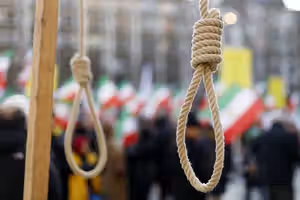
Thursday’s warning comes a day after UN human rights chief Volker Türk said Iran had executed at least 56 people on national security-related charges since March 19, including 27 in cases linked to protests earlier this year.
Türk said executions and death sentences had risen since March and that more than 100 other people faced similar charges and the death penalty.
The figures follow a series of executions in recent weeks involving young people detained over the January protests.
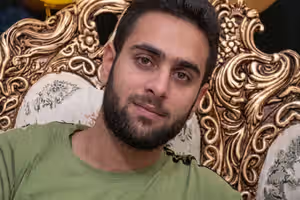
Iranian authorities executed 20-year-old Arvin Kheirkhah at Shahroud prison on Saturday after he was sentenced to death over his involvement in the protests, according to information obtained by Iran International.
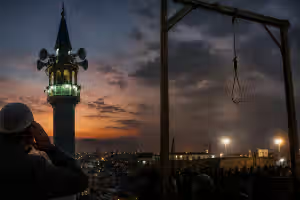
Days earlier, authorities hanged Amirhossein Safari and Abolfazl Sepahi in Isfahan’s Alikhani Square. They were among 12 young men sentenced to death in a case stemming from protests there in January.
A group of UN human rights experts led by Mai Sato, the UN Special Rapporteur on the situation of human rights in Iran, had urged Tehran to halt executions in the Isfahan case, citing concerns about closed proceedings, alleged ill-treatment and the use of confessions broadcast on state television.
Türk urged Iranian authorities to halt all executions and move towards abolishing the death penalty.
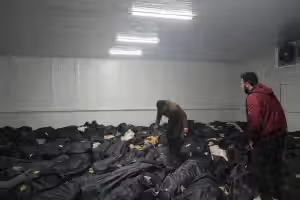
Iranian President Masoud Pezeshkian rejected reports that tens of thousands of people were killed in the January protest crackdown, accusing those publishing higher death tolls of misleading the public.
In an interview published on Thursday, Pezeshkian acknowledged that thousands had been killed but rejected estimates putting the toll at 30,000 to 60,000.
“Some media outlets and journalists said that 40,000 or 60,000 people were killed in Iran,” Pezeshkian said.
He said authorities responded by publishing names and national identification numbers of those they said had been killed and inviting people to provide names that were missing.
“But those sitting outside the country, presenting themselves as concerned, informed and sometimes as intellectuals and academics, turned a figure of around 3,000 into 30,000 or 40,000 and misled public opinion,” he said.
Pezeshkian described those behind the higher estimates as “cowards” and “traitors to the country.”
Trump figure rejected
Pezeshkian also rejected US President Donald Trump's account of the crackdown.
Trump said at a NATO summit in Ankara in July that Iranian authorities had killed 54,000 protesters and argued that the scale of the killings had prevented demonstrators from overthrowing the Islamic Republic.
“They can’t take over because they’re dead. They killed them,” Trump said at the time.
Pezeshkian said Trump had acknowledged that protesters had received outside support, accusing Washington of seeking to exploit unrest inside Iran.
“Trump himself explicitly said that they had armed these people and supported them, so it was clear what their objective was,” Pezeshkian said.
Trump's comments cited above, however, described the protesters as unarmed and Iranian security forces as having machine guns.
Pezeshkian acknowledged that some of those involved in the protests had legitimate grievances and that innocent people had been caught up in the violence.
“We had problems, and we still have them,” he said. “Some people were legitimately raising their problems, but another group wanted to use this environment to pursue their sinister objectives.”
He also acknowledged failures in the authorities' handling of the unrest.
“Because we were not sufficiently prepared to manage the situation, many people were harmed,” Pezeshkian said. “Many young people lost their lives and others lost parts of their bodies.”
“We should not have allowed things to reach this point,” he added.
Iran International reported in January that more than 36,500 people were killed by security forces during the January 8-9 crackdown, based on classified documents, field reports and accounts from medical workers, witnesses and victims' families reviewed by its Editorial Board.
The figure included information from internal Iranian government and security documents.
Remarks draw backlash
Pezeshkian's comments prompted criticism from government opponents and some Iranians who challenged both his death toll and his description of people reporting higher figures as traitors.
Mehdi Mahmoudian, a human rights activist and former political prisoner, called on Pezeshkian to explain responsibility for the deaths that the president himself acknowledged.
“Please explain who killed those several thousand people whose deaths you yourself do not deny, and what should the perpetrators of this crime be called?” Mahmoudian wrote on X.
A previously published account by dissident cleric Mojtaba Lotfi was also recirculated following Pezeshkian's remarks. Lotfi said local checks in his hometown of Najafabad had identified at least 30 names missing from the government's list of those killed, arguing that the official count was incomplete.
Iran International also received messages from citizens disputing Pezeshkian's account and criticizing his comments, with some saying that disagreements over the final number did not justify the killing of protesters.