Iran says shipping route coordinates agreed in Hormuz talks with Oman

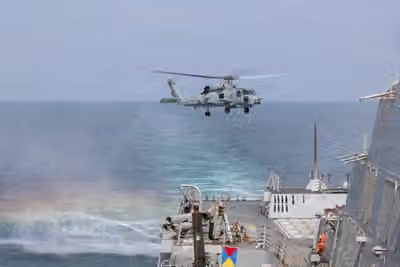
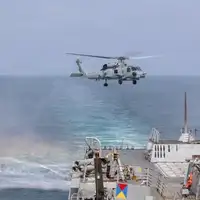
Iran and Oman have agreed on the geographical coordinates of a proposed safe commercial shipping route through the Strait of Hormuz and are finalizing a joint statement, Iranian Foreign Ministry spokesperson Esmaeil Baghaei said on Wednesday.
“Provided that certain third parties do not obstruct the process, a joint statement by the two countries outlining the main considerations and points agreed upon is also being reviewed and finalized,” Baghaei said.
He said talks between Iran and Oman, the two coastal states of the strait, had been underway for the past two months, with the route’s technical, legal, security and environmental aspects examined by the relevant Iranian authorities.
“An understanding with Oman cannot, in itself, mean that the strait has become safe for passing vessels, because the factors creating insecurity in the Strait of Hormuz — particularly the US naval blockade and other actions against Iran and its interests — remain in place,” he added.
Asked about possible visits by Parliament Speaker Mohammad-Bagher Ghalibaf or Foreign Minister Abbas Araghchi to Pakistan or Qatar, Baghaei said no such trips were planned.
He said Pakistan and Qatar were continuing efforts to reduce tensions and that Iran remained in contact and exchanged views with both countries.





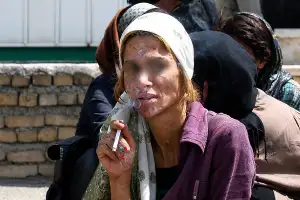
The use of nas has become increasingly common among students, particularly in middle school, said Mostafa Mohammadpour, head of the state Welfare Organization office in the northeastern city of Kashmar. In some cases, he added, children in the upper years of primary school have begun using it.
"What has now become common among students and paves the way for drug dependence starts with the use of nas," Mohammadpour said. "Unfortunately, children have very easy access to it because selling it is not considered a crime and it is not recognized as a narcotic."
Nas, known across the region as naswar, is a moist green tobacco mixture held under the lip or tongue. It is a centuries-old habit in eastern Iran, Afghanistan and Central Asia, and because it produces no smoke, a child can use it in a classroom without anyone noticing.
'Why don't they stop it?'
The warning drew a wave of responses from users reacting to Iran International's coverage, many asking why the product remains on open sale despite years of warnings about its risks.
"Why don't they stop it from being distributed?" one commenter asked.
Another argued the answer lies in giving children somewhere else to go. "Municipalities should build at least three sports complexes for students in every district and make them free. School facilities should also be improved so students stay occupied and don't turn to it," the commenter wrote.
Others aimed their frustration at official indifference. "Do they even care what happens to young people?" one wrote.
Some tied the issue to wider political grievances. One X user alleged that the authorities allow addiction to spread among the young to blunt political activism, and wrote that nas "causes addiction quickly," "causes cancer in the mouth" and "damages teeth," adding a claim, which could not be independently verified, that products sold in Iran contain arsenic.
Within every child's reach
Because nas is not classified as an illegal narcotic, it sits on the shelves of small shops, and students obtain it with little difficulty, according to Mohammadpour.
The habit is most entrenched in the northeastern province of Razavi Khorasan, he said, but is no longer confined to one region, with nas now readily available across much of the country.
Tehran is no exception. Iranian media have reported vendors openly selling nas in and around the capital's Molavi market, the green tobacco displayed in packages large and small under a variety of brands.
The market draws buyers with lower prices and a wider selection, though the product is also sold through herbal shops across the city.
For children, the attraction is obvious: it is cheap, easy to hide and everywhere.
More than a tobacco habit
Doctors warn the risks run well beyond nicotine.
Research has linked nas to cancers of the mouth, esophagus and pancreas, as well as cardiovascular disease. Health experts also reject the belief that smokeless tobacco is a safe alternative to cigarettes, warning that no tobacco product is without risk.
The spread among students carries a further danger: early exposure to nicotine can leave children more vulnerable to addiction of every kind later in life, the concern at the heart of Mohammadpour's "gateway" warning.
A country's changing addictions
The warning lands against a wider shift in substance use in Iran.
More than 4.4 million people in Iran use narcotics regularly or occasionally, according to a report last year in the daily Shargh, which estimated that, counting their families, some 15 million people live with the consequences of drug use.
Officials and health experts have also pointed to rising use of synthetic drugs, a falling age of first use, and growing numbers of women and young people among users, signs that addiction in Iran is getting younger.
The children with green packs in their pockets, on this reading, are not an anomaly but the leading edge.
The action by Bank of Industry and Mine (BIM) comes despite domestic statutory provisions extending NIOC’s debt repayment deadlines through the end of the current Iranian fiscal year in March 2027, Fars reported, without giving the size of the debt or saying when the accounts were frozen.
The bank is a government-owned lender that mainly finances industrial and mining projects.
The apparent mismatch between the repayment timetable and the freezing of the accounts was not explained by Fars.
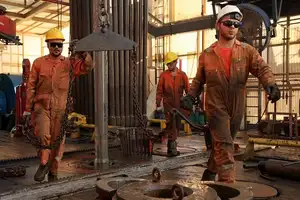
NIOC, overseen by Iran's Ministry of Petroleum, sits at the center of the country's energy industry, managing much of its oil exploration, production and exports and providing a major source of revenue.
Later on Wednesday, an NIOC financial official told the Tasnim news agency that the company had been in a dispute with Iran's tax authorities over electronic reporting requirements.
Morteza Rouhi, a tax official in NIOC's financial management division, said state-budgeted companies such as NIOC hold some information they are not permitted to disclose, including details related to oil exports, while tax rules require companies to register sales and transactions electronically.
“The oil and economy ministers held a meeting, after which the president’s legal office intervened and ordered a halt to enforcement. We now have no concerns about the National Iranian Oil Company’s accounts being frozen,” Rouhi said.
Sanctions and domestic pressure
Fars said the accounts were frozen over debt but also pointed in the same report to financial restrictions previously imposed on NIOC by the US Treasury. The bank itself was sanctioned in 2018.
The reference is notable because Washington's restrictions on NIOC have themselves been tied to the company's relationship with the Revolutionary Guards.
The US Treasury determined in 2012 that NIOC was an agent or affiliate of the Islamic Revolutionary Guard Corps and in 2020 designated the company under counterterrorism authorities over what it said was NIOC's support for the IRGC's Quds Force.
NIOC is nevertheless formally overseen by Iran's Ministry of Petroleum and sits at the heart of the state economy, managing much of the country's oil production and exports.
The account freeze therefore puts a domestic financial restriction on a government-controlled company whose international financial finances have been affected by its links to the IRGC, as described by the US Treasury.
Fault lines in Tehran
The action also comes as the war and negotiations with Washington have made divisions among Iran's centers of power increasingly public.
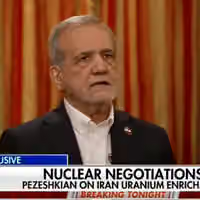
Those divisions do not fall neatly between the government and the IRGC. President Masoud Pezeshkian and officials involved in diplomacy, including Foreign Minister Abbas Araghchi and Parliament Speaker Mohammad Bagher Ghalibaf, have faced pressure from hardline lawmakers, media and political groups opposed to concessions to Washington.
Ghalibaf, himself a former senior IRGC commander, has faced criticism from ultra-hardliners over his role in negotiations. Lawmakers have also stepped up pressure on Araghchi to disclose details of the US talks, with one senior lawmaker saying this week that parliamentarians were gathering material for a possible impeachment effort against the foreign minister.
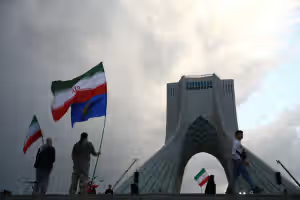
The divisions have also surfaced among pro-government supporters mobilized on the streets during the war, a constituency sometimes referred to as the "meydan," or field.
Ghalibaf has emphasized the authorities' role in that mobilization, saying officials called supporters onto the streets after news of former Supreme Leader Ali Khamenei's death because they feared the situation could otherwise take a “different turn”.
Some of those gatherings later became platforms for opposition to negotiations and criticism of Ghalibaf, Araghchi and other officials involved in talks with Washington, turning a show of establishment support into another source of pressure over diplomacy.
Araghchi has suggested that foreign intelligence operations could exploit such internal vulnerabilities.
In a recent interview, he said they could seek not only to gather information but also to influence Iran's decision-making and shape its psychological environment and public perceptions.
The NIOC account freeze has not been linked to those political disputes. But it comes as the strains of war, US sanctions and renewed diplomacy increasingly expose tensions among the government, security establishment and other centers of power within the Islamic Republic.
Türk said executions and death sentences had risen since March, with more than 100 other people facing similar charges and the death penalty.
He urged Iranian authorities to halt all executions and move towards abolishing the death penalty.
The figures come after a series of executions in recent weeks of young people detained over the January protests, some of which drew gatherings by relatives and members of the public seeking to stop the sentences from being carried out.
Protesters executed
Iranian authorities executed 20-year-old Arvin Kheirkhah at Shahroud prison on Saturday after he was sentenced to death over his involvement in the January protests, according to information obtained by Iran International.
Kheirkhah had been convicted by a Revolutionary Court on charges including moharebeh, or "waging war against God."
His family gathered outside Shahroud prison on Friday night in an effort to stop the execution, according to Iran International. In a final conversation with his family, Kheirkhah urged them not to let him be forgotten.
His execution came days after authorities hanged Amirhossein Safari and Abolfazl Sepahi in Isfahan's Alikhani Square.
The two were among 12 young men sentenced to death in a case stemming from the January protests in the square. Iranian authorities accused the defendants of involvement in the deaths of four security personnel as well as arson and vandalism.
People gathered around the square overnight before the executions amid a heavy deployment of security forces.
Two other defendants in the same case, Golmohammad Mohammadi and Erfan Esfandiari, were executed on July 19, bringing the number put to death in the case to four.
Others remain under death sentences
A group of UN human rights experts, led by Mai Sato, the UN Special Rapporteur on the situation of human rights in Iran, urged Tehran in late July to halt the executions of defendants in the Isfahan case.
"Sentencing 12 people to death in one hearing, in a closed courtroom and without clarity as to each defendant's individual responsibility violates established fair trial standards," the UN experts said in a statement.
They said the defendants, aged from their late teens to early twenties, had reportedly faced arbitrary detention, enforced disappearance and, in some cases, ill-treatment.
The UN experts also raised concerns that convictions relied heavily on confessions broadcast on Iranian state television, while Revolutionary Court hearings were held behind closed doors and the judgments were not made public.
Average annual inflation has climbed to a record 62%, while year-on-year inflation has surged to 82%, rapidly eroding household purchasing power.
Food prices remain the principal driver of overall inflation, with annual food inflation staying in triple digits for a sixth consecutive month. In July, food inflation reached 134% nationwide and 140% in rural areas. More than two-thirds of the food items monitored by the statistical agency now exceed what economists describe as crisis-level inflation.
Prices have risen sharply across other sectors as well. Household appliances are estimated to cost 114% more than a year ago, while transportation costs have climbed 103%. Economists warn that a possible gasoline price increase could push food inflation even higher by raising distribution and delivery costs.
War or government policy?
Critics of President Masoud Pezeshkian’s government, many of whom also oppose an agreement with the United States, argue that the inflation surge is rooted entirely in domestic economic policy rather than the recent conflict.
Hojjat Abdolmaleki, labor minister under former president Ebrahim Raisi, dismissed any connection between the war and rising prices.
“The war has had no effect whatsoever on inflation. Inflation has risen steadily throughout the Pezeshkian Administration, and the war’s contribution to these price increases is zero,” he said.
“Virtually all of this inflation is the direct result of misguided policies and government incompetence. Even without the war, the situation would have been the same, perhaps even worse.”
Other economists reject that assessment, arguing that both domestic policy and the conflict have driven prices higher.
Mohammad Sadegh-Alhosseini told the Iranian Students News Agency (ISNA) that domestic policies could account for inflation of between 30% and 50%, but that the increase beyond that range was linked to international tensions and the war.
Mojtaba Yousefi, a member of parliament, also said it was inaccurate to claim that the war had no effect on prices. “But it is equally wrong to attribute all inflation to the war,” he said.
Economists also caution that even an agreement between Tehran and Washington, potentially unlocking frozen assets, easing sanctions, increasing oil revenue and reducing inflation expectations, would be unlikely to bring prices down quickly.
They say chronic budget deficits, entrenched corruption and structural inefficiencies are so deeply embedded that reversing them could take years.
Even if the fighting ends, the cost of rebuilding damaged infrastructure and industry would continue to strain public finances. Conservative politician Mohammad-Reza Bahonar recently estimated reconstruction costs at $200 billion.
Purchasing power continues to collapse
The inflation surge has increasingly affected ordinary Iranians. According to a report by the Iranian Labour News Agency (ILNA), during recent months even basic staples such as chicken, eggs and bread have become unaffordable for many working-class households. Bread prices alone have risen by between 100% and 140% on average.
Official data show that prices of at least eight food items have more than doubled over the past year. Cooking oil has risen 261%, while meat prices have increased 145%.
By comparison, ILNA wrote, the minimum wage has increased by only 60%, while salaries for civil servants, pensioners, nurses and teachers have risen by between 20% and 43%, averaging roughly 30%. As a result, many of these households no longer fit the conventional definition of the middle class, the report argued.
Government food vouchers introduced in January have also lost much of their purchasing power, as authorities have left their value unchanged despite soaring food prices.
Ahmad, a retired civil servant in Tehran, said the vouchers initially allowed him to buy around ten food items. "Now I can only afford three or four."
Social media has also reflected the growing financial strain. Users report increasing numbers of people selling, or even renting out, personal belongings such as electronic devices to cover daily expenses.
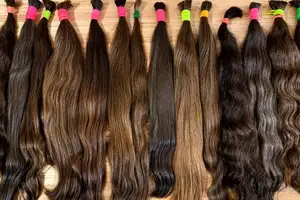
Journalist Azadeh Mokhtari wrote: "When advertisements for selling hair, or even renting laptops for online classes, become more common, it means the middle class is being worn away, and the lower-income class is being pushed out of the economy."
Misery index reaches new peak
The deteriorating economic environment is also reflected in Iran's misery index, the combined rate of annual inflation and unemployment.
With annual inflation at 62% and unemployment at 9.1% in the quarter ending in June, the misery index climbed to a record 71.1%, up from 64.2% in the previous quarter. The index stood at 56.6% during the same period in 2021.
The economic burden is not evenly distributed across the country. Several provinces have recorded misery index readings above 100%, with Lorestan registering the highest level at 121.5%.
Economists say the figures reflect not only declining purchasing power and weaker job security but also rising uncertainty that makes long-term financial planning increasingly difficult for households.