• العربية
  • فارسی
Brand
  • Iran Insight
  • Politics
  • Economy
  • Analysis
  • Special Report
  • Opinion
  • Podcast
  • Iran Insight
  • Politics
  • Economy
  • Analysis
  • Special Report
  • Opinion
  • Podcast
  • Theme
  • Language
    • العربية
    • فارسی
  • Iran Insight
  • Politics
  • Economy
  • Analysis
  • Special Report
  • Opinion
  • Podcast
All rights reserved for Volant Media UK Limited
volant media logo

Iran state bank freezes national oil company accounts over debt

Niloufar Goudarzi
Niloufar Goudarzi

Iran International

Aug 5, 2026, 12:59 GMT+1Updated: 14:36 GMT+1
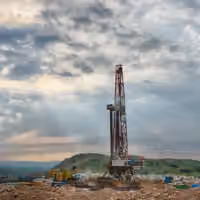
A view from Souroush oil filed in the Persian Gulf

An Iranian state-owned bank has frozen accounts belonging to the National Iranian Oil Company over outstanding debt obligations, the IRGC-affiliated Fars news agency reported on Wednesday.

The action by Bank of Industry and Mine (BIM) comes despite domestic statutory provisions extending NIOC’s debt repayment deadlines through the end of the current Iranian fiscal year in March 2027, Fars reported, without giving the size of the debt or saying when the accounts were frozen.

The bank is a government-owned lender that mainly finances industrial and mining projects.

The apparent mismatch between the repayment timetable and the freezing of the accounts was not explained by Fars.

NIOC, overseen by Iran's Ministry of Petroleum, sits at the center of the country's energy industry, managing much of its oil exploration, production and exports and providing a major source of revenue.

Later on Wednesday, an NIOC financial official told the Tasnim news agency that the company had been in a dispute with Iran's tax authorities over electronic reporting requirements.

Morteza Rouhi, a tax official in NIOC's financial management division, said state-budgeted companies such as NIOC hold some information they are not permitted to disclose, including details related to oil exports, while tax rules require companies to register sales and transactions electronically.

“The oil and economy ministers held a meeting, after which the president’s legal office intervened and ordered a halt to enforcement. We now have no concerns about the National Iranian Oil Company’s accounts being frozen,” Rouhi said.

Sanctions and domestic pressure

Fars said the accounts were frozen over debt but also pointed in the same report to financial restrictions previously imposed on NIOC by the US Treasury. The bank itself was sanctioned in 2018.

The reference is notable because Washington's restrictions on NIOC have themselves been tied to the company's relationship with the Revolutionary Guards.

The US Treasury determined in 2012 that NIOC was an agent or affiliate of the Islamic Revolutionary Guard Corps and in 2020 designated the company under counterterrorism authorities over what it said was NIOC's support for the IRGC's Quds Force.

NIOC is nevertheless formally overseen by Iran's Ministry of Petroleum and sits at the heart of the state economy, managing much of the country's oil production and exports.

The account freeze therefore puts a domestic financial restriction on a government-controlled company whose international financial finances have been affected by its links to the IRGC, as described by the US Treasury.

Fault lines in Tehran

The action also comes as the war and negotiations with Washington have made divisions among Iran's centers of power increasingly public.

Those divisions do not fall neatly between the government and the IRGC. President Masoud Pezeshkian and officials involved in diplomacy, including Foreign Minister Abbas Araghchi and Parliament Speaker Mohammad Bagher Ghalibaf, have faced pressure from hardline lawmakers, media and political groups opposed to concessions to Washington.

Ghalibaf, himself a former senior IRGC commander, has faced criticism from ultra-hardliners over his role in negotiations. Lawmakers have also stepped up pressure on Araghchi to disclose details of the US talks, with one senior lawmaker saying this week that parliamentarians were gathering material for a possible impeachment effort against the foreign minister.

The divisions have also surfaced among pro-government supporters mobilized on the streets during the war, a constituency sometimes referred to as the "meydan," or field.

Ghalibaf has emphasized the authorities' role in that mobilization, saying officials called supporters onto the streets after news of former Supreme Leader Ali Khamenei's death because they feared the situation could otherwise take a “different turn”.

Some of those gatherings later became platforms for opposition to negotiations and criticism of Ghalibaf, Araghchi and other officials involved in talks with Washington, turning a show of establishment support into another source of pressure over diplomacy.

Araghchi has suggested that foreign intelligence operations could exploit such internal vulnerabilities.

In a recent interview, he said they could seek not only to gather information but also to influence Iran's decision-making and shape its psychological environment and public perceptions.

The NIOC account freeze has not been linked to those political disputes. But it comes as the strains of war, US sanctions and renewed diplomacy increasingly expose tensions among the government, security establishment and other centers of power within the Islamic Republic.

Most Viewed

Tehran records heaviest damage in latest war, municipal report shows
1

Tehran records heaviest damage in latest war, municipal report shows

2
EXCLUSIVE

Iran's president met Mojtaba Khamenei in the back seat of a car

3

Khamenei warns Pezeshkian next resignation will be accepted, in-law says

4

Aramco sidesteps Hormuz as Iran crisis cuts flows to a tenth

5

US depleted 'virtually all' long-range precision missiles in Iran war - Reuters

Banner
Banner
Banner

Spotlight

  • Anti-Islam posts follow Iran's dawn executions, sparking hardline backlash

    Anti-Islam posts follow Iran's dawn executions, sparking hardline backlash

  • Why Afghans still risk death to reach Iran
    ANALYSIS

    Why Afghans still risk death to reach Iran

  • Iran's president met Mojtaba Khamenei in the back seat of a car
    EXCLUSIVE

    Iran's president met Mojtaba Khamenei in the back seat of a car

  • Trump's U-turn reopens Tehran's political faultline
    INSIGHT

    Trump's U-turn reopens Tehran's political faultline

  • Deny first, negotiate later, Tehran's familiar diplomacy
    INSIGHT

    Deny first, negotiate later, Tehran's familiar diplomacy

  • Iran managing the inflation statistic, not the inflation
    ANALYSIS

    Iran managing the inflation statistic, not the inflation

  • Beyond espionage: Araghchi says spies seek to shape Iran's decisions

    Beyond espionage: Araghchi says spies seek to shape Iran's decisions

  • Ghalibaf reveals Tehran feared street unrest after Iran International broke Khamenei news

    Ghalibaf reveals Tehran feared street unrest after Iran International broke Khamenei news

  • Scandal rocks Iran's secret oil money network as billions go 'missing'

    Scandal rocks Iran's secret oil money network as billions go 'missing'

  • Who speaks for Iran: What the public rift means, and what it hides

    Who speaks for Iran: What the public rift means, and what it hides

  • Iran sidelines ultra-hardliners from pro-government nightly rallies

    Iran sidelines ultra-hardliners from pro-government nightly rallies

•
•
•

More Stories

War or government failure? Record inflation fuels political battle in Iran

Aug 5, 2026, 09:10 GMT+1
•
Maryam Sinaiee
100%

The latest figures released by the Statistical Center of Iran offer the starkest assessment yet of the country's economy, as record inflation intensifies debate over whether the war or government mismanagement is primarily to blame.

Average annual inflation has climbed to a record 62%, while year-on-year inflation has surged to 82%, rapidly eroding household purchasing power.

Food prices remain the principal driver of overall inflation, with annual food inflation staying in triple digits for a sixth consecutive month. In July, food inflation reached 134% nationwide and 140% in rural areas. More than two-thirds of the food items monitored by the statistical agency now exceed what economists describe as crisis-level inflation.

Prices have risen sharply across other sectors as well. Household appliances are estimated to cost 114% more than a year ago, while transportation costs have climbed 103%. Economists warn that a possible gasoline price increase could push food inflation even higher by raising distribution and delivery costs.

War or government policy?

Critics of President Masoud Pezeshkian’s government, many of whom also oppose an agreement with the United States, argue that the inflation surge is rooted entirely in domestic economic policy rather than the recent conflict.

Hojjat Abdolmaleki, labor minister under former president Ebrahim Raisi, dismissed any connection between the war and rising prices.

“The war has had no effect whatsoever on inflation. Inflation has risen steadily throughout the Pezeshkian Administration, and the war’s contribution to these price increases is zero,” he said.

“Virtually all of this inflation is the direct result of misguided policies and government incompetence. Even without the war, the situation would have been the same, perhaps even worse.”

Other economists reject that assessment, arguing that both domestic policy and the conflict have driven prices higher.

Mohammad Sadegh-Alhosseini told the Iranian Students News Agency (ISNA) that domestic policies could account for inflation of between 30% and 50%, but that the increase beyond that range was linked to international tensions and the war.

Mojtaba Yousefi, a member of parliament, also said it was inaccurate to claim that the war had no effect on prices. “But it is equally wrong to attribute all inflation to the war,” he said.

Economists also caution that even an agreement between Tehran and Washington, potentially unlocking frozen assets, easing sanctions, increasing oil revenue and reducing inflation expectations, would be unlikely to bring prices down quickly.

They say chronic budget deficits, entrenched corruption and structural inefficiencies are so deeply embedded that reversing them could take years.

Even if the fighting ends, the cost of rebuilding damaged infrastructure and industry would continue to strain public finances. Conservative politician Mohammad-Reza Bahonar recently estimated reconstruction costs at $200 billion.

Purchasing power continues to collapse

The inflation surge has increasingly affected ordinary Iranians. According to a report by the Iranian Labour News Agency (ILNA), during recent months even basic staples such as chicken, eggs and bread have become unaffordable for many working-class households. Bread prices alone have risen by between 100% and 140% on average.

Official data show that prices of at least eight food items have more than doubled over the past year. Cooking oil has risen 261%, while meat prices have increased 145%.

By comparison, ILNA wrote, the minimum wage has increased by only 60%, while salaries for civil servants, pensioners, nurses and teachers have risen by between 20% and 43%, averaging roughly 30%. As a result, many of these households no longer fit the conventional definition of the middle class, the report argued.

Government food vouchers introduced in January have also lost much of their purchasing power, as authorities have left their value unchanged despite soaring food prices.

Ahmad, a retired civil servant in Tehran, said the vouchers initially allowed him to buy around ten food items. "Now I can only afford three or four."

Social media has also reflected the growing financial strain. Users report increasing numbers of people selling, or even renting out, personal belongings such as electronic devices to cover daily expenses.

  • Economic crisis drives Iranians to sell hair, rent laptops

    Economic crisis drives Iranians to sell hair, rent laptops

Journalist Azadeh Mokhtari wrote: "When advertisements for selling hair, or even renting laptops for online classes, become more common, it means the middle class is being worn away, and the lower-income class is being pushed out of the economy."

Misery index reaches new peak

The deteriorating economic environment is also reflected in Iran's misery index, the combined rate of annual inflation and unemployment.

With annual inflation at 62% and unemployment at 9.1% in the quarter ending in June, the misery index climbed to a record 71.1%, up from 64.2% in the previous quarter. The index stood at 56.6% during the same period in 2021.

The economic burden is not evenly distributed across the country. Several provinces have recorded misery index readings above 100%, with Lorestan registering the highest level at 121.5%.

Economists say the figures reflect not only declining purchasing power and weaker job security but also rising uncertainty that makes long-term financial planning increasingly difficult for households.

Iran eyes Pakistani ports as route around US blockade

Aug 4, 2026, 18:55 GMT+1
100%
A soldier stands guard beside the Cosco Wellington, the first container ship to depart after the inauguration of the China Pakistan Economic Corridor port in Gwadar, Pakistan November 13, 2016.

Iran is exploring using two of Pakistan’s ports to keep trade moving amid the US blockade of its own ports, a senior Iranian official said on Tuesday.

Mohammad-Ali Dehghan Dehnavi, head of Iran’s Trade Promotion Organization, said Karachi and Gwadar could serve as hubs for re-exporting Iranian goods to third countries. He said Pakistan could also supply Iran with essential goods and industrial raw materials.

The comments came during a visit to Islamabad alongside Iranian Industry, Mine and Trade Minister Mohammad Atabak for bilateral trade talks.

Pakistan and Iran said they would work toward increasing trade to $10 billion, advancing a free trade agreement and removing barriers involving customs, border logistics and cargo movement.

100%
Iranian and Pakistani officials attend a bilateral trade meeting in Islamabad, Pakistan, Aug. 4, 2026.

Pakistan emerged as a key mediator after US-Israeli strikes on Feb. 28 triggered the Iran war and Tehran largely closed the Strait of Hormuz. When Pakistan-hosted US-Iran talks ended without a breakthrough on April 13, President Donald Trump ordered a blockade of maritime traffic entering and leaving Iranian ports.

The blockade ended on June 18 under an interim agreement mediated by Pakistan but was reinstated on July 14 after the deal began to unravel and fighting resumed.

Traffic through the Strait of Hormuz remains severely restricted. Kpler data showed only six vessels — three tankers and three bulk carriers — passed through the waterway on Monday, down from seven on Sunday, with all six using the route through Iranian waters.

On April 22, the US president said the naval blockade was costing Iran $500 million a day, while the War Department estimated that Tehran had lost $4.8 billion in oil revenue by May 1.

A Friday report by The Telegraph said the United States and Israel are weighing a possible land blockade of Iran to deepen its economic isolation, as President Trump reportedly believes the naval blockade in the Strait of Hormuz has achieved all it can.

Trump discussed the proposal with Israeli Prime Minister Benjamin Netanyahu during their meeting in Washington last Tuesday, alongside several other military and non-military options, according to the report.

A senior Israeli official suggested sealing Iran’s land routes to prevent goods from entering or leaving the country, saying such pressure could produce unpredictable consequences.

Iran shares extensive land borders with Iraq, Turkey, Afghanistan, Pakistan, Turkmenistan, Azerbaijan and Armenia.

Aramco sidesteps Hormuz as Iran crisis cuts flows to a tenth

Aug 4, 2026, 09:34 GMT+1
100%
General view of Saudi Aramco's Ras Tanura oil refinery and oil terminal in Saudi Arabia.

Saudi Aramco is routing crude around the Strait of Hormuz via its East-West pipeline as the Iran-related crisis has cut shipping through the strait to a tenth of pre-conflict levels, Chief Executive Amin Nasser said on Tuesday.

"The ongoing geopolitical crisis continues to aggravate the biggest supply shock in history," Nasser said, as the Saudi oil giant reported a 42% jump in second-quarter profit.

"We continue to optimize the flexibility of the East-West pipeline," Nasser said.

The pipeline gives Saudi Arabia an alternative route for crude exports, carrying oil from the kingdom's main producing areas in the east to the Red Sea and away from the Strait of Hormuz.

Nasser said Aramco had "managed risks effectively for some time" and that the Saudi government was also working to address risks to oil shipments.

"The government is tackling this risk and that has never limited our option to go through Bab el-Mandab," he said.

Aramco's East-West pipeline and global inventories have helped ease the supply shock caused by the crisis, lowering the net loss to around 1.8 billion barrels, Nasser said.

Strait losses mount weekly

"Current trade flows through the Strait of Hormuz are at a tenth of pre-conflict levels and the world will continue to lose more than 100 million barrels for each week the strait is closed," Nasser said.

The world has lost more than 2.6 billion barrels of oil destined for a number of critical industries as a result of the crisis, he said.

An average of 11 million barrels per day of liquids supply had been removed, while Asia's crude oil imports fell by around 6 million barrels per day at the peak of the crisis, Nasser said.

"If the strait were open today it would take up to 18 months at an average rate of 2.1 million barrels a day to replenish depleted inventories," he said.

Nasser also warned that pressure was building elsewhere in the global energy system, saying the global refining system was "stretched heavily."

"There is a disconnect between futures and physical markets," Nasser said, pointing to strong refining margins that reflected tightness in refined products.

"If refineries were to suffer any major unplanned or prolonged shutdown the global energy supply system could face more severe pressure," he said.

Nasser said Aramco continued to hope for "a resolution that restores normal shipping and stabilizes the market," but warned that a recovery would not be immediate.

"Normalization will take time," he said.

Iran managing the inflation statistic, not the inflation

Aug 3, 2026, 21:00 GMT+1
•
Mohamad Machine-Chian
100%

A month-long banking outage helped Iran’s Central Bank claim inflation had nearly halved, even as prices stood 84 percent higher than a year earlier and food costs continued to rise sharply.

In late July, the governor of Iran's central bank, Abdolnaser Hemmati, announced a victory: monthly inflation, he said, had been nearly halved in a single month — from 7.4 percent in the month ending June 21 to 3.6 percent in the month ending July 22 — thanks to “measures and tools at the bank’s disposal.” He did not name a single tool.

Numbers like these need translation. Monthly inflation is a standard statistic everywhere, but in Iran it is the number people live by: when prices move this fast, the month-to-month change is what a household actually feels at the store.

By the central bank’s own report, prices are now about 84 percent higher than a year ago. Even the “victory” month is nothing to celebrate: 3.6 percent, repeated for 12 months, compounds to an annual rate above 50 percent.

What the announcement omitted is that for almost exactly that statistical month, Iranians could not use their banks.

On June 13, electronic services failed at four major state banks. The state-linked company that runs their infrastructure claimed a cyberattack and said it had taken backup systems offline as a precaution, while official promises of a fix kept slipping.

On June 23, a second wave hit eight banks. Card readers went dead and banking apps would not load in a country where everyday life runs on debit cards, leaving millions of people unable to reach their own money for weeks.

Bank Melli, one of Iran’s largest banks, later waived late-payment penalties for a precisely defined window: June 13 to July 14. That amounted to a full month of disruption, by the bank’s own admission.

The same month piled on more. The state semi-shut the country for about a week in early July for Ali Khamenei’s funeral ceremonies. In the second week of July, fighting with the United States resumed and the naval blockade of Iran’s ports returned.

Extreme heat and a failing power grid then closed offices and banks in several provinces in the final week. In a month like that, a great many purchases simply never happened — not because prices had calmed, but because buying was impossible. A purchase that cannot happen puts no pressure on prices.

The central bank’s own report records the tell. Food inflation — groceries, the most card-dependent of all purchases — collapsed from 8.7 percent to 1.8 percent.

The dials the governor did not mention moved the other way: prices versus a year earlier accelerated, and the 12-month average rose from 57.7 to 61.4 percent.

Street prices told the same story. The announced consumer price of a carton of eggs rose about 20 percent between late May and mid-July, roughly double the official inflation rate for the same stretch.

Halving an inflation rate ordinarily requires tight money sustained over a long period. In Iran’s case, no tightening of any kind occurred: deposit rates did not move until late July, liquidity kept growing rapidly, and there was no sign of fiscal restraint.

A central bank that possessed a painless one-month cure would also need to explain why it kept that cure in the drawer while annual inflation has averaged above 40 percent over the past five years.

There is an old warning in economics, associated with the British economist Charles Goodhart, that when a measure becomes a target, it ceases to be a good measure. Iran’s monthly inflation rate has now completed that journey.

In July, it stopped measuring price pressure in the Iranian economy and began measuring something else: the downtime of the country’s payment system.

A government can manage inflation, or it can manage the inflation statistic. Only one of these shows up at the grocery store.

Economic crisis drives Iranians to sell hair, rent laptops

Aug 3, 2026, 11:27 GMT+1
100%

Iranian households are increasingly selling personal belongings ranging from natural hair to empty perfume bottles and renting out or borrowing basic work tools such as laptops, reflecting deepening economic hardship, the semi-official ILNA news agency reported on Sunday.

The report described the trend as the emergence of a "survival economy," in which even the smallest household possessions have become tradable assets as families struggle with soaring inflation and shrinking purchasing power.

Online classified advertisements, according to ILNA, increasingly feature offers to sell used work shoes and clothing, empty perfume bottles and natural hair for extensions, alongside listings advertising the rental of property deeds, salary slips and other financial guarantees.

From laptops to perfume bottles

The agency also highlighted growing demand for laptop rentals, with users seeking temporary access to devices for basic tasks such as typing documents, using Microsoft Office software or attending online classes.

"What may initially appear strange or even humorous actually reflects declining purchasing power, changing consumption patterns and households' efforts to generate cash," ILNA wrote.

The shift, The report said, illustrates how ownership is increasingly giving way to renting, while everyday items are being used until the very end of their economic value.

  • Where steak is a dream

    Where steak is a dream

The findings come as inflation continues to weigh on Iranian households. According to the Statistical Center of Iran, annual inflation reached 66% in the Iranian month ending in late July, while year-on-year inflation stood at 87.9%.

A 'survival economy'

The growing number of advertisements, the report said, reflects a broader transformation in household finances, where assets once considered worthless or purely personal are increasingly being converted into immediate sources of income.

The agency said many sellers now bundle together low-value household items to improve their chances of making a sale, while advertisements offering natural hair have also become more common, with prices ranging from negotiable sums to several million rials depending on length, color and quality.

The report follows other recent signs of mounting financial pressure, including the spread of installment payments for healthcare and pharmaceuticals, as many Iranian families struggle to cover everyday expenses.

  • Iranians borrow for medicine while state shields Arbaeen healthcare

    Iranians borrow for medicine while state shields Arbaeen healthcare

The expansion of the market for second-hand goods, rentals and personal assets, ILNA said, reflects a growing effort by households to generate cash in an economy where almost anything can become a source of income.