Guards ground forces ready for new attack, lawmaker says
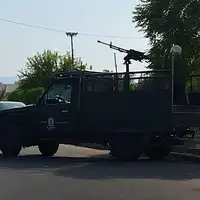
Iran's armed forces, particularly the Revolutionary Guards' ground forces, are fully prepared to respond if the enemy launches another attack, parliamentary National Security Committee spokesperson Hassan Ghashghavi said on Friday.
Ghashghavi said the committee met with the commander of an IRGC ground forces headquarters, who briefed lawmakers on the latest deployment of what he described as hostile forces and outlined plans for pre-emptive strikes and defensive operations in the event of any new attack on Iran.
Satellite image shows extensive destruction at Ali Khamenei's compound in Tehran after the US-Israeli airstrike on Feb. 28 that killed Khamenei and several senior military commanders.
A meeting at Ali Khamenei's office where he was killed in February was focused on preparations to manage future protests as well as responding to what officials believed was an imminent US-Israeli attack, according to Noor News, a security-linked media outlet.
The report, published on Friday, followed recent remarks by Foreign Minister Abbas Araghchi, who said the US-Israeli attack that killed Khamenei and several senior military commanders did not occur during a full meeting of Iran's Defense Council. Instead, Araghchi said, a subordinate committee of the council, chaired by the council's secretary, was meeting at the time.
According to Noor News, the committee was chaired by Ali Shamkhani and was discussing the implementation of a comprehensive plan to organize resources, personnel, structures and equipment to manage future protests, while also assessing what participants believed was an imminent US-Israeli attack on Iran.
Protest response and military planning
The outlet said officials viewed the country as facing a "multi-layered threat" combining foreign military action with the prospect of domestic unrest, making preparations for both scenarios a priority.
The protest management plan, Noor News wrote, gained urgency after nationwide protests in January 2026. Khamenei, it added, rejected a proposal to transfer responsibility for the plan to the Supreme National Security Council's secretariat and instead instructed Shamkhani to oversee its implementation until its completion.
Khamenei and Shamkhani, the report added, also emphasized reducing casualties among civilians and protesters during demonstrations, leading to the development of new equipment and procedures for managing public gatherings.
The January protests were triggered by soaring prices, a collapsing currency and deep public anger toward the Islamic Republic. What began as an economic protest quickly evolved into a nationwide political crisis, prompting one of the most intense crackdowns in the Islamic Republic’s history.
Authorities responded with internet shutdowns, mass arrests and a violent crackdown. More than 36,500 Iranians were killed by security forces during the nationwide crackdown on January 8 and 9, according to classified government documents and other evidence reviewed by Iran International's Editorial Board.
The strike began while the committee was in session, killing Shamkhani and several senior military commanders, according to Noor News. The outlet said the meeting was intended to prepare for what participants believed would be simultaneous external military action and internal unrest.
Khamenei was killed on February 28 in the opening hours of the US-Israeli war against Iran. He died in a coordinated airstrike targeting his heavily fortified compound in Tehran as part of a broader operation aimed at decapitating Iran's military and political leadership. Satellite imagery later showed extensive destruction at the compound.
Khamenei, who had ruled Iran since 1989, was 86. The Assembly of Experts subsequently appointed his son, Mojtaba Khamenei, as Iran's new Supreme Leader.
File ohoto shows a police officer standing inside a café in Tehran during an inspection.
Several cafés in central Tehran have been shut down after authorities renewed pressure over compulsory hijab, days after senior clerics called for stricter enforcement and weeks after the government briefly tolerated looser dress code during wartime pro-establishment gatherings.
Café owners describe a renewed campaign against businesses associated with a different urban lifestyle.
Among the cafés forced to close in recent days were some located along Tehran's central streets. Some had previously been shuttered over allegations they failed to enforce Iran's compulsory hijab rules.
The latest wave followed public appeals by Friday prayer leaders for tougher action.
“The situation regarding hijab in society is not acceptable,” Mohammad Reza Naseri, the Friday prayer imam of Yazd, said on July 17, urging officials and cultural institutions to confront what he described as “corruption and indecency.”
In the northern city of Rasht, Friday prayer imam Rasoul Falahati praised pro-government nighttime gatherings and argued that confronting what he called “organized unveiling” should also involve public participation. Falahati urged the government and parliament to fully implement Iran's hijab law.
Days later, café owners in central Tehran found their businesses sealed.
'They saw us as the odd ones out'
The owner of a café on Sanaii Street in Tehran, which was closed on July 20, told Iran International that unusual pressure had built over recent weeks, saying organizers of nighttime gatherings appeared to view cafés such as his as incompatible with the atmosphere they wanted to create.
According to the owner, plainclothes men carrying radios and firearms visited the café twice in the days before the funeral of Ali Khamenei, the slain leader of the Islamic Republic, describing the business, its staff and customers as “a stain of shame” and “the enemy's foot soldiers.”
“One of them said our city was preparing for the funeral of the leader, yet you are here engaged in pleasure, music and corruption,” the owner recalled.
He said he warned employees that closure appeared imminent.
A young woman who managed the dining area at another shuttered café on the same street said rumors of inspections had circulated the previous day, but the conduct of officials still came as a shock.
“The way they stormed in and behaved was so aggressive and disrespectful that everyone was stunned,” she said. “Some colleagues did not even have time to collect their personal belongings before the café was closed.”
Wartime images told a different story
The closures stand in sharp contrast with scenes seen only weeks earlier.
During the 40-day war and its aftermath, women without compulsory hijab appeared openly at pro-establishment nighttime gatherings and at Ali Khamenei's funeral. State media interviewed some of them, and their images appeared in official coverage.
Women gather at a café in Tehran. Cafés have become important social spaces for young Iranians, but several venues in the capital were recently closed. (File photo)
Religious singers also adopted a noticeably different tone.
“A woman with loose hijab who has come to the square is the light of our eyes and the daughter of our country,” one speaker said during a gathering.
The imagery contrasted with years of rhetoric from parts of Iran's political and religious establishment portraying women who reject compulsory hijab as posing an ideological challenge to the Islamic Republic.
The difference appeared less a change in official thinking on compulsory hijab than a reflection of changing political priorities. At a moment when authorities sought to project national unity and broad public participation, women with different styles of dress became part of the official narrative. As that period faded, so did the visible tolerance.
The pattern extended beyond dress.
State media also featured rappers performing songs supporting the system and Iran's armed forces, despite rap music facing years of official restrictions and criticism.
The contrast illustrated a broader pattern. Different forms of dress, music or cultural expression appeared acceptable when reinforcing an official political message but faced restrictions once they existed outside that framework.
Pressure spreads beyond Tehran
The closures in central Tehran form part of a broader campaign affecting businesses across Iran.
On May 19, the historic Ameri House hotel complex in the central city of Kashan was closed over what authorities described as failure to observe mandatory hijab rules.
On June 15, the judiciary's Mizan news agency reported that prosecutors ordered a Tehran café closed and opened a criminal case against its managers after images circulated online from an event authorities said violated legal and religious standards.
The campaign expanded elsewhere.
On July 2, the public prosecutor of Kohgiluyeh County announced the closure of 10 cafés and teahouses in Dehdasht for allegedly failing to observe religious standards.
Less than three weeks later, the Mohseni Mansion, a restored historic Qajar-era property operating as a hotel and restaurant in the southern city of Behbahan, was shut over what officials described as optional hijab among some customers and the playing of music.
A customer smokes a cigarette inside a café in central Tehran. (File photo)
Authorities in Lorestan, Ardebil and Aran va Bidgol have also announced closures of businesses over accusations including unveiling, failure to observe Islamic standards, moral violations.
Competing accounts
Officials and business owners offer different explanations for the closures.
Tasnim News Agency, which is affiliated with the Islamic Revolutionary Guards Corps, rejected suggestions that the cafés had been targeted over morality enforcement. The businesses, it said, were closed solely because of licensing and trade violations and that the action had “no connection” to moral security.
They describe earlier warnings, visits by plainclothes personnel, scrutiny of customers' clothing and growing pressure surrounding the atmosphere inside their businesses. Their accounts differ sharply from the official explanation and leave unanswered questions about the principal reason behind the closures.
For many owners, the consequences extend beyond politics. Many cafés had already struggled amid economic stagnation, falling purchasing power, internet disruptions and a sharp decline in customers. Sudden closure leaves employees without wages, rent unpaid and businesses facing taxes and debts despite being unable to operate.
A shopkeeper sits in darkness at a laptop store in Dezful, southern Iran, during a power outage affecting local businesses, July 14, 2026
Iran's closure of the Strait of Hormuz appears to have dealt far greater damage to its own trade with China than to Beijing's commerce with the rest of the Persian Gulf, according to newly released Chinese customs data.
Between March and June 2026, Iran's non-oil trade with China totaled just $830 million, down from $3.3 billion during the same period last year—a decline of roughly 75%.
Kpler shipping data reviewed by Iran International also point to a sharp decline in Iranian oil exports to China.
Average daily unloadings at Chinese ports fell from 1.74 million barrels per day in April to around 550,000 barrels per day in the first half of July.
Together, the figures suggest the Strait of Hormuz closure has dealt a severe blow to Iran's economic ties with its largest trading partner.
China remains the only major buyer of sanctioned Iranian crude and was by far Iran's most important commercial partner in 2025.
The disruption has also sharply increased transportation costs. According to the head of logistics at Iran's Trade Promotion Organization, shipping a container from China to Iran now costs $8,000–$9,000, up from $2,500–$3,500before the conflict.
Transporting goods through Central Asian rail corridors has become even more expensive.
Iran hit harder than regional rivals
Although trade between China and other Persian Gulf states also declined after the Strait closure, the contraction was far less severe than in Iran's case.
Chinese customs data show Bahrain, Iraq, Kuwait, Qatar, Saudi Arabia and the United Arab Emirates recorded a combined $109 billion in bilateral trade with China during the first half of 2026, a 29% decline from a year earlier.
By contrast, total trade between Iran and China during the same six-month period fell 59%.
Trade between China and Oman proved even more resilient, remaining virtually unchanged at around $16 billion during the first half of the year.
The figures indicate that Iran has borne a disproportionately large share of the commercial costs associated with disrupting one of the world's most important shipping lanes.
Broader trade slowdown
The impact extends well beyond China.
Last year, Iran’s Arab neighbours accounted for roughly 51% of Iran's total non-oil trade. Since March, trade between Iran and all of those countries except Iraq has effectively come to a halt.
Iran itself has stopped publishing monthly foreign trade statistics since the regional war began, leaving customs data from trading partners among the few remaining indicators of the country's external commerce.
Data from other major economies point in the same direction.
According to Eurostat, trade between Iran and the European Union fell by more than half during the first three months of the conflict, dropping below €430 million.
India offered one notable exception. A one-month US sanctions waiver allowed Indian refiners to receive two cargoes of Iranian crude in May, lifting India's imports from Iran by more than 340% to about $950 million during the first five months of the year.
Even so, India's exports to Iran fell 17% to $470 million, reflecting weaker non-oil trade.
Official Turkish data painted a steadier picture. Despite a doubling of Iranian natural gas exports, overall trade between Iran and Turkey remained broadly unchanged at around $1.9 billion during the first half of the year.
The Chinese customs figures, shipping data and trade statistics from Europe suggest that while the Strait of Hormuz crisis has disrupted commerce across the region, Iran has so far paid a markedly higher commercial price than many of the countries it sought to pressure.
A vessel at the Strait of Hormuz, as seen from Musandam, Oman, July 17, 2026.
Just one vessel transited the Strait of Hormuz on Thursday, the lowest daily traffic since May 7, as the United States and Iran escalated military and economic threats while commercial shipping continued to avoid one of the world's most important energy chokepoints.
Kpler ship-tracking data showed only one vessel exited the strait on July 23, down from three the previous day, while no ships entered.
The sole crossing was the New Giant, a very large crude carrier carrying 2 million barrels of Iraqi Basrah crude bound for China's Rizhao port.
The sharp decline came as US strikes on Iran entered a 13th consecutive night and oil prices climbed back above $100 a barrel.
US President Donald Trump on Thursday expanded the confrontation beyond the battlefield, warning that Iranian funds under US control would be used to compensate victims of attacks on commercial shipping.
"Any and all damages done to Ships, Cargo, or anything related thereto, will be paid for by Iranian Money that the United States has in its possession, and controls," Trump wrote on Truth Social.
Iranian Foreign Minister Abbas Araghchi condemned the proposal, warning that once governments normalize confiscating another state's assets, "no one's assets are safe."
Calling the idea an "incendiary precedent," he said seizing another country's assets to pay for unrelated future claims would create international instability and that the resulting chaos would not be "pretty or peaceful."
Iranian leaders meanwhile continued to frame disruption to Persian Gulf shipping as part of their broader deterrence strategy.
"The equation of this war is clear: either everyone or no one," Parliament Speaker Mohammad-Bagher Ghalibaf wrote on X this week. "In a region where we cannot sell oil, no one will sell oil."
The disruption is increasingly reshaping regional shipping patterns.
The clean tanker Torm Innovation, carrying around 500,000 barrels of naphtha bound for Asia, altered course toward the Suez Canal instead of taking its usual route through the Bab el-Mandeb Strait, according to Kpler and LSEG ship-tracking data.
Regional trading sources said routing vessels to Asia via the Suez Canal rather than the Bab el-Mandeb could make voyages nearly three times longer, adding substantially to transport costs.
Saudi Aramco has also begun offering additional crude cargoes loading from Egypt's Mediterranean port of Sidi Kerir as an alternative to its Red Sea export terminals, reflecting growing efforts by producers and shippers to adapt to the disruption.
Traffic through the Bab el-Mandeb Strait nevertheless increased on Thursday.
Kpler recorded 32 commodity tanker crossings, up from 26 a day earlier. Fourteen vessels entered the Red Sea and 18 exited into the Gulf of Aden, including nine crude carriers—two of them Chinese supertankers bound for China.
U.S. President Donald Trump arrives at Dobbins Air Reserve Base in Marietta, Georgia, U.S., July 22, 2026.
President Donald Trump moved closer on Thursday to expanding the US campaign against Iran, threatening both a major new military operation and financial punishment as diplomacy faltered.
Trump told Israel’s Channel 12 that he was considering a “massive attack” larger than Operation Epic Fury, though he stressed that no final decision had been made and no new military orders had been issued.
“I am close to making a decision. We are fully prepared for it,” Trump said, adding that the United States could act alone but Israel would join “within two minutes” if asked.
Trump also said Iran would ultimately bear the financial cost of attacks on commercial shipping.
In a post on Truth Social, he said that “any and all damages” to ships, cargo and related property would be paid from Iranian funds under US control.
“These damages may be very substantial but, nevertheless, this is the fair and equitable thing to do,” he wrote.
Iran has nearly $100 billion in assets frozen abroad and beyond Tehran’s control, though only part of that sum is directly held by the United States or clearly within its legal reach.
The threat added an economic dimension to Washington’s military pressure as mediation efforts showed fresh signs of collapse.
Axios, citing two regional sources involved in the talks, reported that Iran had rejected the latest proposal delivered through intermediaries. One source said Tehran was “not cooperating.”
Trump struck a similar tone at the White House, telling reporters that Iran wanted an agreement but was not prepared to accept Washington’s terms.
Iranian Foreign Minister Abbas Araghchi responded by accusing figures in the US administration of ignoring “realities on the ground” and focusing instead on the 2028 presidential election.
The diplomatic impasse unfolded alongside a widening regional confrontation.
Kuwaiti authorities said hostile drones struck the Abdali border crossing with Iraq, causing material damage but no casualties. The military later reported intercepting additional drones.
The IRGC-affiliated Tasnim News Agency attributed two attacks near the crossing to Iran-allied armed groups, saying a border terminal and command building were targeted in retaliation for a reported US strike near Iran’s Shalamcheh crossing.
Iran also sharpened its dispute with neighboring states. Foreign Ministry spokesman Esmail Baghaei said Persian Gulf countries and Jordan must formally deny a US Central Command claim that they had assisted American operations against Iran.
Baghaei argued that Tehran was entitled to strike US bases and assets on their territory in self-defense if they had participated in the campaign.
Israel, meanwhile, prepared for the possibility that a broader US operation could draw it directly back into the conflict.
Defense Minister Israel Katz said the country was ready “for every scenario” and warned that Iran would face a “crushing blow” if it attacked Israel.
In Washington, the Senate voted 49-47 against advancing a resolution that would have required congressional authorization for continued hostilities against Iran, blocking an effort to limit Trump’s war powers as he considers expanding the campaign.