People talk and work at Nook Cafe in Tehran, Iran in this file photo from September 2024
The latest round of café closures in Tehran is a reminder to ordinary Iranians that wartime or otherwise, those in power still decide how much space they are allowed to occupy.
On Sunday morning, authorities sealed several well-known cafés on Sanaei Street in central Tehran, with reports of similar closures in nearby Iranshahr. Among them were Dobar, 1401, Sam Café, Jo Café and Café Man.
The website Emtedad reported that each café was given a different explanation. Some were told it was because of hijab. Others because they served sandwiches. Others because they had chairs on the pavement.
The variety of reasons almost felt more revealing than any single one.
Hamed, who manages one of the affected cafés, says staff had already been warned that officials would come to seal the premises before inspectors even arrived.
"They told us they were coming," he says. "Now I'm trying to work out how we're supposed to pay wages, rent and everything else. First there was the war. Now this. Every few weeks there's another blow for small businesses and ordinary people."
The official explanations seemed almost secondary. The decision, many felt, had already been made.
Sanaei has become a familiar place in these dispatches because it represents something increasingly scarce in Tehran: a refuge. Its cafés are not cheap, often more expensive than many young people can comfortably afford. Yet they remain full. Students spend hours over a single coffee. Couples linger. Friends argue about politics, music and migration.
After weeks of war, blackouts and an internet that barely functioned, the street had slowly begun to feel alive again. For a few weeks, Sanaei almost felt like itself again. That, many people now believe, was precisely the problem.
Shiva, 33, who regularly meets friends there, says cafés are more than businesses. They are among the last places where the city still feels like a city.
"The war could have brought people together," she says. "Instead, it feels as though they're using its aftermath to settle scores with people they don't see as loyal."
Whether that is the authorities' intention is impossible to know. What is striking is how many people independently reached almost the same conclusion.
Many believe the authorities fear respite almost as much as dissent. When a city begins to relax, people gather, talk, laugh and slowly reclaim public life. Moments like Sunday's, they believe, are periodic reminders that no part of that life exists beyond the state's reach.
Ladan, a 28-year-old nurse who rarely visits Sanaei anymore because cafés have become too expensive, nevertheless took the closures personally.
"It almost feels as though someone decided the war hadn't put enough pressure on people," she says. "So they went after the places where people still gathered. It's difficult not to feel that ordinary life itself has become the target."
That helps explain why the closures provoked such bitterness. It was not the inconvenience, but the contempt. Many people felt that after months of war, inflation, blackouts and uncertainty, the authorities' instinct was still not to ask what society needed, but to remind society who remained in charge.
The Islamic Republic has already lost many of the social battles it once fought so fiercely, at least in Tehran. Compulsory hijab is openly challenged. Young men and women mix freely. Cafés remain among the few places where a generation battered by protests, repression and war can still carve out something resembling an ordinary life.
But losing the social argument is not the same as losing the power to enforce it. That may be the real message behind Sunday's closures: not that chairs on the pavement or sandwiches suddenly became intolerable, but that almost any pretext can be enough to take away a business, a meeting place or simply somewhere people had begun to feel at ease.
Hamed shrugs when asked whether the cafés will eventually reopen.
"They probably will," he says. "But that's not really the point anymore."
Perhaps he is right. After everything people have lived through, the instinct of those in power still seems to be not to give society a little more room to breathe, but to remind it that even breathing remains a privilege, not a right.
A view the panel at Iran International town hall in Washington, DC (July 2026)
The US may be peeling away layers of Iran's leadership, but without a plan for what comes next, bombing the coast and seizing islands cannot reach the problem in Tehran, and risk delivering an IRGC takeover rather than real change, experts said at an Iran International town hall.
The panel, held at Iran International's Washington headquarters and moderated by Fardad Farahzad, brought together Michael Rubin of the American Enterprise Institute, Ilan Berman of the American Foreign Policy Council, and Iranian-American analyst Fereshteh Pezeshk.
The discussion came amid renewed US strikes, with attacks tearing through bridges and infrastructure across Iran's south.
Is Washington heading for a ground operation?
The question hanging over the room was whether the air campaign is a prelude to something larger. Rubin framed the choice in stark terms.
"When you have a hornet's nest, you have two good options. One is to leave it alone. The other one is to get rid of it," he said. "The last thing you want to do is sit underneath it lightly tapping it with a stick, and we're getting to the point where that stick tapping is over."
The open question, he added, is "are we heading to boots on the ground? And if we're heading to boots on the ground, are we simply talking about the islands in the Persian Gulf, or are we talking about some of the ports?"
Pezeshk talked about the risks. A move onto Iranian soil, she argued, would be "disastrous," and not only in military terms. "A very good population of Iranians, unlike the rest of the Middle East, are pro-American," she said, describing "a chasm between the people and the Islamic Republic" after the killing on Iran's streets.
Michael Rubin of the American Enterprise Institute at Iran International town hall in Washington
An occupation, she warned, could close that chasm rather than widen it. "The solution is in Tehran, not on the coasts. You've got to resolve that problem."
Berman placed the same question inside American politics, noting that gasoline prices and looming midterm elections are shaping every decision the administration makes.
The task now, he said, is to establish what military planners call escalation dominance, "to show the Iranian regime that they have more firepower and they have politically more will to stay and to fight."
Regime change or transformation?
The most contested idea of the evening came from Berman, who argued that a quieter transformation has already taken place inside the Islamic Republic.
The current rulers, he said, "have a different DNA. They behave differently, they negotiate differently," a shift he traced in part to a war that opened at the very top of the escalation ladder with the killing of the supreme leader.
However, he pointed out that the change has not produced true regime change. “The Trump administration hasn’t dug deep enough... “You haven’t had regime change as most of us have historically thought about it – a transition from the Islamic Republic to a fundamentally different governing system.”
Rubin pushed the logic toward the machinery of power, describing an effort to peel away the leadership layer by layer. With the Revolutionary Guards numbering well over 100,000, he argued, "somewhere along those ranks there is someone who wants to enrich himself" and would deal with Washington.
But he cautioned that the administration may not know who actually runs the country, comparing its approach to "negotiating with the doorman in a skyscraper rather than negotiating with the owner."
Both men returned to a warning that any transition badly managed could produce something worse.
Iranian-American analyst Fereshteh Pezeshk at Iran International town hall
Pezeshk offered the strongest caution against treating decapitation strikes as a complete regime-change strategy. “You have to resolve the political issue in Tehran, not the manifestation.”
She pressed the point harder: removing the leadership without a plan for the day after risks chaos. "How do you ensure it's not going to be a Taliban-like power that comes in? Are you working with the opposition? Are you inclusive enough?" She saw little sign of that groundwork.
"The guy sitting in Tehran is going to be there forever until they die. The US president, two and a half years from now, is gone."
The next uprising, and a fumbled chance
If there was a shared conviction, it was that Iran's streets, not its negotiators, will decide the outcome, and that Washington keeps missing its moments there.
Berman described unrest in Iran as a cyclical force, erupting roughly every two and a half years and accelerating. The lesson of the past six months, he said, is that the US was caught flat-footed when it mattered.
When the internet went dark in January, he recounted, the administration assumed it could "just pierce that veil" with Starlink units and VPNs. Instead it found the jamming, aided by Russia and China, far more robust than expected, and its own tools not prepositioned.
"One of the most important lessons that this last half year has brought is we should be thinking now about the next round of protests, because the next protest is going to start."
Pezeshk argued it already had. She credited the January protests, set off in part by an opposition call to the streets, as "one of the biggest protests ever in Iranian history," met with a killing she put at around 40,000. Her frustration was that such a force draws so little attention in Washington.
The Kurds, the islands, and a mafia state
Asked whether the US might arm Kurdish or other groups to open a ground front, the panel was wary. Rubin noted Washington's long reluctance to back separatist movements in the region, and Pezeshk attributed the on-again, off-again talk to "the chaos of the Trump administration."
Berman said officials he had spoken to were "very nervous about the steadfastness and the resolve of these elements."
Ilan Berman of the American Foreign Policy Council
Rubin, speaking "as an analyst rather than advocate," sketched where a limited campaign might fall: not the ports, but strategic islands, from Abu Musa and the Tunbs to Kish and Qeshm, "the gateway to Bandar Abbas."
He warned that seizing Iranian territory could backfire by rallying a fiercely nationalist public. The Islamic Republic, he argued, would not be moved by the loss of land the way a normal state would.
"They act like a mafia. They don't care if part of the country is gone as long as they're still in power."
Pezeshk’s argument was that territorial occupation – whether by US forces, Kurdish groups or another regional actor – could unite Iranians around national sovereignty.
Can an ideological system make a lasting deal?
Rubin argued that the Islamic Republic’s political identity limits its ability to reach the kind of pragmatic agreement sought by the Trump administration. Rubin argued that the Islamic Republic’s political identity limits its ability to reach the kind of pragmatic agreement sought by the Trump administration.
Pezeshk was skeptical any lasting deal is possible with a system she sees as ideological to its core.
Persian Gulf states, she said, want development, not confrontation, "they do not want to go back to the 18th century," while the Islamic Republic "has a tolerance for absorbing a lot of pain just because they don't care about their people."
Whether the war ends at the table or on the coast, the panel's consensus held that its true resolution lies elsewhere.
As Rubin put it, the nuclear file, the missiles and the proxies are all "the manifestation of the root cause, which is the Islamic Republic."
Iran's Parliament Speaker Mohammad Bagher Ghalibaf (left) and hardline lawmaker Hamid Rasaei
A hardline Iranian lawmaker accused parliament speaker Mohammad Bagher Ghalibaf of backing a US deal that blocks revenge for Ali Khamenei’s killing and could paralyze the state, paving the way for a bloodless coup.
Hamid Rasaei said the memorandum negotiated with Washington was fundamentally incompatible with retaliation, accusing Ghalibaf of trying to disguise that contradiction through religious and ideological rhetoric.
“Revenge is fundamentally incompatible with this memorandum,” Rasaei said in an interview with the YouTube channel Hokmran.
“As you can see, Mr. Ghalibaf is tying himself in knots, scrambling to link revenge to the reappearance of the Imam of the Age, because he has signed something that prevents you from taking revenge.”
Ghalibaf led Iran’s negotiating team in talks with the United States and has emerged as the principal defender of the Islamabad memorandum among the Islamic Republic’s senior officials.
The agreement’s first clause commits Iran and the United States to end military operations, refrain from initiating further attacks and avoid the threat or use of force against each other.
Ghalibaf said last month that just as vengeance for the third Shiite imam would be fulfilled through the reappearance of the Imam of the Age, vengeance for the slain supreme leader would be achieved through the “liberation of Jerusalem.”
He later described the liberation of Jerusalem, or Al-Quds, as the “final step of revenge” and said Iran could support its allies through missiles when military action was needed and through negotiations when political pressure was more effective.
By tying revenge to a distant ideological objective rather than an immediate attack on the United States or Israel, Ghalibaf appeared to be seeking a way to preserve the Islamic Republic’s rhetoric of vengeance while containing the escalation that could derail negotiations.
‘Preparing grounds for coup’
Rasaei rejected that formulation, arguing that abandoning immediate retaliation would allow threats against the new Supreme Leader Mojtaba Khamenei to remain in place and prevent him from appearing publicly.
“Those who want revenge removed from the equation so that it never happens—what are they really after?” he said. “They want this threat to continue hanging over your leader. They want your leader to remain unable to appear in public.”
Rasaei argued that continued threats and the leader’s absence could then be invoked to suspend the country’s governing institutions.
“They want the threat to remain in place,” he said. “As long as it does, you cannot convene parliament. They will say there is no security, so parliament should not meet, the judiciary should not function and the government should not operate—just hand everything over.”
“This would become the prelude to a coup without a single shot being fired,” he added. “This is how the groundwork is laid for a very polished coup. There must be revenge. There absolutely must be.”
The accusation reflects widening divisions among the Islamic Republic’s hardliners over whether diplomacy with Washington can be reconciled with demands to retaliate for Ali Khamenei’s death.
Ghalibaf has argued that negotiations and military power are complementary rather than contradictory, saying diplomacy can preserve gains made on the battlefield when it is backed by the ability to fight. His position resembles Washington’s argument that negotiations are most effective when supported by military pressure.
Mojtaba Khamenei, however, has doubled down on the promise of direct revenge. In a message issued after his father’s burial, he described retaliation as a “national demand” that “will most certainly be carried out.” He also warned that those responsible for the killing would lose any hope of dying peacefully in their beds.
Those remarks strengthened hardline demands for action and sharpened the contradiction between Tehran’s continuing negotiations with Washington and its leadership’s public commitment to punish those behind Khamenei’s killing.
Rasaei also attacked Iranian figures who have urged Mojtaba Khamenei to set aside revenge, referring to Fayyaz Zahed, an adviser to former foreign minister Mohammad Javad Zarif.
Zahed said in a recent interview that Mojtaba Khamenei should “put his personal issues aside” and forgo revenge for his father’s blood, adding that such restraint was the meaning of governance.
“Take that foul-mouthed person who spoke up last week and said Agha Mojtaba should put aside his personal animosity—even though they killed his father,” Rasaei said.
Zahed’s remarks drew a backlash from media affiliated with the Revolutionary Guards. Fars News said he had arrogantly advised Khamenei to abandon revenge and argued that the blood of those regarded by the Islamic Republic as martyrs was “not negotiable.”
Rasaei also criticized former president Mohammad Khatami’s call for an “honorable peace,” saying such proposals ultimately amounted to removing revenge from consideration.
He argued that Iran should respond not only to attacks but also to explicit threats, saying Tehran should strike before its adversaries have an opportunity to carry them out.
“A threat should be treated as an attack,” Rasaei said. “We shouldn’t wait for him to do it before responding. The moment he says it, we should strike.”
He ended by questioning whether Iran could negotiate with the same government it had pledged to punish.
“At times, we act as though revenge can somehow be reconciled with negotiations and an agreement,” he said. “But I ask you: how can you reach an agreement with someone against whom you intend to take revenge?”
A man with a visible disability rests on a park bench in Isfahan during the summer heat, with crutches leaning against the bench, July 17, 2026
Iran's leading economists warned Monday that renewed conflict with the United States risks pushing the country's long-festering economic problems into a more dangerous phase, arguing that inflation is becoming increasingly difficult to contain.
The unusually candid warnings came at a two-day economic conference in Tehran that brought together senior economists, policymakers and business leaders after being postponed three times because of regional instability and wartime conditions.
Speakers said the latest escalation with Washington had transformed discussions from long-term reform into managing an economy under renewed military pressure.
Former presidential adviser Masoud Nili delivered one of the starkest assessments, warning that Iran's economy was moving from a chronic but manageable malaise into an active crisis.
Years of structural mismanagement, he said, were now visibly breaking open, while inflation had entered a "more slippery phase" in which subsidies and social safety nets were no longer sufficient to protect household welfare.
Media coverage reflected the divide between government officials seeking to reassure the public and independent economists warning that structural weaknesses were becoming harder to ignore.
Economic daily Donya-ye-Eghtesad listed chronic inflation, weak and unstable growth, persistent budget deficits, foreign-exchange volatility, dual exchange rates, pension-fund insolvency, foreign-policy pressures and rising geopolitical risks among the country's most urgent challenges.
Economist Mehrdad Sepahvand, one of the conference organizers, said the event had been delayed three times because of the regional crisis.
Investment gap
Former Central Bank Governor Hossein Abdoh Tabrizi argued that banking reform was essential, saying financial institutions must become "efficient allocators of capital rather than money-printing engines."
Although public confidence in the banking system had held up during recent regional conflict, he said, deeper reforms were needed to channel savings into productive investment.
Economist Mohammad-Mehdi Behkish said rebuilding damaged infrastructure, restoring economic growth and modernizing industry would require about $500 billion in investment.
Domestic resources alone were nowhere near sufficient, he argued, making greater foreign engagement and integration into the global economy indispensable.
Alireza Bakhtiari, director of the Donya-ye-Eghtesad Media Group, said policymakers remained trapped between what he described as a "survival paradigm" and a "growth paradigm," arguing that many of Iran's domestic economic constraints could not be resolved without major foreign-policy decisions.
Government response
Government-linked outlets focused instead on Central Bank Governor Abdolnaser Hemmati, who acknowledged the severity of the economic situation while urging against panic.
Hemmati cited Iranian and international data showing a 47 percent decline in real per-capita income, saying the purchasing power of the average Iranian had fallen to levels last seen in the late 1990s.
Calling for "realism without doom-mongering," he argued that neither denial nor exaggeration would improve the economy.
"Price stability alone doesn't create goods," he said. "Only investment and productivity can sustainably restore Iranians' purchasing power."
Inflation pressures
Independent economists painted an even darker picture.
Hossein Tavakolian warned that inflation was entering a more dangerous phase.
Monthly inflation, once around 3 percent and equivalent to roughly 40 percent annually, was now periodically reaching 10 percent, he said, with nearly every major consumer category entering what he described as "red zones."
Academic economist Teymour Rahmani argued that inflation in Iran was fundamentally a political and fiscal problem rather than simply a monetary one.
Although direct government borrowing from the central bank had been curtailed, he said, fiscal pressures had merely shifted onto commercial banks, postponing rather than solving the country's inflation problem.
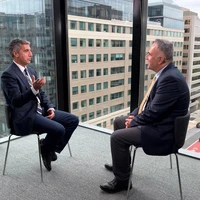
Iranian Foreign Minister Abbas Araghchi speaks during an interview for the YouTube program Majaray-e Jang (Story of War) in an image published on his Telegram channel.
Criticism of Foreign Minister Abbas Araghchi's recent interview has spread across Iranian conservative media, with critics arguing he disclosed sensitive information about wartime security and internal decision-making following its publication this week.
The backlash followed Araghchi's appearance on the YouTube program Majaray-e Jang (Story of War), in which he discussed the wars with the United States and Israel, internal security planning, succession preparations and negotiations with Washington. He also said security gaps that enabled attacks on senior officials and leadership sites "probably still have not been fully resolved."
"If you wanted publicity or to repair your image, you made it worse," Mostafa Khoshcheshm, a political analyst appearing on Iranian state television, said in response to the interview.
Araghchi's remarks, Khoshcheshm said, reflected what he described as "a lack of strategic thinking," adding: "I am genuinely concerned." He called the interview "a disaster in public relations, image-building and image repair."
Araghchi had said attacks on the former Supreme Leader Ali Khamenei's compound were carried out through "security gaps" that continued to affect decision-makers and the public atmosphere.
He also described wartime contingency plans, including preparations for the possible killing of the country's leader and the government's response to attacks on senior officials.
Conservative newspapers criticize disclosures
Javan, a newspaper affiliated with the Revolutionary Guards, wrote on Tuesday that confirming details surrounding the attacks, discussing the day the former leader was killed or revealing that the foreign minister had no contact with new Supreme Leader Mojtaba Khamenei were not matters that should have been disclosed publicly.
"Please keep the locations of the remaining tunnels and military bases to yourself in future interviews, and exercise restraint when discussing important events," the newspaper wrote.
Safeguarding national security, protecting public trust and defending the country's interests should outweigh the appeal of widely viewed media interviews, Javan added.
Conservative outlet Tabnak also questioned Araghchi's decision to give the interview to documentary filmmaker and online host Javad Mogoei rather than an experienced journalist.
The outlet wrote that some of the information discussed was likely to be of greater value to Israeli and US intelligence services than to viewers. It also argued that diplomacy and journalism are both specialized professions, asking whether senior officials should grant interviews to content creators without established experience covering political affairs.
The commentary compared Araghchi's media approach with that of former Foreign Minister Mohammad Javad Zarif, arguing that although Zarif also preferred interviews with individuals rather than media organizations, he chose interviewers who better understood political and security sensitivities.
Reaction from Raisi allies
Raja News, a media outlet close to supporters of former president Ebrahim Raisi, also criticized the interview, focusing on remarks by Mogoei identifying locations of underground tunnels and saying military commanders frequently used them.
Araghchi, the outlet said, should not have disclosed such information and argued that the program's producers should have removed those passages during editing. It also questioned why the host publicly identified locations associated with senior commanders, even if foreign intelligence agencies were already aware of them.
The wide-ranging interview touched on issues that Iranian officials have rarely discussed publicly, including internal security failures, wartime contingency plans and high-level decision-making during the conflict.
Senior Iranian officials pay their respects before the coffin of Supreme Leader Ali Khamenei during funeral ceremonies in Tehran. Foreign Minister Abbas Araghchi is seen at far left, July 2, 2026
Foreign intelligence penetration of Iran is hardly a secret. But Iranian Foreign Minister Abbas Araghchi has now suggested the operation goes beyond locating officials or stealing information and seeks to influence decision-making inside the Islamic Republic itself.
The remark marked a subtle but significant shift. Iranian officials have long acknowledged espionage and intelligence breaches, particularly after the precision with which senior commanders, nuclear scientists and political leaders have been located and targeted exposed profound vulnerabilities within Iran's security establishment.
Speaking in the first part of a nearly 90-minute podcast interview, Araghchi suggested foreign intelligence activity inside Iran may be something more ambitious than gathering intelligence: shaping the decisions of the state itself.
He made the remarks when asked by establishment podcaster Javad Mogoei about the opening hours of the war, when coordinated strikes killed Iran's supreme leader along with several senior military, security and political figures.
"I believe this security breach is not limited merely to infiltration and obtaining information," Araghchi said.
"Sometimes it also exists in influencing the decision-making process itself. And even more importantly, it extends to shaping our psychological environment and public perception."
Araghchi did not identify any foreign intelligence service or explain how such influence might operate, although Israel appeared to be the implied actor in the discussion.
To Alex Vatanka, a senior fellow at the Middle East Institute, that distinction was the most revealing part of the interview.
"The job of these assets isn't just to leak the location of leaders in a certain place to be killed," Vatanka told Iran International. "It is to influence decision-making. It's to influence the policy process."
Vatanka believes Araghchi's remarks were directed as much at Iran's internal political debate as at foreign intelligence operations.
"He's hinting that elements inside the regime are openly arguing for policies that the enemy—the United States and Israel—prefer," he said. "Is he talking about the pro-war hawks? Is this part of scoring points against one another? Could well be."
"These things are obviously not accidental," he added. "This is very much messaging at a moment of war."
Mogoei nevertheless raised another possibility, invoking Masoud Kashmiri, the alleged infiltrator who rose through the ranks of the Islamic Republic before the 1981 bombing that killed President Mohammad Ali Rajai and Prime Minister Mohammad-Javad Bahonar.
"Perhaps we have another Kashmiri," he suggested.
Araghchi did not endorse the comparison, saying Iran's adversaries had become familiar with the supreme leader's routine and that the Intelligence Ministry meeting may simply have coincided by chance.
Whether Araghchi was describing a sophisticated foreign influence operation or speaking more broadly about the effect of outside pressure on Iran's internal politics is where analysts begin to diverge.
Omid Memarian, an Iran analyst at DAWN, said one possible manifestation of the kind of influence Araghchi described would be officials advocating policies that prolong the war despite the damage continued conflict causes to the Islamic Republic's own interests.
"Some of the decisions they are making are exactly the things that Israelis might wish for," Memarian told Iran International.
"When it comes to Iran's national security and national interests, they don't make sense,” he added. "We see the smoke. We don't see the fire."
Behnam Ben Taleblu, senior director of the Iran Program at the Foundation for Defense of Democracies, said Araghchi's comments should also be viewed through the lens of Iran's internal political rivalries.
"That doesn't mean these guys are doves by any measure," Taleblu told Iran International. "But it does mean that they have different views about how best to preserve, protect and defend the Islamic Republic."
Taleblu said public acknowledgments of security failures are often aimed less at the Iranian public than at rival political factions or security institutions, with officials defending their own approach while criticizing competing strategies.
He said Araghchi's comments also highlighted a less discussed aspect of intelligence operations: their ability to shape leaders' perceptions rather than merely gather information.
"Influence is to shape their decision-making, perhaps by lulling the Supreme Leader's office into a false sense of security and back into the routines that existed before," he said.