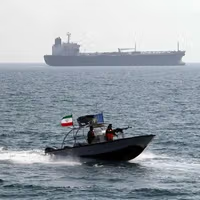
Opponents of the Iran-US understanding have launched a fierce campaign against Parliament Speaker Mohammad-Bagher Ghalibaf, described as the agreement's chief negotiator, and President Masoud Pezeshkian, accusing them of surrendering Iran's authority over the Strait of Hormuz, thereby allowing the establishment of an Oman-American shipping corridor.
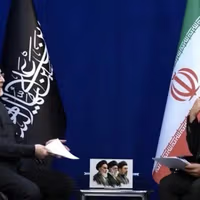
The criticism intensified after a televised interview with Ghalibaf aired on Tuesday, during which he appeared to reject calls by hardliners to close the strategic waterway.
"We must not turn the Strait against itself. The Strait is valuable only if traffic through it increases day by day, not decreases," he said.
His remarks were interpreted by conservative critics as a signal that Tehran has accepted Washington’s preferred arrangements governing maritime traffic through the Strait.
Focus shifts to Omani route
The controversy was fueled by satellite-based vessel tracking videos recently published by Kpler, which appeared to show that many non-Iranian commercial vessels have recently transited the Omani side of the Strait apparently accompanied by US naval vessels, while only a limited number of Iranian vessels were using the Iranian side. Hardliners argue that this reflects a de facto shift away from Iran's jurisdiction.
Ehsan Hosseini, editor-in-chief of the conservative economic website Khat-e Energy, claimed in a video posted online that both "the naval blockade and the Omani corridor are products of negotiations with the United States."
"At this very moment, groups of ships are passing through this corridor under US military escort. Your grave mistake is unforgivable."
In a separate social media post, Hosseini wrote that Iran's diplomats had "not only failed to collect any fees, but also created the conditions for establishing an Omani corridor through the Strait." He questioned whether Iran lacked the military capability to prevent the arrangement or whether "someone has tied the hands of the armed forces."
Military issues warning
Amid the growing debate, the Khatam al-Anbiya Central Headquarters issued a strongly worded statement on Thursday amid hardliner pressure, without explicitly referring to the alleged Omani corridor.
The military command said all commercial and oil tankers were required to navigate through routes designated by Iran and warned that any vessel departing from those routes or disregarding “Iranian navigation protocols” in the Strait would face "an immediate and decisive response by the armed forces," placing the security of non-compliant ships at risk.
Several Friday prayer leaders also addressed the issue.
Hassan Ameli, Friday prayer leader of Ardabil, claimed the United States had violated the agreement by establishing "a new waterway alongside Oman."
Mohammad-Nabi Mousavifard, the Friday prayer leader of Ahvaz, issued an even stronger warning.
"If any ship passes through this waterway without permission and without observing the laws of the Islamic Republic, it will be sunk in the depths of the Persian Gulf."
Dispute over Strait management fees
According to The Wall Street Journal, US officials proposed during talks in Doha earlier this week that Iran abandon its demand to collect transit charges from ships crossing the Strait in exchange for access to frozen Iranian assets abroad. Tehran reportedly continues to insist on charging vessels for passage.
Hardliners argue that revenue generated from shipping fees could rival Iran's oil income.
They also accuse Ghalibaf of keeping parliament inactive to allow the agreement with Washington to proceed without interference from lawmakers affiliated with the ultra-hardliner Paydari (Steadfastness) Party, who are reportedly preparing draft legislation on a new legal framework for administering the Strait.
Iranian officials have maintained that the payments would be "management fees" rather than transit tolls, which could raise legal objections under international maritime law.
In his interview, Ghalibaf said ships would be allowed to pass without charge for only 60 days under the signed understanding, although he did not specify the type or amount of the fees that would eventually be imposed.
Social media backlash
Hardliner social media users also directed their criticism at Ghalibaf and the Pezeshkian administration.
One X user, Reza Valizadeh, referred to the Kpler tracking footage and wrote: “This is the doing of Ghalibaf and Pezeshkian. Nobody is passing through the Iranian section of the Strait of Hormuz."
Another user, Mohammad-Hossein Chavoshi, claimed that "part of the Strait of Hormuz has effectively slipped out of Iran's control" because international vessels were using a route designated by Oman.
He argued that the sovereign rights over the Strait emphasized by Supreme Leader Mojtaba Khamenei had effectively been abandoned and warned that "no one knows what will happen in two months if this continues."