• العربية
  • فارسی
Brand
  • Iran Insight
  • Politics
  • Economy
  • Analysis
  • Special Report
  • Opinion
  • Podcast
  • Iran Insight
  • Politics
  • Economy
  • Analysis
  • Special Report
  • Opinion
  • Podcast
  • Theme
  • Language
    • العربية
    • فارسی
  • Iran Insight
  • Politics
  • Economy
  • Analysis
  • Special Report
  • Opinion
  • Podcast
All rights reserved for Volant Media UK Limited
volant media logo

Talk of dissolving IRGC revives debate over Iran's dual military

Maryam Sinaiee
Maryam Sinaiee

Iran International

Jul 2, 2026, 10:42 GMT+1
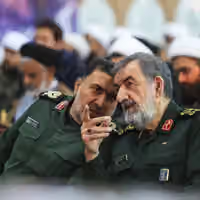
IRGC commanders meeting Iran's late Supreme Leader ali Khamenei in September 2007

A state-TV commentator’s claim that factions want to dissolve the IRGC has revived debate over Iran’s dual military structure, the Guards’ expanding political and economic role, and whether the army-IRGC system remains an asset after a war that exposed its reach and costs.

Kharratian has often argued that Iran must preserve what he sees as its strategic leverage in any confrontation or negotiation with Washington, including its military and nuclear capabilities, control over pressure points such as the Strait of Hormuz, the impact of oil prices and political divisions inside the United States.

His latest remarks have triggered debate across Iranian media and social networks.

Some experts interviewed by Iran International said any restructuring of the IRGC would likely amount to little more than a rebranding exercise, preserving the Guards’ power while trying to shed some of their political and economic baggage.

Others see the debate as a sign that Iran’s leadership understands the country cannot emerge from the recent war unchanged.

Proposal predates the war

The discussion is not entirely new. Shortly before the outbreak of the recent war, the moderate daily Jomhouri-e Eslami proposed merging the IRGC into the regular army, arguing that Iran’s security and economic conditions required a review of the country’s military structure.

The newspaper said such a move could create a more coherent defense system. But its argument went beyond military organization.

The article also criticized the IRGC’s growing reach outside the battlefield, including its role in the economy, politics, media and parts of diplomacy.

It said that expansion had not produced greater national power or strategic cohesion, but had instead given the IRGC the image of a controversial, factional and multifaceted institution.

Domestically, the newspaper argued, the Guards had become a source of political dispute.

Abroad, it said, their expanded role had given Iran’s adversaries a pretext for pressure, sanctions and costly decisions against Iran’s national interests.

Hardline backlash

Jomhouri-e Eslami’s proposal drew an immediate backlash from conservative media.

The hardline newspaper Kayhan described the idea as “a project to eliminate the IRGC,” comparing it to what it called US and Israeli efforts to dismantle Iraq’s Popular Mobilization Forces.

It dismissed the proposal as “not an expert discussion,” but rather a continuation of foreign projects aimed at weakening what it called the Islamic Republic’s defensive arm.

Abdollah Ganji, the former managing director of the IRGC-affiliated newspaper Javan, also denounced Jomhouri-e Eslami on X, calling it “a polluted mouthpiece.”

He wrote that raising such an idea while the country faced the threat of war was, “even if it is not evidence of enemy infiltration, evidence of catastrophically flawed understanding.”

Arguments for restructuring

Not all commentary rejected the idea. The website Eghtesad 24 argued that, given the IRGC’s designation as a terrorist organization by the United States and the European Union, some analysts viewed a merger with the regular army as a possible way to reduce legal and diplomatic pressure on Iran.

The outlet wrote that “merging the army and the IRGC could, from the perspective of reducing legal and international pressure, be worthy of consideration,” adding that such a move could reduce some of the diplomatic costs created by those designations.

It also referred to an earlier claim by IRGC commander Hassan Kazemi that the United States had demanded the dissolution of the IRGC and its integration into the regular army.

Social media reflects sharp divisions

The issue has circulated on Iranian social media for months, where hardline users have recently accused senior officials involved in negotiations, including Parliament Speaker Mohammad Bagher Ghalibaf and members of President Masoud Pezeshkian’s administration, of trying to sideline revolutionary forces and even plotting a coup.

One X user wrote: “The final stage of the coup is dissolving the IRGC and merging the armed forces.”

Another said: “You’ll take the dream of dissolving the IRGC to your grave.”

A third argued that Kharratian’s remark alone was enough to show that “the coup plotters signed Iran’s destruction and partition long ago,” adding that dissolving the IRGC would mean disarming the Islamic Revolution and stripping it of legitimacy.

Others voiced a different concern. They argued that if a merger ever took place, it would not produce a more conventional national army, but would instead amount to the regular army being absorbed into the IRGC, turning the unified force into an ideological military organization.

A recurring debate

The idea of dissolving the IRGC or merging it with the regular army dates back to the early years of the Islamic Republic under Ruhollah Khomeini.

No merger took place. But in 1989, Iran merged the Ministry of Defense and the Ministry of the IRGC as part of an administrative, budgetary and logistical restructuring, while leaving the two forces institutionally separate.

The General Staff of the Armed Forces was also established to coordinate strategy, assign responsibilities and oversee the military.

Later that year, Iran’s new supreme leader, Ali Khamenei, emphasized that both the IRGC and the regular army should be preserved, and that neither should be sacrificed for the other.

Months later, he sought to settle the debate by defining the IRGC’s primary mission as defending the Islamic Revolution and the Islamic Republic, while assigning the regular army responsibility for defending Iran’s borders.

Most Viewed

Khamenei to end Eje'i’s judiciary tenure after one term
1
EXCLUSIVE

Khamenei to end Eje'i’s judiciary tenure after one term

2

Deadly attacks shake northwest Iran as IRGC reports new clashes

3

How Trump decided to strike Iran, new book reveals final hours

4

IRGC moves to seize historic Protestant church in Tehran

5
VOICES FROM IRAN

Two-week banking disruption leaves Iranians struggling to access money

Banner
Banner
Banner

Spotlight

  • Talk of dissolving IRGC revives debate over Iran's dual military

    Talk of dissolving IRGC revives debate over Iran's dual military

  • Mojtaba Khamenei’s key word for Iran’s future: a people given a mission
    ANALYSIS

    Mojtaba Khamenei’s key word for Iran’s future: a people given a mission

  • Iran parliament cries censorship after Ghalibaf interview cut short

    Iran parliament cries censorship after Ghalibaf interview cut short

  • How Trump decided to strike Iran, new book reveals final hours

    How Trump decided to strike Iran, new book reveals final hours

  • Khamenei to end Eje'i’s judiciary tenure after one term
    EXCLUSIVE

    Khamenei to end Eje'i’s judiciary tenure after one term

  • Iran among top foreign espionage threats to Germany, security report says

    Iran among top foreign espionage threats to Germany, security report says

  • Two-week banking disruption leaves Iranians struggling to access money
    VOICES FROM IRAN

    Two-week banking disruption leaves Iranians struggling to access money

  • Is Tehran preparing to reinvent the IRGC?

    Is Tehran preparing to reinvent the IRGC?

  • Iran ultra-hardliners accuse Ghalibaf, Pezeshkian of ‘coup’ over US deal

    Iran ultra-hardliners accuse Ghalibaf, Pezeshkian of ‘coup’ over US deal

•
•
•

More Stories

Iran ultra-hardliners accuse Ghalibaf, Pezeshkian of ‘coup’ over US deal

Jul 2, 2026, 08:55 GMT+1
•
Maryam Sinaiee
Iran ultra-hardliners accuse Ghalibaf, Pezeshkian of ‘coup’ over US deal
100%
A group of female ultra-hardliners staging a sit-in near the place Supreme Leader Ali Khamenei was killed on February 28 in protest to MoU signed with the United States

Iran’s ultra-hardliners have escalated their campaign against the US-Iran memorandum, accusing Parliament Speaker Mohammad Bagher Ghalibaf and President Masoud Pezeshkian of forcing through a deal they say amounts to a “coup” against the position of the slain Supreme Leader.

The accusations come from the most hardline wing of Iran’s conservative camp, including the Paydari Party and supporters of Saeed Jalili, and mark the latest escalation in a long-running power struggle inside the establishment.

The US-Iran memorandum has deepened that rift, exposing a widening divide between pragmatic conservatives aligned with Ghalibaf and factions that reject any compromise with Washington.

With more conservatives moving closer to Pezeshkian’s administration, Jalili’s camp appears increasingly worried that it is being pushed to the margins.

Old rivalries flaring up

The latest controversy began Tuesday when hardline lawmaker Mahmoud Nabavian posted a blunt warning on X: “People of Iran, is a coup underway?”

Nabavian argued the Supreme Leader’s 10 conditions for negotiations had been ignored and that the memorandum with the United States had been forced through despite his objections.

A day earlier, he wrote that what officials described as the country’s interest, despite the Leader’s opposition, was “not expediency but the very essence of corruption.”

The remarks triggered a fierce conservative backlash.

Mojtaba Zarei, a Tehran lawmaker considered close to Ghalibaf, dismissed the accusation as the fantasy of the super-revolutionary camp and an election slogan aimed at rivals.

Citing reports that around 60 Paydari-affiliated lawmakers planned to stage a sit-in outside parliament, Zarei said parliament’s leadership, the Supreme National Security Council and other lawmakers had thwarted what he called an election-driven attempt by a “super-revolutionary” party to seize parliament in the style of Eastern Europe’s color revolutions.

Parliament dispute fuels tensions

Paydari lawmakers have denounced the suspension of parliamentary sessions for more than 120 days since the war began, saying the closure has stripped parliament of its oversight role at a critical moment.

Unverified social media reports suggested that security agencies pressured some legislators to drop plans for a sit-in, while separate reports claimed hardline lawmaker Hamid Rasaei was briefly detained for several hours.

Still, around a dozen lawmakers gathered outside parliament on Tuesday in protest, according to social media reports.

Rouydad24 reported that one of the group’s main aims in forcing parliament back into session is to pass legislation asserting full Iranian control over the Strait of Hormuz, a step that could create new obstacles for implementing the US-Iran memorandum.

'Coup' accusations dominate social media

The coup narrative has spread quickly among ultra-hardline activists on social media, where Ghalibaf and Pezeshkian are being portrayed as defying the Supreme Leader’s wishes.

One user said Ghalibaf had known the Supreme Leader’s position but “not only voted against it himself, but persuaded other commanders to do the same.”

Another described a coordinated coup project aimed at weakening revolutionary forces, promoting “begging diplomacy,” ignoring the killing of Shiites in Lebanon and turning Iran into a passive country.

The post concluded that confronting this “silent coup” required exposing those behind it, resisting surrender and returning to the path of resistance.

Security concerns ahead of Khamenei funeral

Some social media posts by supporters of the ultra-hardline faction have raised concerns that they may use the funeral of Supreme Leader Ali Khamenei, scheduled for July 9, to protest against the memorandum.

One ultra-hardliner activist claimed on X that "the coup is advancing; they are only waiting to assassinate the Leader," before adding: "I see no solution other than removing this government and Ghalibaf. Going to Tehran [for the funeral] is the best opportunity."

  • Khamenei mourning site shut as shroud-wearing hardliners expose loyalist rift

    Khamenei mourning site shut as shroud-wearing hardliners expose loyalist rift

The rhetoric echoes a confrontation during this year’s Muharram ceremonies, when security forces dismantled a mourning site near the place where Ali Khamenei was killed.

The site had been occupied for three days by mostly female ultra-hardliners wearing white burial shrouds to signal readiness for death or revenge. The protesters chanted harsh slogans against officials who backed negotiations.

One participant later posted a video accusing “coup agents” of assaulting protesters and seizing their sound equipment.

The footage showed shroud-clad women chanting “Allahu Akbar” as security personnel moved to disperse them.

Mojtaba Khamenei’s key word for Iran’s future: a people given a mission

Jul 1, 2026, 14:44 GMT+1
•
Mehdi Beigi
Mojtaba Khamenei’s key word for Iran’s future: a people given a mission
100%

Since becoming Supreme Leader, Mojtaba Khamenei has repeatedly used ba’sat, a term rooted in divine mission, to cast Iranians not just as citizens but as a force tasked with carrying forward the Islamic Republic’s project at home and beyond.

Around 20 messages and written statements have been issued in Mojtaba Khamenei’s name since the Assembly of Experts named him Iran’s new Supreme Leader on March 8.

Some have been routine: condolences, formal greetings and remarks for official occasions. But at least half go further, offering an early view of his political and ideological vocabulary.

They cover a wide range of subjects, from the army, parliament and the Persian language to Hajj, Shiite’s anniversary of Eid al-Ghadir, the Persian Gulf, the US-Iran memorandum of understanding and the so-called Axis of Resistance.

Read together, one word stands out: ba’sat (be’that).

In Islamic tradition, ba’sat refers to being chosen and sent on a divine mission. It is most closely associated with prophethood: the moment a prophet is commissioned to carry a message and fulfill a sacred duty.

In Mojtaba Khamenei’s messages, however, the word is not used only as a religious expression. It becomes a political language for describing the role of the people.

People walk in front of a banner of Supreme Leader Mojtaba Khamenei in Tehran (May 2026)
100%
People walk in front of a banner of Supreme Leader Mojtaba Khamenei in Tehran (May 2026)

A sacred word enters politics

Mojtaba Khamenei has used ba’sat in several forms: the ba’sat of the Iranian nation, the ba’sat of the people, the ba’sat of artists, a mission-bearing nation and even a commissioned Islamic ummah.

The ummah, in Islamic political language, refers to the wider Muslim community beyond national borders.

In this framework, Iranians are not presented merely as citizens of a country, voters in a political system or supporters of the Islamic Republic.

They are described as bearers of a historical mission. That is where ba’sat becomes politically important.

It casts the people as the human force of a larger ideological project, rather than simply as a society expected to support the government.

The first clear example appeared in Mojtaba Khamenei’s Hajj message in late May.

He wrote that after the killing of Ali Khamenei, the Iranian nation experienced a divine ba’sat and astonished the world by appearing wherever its presence was needed.

The more revealing line came later. Following the ba’sat of the Iranian nation and the Axis of Resistance, he wrote, the ba’sat of the Islamic ummah would follow.

In a single sequence, he linked the Iranian people, Tehran’s regional network of allied forces and the wider Muslim world.

The message was not only that Iranians had awakened. It was that they had been assigned a role in a project extending beyond Iran’s borders.

People or a mission-bearing nation?

The same pattern appears in other messages. In a statement marking Ferdowsi Day, artists were asked to carry out their own ba’sat in continuation of the people’s ba’sat, and to record the story of this uprising for history.

In a message marking the start of the third year of the 12th parliament, the legislature was told to bring itself into line with a mission-bearing nation.

The chain is revealing.

The mission begins with the people, moves into culture and art, enters formal institutions such as parliament, and is then projected outward toward the Islamic ummah and the Axis of Resistance.

This is not just ceremonial language. In Mojtaba Khamenei’s early vocabulary, the people are not treated simply as a source of legitimacy or as a crowd mobilized for elections, funerals and rallies.

They are framed as a force expected to move the system forward.

That role is tied to resistance against the United States and Israel, support for Tehran’s regional allies, and the claim that Iran is helping shape a new regional and global order.

People inside an old project

This language also connects Mojtaba Khamenei to one of Ali Khamenei’s central ideological themes.

For years, the former Supreme Leader spoke of a five-stage process leading to a new Islamic civilization.

In that theory, the Islamic Revolution was only the beginning.

It was to be followed by an Islamic system, an Islamic government, an Islamic society and, finally, a new Islamic civilization.

Institutions alone were never enough for that project. The theory required society itself to be transformed, with people seeing themselves not merely as subjects of a government but as participants in a long ideological struggle.

Mojtaba Khamenei’s use of ba’sat appears to supply that missing human engine.

If Ali Khamenei’s five-stage theory was the roadmap, ba’sat is Mojtaba Khamenei’s way of describing the people expected to carry it forward.

The Iranian nation becomes mission-bearing. Artists must narrate that mission. Parliament must adjust itself to it. The Axis of Resistance gives it regional depth. And the Islamic ummah gives it a transnational horizon.

Resistance remains central

This is why ba’sat matters beyond the number of times it appears.

Terms such as resistance, America, Israel and the Iranian nation have long been central to the Islamic Republic’s political vocabulary.

Ba’sat does something more specific. It redefines the relationship between people and power.

In this view, people are not only expected to obey, vote, mourn, rally or endure.

They are said to have been commissioned into a larger project, one that links domestic loyalty to regional confrontation and an imagined future order.

In Mojtaba Khamenei’s first message after becoming Supreme Leader, he described the Axis of Resistance as an inseparable part of the values of the Islamic Revolution.

In later messages, he returned to Lebanon, Palestine, Iraq and Yemen.

After the US-Iran memorandum, he said he had initially opposed the agreement but allowed its implementation because the president and the Supreme National Security Council had pledged to protect both the rights of the Iranian nation and those of the Axis of Resistance.

In his Persian Gulf message, he linked the policy of resistance and a strong Iran to the beginning of a new regional and global order.

Mojtaba Khamenei is not abandoning the ideological architecture of his predecessor. He is recasting it in a new vocabulary, with the people placed more explicitly at the center of the mission.

If this reading is correct, ba’sat is more than a religious flourish.

It may be the connecting term between the second and third leaders of the Islamic Republic: a word that preserves Ali Khamenei’s project of a new Islamic civilization while giving Mojtaba Khamenei a language of his own.

The result is not an ideological break. It is an effort to continue the same project with a sharper definition of the people’s role in it: not simply as supporters of the Islamic Republic, but as a people told they have been given a mission.

Khamenei to end Eje'i’s judiciary tenure after one term

Jun 30, 2026, 20:48 GMT+1
•
Shahed Alavi
Khamenei to end Eje'i’s judiciary tenure after one term
100%

Iran's Supreme Leader Mojtaba Khamenei plans to remove judiciary chief Gholam-Hossein Mohseni Eje'i at the end of his first five-year term and appoint a new figure to lead the judiciary, sources familiar with the matter told Iran International.

Sources inside Iran told Iran International that Khamenei does not intend to extend Eje'i’s term for another five years, breaking with a practice followed for nearly four decades in which judiciary chiefs have usually served two consecutive five-year terms.

The sources, who spoke on condition of anonymity, said the decision is not aimed at judicial reform but is part of a broader reshaping of power after the recent war.

They said the new supreme leader is seeking to replace key officials in major state institutions with figures more closely aligned with him.

Eje'i’s expected removal could mark one of the first major signs of Khamenei’s effort to rebuild control over the Islamic Republic’s judicial, security and political apparatus after the transfer of power.

Hardliners step up pressure on Eje'i

The decision comes amid growing criticism of Eje'i from hardline figures after the names of Supreme National Security Council members who voted in favor of a memorandum of understanding with the United States were disclosed.

Critics say Eje'i’s vote was at odds with Khamenei’s stated position, after the leader said in a letter that he had, in principle, held a different view on the memorandum of understanding.

Signs of dissatisfaction with Eje'i’s five-year record have also appeared in recent official and semi-official commentary close to the power structure.

In a message marking Judiciary Week, Khamenei did not clearly endorse Eje'i’s continuation in office. Instead, he addressed the judiciary as an institution and called for the “actualization” of demands previously made by former Supreme Leader Ali Khamenei.

The message repeated calls for the implementation of the judicial transformation document, fighting corruption inside the judiciary, reviving public rights, blocking the use of recommendations and lobbying, and improving communication with the public.

Eje'i seeks to defend his record

A day later, Eje'i published a letter to Khamenei in deferential language, defending the judiciary’s performance and pledging to continue the path of “judicial transformation.”

“I and all components of the judiciary consider ourselves obliged to carry out Your Excellency’s binding commands precisely, swiftly and without any reduction,” Eje'i wrote.

Media outlets and figures close to the establishment criticized Eje'i for not publishing such a letter before Khamenei’s message. Some also described the new leader’s renewed emphasis on his father’s demands as a negative assessment of Eje'i’s record, arguing that their repetition showed the judiciary had failed to deliver practical results under him.

Rival factions inside the establishment have also stepped up attacks on Eje'i, accusing him of distancing himself from the leadership’s demands.

Media close to Parliament Speaker Mohammad Bagher Ghalibaf and President Masoud Pezeshkian have described the attacks as part of an effort by the faction aligned with Saeed Jalili, a member of Iran’s Supreme National Security Council, and the Paydari Front to create divisions among senior officials and weaken the postwar political path.

Media close to the judiciary and Eje'i’s supporters have sought to portray his five-year record as successful, citing reduced imprisonment, electronic court proceedings, shorter trials, anti-corruption efforts and public outreach.

Rights groups point to record of repression

Human rights groups and activists say Eje'i is not a reformist figure but a long-standing part of the Islamic Republic’s repressive judicial and security apparatus.

They point to his record in the Special Clerical Court, the Ministry of Intelligence, and later as first deputy and head of the judiciary, saying his tenure has been marked by continued heavy sentences against protesters, political activists, journalists, prisoners of conscience and minorities.

Rights advocates say the judiciary under Eje'i has continued to act as the legal and executive arm of security institutions in political and security cases.

They also argue that replacing Eje'i alone would not bring meaningful change without structural reform, an end to security interference in judicial cases, guaranteed access to lawyers, a halt to forced confessions, the annulment of political verdicts and respect for fair trial standards.

Iran media urged to avoid spotlighting political disputes during Khamenei funeral

Jun 30, 2026, 15:36 GMT+1
Iran media urged to avoid spotlighting political disputes during Khamenei funeral
100%

A confidential directive by Iran’s top security body urged media outlets to avoid spotlighting political disputes during slain Supreme Leader Ali Khamenei’s funeral and limit coverage of US talks and regional developments, according to a copy obtained by Iran International.

The directive by the Supreme National Security Council said that, with programs linked to what it called the “historic funeral procession of the martyred Leader of the Revolution” beginning Friday, media outlets should help preserve national cohesion and maintain a focused media narrative.

It recommended that issues related to follow-up on the Islamabad memorandum of understanding — including the “balanced implementation of commitments,” especially over Hormuz, developments inside Lebanon, what it called the destructive role of the Lebanese government, the need to end Israeli attacks and opposition to externally imposed solutions — be gradually removed from media priority over the next 48 hours.

Instead, the directive said media capacity should mainly be used to explain the “personal, intellectual, cultural, political, historical and national dimensions of Iran’s martyr,” reflect “the presence and solidarity of the people,” and provide the “most magnificent possible coverage” of the ceremonies.

It said that if any “transgression or aggression” by enemies occurred during the period, “the issue of continuing defense alongside the holding of extensive ceremonies related to the funeral procession will naturally receive attention.”

The directive also urged outlets to avoid amplifying “internal political disputes, factional disagreements, media controversies” and issues that could polarize public opinion or divert attention from what it called a “national and historic occasion.”

News and analysis related to “negotiations, the agreement and other political and regional developments” should be covered “only to the extent necessary,” it said, warning media outlets not to turn those issues into the main focus of coverage or reproduce and amplify “rival media narratives about Iran’s defeat or retreat.”

Deadly attacks shake northwest Iran as IRGC reports new clashes

Jun 30, 2026, 13:48 GMT+1
Deadly attacks shake northwest Iran as IRGC reports new clashes
100%
image shows IRGC members Khaled Khaledinia (left) and Borhan Krisani, who were killed in a shooting outside a home in Paveh county, Kermanshah province, on June 29, 2026.

The Islamic Revolutionary Guard Corps (IRGC) said six armed men were killed in a clash near Iran's northwestern border on Tuesday. The announcement came hours after the Guards said two of its members were killed in a separate shooting in the region.

The IRGC Ground Forces said the six-member team was engaged in the mountains between Mahabad and Piranshahr after entering Iran's northwestern border region.

“The team entered the country's northwestern border region with the aim of carrying out sabotage and terrorist operations,” the IRGC's Hamzeh Seyed al-Shohada base said.

The Guards said four bodies, along with weapons and military equipment, were recovered after the clash, which it said involved fire support.

Two IRGC members killed in Paveh

Earlier on Tuesday, the IRGC's Kermanshah provincial public relations office said two local Guards members were killed and two others wounded after gunmen opened fire outside a home in Paveh county on Monday evening.

The dead were identified as Khaled Khaledinia and Borhan Krisani. Authorities said they were investigating the shooting and working to identify those responsible.

The Kurdish human rights group Hengaw identified the two wounded men as Kamel Shabrang, also known as Kamel Hajiji, and Kamal Abdi, adding that Hajiji was in a coma because of his injuries.

Hengaw also said a newly formed group calling itself Khori Hiva, meaning "Sun of Hope" in Kurdish, had claimed responsibility for the attack, saying Khaledinia participated in the crackdown on protesters in Javanrud during the 2022 Woman, Life, Freedom protests.

Conflicting accounts emerged over whether civilians were also killed. Hardline outlet Raja News reported that Khaledinia's sister and niece died in the attack, but Paveh governor Farzad Almasi rejected that account, telling ISNA that all four people targeted were men serving with the local IRGC unit, with two killed and two wounded.

Almasi said two gunmen riding a motorcycle opened fire before fleeing the scene and that efforts to identify and arrest the attackers were continuing.

The separate attacks underscored continuing security challenges in Iran's Kurdish-populated western and northwestern regions, where clashes between Iranian security forces and armed Kurdish groups have continued intermittently.