Local residents use improvised tools to fight a wildfire in the Zagros forests.
When flames appeared over the Zagros, local residents again climbed toward the fire with shovels, branches and bottles of water, exposing a recurring failure: Iran’s largest oak landscape is burning faster than the state can protect it.
This time, Taghi Changalvaei was one of those who went.
He entered the fire to help save Khayiz, a protected area in the southern Zagros near Behbahan, in Khuzestan province. He did not return.
For Zagros communities, his death was familiar. For years, local residents and environmental volunteers have been losing friends and relatives to fires that return each summer across the mountains.
Iranian media have reported that since 2020, 27 people have died while trying to control fires in the Zagros.
Most were not professional firefighters. They had no specialized training, no protective clothing and little more than improvised tools.
They went because the forests were burning, and because in many parts of the Zagros, people know that if they do not move first, help may arrive too late.
A landscape primed to burn
The Zagros Mountains run for about 1,600 kilometers, from northwestern Iran toward the Persian Gulf. Their oak woodlands cover almost six million hectares, roughly 40 percent of Iran’s forest area, and support millions of rural livelihoods while helping regulate water and prevent soil erosion.
The Persian oak defines this landscape, shaping village economies, water systems and grazing patterns. But the Zagros oak belt has been shrinking for decades under pressure from illegal logging, overgrazing, drought, climate change and poor management.
Each summer, fire turns that decline into an emergency. That pattern was visible again in Khayiz, where a blaze that began on Badil Mountain burned for days through protected forests near Behbahan, exposing shortages of aerial firefighting capacity.
Experts say the fires have become larger, harder to contain and more closely tied to climate stress, fuel buildup and weak management.
Winter and spring rains can cover the slopes with grasses and seasonal plants. By early summer, heat dries that vegetation into fuel load: the combustible layer that lets a spark, a cigarette butt, a campfire or an intentional blaze spread quickly.
One part of the debate concerns grazing. In the past, livestock consumed part of the seasonal vegetation that now dries out in the mountains. From around 2021, authorities pursued efforts to reduce grazing pressure more seriously to help forests and pastures recover from overuse.
The aim was environmental protection: overgrazing has long damaged Zagros forests, limiting natural regeneration and weakening young oak growth. But some experts argue that reducing livestock presence without alternative vegetation management may have left more dry grass and brush by summer.
That does not make grazing restrictions the cause of the fires. Climate change, drought, oak decline, human negligence, arson, weak fire roads, aircraft shortages, poor coordination and lack of equipment all remain central. Unmanaged vegetation, some experts say, may be one piece of a larger puzzle.
In parts of Spain and the western United States, targeted grazing is used to reduce wildfire fuel loads and maintain firebreaks. For the Zagros, the question is whether the state can protect forests without removing one form of vegetation control and failing to replace it with another.
Bigger fires, weaker capacity
The statistics point to a worsening burden. In the Iranian year that began in March 2021, about 21,000 hectares of forests across the country burned, according to figures cited in Iranian media. By the year that began in March 2024, that figure had risen to about 27,000 hectares.
By November 2025, Iran had recorded more than 2,300 fires across national land, forests and rangelands, burning about 46,000 hectares. A recent study of the southern Zagros recorded more than 13,000 fire events from 2000 to 2023, with a sharp increase in the most recent years covered by the study.
The year that began in March 2026 has opened with another wave of fires, from Khayiz and Mongasht to the highlands of Lorestan, Fars and Kordestan provinces. Mongasht, a long mountain massif between Khuzestan and Chaharmahal-Bakhtiari, is one of several rugged areas where local residents are often the first responders.
The financial picture has also worsened. On paper, the rial budget of Iran’s Natural Resources and Watershed Management Organization has increased. But once the collapse in the value of Iran’s currency is taken into account, its real resources appear to have fallen sharply.
Calculations based on budget figures cited in Iranian media and market exchange rates suggest the organization’s dollar-denominated budget dropped from roughly $94 million in the Iranian year that began in March 2021 to about $41 million in the year that began in March 2026. Compared with the year that began in March 2016, the decline is estimated at more than 60 percent.
The direction is clear: while the fires have grown, the state’s real capacity to fight them has shrunk.
The consequences are visible on the ground. The fire in Khayiz is now out. But for Changalvaei‘s family, and for the families of others who died trying to save the Zagros, the fire has not ended.
Without changes in policy, funding and firefighting capacity, next summer will bring the same scene again: men with shovels, branches and bottles of water climbing toward the smoke, while fire moves through the oaks and leaves behind ash and names.
Iranian security forces arrested environmental activists Houman Jokar and Sepideh Kashani at their home on Wednesday and seized their electronic devices, their lawyer said.
Lawyer Hojjat Kermani said Kashani's sister, Sima Kashani, was also arrested. He said it was not immediately clear which security agency had detained the three, according to the Emtedad news website.
Kermani said the arrests, ahead of a long public holiday and the closure of judicial offices, had increased concern among their families.
Jokar and Kashani were among a group of environmental activists arrested in 2018 by the Revolutionary Guards' intelligence organization. They were later convicted on espionage charges after a case that drew criticism from human rights groups and UN experts over the arrests, interrogations and trial.
Jokar was sentenced to eight years in prison and Kashani to six years. The other defendants were released from Tehran's Evin prison at different times, with the last of them freed in April 2024.
One of the defendants, Iranian-Canadian conservationist Kavous Seyed-Emami, died in custody about a month after his arrest in 2018. Iranian judicial officials said he had killed himself, a conclusion rejected by his family.
The latest arrests come amid reports by rights groups of a new wave of detentions of civil, political and labor activists across Iran following recent unrest and the war with Israel and the United States.
A dust storm has affected large parts of central and eastern Iran this week, with air quality reaching hazardous levels in some areas, visibility falling and authorities closing roads in parts of the country on Thursday.
Air quality monitors showed hazardous pollution levels in parts of Kerman, Yazd, Isfahan, Markazi, Chaharmahal-Bakhtiari, and Sistan-Baluchestan provinces, according to Iranian media.
The sustainable development news site Payam-e Ma reported that air quality index readings reached 500, the highest level on the scale, at several monitoring stations in Kerman province on Thursday morning.
The site said the extent of the dust storm showed it was a regional weather event rather than pollution from local urban or industrial sources.
Experts told the outlet that simultaneous increases in airborne particles across several provinces on Iran's central plateau pointed to weather systems carrying dust across the region.
Repeated droughts, shrinking vegetation cover, dry wetlands and expanding dust sources had increased the frequency and severity of such events, they said.
"From this afternoon, the concentration of dust will gradually decrease," she told state media, adding that skies over the province would remain dusty on Friday, although conditions would improve.
Authorities issue health warnings
Authorities across affected provinces urged residents to stay indoors where possible, wear masks and avoid unnecessary outdoor activity, particularly children, older people and those with heart or lung conditions.
In Isfahan province, crisis management chief Mansour Shishehforoush said a dust mass with domestic origins had entered from Semnan province and northern parts of Isfahan.
"This condition will continue until the end of Thursday," he told IRNA.
He said authorities had ordered temporary restrictions on polluting industrial units and other measures to reduce health risks.
In Yazd province, weather official Ghasem Raji said the dust had spread across most parts of the province from Wednesday afternoon into Thursday morning.
"Horizontal visibility in Yazd city reached the critical level of 500 meters at times today," Raji told Mehr. He said relatively strong winds had carried dust into the province from neighboring areas and warned the conditions would continue through Thursday, disrupting travel.
Police in Kerman province said heavy dust and sharply reduced visibility had forced the closure of roads in both directions in Rigan, Fahraj and Narmashir counties until further notice. Authorities urged motorists to avoid the affected routes, slow down elsewhere in the province and postpone unnecessary travel.
Maryam Salajegheh, a Kerman weather official, said conditions would remain severe until Thursday afternoon.
"From this afternoon, the concentration of dust will gradually decrease," she told state media, adding that skies over the province would remain dusty on Friday, although conditions would improve.
In Chaharmahal and Bakhtiari province, a weather official said dust had moved in from central and neighboring provinces and would persist until early next week.
"With the increase in wind speed in the coming days, dust will intensify," the official, identified by state media as Qatreh, said.
Since becoming Supreme Leader, Mojtaba Khamenei has repeatedly used ba’sat, a term rooted in divine mission, to cast Iranians not just as citizens but as a force tasked with carrying forward the Islamic Republic’s project at home and beyond.
Around 20 messages and written statements have been issued in Mojtaba Khamenei’s name since the Assembly of Experts named him Iran’s new Supreme Leader on March 8.
Some have been routine: condolences, formal greetings and remarks for official occasions. But at least half go further, offering an early view of his political and ideological vocabulary.
They cover a wide range of subjects, from the army, parliament and the Persian language to Hajj, Shiite’s anniversary of Eid al-Ghadir, the Persian Gulf, the US-Iran memorandum of understanding and the so-called Axis of Resistance.
Read together, one word stands out: ba’sat (be’that).
In Islamic tradition, ba’sat refers to being chosen and sent on a divine mission. It is most closely associated with prophethood: the moment a prophet is commissioned to carry a message and fulfill a sacred duty.
In Mojtaba Khamenei’s messages, however, the word is not used only as a religious expression. It becomes a political language for describing the role of the people.
People walk in front of a banner of Supreme Leader Mojtaba Khamenei in Tehran (May 2026)
A sacred word enters politics
Mojtaba Khamenei has used ba’sat in several forms: the ba’sat of the Iranian nation, the ba’sat of the people, the ba’sat of artists, a mission-bearing nation and even a commissioned Islamic ummah.
The ummah, in Islamic political language, refers to the wider Muslim community beyond national borders.
In this framework, Iranians are not presented merely as citizens of a country, voters in a political system or supporters of the Islamic Republic.
They are described as bearers of a historical mission. That is where ba’sat becomes politically important.
It casts the people as the human force of a larger ideological project, rather than simply as a society expected to support the government.
The first clear example appeared in Mojtaba Khamenei’s Hajj message in late May.
He wrote that after the killing of Ali Khamenei, the Iranian nation experienced a divine ba’sat and astonished the world by appearing wherever its presence was needed.
The more revealing line came later. Following the ba’sat of the Iranian nation and the Axis of Resistance, he wrote, the ba’sat of the Islamic ummah would follow.
In a single sequence, he linked the Iranian people, Tehran’s regional network of allied forces and the wider Muslim world.
The message was not only that Iranians had awakened. It was that they had been assigned a role in a project extending beyond Iran’s borders.
People or a mission-bearing nation?
The same pattern appears in other messages. In a statement marking Ferdowsi Day, artists were asked to carry out their own ba’sat in continuation of the people’s ba’sat, and to record the story of this uprising for history.
In a message marking the start of the third year of the 12th parliament, the legislature was told to bring itself into line with a mission-bearing nation.
The chain is revealing.
The mission begins with the people, moves into culture and art, enters formal institutions such as parliament, and is then projected outward toward the Islamic ummah and the Axis of Resistance.
This is not just ceremonial language. In Mojtaba Khamenei’s early vocabulary, the people are not treated simply as a source of legitimacy or as a crowd mobilized for elections, funerals and rallies.
They are framed as a force expected to move the system forward.
That role is tied to resistance against the United States and Israel, support for Tehran’s regional allies, and the claim that Iran is helping shape a new regional and global order.
People inside an old project
This language also connects Mojtaba Khamenei to one of Ali Khamenei’s central ideological themes.
For years, the former Supreme Leader spoke of a five-stage process leading to a new Islamic civilization.
In that theory, the Islamic Revolution was only the beginning.
It was to be followed by an Islamic system, an Islamic government, an Islamic society and, finally, a new Islamic civilization.
Institutions alone were never enough for that project. The theory required society itself to be transformed, with people seeing themselves not merely as subjects of a government but as participants in a long ideological struggle.
Mojtaba Khamenei’s use of ba’sat appears to supply that missing human engine.
If Ali Khamenei’s five-stage theory was the roadmap, ba’sat is Mojtaba Khamenei’s way of describing the people expected to carry it forward.
The Iranian nation becomes mission-bearing. Artists must narrate that mission. Parliament must adjust itself to it. The Axis of Resistance gives it regional depth. And the Islamic ummah gives it a transnational horizon.
Resistance remains central
This is why ba’sat matters beyond the number of times it appears.
Terms such as resistance, America, Israel and the Iranian nation have long been central to the Islamic Republic’s political vocabulary.
Ba’sat does something more specific. It redefines the relationship between people and power.
In this view, people are not only expected to obey, vote, mourn, rally or endure.
They are said to have been commissioned into a larger project, one that links domestic loyalty to regional confrontation and an imagined future order.
In Mojtaba Khamenei’s first message after becoming Supreme Leader, he described the Axis of Resistance as an inseparable part of the values of the Islamic Revolution.
In later messages, he returned to Lebanon, Palestine, Iraq and Yemen.
After the US-Iran memorandum, he said he had initially opposed the agreement but allowed its implementation because the president and the Supreme National Security Council had pledged to protect both the rights of the Iranian nation and those of the Axis of Resistance.
In his Persian Gulf message, he linked the policy of resistance and a strong Iran to the beginning of a new regional and global order.
Mojtaba Khamenei is not abandoning the ideological architecture of his predecessor. He is recasting it in a new vocabulary, with the people placed more explicitly at the center of the mission.
If this reading is correct, ba’sat is more than a religious flourish.
It may be the connecting term between the second and third leaders of the Islamic Republic: a word that preserves Ali Khamenei’s project of a new Islamic civilization while giving Mojtaba Khamenei a language of his own.
The result is not an ideological break. It is an effort to continue the same project with a sharper definition of the people’s role in it: not simply as supporters of the Islamic Republic, but as a people told they have been given a mission.
Rising drug prices and lagging insurance coverage are pushing diabetes medication further out of reach in Iran, documents obtained by Iran International show, with one patient’s NovoMix FlexPen insulin payment rising more than 24-fold in less than two months.
The patient paid 1,592,500 rials (about $0.91) for 15 insulin pens in early May. The same prescription, purchased from the same pharmacy in Tabriz on June 28, cost 39,092,500 rials (about $22.27), an increase of about 2,355%.
The sharp rise in the patient's bill far exceeded the increase in the price of the medicine itself. The total cost of the prescription rose from 96,862,500 rials (about $55.19) to 134,362,500 rials (about $76.56), an increase of 37,500,000 rials (about $21.37), or about 38.7%.
The receipts show the same billing categories, including the insurer's contribution, the patient's share, coverage for patients with special illnesses and pharmacy service fees. But while the drug's price increased, the Social Security Organization's reimbursement remained fixed at 96,000,000 rials (about $54.70), leaving the patient to pay the difference.
The newer receipt also included a new line item labeled "difference" worth 37,500,000 rials (about $21.37), transferring the additional cost directly to the patient. That line did not appear on the receipt issued in early May.
As a result, while the price of the drug itself increased by less than 40%, the patient's out-of-pocket payment rose more than 24-fold because the insurance reimbursement ceiling was not adjusted.
Drug prices continue to climb
Iran International reported in late April that insulin prices had already surged compared with levels before the Persian New Year (March 21), with some domestically produced brands rising by up to 212% and imported products by as much as 271%.
The latest receipts suggest prices have continued to rise since then, while also highlighting the growing burden on patients as insurance coverage has failed to keep pace with higher costs.
Pharmaceutical industry representatives say the crisis has been driven by a combination of factors, including the removal of subsidized exchange rates, the depreciation of the rial, higher prices for raw materials and packaging, rising wages, increased financing costs and supply chain disruptions linked to the recent war.
They say manufacturers have also struggled with higher working capital requirements, while delayed price adjustments and insufficient government and banking support have compounded the problem.
Since January, following the government's exchange-rate unification policy, pharmaceutical raw materials that had previously been imported at a subsidized exchange rate have instead been purchased at rates more than five times higher.
Mohammad Abdehzadeh, head of the Health Economy Commission at the Tehran Chamber of Commerce, told Donya-ye Eqhtesad on Wednesday that most medicines had been removed from the subsidized currency system since March and were now being produced using the new exchange rate.
The newspaper said Iran's pharmaceutical sector was facing twin pressures: producers struggling with sharply higher manufacturing costs and liquidity shortages, and patients increasingly forced to bear a much larger share of medicine costs out of pocket.
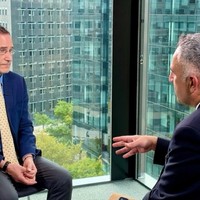
Iranian Parliament Speaker Mohammad Bagher Ghalibaf during his state TV interview before the broadcast was abruptly cut short.
Iran’s state broadcaster cut short a pre-recorded interview with Parliament Speaker Mohammad Bagher Ghalibaf on Tuesday, triggering protests from parliament and speculation that politically sensitive sections had been censored.
The interview was interrupted while Ghalibaf was explaining the mechanism for releasing Iranian assets abroad.
Video of the broadcast shows his remarks being cut off abruptly, followed by a black screen before the channel switched to other programming.
IRIB later said the interview would continue in a second installment on Wednesday, adding that this had been announced in an on-screen ticker at the end of the program.
Parliament says broadcaster gave no notice
In a statement, parliament's media office said the interview had been recorded more than two hours before broadcast and delivered in full to IRIB.
It said that if the broadcaster had decided not to air parts of the interview, it should have coordinated with parliament beforehand. Instead, it said, "The interview was stopped in the middle of its broadcast without any prior notice."
The statement said the cut section covered some of the most sensitive issues in the interview: possible IAEA inspections of Iranian nuclear sites, efforts to release frozen Iranian assets, the reported $300 billion reconstruction credit in the US-Iran MoU, responses to remarks by US President Donald Trump, and what it called Supreme Leader Mojtaba Khamenei’s strategic message last month.
Video of missing segment circulates
Several Iranian media outlets later published what they described as a brief clip from the unaired portion of the interview.
In the footage, Ghalibaf defended the mechanism for releasing Iranian funds, saying critics ignored that similar humanitarian purchase arrangements had existed for years.
"Where were these purchases made over the past 15 years? Weren't the letters of credit opened in London?" Ghalibaf said.
"Why has this suddenly become an issue? Because they do not want to admit that this memorandum of understanding opened the way for OFAC authorization. This is the power of the Islamic Republic. Be proud of it and stand by it. This document is America's defeat, and we achieved it with dignity," he added.
Iranian media reported that about 20 minutes of the interview had not been aired.
Messages sent by viewers to Iran International suggested the interview was cut as Ghalibaf referred to an earlier agreement under late president Ebrahim Raisi that enabled about $6 billion in Iranian funds to be transferred from South Korea to Qatar for humanitarian purchases.
Other audience messages linked the interruption to reports that a senior IRIB executive had returned to the broadcaster after leaving following another controversial live broadcast last month.
During that program, hardline lawmaker Mahmoud Nabavian disclosed what he described as confidential correspondence from Supreme Leader Mojtaba Khamenei criticizing the US-Iran negotiations before the interview was abruptly cut short. IRIB later said Nabavian's remarks had violated the law and announced the executive's departure.
Iranian news website Jamaran cited unnamed sources saying the executive had returned to work on Tuesday and raised questions about whether the personnel change was connected to the interruption of Ghalibaf's interview. No official has confirmed or denied the report.
Broader political divisions
The dispute over Ghalibaf's interview came amid growing signs of divisions within Iran's ruling establishment over the US-Iran memorandum of understanding.
Several Iranian media outlets portrayed the interruption as evidence of widening political rifts. Fararu said it reflected the growing influence within state broadcasting of allies of hardline politician Saeed Jalili and the ultraconservative Paydari Front, arguing that IRIB could no longer tolerate "even the official narrative of the conservative parliament speaker."
The outlet described the episode as "factional monopolization," "another crossed red line," and "media self-sabotage at one of the country's most sensitive political moments."
The controversy follows weeks of public infighting over negotiations with Washington. Hardline figures have repeatedly accused Ghalibaf, Foreign Minister Abbas Araghchi, and President Masoud Pezeshkian of making excessive concessions, while Ghalibaf and his allies have defended the agreement and pushed back against the criticism.