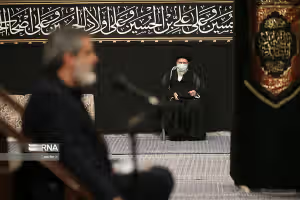
A man holding a photo of Supreme Leader Mojtaba Khamenei during a religious ceremony in Tehran
A senior aide to President Masoud Pezeshkian has turned Iran’s dispute over the US memorandum into a fight over authority, arguing that Supreme Leader’s views are subject to expert review within the state’s decision-making bodies rather than implemented automatically.
Vice President Mohammad-Jafar Ghaempanah came under fierce criticism from ultra-hardliners after saying Khamenei’s recent message on the memorandum showed respect for the Islamic Republic’s institutional decision-making process, not opposition to the agreement.
The dispute follows the publication of a written message attributed to Khamenei, in which he said he had “a different view in principle” about the memorandum but approved it after receiving assurances from the Supreme National Security Council and its chairman, Pezeshkian, that Iran’s national interests and those of the so-called Axis of Resistance would be protected.
That phrase has become the center of an increasingly bitter dispute.
Ultra-hardliners argue that Khamenei’s statement proves he had serious reservations about the agreement and accepted it only under pressure.
Some conservative figures and media outlets, including the hardline daily Kayhan, have warned that portraying the Supreme Leader as being at odds with the SNSC risks deepening political polarization.
Vice President Mohammad-Jafar Ghaempanah (left) and Iranian President Masoud Pezeshkian
A message read two ways
According to Ghaempanah, Khamenei had instructed that the memorandum be discussed at an SNSC meeting attended by senior military commanders, and had said the agreement should be accepted if three-quarters of members approved it.
“If every opinion expressed by the Leader were implemented without question, there would be no need for institutions such as parliament or the SNSC. The Leader expresses his views, and those views are examined by experts,” he added.
Ghaempanah said all but one member voted in favor of signing the memorandum, after which Khamenei authorized it while warning that “Iran must not retreat in the face of excessive American demands.”
He also said Khamenei’s reported remark that he had “a different view in principle” did not mean opposition to the memorandum, but instead strengthened Iran’s bargaining position with the United States.
Authority at the center of backlash
Ultra-hardliners interpreted Ghaempanah’s remarks as diminishing the doctrine of Velayat-e Faqih, or Guardianship of the Islamic Jurist, arguing that he had implied the Supreme Leader’s view could be subordinated to decisions taken by the SNSC.
Reza Narimani, a prominent eulogist or maddah (religious singer) associated with the ultra-hardline camp, accused Ghaempanah of misunderstanding the concept of Velayat-e Faqih.
Writing on the hardline Raja News website, Narimani said Ghaempanah should not hold office if he believed “not everything the Leader says is binding,” arguing that practical commitment to the Leader’s directives is a prerequisite for serving in the Islamic Republic.
He further wrote that Ghaempanah “is not in a position to subject the Leader’s opinion to expert review because the Leader’s opinion itself is the expert judgment within the framework of divine law.”
Addressing Ghaempanah directly, Narimani added: “The problem is your understanding. Your understanding of the Guardianship of the Islamic Jurist is flawed, and that is why the country’s problems remain unresolved. Instead of negotiating with America and looking to the West to solve the country’s problems, improve your own understanding until it reaches that of the Leader.”
The comments were widely shared by ultra-hardline social media users.
One user, Hamid Khorasani, wrote: “This system is the system of the Guardianship of the Islamic Jurist. Either you do not understand the meaning of Absolute Guardianship of the Islamic Jurist, or you do understand and are acting on behalf of the enemy.”
Another user wrote: “You cannot consider your own opinion on par with the opinion of the Leader! According to the Constitution … the Leader’s opinion is the top priority of the entire system and governmental institutions.”
The 'coup' claim spreads
The controversy comes amid an escalating ultra-hardline campaign against the Pezeshkian administration over the US memorandum.
Hardline lawmaker Mahmoud Nabavian has already accused Pezeshkian and Parliament Speaker Mohammad Bagher Ghalibaf of carrying out a “coup” against the Supreme Leader by bypassing his authority to push through the agreement with Washington.
A hardline social media user, Shahram Rashidnia, wrote that “the time for advice and warnings to Pezeshkian’s government is over; the coup against the Leader is now open and explicit.”
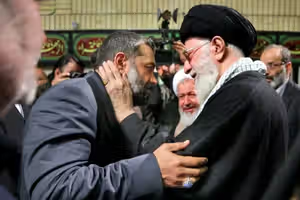
He urged supporters to use Khamenei’s funeral ceremonies to defeat what he described as the conspiracy.
Government says remarks distorted
Supporters of the government argue that Ghaempanah was explaining Khamenei’s message, not challenging his authority.
They say the text shows that Khamenei initially held a different view but approved the memorandum after receiving guarantees from Pezeshkian on behalf of the SNSC, while making clear that implementation depended on the United States honoring its commitments and avoiding excessive demands.
The Executive Vice Presidency’s public relations office issued a statement on Wednesday rejecting criticism of Ghaempanah’s remarks, saying they had been taken out of context and distorted.
It said his comments “in no way conflict with the position of the Guardianship of the Islamic Jurist.”
The statement also warned that “in the current sensitive circumstances, taking officials’ remarks out of context and creating a false dichotomy between the Leader and the state’s institutions not only fails to protect the position of the Guardianship of the Islamic Jurist but could weaken national cohesion and distort understanding of governance in the Islamic Republic.”