• العربية
  • فارسی
Brand
  • Iran Insight
  • Politics
  • Economy
  • Analysis
  • Special Report
  • Opinion
  • Podcast
  • Iran Insight
  • Politics
  • Economy
  • Analysis
  • Special Report
  • Opinion
  • Podcast
  • Theme
  • Language
    • العربية
    • فارسی
  • Iran Insight
  • Politics
  • Economy
  • Analysis
  • Special Report
  • Opinion
  • Podcast
All rights reserved for Volant Media UK Limited
volant media logo
ANALYSIS

Mojtaba Khamenei’s key word for Iran’s future: a people given a mission

Mehdi Beigi
Mehdi Beigi

Iran International

Jul 1, 2026, 14:44 GMT+1

Since becoming Supreme Leader, Mojtaba Khamenei has repeatedly used ba’sat, a term rooted in divine mission, to cast Iranians not just as citizens but as a force tasked with carrying forward the Islamic Republic’s project at home and beyond.

Around 20 messages and written statements have been issued in Mojtaba Khamenei’s name since the Assembly of Experts named him Iran’s new Supreme Leader on March 8.

Some have been routine: condolences, formal greetings and remarks for official occasions. But at least half go further, offering an early view of his political and ideological vocabulary.

They cover a wide range of subjects, from the army, parliament and the Persian language to Hajj, Shiite’s anniversary of Eid al-Ghadir, the Persian Gulf, the US-Iran memorandum of understanding and the so-called Axis of Resistance.

Read together, one word stands out: ba’sat (be’that).

In Islamic tradition, ba’sat refers to being chosen and sent on a divine mission. It is most closely associated with prophethood: the moment a prophet is commissioned to carry a message and fulfill a sacred duty.

In Mojtaba Khamenei’s messages, however, the word is not used only as a religious expression. It becomes a political language for describing the role of the people.

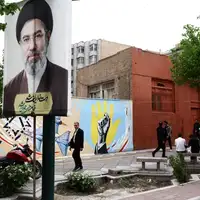
People walk in front of a banner of Supreme Leader Mojtaba Khamenei in Tehran (May 2026)
100%
People walk in front of a banner of Supreme Leader Mojtaba Khamenei in Tehran (May 2026)

A sacred word enters politics

Mojtaba Khamenei has used ba’sat in several forms: the ba’sat of the Iranian nation, the ba’sat of the people, the ba’sat of artists, a mission-bearing nation and even a commissioned Islamic ummah.

The ummah, in Islamic political language, refers to the wider Muslim community beyond national borders.

In this framework, Iranians are not presented merely as citizens of a country, voters in a political system or supporters of the Islamic Republic.

They are described as bearers of a historical mission. That is where ba’sat becomes politically important.

It casts the people as the human force of a larger ideological project, rather than simply as a society expected to support the government.

The first clear example appeared in Mojtaba Khamenei’s Hajj message in late May.

He wrote that after the killing of Ali Khamenei, the Iranian nation experienced a divine ba’sat and astonished the world by appearing wherever its presence was needed.

The more revealing line came later. Following the ba’sat of the Iranian nation and the Axis of Resistance, he wrote, the ba’sat of the Islamic ummah would follow.

In a single sequence, he linked the Iranian people, Tehran’s regional network of allied forces and the wider Muslim world.

The message was not only that Iranians had awakened. It was that they had been assigned a role in a project extending beyond Iran’s borders.

People or a mission-bearing nation?

The same pattern appears in other messages. In a statement marking Ferdowsi Day, artists were asked to carry out their own ba’sat in continuation of the people’s ba’sat, and to record the story of this uprising for history.

In a message marking the start of the third year of the 12th parliament, the legislature was told to bring itself into line with a mission-bearing nation.

The chain is revealing.

The mission begins with the people, moves into culture and art, enters formal institutions such as parliament, and is then projected outward toward the Islamic ummah and the Axis of Resistance.

This is not just ceremonial language. In Mojtaba Khamenei’s early vocabulary, the people are not treated simply as a source of legitimacy or as a crowd mobilized for elections, funerals and rallies.

They are framed as a force expected to move the system forward.

That role is tied to resistance against the United States and Israel, support for Tehran’s regional allies, and the claim that Iran is helping shape a new regional and global order.

People inside an old project

This language also connects Mojtaba Khamenei to one of Ali Khamenei’s central ideological themes.

For years, the former Supreme Leader spoke of a five-stage process leading to a new Islamic civilization.

In that theory, the Islamic Revolution was only the beginning.

It was to be followed by an Islamic system, an Islamic government, an Islamic society and, finally, a new Islamic civilization.

Institutions alone were never enough for that project. The theory required society itself to be transformed, with people seeing themselves not merely as subjects of a government but as participants in a long ideological struggle.

Mojtaba Khamenei’s use of ba’sat appears to supply that missing human engine.

If Ali Khamenei’s five-stage theory was the roadmap, ba’sat is Mojtaba Khamenei’s way of describing the people expected to carry it forward.

The Iranian nation becomes mission-bearing. Artists must narrate that mission. Parliament must adjust itself to it. The Axis of Resistance gives it regional depth. And the Islamic ummah gives it a transnational horizon.

Resistance remains central

This is why ba’sat matters beyond the number of times it appears.

Terms such as resistance, America, Israel and the Iranian nation have long been central to the Islamic Republic’s political vocabulary.

Ba’sat does something more specific. It redefines the relationship between people and power.

In this view, people are not only expected to obey, vote, mourn, rally or endure.

They are said to have been commissioned into a larger project, one that links domestic loyalty to regional confrontation and an imagined future order.

In Mojtaba Khamenei’s first message after becoming Supreme Leader, he described the Axis of Resistance as an inseparable part of the values of the Islamic Revolution.

In later messages, he returned to Lebanon, Palestine, Iraq and Yemen.

After the US-Iran memorandum, he said he had initially opposed the agreement but allowed its implementation because the president and the Supreme National Security Council had pledged to protect both the rights of the Iranian nation and those of the Axis of Resistance.

In his Persian Gulf message, he linked the policy of resistance and a strong Iran to the beginning of a new regional and global order.

Mojtaba Khamenei is not abandoning the ideological architecture of his predecessor. He is recasting it in a new vocabulary, with the people placed more explicitly at the center of the mission.

If this reading is correct, ba’sat is more than a religious flourish.

It may be the connecting term between the second and third leaders of the Islamic Republic: a word that preserves Ali Khamenei’s project of a new Islamic civilization while giving Mojtaba Khamenei a language of his own.

The result is not an ideological break. It is an effort to continue the same project with a sharper definition of the people’s role in it: not simply as supporters of the Islamic Republic, but as a people told they have been given a mission.

Most Viewed

Past funeral disasters cast a shadow over Khamenei's burial
1
INSIGHT

Past funeral disasters cast a shadow over Khamenei's burial

2
ANALYSIS

Is Tehran preparing to reinvent the IRGC?

3

Deadly attacks shake northwest Iran as IRGC reports new clashes

4

Iran bows out of World Cup amid flags, Pride and protest

5
EXCLUSIVE

Khamenei to end Eje'i’s judiciary tenure after one term

Banner
Banner
Banner

Spotlight

  • How Trump decided to strike Iran, new book reveals final hours

    How Trump decided to strike Iran, new book reveals final hours

  • Khamenei to end Eje'i’s judiciary tenure after one term
    EXCLUSIVE

    Khamenei to end Eje'i’s judiciary tenure after one term

  • Iran among top foreign espionage threats to Germany, security report says

    Iran among top foreign espionage threats to Germany, security report says

  • Two-week banking disruption leaves Iranians struggling to access money
    VOICES FROM IRAN

    Two-week banking disruption leaves Iranians struggling to access money

  • Every flare-up narrows space for diplomacy in Tehran
    INSIGHT

    Every flare-up narrows space for diplomacy in Tehran

  • Past funeral disasters cast a shadow over Khamenei's burial
    INSIGHT

    Past funeral disasters cast a shadow over Khamenei's burial

•
•
•

More Stories

Iran parliament cries censorship after Ghalibaf interview cut short

Jul 1, 2026, 10:06 GMT+1
•
Niloufar Goudarzi
Iran parliament cries censorship after Ghalibaf interview cut short
100%
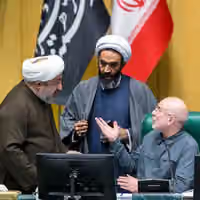
Iranian Parliament Speaker Mohammad Bagher Ghalibaf during his state TV interview before the broadcast was abruptly cut short.

Iran’s state broadcaster cut short a pre-recorded interview with Parliament Speaker Mohammad Bagher Ghalibaf on Tuesday, triggering protests from parliament and speculation that politically sensitive sections had been censored.

The interview was interrupted while Ghalibaf was explaining the mechanism for releasing Iranian assets abroad.

Video of the broadcast shows his remarks being cut off abruptly, followed by a black screen before the channel switched to other programming.

IRIB later said the interview would continue in a second installment on Wednesday, adding that this had been announced in an on-screen ticker at the end of the program.

Parliament says broadcaster gave no notice

In a statement, parliament's media office said the interview had been recorded more than two hours before broadcast and delivered in full to IRIB.

It said that if the broadcaster had decided not to air parts of the interview, it should have coordinated with parliament beforehand. Instead, it said, "The interview was stopped in the middle of its broadcast without any prior notice."

  • Hardline revolt targets Ghalibaf over US agreement

    Hardline revolt targets Ghalibaf over US agreement

The statement said the cut section covered some of the most sensitive issues in the interview: possible IAEA inspections of Iranian nuclear sites, efforts to release frozen Iranian assets, the reported $300 billion reconstruction credit in the US-Iran MoU, responses to remarks by US President Donald Trump, and what it called Supreme Leader Mojtaba Khamenei’s strategic message last month.

Video of missing segment circulates

Several Iranian media outlets later published what they described as a brief clip from the unaired portion of the interview.

In the footage, Ghalibaf defended the mechanism for releasing Iranian funds, saying critics ignored that similar humanitarian purchase arrangements had existed for years.

"Where were these purchases made over the past 15 years? Weren't the letters of credit opened in London?" Ghalibaf said.

"Why has this suddenly become an issue? Because they do not want to admit that this memorandum of understanding opened the way for OFAC authorization. This is the power of the Islamic Republic. Be proud of it and stand by it. This document is America's defeat, and we achieved it with dignity," he added.

Iranian media reported that about 20 minutes of the interview had not been aired.

  • Ghalibaf pushes for the role many thought he already had

    Ghalibaf pushes for the role many thought he already had

Online speculation

Messages sent by viewers to Iran International suggested the interview was cut as Ghalibaf referred to an earlier agreement under late president Ebrahim Raisi that enabled about $6 billion in Iranian funds to be transferred from South Korea to Qatar for humanitarian purchases.

Other audience messages linked the interruption to reports that a senior IRIB executive had returned to the broadcaster after leaving following another controversial live broadcast last month.

During that program, hardline lawmaker Mahmoud Nabavian disclosed what he described as confidential correspondence from Supreme Leader Mojtaba Khamenei criticizing the US-Iran negotiations before the interview was abruptly cut short. IRIB later said Nabavian's remarks had violated the law and announced the executive's departure.

Iranian news website Jamaran cited unnamed sources saying the executive had returned to work on Tuesday and raised questions about whether the personnel change was connected to the interruption of Ghalibaf's interview. No official has confirmed or denied the report.

Broader political divisions

The dispute over Ghalibaf's interview came amid growing signs of divisions within Iran's ruling establishment over the US-Iran memorandum of understanding.

Several Iranian media outlets portrayed the interruption as evidence of widening political rifts. Fararu said it reflected the growing influence within state broadcasting of allies of hardline politician Saeed Jalili and the ultraconservative Paydari Front, arguing that IRIB could no longer tolerate "even the official narrative of the conservative parliament speaker."

The outlet described the episode as "factional monopolization," "another crossed red line," and "media self-sabotage at one of the country's most sensitive political moments."

The controversy follows weeks of public infighting over negotiations with Washington. Hardline figures have repeatedly accused Ghalibaf, Foreign Minister Abbas Araghchi, and President Masoud Pezeshkian of making excessive concessions, while Ghalibaf and his allies have defended the agreement and pushed back against the criticism.

Khamenei to end Eje'i’s judiciary tenure after one term

Jun 30, 2026, 20:48 GMT+1
•
Shahed Alavi
Khamenei to end Eje'i’s judiciary tenure after one term
100%

Iran's Supreme Leader Mojtaba Khamenei plans to remove judiciary chief Gholam-Hossein Mohseni Eje'i at the end of his first five-year term and appoint a new figure to lead the judiciary, sources familiar with the matter told Iran International.

Sources inside Iran told Iran International that Khamenei does not intend to extend Eje'i’s term for another five years, breaking with a practice followed for nearly four decades in which judiciary chiefs have usually served two consecutive five-year terms.

The sources, who spoke on condition of anonymity, said the decision is not aimed at judicial reform but is part of a broader reshaping of power after the recent war.

They said the new supreme leader is seeking to replace key officials in major state institutions with figures more closely aligned with him.

Eje'i’s expected removal could mark one of the first major signs of Khamenei’s effort to rebuild control over the Islamic Republic’s judicial, security and political apparatus after the transfer of power.

Hardliners step up pressure on Eje'i

The decision comes amid growing criticism of Eje'i from hardline figures after the names of Supreme National Security Council members who voted in favor of a memorandum of understanding with the United States were disclosed.

Critics say Eje'i’s vote was at odds with Khamenei’s stated position, after the leader said in a letter that he had, in principle, held a different view on the memorandum of understanding.

Signs of dissatisfaction with Eje'i’s five-year record have also appeared in recent official and semi-official commentary close to the power structure.

In a message marking Judiciary Week, Khamenei did not clearly endorse Eje'i’s continuation in office. Instead, he addressed the judiciary as an institution and called for the “actualization” of demands previously made by former Supreme Leader Ali Khamenei.

The message repeated calls for the implementation of the judicial transformation document, fighting corruption inside the judiciary, reviving public rights, blocking the use of recommendations and lobbying, and improving communication with the public.

Eje'i seeks to defend his record

A day later, Eje'i published a letter to Khamenei in deferential language, defending the judiciary’s performance and pledging to continue the path of “judicial transformation.”

“I and all components of the judiciary consider ourselves obliged to carry out Your Excellency’s binding commands precisely, swiftly and without any reduction,” Eje'i wrote.

Media outlets and figures close to the establishment criticized Eje'i for not publishing such a letter before Khamenei’s message. Some also described the new leader’s renewed emphasis on his father’s demands as a negative assessment of Eje'i’s record, arguing that their repetition showed the judiciary had failed to deliver practical results under him.

Rival factions inside the establishment have also stepped up attacks on Eje'i, accusing him of distancing himself from the leadership’s demands.

Media close to Parliament Speaker Mohammad Bagher Ghalibaf and President Masoud Pezeshkian have described the attacks as part of an effort by the faction aligned with Saeed Jalili, a member of Iran’s Supreme National Security Council, and the Paydari Front to create divisions among senior officials and weaken the postwar political path.

Media close to the judiciary and Eje'i’s supporters have sought to portray his five-year record as successful, citing reduced imprisonment, electronic court proceedings, shorter trials, anti-corruption efforts and public outreach.

Rights groups point to record of repression

Human rights groups and activists say Eje'i is not a reformist figure but a long-standing part of the Islamic Republic’s repressive judicial and security apparatus.

They point to his record in the Special Clerical Court, the Ministry of Intelligence, and later as first deputy and head of the judiciary, saying his tenure has been marked by continued heavy sentences against protesters, political activists, journalists, prisoners of conscience and minorities.

Rights advocates say the judiciary under Eje'i has continued to act as the legal and executive arm of security institutions in political and security cases.

They also argue that replacing Eje'i alone would not bring meaningful change without structural reform, an end to security interference in judicial cases, guaranteed access to lawyers, a halt to forced confessions, the annulment of political verdicts and respect for fair trial standards.

Iran media urged to avoid spotlighting political disputes during Khamenei funeral

Jun 30, 2026, 15:36 GMT+1
Iran media urged to avoid spotlighting political disputes during Khamenei funeral
100%

A confidential directive by Iran’s top security body urged media outlets to avoid spotlighting political disputes during slain Supreme Leader Ali Khamenei’s funeral and limit coverage of US talks and regional developments, according to a copy obtained by Iran International.

The directive by the Supreme National Security Council said that, with programs linked to what it called the “historic funeral procession of the martyred Leader of the Revolution” beginning Friday, media outlets should help preserve national cohesion and maintain a focused media narrative.

It recommended that issues related to follow-up on the Islamabad memorandum of understanding — including the “balanced implementation of commitments,” especially over Hormuz, developments inside Lebanon, what it called the destructive role of the Lebanese government, the need to end Israeli attacks and opposition to externally imposed solutions — be gradually removed from media priority over the next 48 hours.

Instead, the directive said media capacity should mainly be used to explain the “personal, intellectual, cultural, political, historical and national dimensions of Iran’s martyr,” reflect “the presence and solidarity of the people,” and provide the “most magnificent possible coverage” of the ceremonies.

It said that if any “transgression or aggression” by enemies occurred during the period, “the issue of continuing defense alongside the holding of extensive ceremonies related to the funeral procession will naturally receive attention.”

The directive also urged outlets to avoid amplifying “internal political disputes, factional disagreements, media controversies” and issues that could polarize public opinion or divert attention from what it called a “national and historic occasion.”

News and analysis related to “negotiations, the agreement and other political and regional developments” should be covered “only to the extent necessary,” it said, warning media outlets not to turn those issues into the main focus of coverage or reproduce and amplify “rival media narratives about Iran’s defeat or retreat.”

Pezeshkian says Khamenei backed US MoU amid attacks on negotiators

Jun 30, 2026, 09:10 GMT+1
Pezeshkian says Khamenei backed US MoU amid attacks on negotiators
100%
Iranian President Masoud Pezeshkian meets Ayatollah Hashem Hosseini Bushehri, chairman of the Society of Seminary Teachers of Qom, in Qom, Iran, June 30, 2026.

Iranian President Masoud Pezeshkian defended the country’s negotiating team on Tuesday, saying the memorandum of understanding (MoU) with the United States was reached in full coordination with Supreme Leader Mojtaba Khamenei.

“Unfortunately, some groups, in line with the psychological operations of hostile media, are trying to weaken this achievement by attacking the negotiating team and questioning national decisions,” he said.

He added that the memorandum of understanding was reached within the framework of the Islamic Republic’s broader policies and with the support of the Supreme National Security Council.

Pezeshkian made the comments during a meeting with members of the Society of Seminary Teachers of Qom, an influential body of senior Shi'ite clerics.

The remarks came as Pezeshkian’s government faced mounting pressure from ultraconservative factions over the memorandum of understanding with the United States.

In recent weeks, some hardline figures have accused the president and the negotiating team of making concessions and questioned whether key security decisions had the backing of the Supreme Leader.

The attacks have exposed divisions within Iran’s conservative camp, with some establishment-aligned conservatives pushing back against the most radical critics.

  • Far-right overreach against Pezeshkian exposes cracks in the hardline camp

    Far-right overreach against Pezeshkian exposes cracks in the hardline camp

At Tuesday’s meeting, Society of Seminary Teachers of Qom Chairman Ayatollah Hashem Hosseini Bushehri voiced support for the negotiating team and said running the country under current conditions was difficult.

Other members of the group reportedly raised concerns including alleged violations of parts of the Iran-US memorandum of understanding, the need to explain the talks more clearly to the public.

100%

The president insisted that Iran would not retreat from its national rights or core principles, adding that the dominant view in the Supreme National Security Council had been to use diplomacy to consolidate gains made on the battlefield and protect national interests.

Pezeshkian said his government had pursued negotiations from a position of “dignity, power and national interest” and would not give in to imposed demands.

He said the final text of the agreement with the US had been reviewed by expert and security bodies before receiving what he called firm backing from the Supreme National Security Council.

Pezeshkian also said much of his government’s capacity over the past two years had been spent managing crises.

“Over the past two years, a large part of the government’s management capacity has been spent on managing crises, reducing the effects of foreign pressure and preventing the consequences of these challenges from being transferred to people’s daily lives,” he said.

Is Tehran preparing to reinvent the IRGC?

Jun 30, 2026, 07:44 GMT+1
•
Negar Mojtahedi
Is Tehran preparing to reinvent the IRGC?
100%
IRGC commanders Ahmad Vahidi (right) and Reza Sahaban stand before portraits of slain commanders in an event in Tehran, January 25, 2026

Comments by an establishment pundit suggesting the Islamic Revolutionary Guard Corps (IRGC) could be dismantled from within have raised an extraordinary question: is Tehran preparing to reinvent one of the pillars of the Islamic Republic?

The idea would have sounded almost unthinkable just months ago.

But the remarks by Mehdi Khorratian, who has close ties to Iran's hardline establishment, have fueled speculation that at least some in Tehran may be considering a major overhaul of the Islamic Republic's power structure.

Experts interviewed by Iran International say the more revealing question is not whether the IRGC disappears—it is what, if anything, replaces it.

Some believe any restructuring would amount to little more than a rebranding designed to preserve the Guard's power while shedding some of its political and economic baggage. Others see the debate as evidence that Iran's leadership understands the country cannot emerge from the recent war unchanged.

Constitutional obstacle

Historian Shahram Kholdi argues dismantling the IRGC is far more complicated than simply abolishing a military organization.

"The IRGC is not called the Revolutionary Guard Corps of Iran. It is called the Islamic Revolutionary Guard Corps. That is very important," he said.

The obstacle, he argues, lies in the constitution. Article 150 of the Islamic Republic's constitution establishes the Guard not as a conventional military force but as the institution responsible for "guarding the revolution and its achievements."

That ideological mandate makes outright dissolution highly unlikely.

Instead, Kholdi believes the leadership would preserve the system while adapting its structure.

"They will not allow any disruption in the continuity of the Islamic Republic, but they will turn it into what it has been over the past 30 years: a fully military oligarchy disguised as a theocracy," he said.

Kholdi argues restructuring could also serve a practical purpose. As Western governments continue to designate the IRGC as a terrorist organization, folding it into a broader military structure could make it easier for Iranian officials to participate in future international security arrangements linked to any agreement with Washington while complicating efforts to isolate the organization itself.

"It would actually make things much more flexible for them," he said.

A toxic brand

Political analyst Omid Memarian says the IRGC itself has become a liability.

"The IRGC has become a huge liability, both domestically and internationally," he said.

Domestically, he argues, the Guard has become associated with economic mismanagement, political repression and deep involvement across nearly every sector of Iranian life. Internationally, sanctions and terrorism designations have made the organization increasingly costly for Tehran to defend.

"The brand name has become a liability for Iran more and more over the past few years," Memarian said.

That does not necessarily mean the institution itself is disappearing. Rather, he says, it could signal an effort to package the same power structure differently.

"The same people who created this system are doing the rebranding," he said.

Memarian nevertheless believes the debate reflects something larger than institutional reform.

"There is an unwritten consensus that Iran needs a massive departure from the pre-war era," he said.

The debate is unfolding alongside unusually sharp criticism from ultrahardline figures aligned with Saeed Jalili, who have portrayed the post-war political direction as an internal "coup" against Supreme Leader Mojtaba Khamenei. They accuse figures linked to Parliament Speaker Mohammad Bagher Ghalibaf and President Masoud Pezeshkian of steering the Islamic Republic away from its revolutionary course.

Name change or real change?

For Behnam Ben Taleblu, senior director of the Iran Program at the Foundation for Defense of Democracies, the debate begins with a literary question.

"All of this reminds me of the Shakespeare quote from Romeo and Juliet: 'What's in a name?' What is in the name of the Islamic Revolutionary Guard Corps? Its mission is in the name: to preserve, protect and defend the Islamic Revolution."

He does not believe the IRGC is likely to disappear. Instead, he cautions Western governments against confusing cosmetic changes with genuine reform.

"Real transformation comes with behavior. It comes with substance—not style," Ben Taleblu said.

"The West has to distinguish fake transformation from real transformation."

Whether the organization is renamed or folded into another military structure matters less, he argues, than whether it continues sponsoring militant groups abroad, dominating Iran's economy and serving as the central pillar of the Islamic Republic's security apparatus.

"Substance is whether the entity—whatever it's called—continues to act like the IRGC," he said.

A post-war identity crisis

Ultimately, the debate over the IRGC reflects the broader question confronting the Islamic Republic after the recent war: can the system reinvent itself without changing its fundamentals?

Kholdi believes any restructuring would further entrench military rule beneath a religious façade. Memarian argues the leadership recognizes that the pre-war model is no longer sustainable but doubts the same political elite can fundamentally transform the system they built. Ben Taleblu, meanwhile, warns against mistaking pragmatism for moderation.

"People mistake Ghalibaf's opportunism for moderation," he said.

For now, the discussion reveals less about the imminent disappearance of the IRGC than about the Islamic Republic's search for a model capable of surviving its deepest crisis in decades.

Whether that future involves genuine reform or simply a new name for an old institution remains an open question.