Insulin costs soar in Iran as insurance fails to keep up
Rising drug prices and lagging insurance coverage are pushing diabetes medication further out of reach in Iran, documents obtained by Iran International show, with one patient’s NovoMix FlexPen insulin payment rising more than 24-fold in less than two months.
The patient paid 1,592,500 rials (about $0.91) for 15 insulin pens in early May. The same prescription, purchased from the same pharmacy in Tabriz on June 28, cost 39,092,500 rials (about $22.27), an increase of about 2,355%.
The sharp rise in the patient's bill far exceeded the increase in the price of the medicine itself. The total cost of the prescription rose from 96,862,500 rials (about $55.19) to 134,362,500 rials (about $76.56), an increase of 37,500,000 rials (about $21.37), or about 38.7%.
Rising drug prices and lagging insurance coverage are pushing diabetes medication further out of reach in Iran, documents obtained by Iran International show, with one patient’s NovoMix FlexPen insulin payment rising more than 24-fold in less than two months.
The patient paid 1,592,500 rials (about $0.91) for 15 insulin pens in early May. The same prescription, purchased from the same pharmacy in Tabriz on June 28, cost 39,092,500 rials (about $22.27), an increase of about 2,355%.
The sharp rise in the patient's bill far exceeded the increase in the price of the medicine itself. The total cost of the prescription rose from 96,862,500 rials (about $55.19) to 134,362,500 rials (about $76.56), an increase of 37,500,000 rials (about $21.37), or about 38.7%.
The receipts show the same billing categories, including the insurer's contribution, the patient's share, coverage for patients with special illnesses and pharmacy service fees. But while the drug's price increased, the Social Security Organization's reimbursement remained fixed at 96,000,000 rials (about $54.70), leaving the patient to pay the difference.
The newer receipt also included a new line item labeled "difference" worth 37,500,000 rials (about $21.37), transferring the additional cost directly to the patient. That line did not appear on the receipt issued in early May.
As a result, while the price of the drug itself increased by less than 40%, the patient's out-of-pocket payment rose more than 24-fold because the insurance reimbursement ceiling was not adjusted.
Drug prices continue to climb
Iran International reported in late April that insulin prices had already surged compared with levels before the Persian New Year (March 21), with some domestically produced brands rising by up to 212% and imported products by as much as 271%.
The latest receipts suggest prices have continued to rise since then, while also highlighting the growing burden on patients as insurance coverage has failed to keep pace with higher costs.
Pharmaceutical industry representatives say the crisis has been driven by a combination of factors, including the removal of subsidized exchange rates, the depreciation of the rial, higher prices for raw materials and packaging, rising wages, increased financing costs and supply chain disruptions linked to the recent war.
They say manufacturers have also struggled with higher working capital requirements, while delayed price adjustments and insufficient government and banking support have compounded the problem.
Since January, following the government's exchange-rate unification policy, pharmaceutical raw materials that had previously been imported at a subsidized exchange rate have instead been purchased at rates more than five times higher.
Mohammad Abdehzadeh, head of the Health Economy Commission at the Tehran Chamber of Commerce, told Donya-ye Eqhtesad on Wednesday that most medicines had been removed from the subsidized currency system since March and were now being produced using the new exchange rate.
The newspaper said Iran's pharmaceutical sector was facing twin pressures: producers struggling with sharply higher manufacturing costs and liquidity shortages, and patients increasingly forced to bear a much larger share of medicine costs out of pocket.
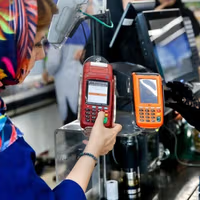
File photo shows a shopper making a card payment at a supermarket checkout in Iran.
A banking disruption lasting more than two weeks has left many Iranians unable to access their accounts, make purchases or transfer money, adding to financial pressures after the recent war and ceasefire.
The problems began on June 13, when customers of several Iranian banks reported failures in mobile banking services and routine financial transactions.
Iran's Central Bank attributed the disruption to a cyberattack on banking infrastructure, saying customer information remained secure and no unauthorized access to banking data had occurred.
However, messages sent to Iran International show that many of the problems remain unresolved more than two weeks later.
Customers said mobile and internet banking services, card-to-card transfers, check processing, balance inquiries and other routine transactions continue to suffer from errors, delays or complete failures.
Several people reported that money had been deducted from their accounts but never reached the intended recipient.
One customer said fifty million rials transferred on June 28 from a bank to another was withdrawn from the sender's account but never credited to the recipient.
Photo shows people outside a branch of Iran's Mellat Bank during widespread banking service disruptions.
A retiree in Tehran said 500 million rials disappeared from a newly opened Bank Saderat account following the disruption without explanation.
Another customer said funds deposited into an account at Bank Tejarat on June 24 could not be located by bank staff despite the customer presenting a transaction reference number.
Payment failures disrupt daily life
Customers also described widespread failures of point-of-sale terminals, disrupting routine shopping.
In some cases, money was deducted from customers' accounts without reaching merchants, with several people saying banks, including Bank Melli, had not provided clear answers about the missing transactions.
Others said alternative payment methods such as card-to-card transfers through banking applications were also unavailable, making purchases impossible.
"Online shopping isn't possible, card-to-card transfers don't work, point-of-sale purchases fail and there is no normal access to bank accounts," one citizen wrote. "Alongside inflation and poverty, these problems have only increased pressure on people."
A business owner said delayed settlements had disrupted operations. "Payments are not reaching my account, and it has affected my business," the person said.
Frozen accounts and delayed salaries
People said the disruption extends beyond failed transactions to broader restrictions on account access.
Several reported that transaction notification messages had stopped arriving, account statements were unavailable and balance inquiries could not be completed.
Others said bank accounts at institutions including Bank Melli, Bank Sepah, Bank Saderat, Bank Refah and Bank Saman had been frozen.
The restrictions have complicated access to salaries and pensions for many customers.
"Employees still haven't been paid," one customer wrote. "My account has been blocked just when my monthly salary should be deposited."
The disruption has also affected checks and loan payments.
A resident of Isfahan said a check issued to purchase a television was bounced despite sufficient funds being available in the account.
Questions over cause of disruption
After services at Bank Melli, Bank Tejarat and Bank Saderat failed on June 23, Informatics Services Corporation attributed the outage to a cyberattack.
Some customers questioned that explanation, arguing the restrictions reflected deliberate measures rather than technical failures.
One customer suggested banks were trying to discourage deposit withdrawals by disrupting transactions. Another said authorities had frozen funds because of financial pressures following the recent conflict.
The Central Bank rejected the allegations on Monday that it had directed banks to use a particular information technology provider to restore services, saying each bank independently selects contractors within existing regulations.
Despite repeated assurances from Iranian officials that banking services would soon return to normal, customers continue to report widespread disruptions.
Photo shows bank cards issued by several Iranian banks amid widespread disruptions to banking and electronic payment services in Iran.
Technology news website CITNA reported on Monday that service outages and instability remain widespread, causing significant disruption to businesses and eroding public confidence.
Tehran Chamber of Commerce chairman Mahmoud Najafi Arab told CITNA the disruption had inflicted serious damage on the business environment at a time when the country needed faster financial services.
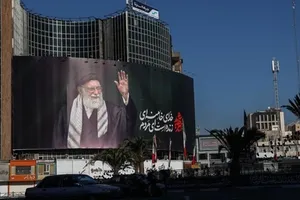
File photo: Supporters of Iran's ruling establishment hold portraits of slain Supreme Leader Ali Khamenei and his successor and son Mojtaba during a nighttime gathering in Iran.
Plans by Iranian authorities to hold funeral ceremonies for slain Supreme Leader Ali Khamenei from July 4 to July 9 have drawn satire over the delayed burial and the absence of his reported successor, alongside objections to efforts to boost turnout.
Iranian officials have announced a series of funeral and burial ceremonies scheduled for early July, months after Khamenei's death. The delay has become the subject of widespread discussion and satire on social media, where users have questioned the circumstances surrounding the burial and speculated about the condition of his remains.
One audience told Iran International: "A funeral for an empty coffin shows how frightened the remaining authorities are. They know they no longer have public support."
The Islamic Republic's second supreme leader was killed on the morning of February 28, in the opening hours of the war with Israel and the United States.
Others questioned the absence of Mojtaba Khamenei, who has been identified by Iranian authorities as the country's third supreme leader. Since his appointment, no public appearance, audio message or video statement has been released, with only written messages issued in his name.
Several also referred to earlier remarks by pro-government eulogist Mansour Arzi, who said during a gathering of supporters that "it will later be revealed what remained of our leader's body," adding to public speculation surrounding the burial.
‘Little significance’
Many messages also responded to comments by First Vice President Mohammad Reza Aref, who described Khamenei's funeral on Sunday as "the most important event of the 21st century."
One dismissed the characterization, saying the burial held little significance even inside Iran, let alone internationally.
Another wrote that the delayed burial of "one of the century's biggest dictators" would instead be remembered as "one of the happiest events" for many Iranians.
The empty seat reserved for Iran's Supreme Leader Ali Khamenei at his compound in Tehran is draped in black mourning cloth during a ceremony.
Organized attendance
Many readers said that state institutions were preparing to boost attendance through administrative measures rather than voluntary participation.
A principal at a Tehran high school told Iran International that schools had received instructions two weeks earlier to prepare to accommodate visitors arriving from other cities and neighboring countries for the ceremonies.
"Our school lacks even basic facilities such as prayer hall carpets and air conditioning, yet we have been ordered to prepare for guests," the principal said.
Iran International also received messages saying that employees at state institutions, including municipal offices and the mobile operator Hamrah-e Aval, had been informed that leave and remote work would be suspended during the funeral period.
Several citizens said such measures suggested authorities expected limited spontaneous attendance and were relying on public-sector workers and organized transportation to increase turnout.
Others asaid that buses had been dispatched to rural areas with offers of free transport, meals and local incentives to encourage participation, describing the effort as a familiar method of increasing attendance at official gatherings.
Calls for protest
Some viewed the week-long ceremonies as an opportunity for peaceful protest.
One suggested people mark the funeral by blowing whistles, clapping or shouting from their windows during the evenings.
Others called for broader demonstrations, arguing that concentrating government supporters in one location could create an opportunity for nationwide protests.
The comments followed a call issued on Sunday by exiled Prince Reza Pahlavi's media office for Iranians abroad to take part in demonstrations between July 4 and July 9, describing the period as a "Global Week of Action for a Free Iran."
Iran's elimination from the FIFA World Cup prompted a wave of public reactions, with many citizens arguing the team's defeat reflected the political positions of some players rather than simply a sporting failure, according to messages sent to Iran International.
Many of the messages linked the result to the conduct of several national team players during the pro-government night-time gatherings that followed the US-Israeli attack and killing of Ali Khamenei, singling out defender Ramin Rezaeian more frequently than any other player.
Rezaeian was slammed for his pro-regime stance in face of the massacre of over 36000 protesters during January protests.
National football team player Ramin Rezaeian crouches on the pitch after the team's elimination from the FIFA World Cup 2026.
Iran's elimination from the FIFA World Cup prompted a wave of public reactions, with many citizens arguing the team's defeat reflected the political positions of some players rather than simply a sporting failure, according to messages sent to Iran International.
Many of the messages linked the result to the conduct of several national team players during the pro-government night-time gatherings that followed the US-Israeli attack and killing of Ali Khamenei, singling out defender Ramin Rezaeian more frequently than any other player.
Rezaeian was slammed for his pro-regime stance in face of the massacre of over 36000 protesters during January protests.
"You were eliminated a long time ago, the moment you turned your backs on those who lost their lives," one viewer wrote to Rezaeian.
Many said the team's relationship with the public had broken down weeks earlier when some players attended pro-government gatherings and voiced support for the Islamic Republic after the crackdown on protesters. They argued that the loss of public backing ultimately affected the team's fortunes on the pitch.
Others described the defeat as karma or the result of the grief of families seeking justice for relatives killed during the protests. Several wrote that the team no longer enjoyed the goodwill and support that had accompanied previous World Cup campaigns.
Some messages contrasted the current squad with former national team goalkeeper Mohammad Rashid Mazaheri, whom they described as having stood with anti-government protesters. Mazaheri was detained after publicly supporting protesters and has since disappeared from public view, according to people familiar with his case.
Public support
Several citizens said the national team no longer represented the wider public, pointing to the absence of the large public gatherings and celebrations that had accompanied previous tournaments.
"This is not a national team that represents the people. We are happier to see it lose," one person wrote.
Others referred to a disallowed goal by Shoja Khalilzadeh, linking it to his previous remarks about dedicating goals to Iran's Supreme Leader. Some also pointed to Rezaeian's tears after the elimination, arguing the outcome reflected the political choices made by some members of the squad.
A common thread across the messages was the view that sporting success and public trust cannot be separated, and that distancing themselves from large sections of Iranian society ultimately carried consequences beyond football.