• العربية
  • فارسی
Brand
  • Iran Insight
  • Politics
  • Economy
  • Analysis
  • Special Report
  • Opinion
  • Podcast
  • Iran Insight
  • Politics
  • Economy
  • Analysis
  • Special Report
  • Opinion
  • Podcast
  • Theme
  • Language
    • العربية
    • فارسی
  • Iran Insight
  • Politics
  • Economy
  • Analysis
  • Special Report
  • Opinion
  • Podcast
All rights reserved for Volant Media UK Limited
volant media logo
VOICES FROM IRAN

Citizens tell Iran football team it lost the public long ago

Jun 29, 2026, 10:33 GMT+1

Iran's elimination from the FIFA World Cup prompted a wave of public reactions, with many citizens arguing the team's defeat reflected the political positions of some players rather than simply a sporting failure, according to messages sent to Iran International.

Many of the messages linked the result to the conduct of several national team players during the pro-government night-time gatherings that followed the US-Israeli attack and killing of Ali Khamenei, singling out defender Ramin Rezaeian more frequently than any other player.

Rezaeian was slammed for his pro-regime stance in face of the massacre of over 36000 protesters during January protests.

Continue reading

Most Viewed

Iraq arrests officials tied to Iran-aligned parties in Baghdad raids, sources say
1
EXCLUSIVE

Iraq arrests officials tied to Iran-aligned parties in Baghdad raids, sources say

2
INSIGHT

Khamenei mourning site shut as shroud-wearing hardliners expose loyalist rift

3

Iran's top clerical body turns on itself over US deal

4
INSIGHT

Return of Iran-US thaw advocate ignites hardline debate

5
VOICES FROM IRAN

Citizens tell Iran football team it lost the public long ago

Banner
Banner
Banner

Spotlight

  • Why falling oil prices don't mean Hormuz crisis is over
    ANALYSIS

    Why falling oil prices don't mean Hormuz crisis is over

  • Return of Iran-US thaw advocate ignites hardline debate
    INSIGHT

    Return of Iran-US thaw advocate ignites hardline debate

  • How a US-Iran deal can reshape the Middle East
    ANALYSIS

    How a US-Iran deal can reshape the Middle East

  • Iranians recast Ashura mourning to remember January protest victims
    VOICES FROM IRAN

    Iranians recast Ashura mourning to remember January protest victims

  • Investigation traces January protest deaths to Gharazi Hospital in Isfahan
    SPECIAL REPORT

    Investigation traces January protest deaths to Gharazi Hospital in Isfahan

  • US-Iran MoU pauses conflict but leaves nuclear dispute unresolved

    US-Iran MoU pauses conflict but leaves nuclear dispute unresolved

•
•
•

More Stories

Citizens tell Iran football team it lost the public long ago

Jun 29, 2026, 10:05 GMT+1
Citizens tell Iran football team it lost the public long ago
100%
National football team player Ramin Rezaeian crouches on the pitch after the team's elimination from the FIFA World Cup 2026.

Iran's elimination from the FIFA World Cup prompted a wave of public reactions, with many citizens arguing the team's defeat reflected the political positions of some players rather than simply a sporting failure, according to messages sent to Iran International.

Many of the messages linked the result to the conduct of several national team players during the pro-government night-time gatherings that followed the US-Israeli attack and killing of Ali Khamenei, singling out defender Ramin Rezaeian more frequently than any other player.

Rezaeian was slammed for his pro-regime stance in face of the massacre of over 36000 protesters during January protests.

  • Over 36,500 killed in Iran's deadliest massacre, documents reveal

    Over 36,500 killed in Iran's deadliest massacre, documents reveal

"You were eliminated a long time ago, the moment you turned your backs on those who lost their lives," one viewer wrote to Rezaeian.

Many said the team's relationship with the public had broken down weeks earlier when some players attended pro-government gatherings and voiced support for the Islamic Republic after the crackdown on protesters. They argued that the loss of public backing ultimately affected the team's fortunes on the pitch.

Others described the defeat as karma or the result of the grief of families seeking justice for relatives killed during the protests. Several wrote that the team no longer enjoyed the goodwill and support that had accompanied previous World Cup campaigns.

Some messages contrasted the current squad with former national team goalkeeper Mohammad Rashid Mazaheri, whom they described as having stood with anti-government protesters. Mazaheri was detained after publicly supporting protesters and has since disappeared from public view, according to people familiar with his case.

Public support

Several citizens said the national team no longer represented the wider public, pointing to the absence of the large public gatherings and celebrations that had accompanied previous tournaments.

"This is not a national team that represents the people. We are happier to see it lose," one person wrote.

  • Armed patrols and nightly pro-government rallies spread fear across Iranian cities

    Armed patrols and nightly pro-government rallies spread fear across Iranian cities

Others referred to a disallowed goal by Shoja Khalilzadeh, linking it to his previous remarks about dedicating goals to Iran's Supreme Leader. Some also pointed to Rezaeian's tears after the elimination, arguing the outcome reflected the political choices made by some members of the squad.

A common thread across the messages was the view that sporting success and public trust cannot be separated, and that distancing themselves from large sections of Iranian society ultimately carried consequences beyond football.

Iranians recast Ashura mourning to remember January protest victims

Jun 26, 2026, 12:38 GMT+1
•
Saba Heidarkhani
Iranians recast Ashura mourning to remember January protest victims
100%
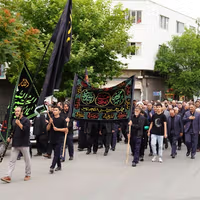
File photo shows a subdued Muharram mourning procession through a street in Iran.

Many Iranians are using the Shiite mourning period of Muharram to commemorate those killed in January's nationwide protests rather than take part in state-backed religious ceremonies, according to messages sent to Iran International and videos from across the country.

Muharram is the holiest month in the Shiite Muslim calendar. Its ninth and tenth days, Tasu'a and Ashura, commemorate the seventh-century killing of Imam Hussein, the grandson of the Prophet Muhammad, whose death at the Battle of Karbala symbolizes resistance against oppression and is marked each year with public mourning processions.

Messages received by Iran International suggest this year's ceremonies have drawn smaller crowds than in previous years, with many Iranians saying the nights of January 8 and 9 massacres have become their own Tasu'a and Ashura, when they mourn tens of thousands of those killed.

Social media posts also show many users replacing traditional Muharram images with photographs and names of people killed during recent protest crackdowns.

Many shared similar sentiments, writing: "We have had our own Ashura. We have seen the real oppressed."

Quieter ceremonies, different mourning

Videos sent to Iran International show some mourning processions incorporating tributes to those killed in the protests.

One resident said a banner bearing the names and photographs of protest victims was raised during Ashura ceremonies in Homayounshahr, near Isfahan, on June 25. According to the account, it was displayed openly during the religious gathering.

The mother of 25-year-old Mohammad Jafarpour, who was killed by security forces in Khomeinishahr, Isfahan province, on January 9, posted a video from his graveside on Wednesday.

"My mourning procession this year, my Ashura and Tasu'a, is your grave, my son," she wrote.

Several residents described this year's Muharram ceremonies as noticeably subdued.

A Tehran resident said that while passing Enghelab Square in central Tehran on June 24, coinciding with Tasu'a, they saw only a single woman waving the Islamic Republic's flag.

Another said chest-beating processions in their town, once dominated by young people, were this year attended mainly by older participants.

"The young people of our city were buried in January with all their dreams," the resident said.

  • A nation in limbo: 100 days after the massacre, has the world moved on?

    A nation in limbo: 100 days after the massacre, has the world moved on?

For decades, Muharram rituals have been strongly promoted by the Islamic Republic and, in many state-supported ceremonies, religious observances have also served as platforms for political messaging and expressions of support for the government's ideological positions.

Karbala remembered through recent protests

Many said they now wear black during Muharram to mourn those killed in the January protests.

Some residents also said that mourning ceremonies in places including Kangavar in Kermanshah province included elegies for those killed during the protests.

Video received by Iran International showed the mother of a victim called Mohammad Radmannia addressing mourners during a Tasu'a ceremony in Tehran, urging them: "Do not let my son's path be extinguished."

Radmannia, 29, was killed by security forces during protests in Tehran's Nezamabad neighborhood on January 9.

  • Over 36,500 killed in Iran's deadliest massacre, documents reveal

    Over 36,500 killed in Iran's deadliest massacre, documents reveal

Another video shared by the sister of 25-year-old Amirhossein Javadzadeh showed their mother searching through Muharram mourners while calling her son's name aloud.

Elsewhere, mourners in Lafmejan village in Gilan province gathered at the grave of 18-year-old Mani Safarpour during a Muharram procession. His photograph was mounted on ceremonial drums used in the procession. Safarpour was killed during protests in Tehran on January 8.

The use of Muharram commemorations to remember those killed in anti-government protests has continued since the Woman, Life, Freedom movement.

During Muharram in 2023, mourners in several cities sang protest songs, held symbolic performances honoring those killed, distributed memorial food offerings in their names and gathered at gravesides.

Power, water outages disrupt daily life across Iran

Jun 25, 2026, 13:40 GMT+1
Power, water outages disrupt daily life across Iran
100%
File photo shows residents queue with containers to collect water from a public distribution point in the central Iranian city of Yazd amid water cuts.

Daily electricity and water outages disrupted life across Iran as summer began, with residents blaming years of underinvestment and deteriorating infrastructure despite officials citing rising demand and shrinking water supplies.

Messages sent to Iran International from residents in Khuzestan, Ilam, Lorestan, East Azarbaijan, Alborz, Tehran and other provinces described hours-long daily power cuts and recurring water shortages that began with the onset of summer.

The reports come as much of Iran experiences extreme heat, placing additional strain on the country's aging electricity and water networks.

A resident of Khuzestan, one of Iran's main electricity-producing provinces, said scheduled power cuts had resumed despite the province generating far more electricity than it consumes.

"On the first day of summer, with temperatures above 50 degrees Celsius, they started cutting electricity again in a province that produces twice its own needs."

Residents in Ilam province also reported electricity outages lasting up to four hours as temperatures reached 46 degrees Celsius. One warned that if the blackouts continue, authorities would face "angry and protesting people."

  • Iran runs dry as Islamic Republic funds ideology and foreign proxies

    Iran runs dry as Islamic Republic funds ideology and foreign proxies

In Pardis, east of Tehran, a resident of a 14-story apartment building said electricity was cut for four hours during the day, leaving elevators out of service.

"How are we supposed to climb all these stairs?"

Others said the loss of elevator access posed particular difficulties for elderly residents and families with young children.

Water shortages deepen disruption

Citizens also reported prolonged water outages, which they said often coincided with electricity cuts because pumping stations stopped operating.

Mehdi Masaeli, secretary of Iran's Electricity Industry Syndicate, said last year that water supplies are interrupted when electricity fails because pumps stop working.

Residents in Boumehen near Tehran said they had access to running water on only two days during the previous week, and then only for a few hours.

"We have a sick person at home. We no longer know who to turn to."

People from Shahriar and Qods, west of Tehran, also described prolonged water cuts, with some saying supplies were unavailable from mid-afternoon until early the following morning. Several said repeated calls to the local water utility produced only tracking numbers and recorded messages.

"Water is a basic necessity, not a luxury service."

Officials have cited falling reservoir levels, declining rainfall and rising consumption as the main causes of the shortages. Many people, however, said authorities were blaming consumers instead of addressing years of underinvestment and poor management.

File photo shows residents lining up with containers to collect water from a tanker truck during water shortages in Iran.
100%
File photo shows residents lining up with containers to collect water from a tanker truck during water shortages in Iran.

One message from Ilam province said the city of Shabab had gone without running water for three consecutive days.

Some also compared the shortages with recent warnings about attacks on infrastructure.

"There was no need for anyone to attack the energy infrastructure," one citizen wrote. "Government inefficiency has taken our water away and pushed us back to the Stone Age. We carry water home in containers."

Higher bills, aging infrastructure

People also complained that utility bills had increased even as services deteriorated.

A resident in Zanjan said electricity and water tariffs had quietly risen just as power cuts resumed. In Ahvaz, people reported sharply higher water bills, with one saying many families could no longer afford to pay them and that local authorities were unwilling to offer installment plans.

  • Rampant electricity outages take toll on frustrated Iranians

    Rampant electricity outages take toll on frustrated Iranians

Energy experts have long warned that Iran's electricity and water systems suffer from years of inadequate investment in power generation, transmission networks and water infrastructure.

They say authorities have repeatedly relied on rotating blackouts and water restrictions to manage seasonal shortages rather than addressing the underlying causes, leaving households increasingly vulnerable during periods of extreme heat.

Don’t feed us, free us: Iranians hit back at Vance over 'hunger' remarks

Jun 24, 2026, 02:57 GMT+1
•
Saba Heidarkhani
Don’t feed us, free us: Iranians hit back at Vance over 'hunger' remarks
100%
Protesters scatter rice into the air in Abdanan during the January 2026 uprising, a scene that later became a symbol of dignity and defiance for many Iranians.

After Donald Trump said Iran has “a hunger problem” and JD Vance said unfrozen Iranian assets could help “feed the Iranian people,” Iranians pushed back, saying the country’s real crisis is repression, corruption and the fight for freedom, not hunger.

Speaking in Switzerland on Monday, Vance said Washington could agree to release frozen Iranian funds for purchases of US agricultural products such as wheat, corn and soybeans.

"If Iranian assets are ever unfrozen, they're going to go to make American farmers richer and to feed the Iranian people," Vance said.

He said the United States and Qatar would oversee the process, though Iranian officials have disputed that characterization.

Trump made similar remarks on Tuesday, saying money taken out of Iran would go to American farmers to provide “corn, soybeans, wheat to Iran.”

“They have a hunger problem, they have a food problem, they have a medicine problem, they got a lot of problems,” Trump said, adding that inflation in Iran had “hit 300%.”

  • Will the Islamic Republic trade with the 'Great Satan'?

    Will the Islamic Republic trade with the 'Great Satan'?

The remarks sparked widespread reactions from Iran International's viewers, many of whom said the country's struggle cannot be reduced to hunger.

"American officials talk about hunger in Iran as if our problem is a lack of food. Everything exists here. Government policies have made food unaffordable. Sending grain won't solve our problems," one viewer told Iran International.

While many respondents acknowledged the country's worsening economic crisis, they argued that inflation, corruption and decades of mismanagement—not a shortage of food—have made life increasingly difficult.

Others said they have little faith that any economic relief provided to the Islamic Republic would ultimately benefit ordinary citizens.

"Right now the Islamic Republic is probably figuring out how to send that wheat to Lebanon and Iraq," one viewer wrote.

The comment was a reference to the Islamic Republic's long-standing support for regional militant allies and proxy groups. Many respondents argued that Tehran has repeatedly prioritized its regional strategy over the welfare of its own citizens.

Several viewers also objected to what they saw as a portrayal of Iranians as a population waiting to be fed.

"The people of Iran are not hungry. They sacrificed their lives and shed blood for freedom," one respondent said.

Many pointed to the nationwide protests of January 2026, arguing that the movement was driven by demands for freedom and political change rather than economic assistance.

Some referenced the symbolic scene in Abdanan, where protesters threw rice into the air during demonstrations. Videos from the western city showed protesters throwing rice into the air, a gesture many interpreted as a rejection of the idea that their uprising was driven by hunger.

"Mr. Vance, you were not there during those January nights in Abdanan when grains of rice fell from the sky like snow," one citizen wrote.

For many respondents, the image symbolized dignity and defiance. They argued that while many Iranians are struggling economically, the country's crisis is ultimately one of governance and freedom.

They did not deny the depth of economic hardship, but said reducing Iran’s crisis to hunger ignored the political nature of their struggle.

Others stressed that Iran is not a poor country lacking resources.

"Our problem with the Islamic Republic is not only economic. It is a government that opposes human dignity, personal freedoms and Iran's ancient national culture. It is governed by ideology and follows a path separate from the Iranian people," one viewer wrote.

Another respondent was blunter.

"Mr. Vance, Iran is a rich country. If you don't believe me, ask Hezbollah, Hamas, the Popular Mobilization Forces and the Houthis."

The reactions reveal deep skepticism among Iranians who wrote to Iran International toward any agreement that could provide financial relief to the Islamic Republic. For them, the issue is not hunger alone, but freedom, dignity and who ultimately benefits when money flows back into the hands of Tehran.


Rising gym fees push fitness beyond reach for many Iranians

Jun 23, 2026, 10:38 GMT+1
•
Saba Heidarkhani
Rising gym fees push fitness beyond reach for many Iranians
100%
A man adjusts a treadmill at a gym in Iran.

Soaring gym fees and shrinking household budgets are forcing many Iranians to abandon sports and fitness activities, turning what was once a routine part of daily life into an unaffordable luxury, according to messages sent to Iran International.

Monthly gym memberships that were once within reach for many families now cost at least 20 million rials ($12.5) in smaller cities. In some gyms in Tehran and other major urban centers, 12 training sessions can cost as much as 200 million rials ($125). The average wage in Iran is $150.

Gym owners say inflation, rising rents, higher energy bills and the growing cost of imported equipment have left them little choice but to raise fees. For many households, however, food, housing and transportation now take priority over exercise.

Teen athletes forced to quit

Many of the messages received by Iran International on the issue came from teenagers who said financial pressures were disrupting their athletic ambitions.

A 15-year-old taekwondo athlete said she had spent months trying to save enough money to buy a punching bag. A 13-year-old basketball player said he had been forced to stop training indoors because of rising fees.

A university student in Mashhad said gym membership remained out of reach despite a strong interest in fitness.

“Registering at a gym and working out is something I still want to do, but my salary is so low that I cannot afford it,” the student said.

100%

The decline in participation is also hitting gym owners and coaches.

A gym manager in eastern Tehran said the number of clients at his facility had fallen to roughly one-third of previous levels, despite keeping membership fees unchanged.

Coaches in several cities said they had lost most of their students in recent months and lacked both fixed salaries and insurance coverage. Many warned that smaller sports businesses could face closure if the trend continues.

Rising costs beyond membership fees

The financial pressure extends beyond gym subscriptions. Coaches and athletes say the price of protein-rich foods and sports supplements has climbed sharply, making it harder to maintain training programs.

Citizens reported that whey protein now costs around 200 million rials ($125), while a 300-gram container of creatine sells for about 40 million rials ($25).

Football players also pointed to soaring equipment costs, saying cleats priced below 50 million rials ($31) have become difficult to find. One player said football field rental fees can also reach 50 million rials ($31).

Health experts have long warned that lower levels of physical activity can contribute to higher healthcare costs over time. For many Iranians, however, regular exercise is increasingly becoming a financial burden rather than a basic part of a healthy lifestyle.