• العربية
  • فارسی
Brand
  • Iran Insight
  • Politics
  • Economy
  • Analysis
  • Special Report
  • Opinion
  • Podcast
  • Iran Insight
  • Politics
  • Economy
  • Analysis
  • Special Report
  • Opinion
  • Podcast
  • Theme
  • Language
    • العربية
    • فارسی
  • Iran Insight
  • Politics
  • Economy
  • Analysis
  • Special Report
  • Opinion
  • Podcast
All rights reserved for Volant Media UK Limited
volant media logo
VOICES FROM IRAN

Iranians criticize Khamenei funeral plans, organized turnout

Saba Heidarkhani
Saba Heidarkhani

Iran International

Jun 29, 2026, 13:35 GMT+1Updated: 15:03 GMT+1
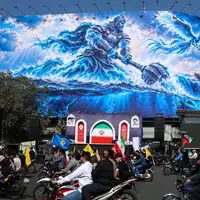
File photo: Supporters of Iran's ruling establishment hold portraits of slain Supreme Leader Ali Khamenei and his successor and son Mojtaba during a nighttime gathering in Iran.

Plans by Iranian authorities to hold funeral ceremonies for slain Supreme Leader Ali Khamenei from July 4 to July 9 have drawn satire over the delayed burial and the absence of his reported successor, alongside objections to efforts to boost turnout.

Iranian officials have announced a series of funeral and burial ceremonies scheduled for early July, months after Khamenei's death. The delay has become the subject of widespread discussion and satire on social media, where users have questioned the circumstances surrounding the burial and speculated about the condition of his remains.

One audience told Iran International: "A funeral for an empty coffin shows how frightened the remaining authorities are. They know they no longer have public support."

The Islamic Republic's second supreme leader was killed on the morning of February 28, in the opening hours of the war with Israel and the United States.

Others questioned the absence of Mojtaba Khamenei, who has been identified by Iranian authorities as the country's third supreme leader. Since his appointment, no public appearance, audio message or video statement has been released, with only written messages issued in his name.

Several also referred to earlier remarks by pro-government eulogist Mansour Arzi, who said during a gathering of supporters that "it will later be revealed what remained of our leader's body," adding to public speculation surrounding the burial.

‘Little significance’

Many messages also responded to comments by First Vice President Mohammad Reza Aref, who described Khamenei's funeral on Sunday as "the most important event of the 21st century."

One dismissed the characterization, saying the burial held little significance even inside Iran, let alone internationally.

Another wrote that the delayed burial of "one of the century's biggest dictators" would instead be remembered as "one of the happiest events" for many Iranians.

The empty seat reserved for Iran's Supreme Leader Ali Khamenei at his compound in Tehran is draped in black mourning cloth during a ceremony.
100%
The empty seat reserved for Iran's Supreme Leader Ali Khamenei at his compound in Tehran is draped in black mourning cloth during a ceremony.

Organized attendance

Many readers said that state institutions were preparing to boost attendance through administrative measures rather than voluntary participation.

A principal at a Tehran high school told Iran International that schools had received instructions two weeks earlier to prepare to accommodate visitors arriving from other cities and neighboring countries for the ceremonies.

"Our school lacks even basic facilities such as prayer hall carpets and air conditioning, yet we have been ordered to prepare for guests," the principal said.

Iran International also received messages saying that employees at state institutions, including municipal offices and the mobile operator Hamrah-e Aval, had been informed that leave and remote work would be suspended during the funeral period.

Several citizens said such measures suggested authorities expected limited spontaneous attendance and were relying on public-sector workers and organized transportation to increase turnout.

Others asaid that buses had been dispatched to rural areas with offers of free transport, meals and local incentives to encourage participation, describing the effort as a familiar method of increasing attendance at official gatherings.

Calls for protest

Some viewed the week-long ceremonies as an opportunity for peaceful protest.

One suggested people mark the funeral by blowing whistles, clapping or shouting from their windows during the evenings.

Others called for broader demonstrations, arguing that concentrating government supporters in one location could create an opportunity for nationwide protests.

The comments followed a call issued on Sunday by exiled Prince Reza Pahlavi's media office for Iranians abroad to take part in demonstrations between July 4 and July 9, describing the period as a "Global Week of Action for a Free Iran."

Most Viewed

Iraq arrests officials tied to Iran-aligned parties in Baghdad raids, sources say
1
EXCLUSIVE

Iraq arrests officials tied to Iran-aligned parties in Baghdad raids, sources say

2
INSIGHT

Khamenei mourning site shut as shroud-wearing hardliners expose loyalist rift

3

Iran's top clerical body turns on itself over US deal

4
INSIGHT

Return of Iran-US thaw advocate ignites hardline debate

5
VOICES FROM IRAN

Citizens tell Iran football team it lost the public long ago

Banner
Banner
Banner

Spotlight

  • Why falling oil prices don't mean Hormuz crisis is over
    ANALYSIS

    Why falling oil prices don't mean Hormuz crisis is over

  • Return of Iran-US thaw advocate ignites hardline debate
    INSIGHT

    Return of Iran-US thaw advocate ignites hardline debate

  • How a US-Iran deal can reshape the Middle East
    ANALYSIS

    How a US-Iran deal can reshape the Middle East

  • Iranians recast Ashura mourning to remember January protest victims
    VOICES FROM IRAN

    Iranians recast Ashura mourning to remember January protest victims

  • Investigation traces January protest deaths to Gharazi Hospital in Isfahan
    SPECIAL REPORT

    Investigation traces January protest deaths to Gharazi Hospital in Isfahan

  • US-Iran MoU pauses conflict but leaves nuclear dispute unresolved

    US-Iran MoU pauses conflict but leaves nuclear dispute unresolved

  • Why Khamenei’s funeral keeps changing

    Why Khamenei’s funeral keeps changing

  • Iranians react with joy and disbelief to Khamenei's death

    Iranians react with joy and disbelief to Khamenei's death

•
•
•

More Stories

Citizens tell Iran football team it lost the public long ago

Jun 29, 2026, 10:33 GMT+1

Iran's elimination from the FIFA World Cup prompted a wave of public reactions, with many citizens arguing the team's defeat reflected the political positions of some players rather than simply a sporting failure, according to messages sent to Iran International.

Many of the messages linked the result to the conduct of several national team players during the pro-government night-time gatherings that followed the US-Israeli attack and killing of Ali Khamenei, singling out defender Ramin Rezaeian more frequently than any other player.

Rezaeian was slammed for his pro-regime stance in face of the massacre of over 36000 protesters during January protests.

Continue reading

Citizens tell Iran football team it lost the public long ago

Jun 29, 2026, 10:05 GMT+1
Citizens tell Iran football team it lost the public long ago
100%
National football team player Ramin Rezaeian crouches on the pitch after the team's elimination from the FIFA World Cup 2026.

Iran's elimination from the FIFA World Cup prompted a wave of public reactions, with many citizens arguing the team's defeat reflected the political positions of some players rather than simply a sporting failure, according to messages sent to Iran International.

Many of the messages linked the result to the conduct of several national team players during the pro-government night-time gatherings that followed the US-Israeli attack and killing of Ali Khamenei, singling out defender Ramin Rezaeian more frequently than any other player.

Rezaeian was slammed for his pro-regime stance in face of the massacre of over 36000 protesters during January protests.

  • Over 36,500 killed in Iran's deadliest massacre, documents reveal

    Over 36,500 killed in Iran's deadliest massacre, documents reveal

"You were eliminated a long time ago, the moment you turned your backs on those who lost their lives," one viewer wrote to Rezaeian.

Many said the team's relationship with the public had broken down weeks earlier when some players attended pro-government gatherings and voiced support for the Islamic Republic after the crackdown on protesters. They argued that the loss of public backing ultimately affected the team's fortunes on the pitch.

Others described the defeat as karma or the result of the grief of families seeking justice for relatives killed during the protests. Several wrote that the team no longer enjoyed the goodwill and support that had accompanied previous World Cup campaigns.

Some messages contrasted the current squad with former national team goalkeeper Mohammad Rashid Mazaheri, whom they described as having stood with anti-government protesters. Mazaheri was detained after publicly supporting protesters and has since disappeared from public view, according to people familiar with his case.

Public support

Several citizens said the national team no longer represented the wider public, pointing to the absence of the large public gatherings and celebrations that had accompanied previous tournaments.

"This is not a national team that represents the people. We are happier to see it lose," one person wrote.

  • Armed patrols and nightly pro-government rallies spread fear across Iranian cities

    Armed patrols and nightly pro-government rallies spread fear across Iranian cities

Others referred to a disallowed goal by Shoja Khalilzadeh, linking it to his previous remarks about dedicating goals to Iran's Supreme Leader. Some also pointed to Rezaeian's tears after the elimination, arguing the outcome reflected the political choices made by some members of the squad.

A common thread across the messages was the view that sporting success and public trust cannot be separated, and that distancing themselves from large sections of Iranian society ultimately carried consequences beyond football.

Iran’s banks keep failing, but no one explains why – Iranian daily

Jun 27, 2026, 08:38 GMT+1
Iran’s banks keep failing, but no one explains why – Iranian daily
100%

Iranian daily Shargh says Iran’s banking system is trapped in a familiar cycle: cyberattack, service collapse, public confusion, brief official statements and a gradual return to normal without any clear report on what failed or who was responsible.

The newspaper wrote that banking outages have become almost routine for many Iranians over the past two years. Cards stop working, ATMs and mobile banking services fail, customers line up outside branches, and officials ask people to be patient and follow news from official sources.

Then, after hours, days or sometimes weeks, services return without a full explanation of the cause, the damage, the vulnerable points in the system or the responsibility of the banks and regulators involved.

The latest wave of disruption hit several major banks in June, including Melli, Saderat, Tejarat and the Export Development Bank of Iran. Mobile banking, internet banking, ATMs, point-of-sale terminals and card-based services were disrupted. The Coordination Council of Banks and the Informatics Services Corporation confirmed cyberattacks but said customer data remained safe.

  • Banking disruption hits services at eight Iranian banks

    Banking disruption hits services at eight Iranian banks

Days later, another wider disruption affected card-based services across the banking network, with Melli, Saderat and Tejarat again among the banks most affected. The Informatics Services Corporation said some services had been deliberately restricted to prevent unauthorized access and protect customers’ data and assets.

But Shargh said many users were still reporting problems even after officials said services had been restored. The paper said ordinary transactions had become difficult for some people, including buying bread, paying taxi fares and transferring or receiving money.

The pattern is not new. During the 12-day Iran-Israel war last year, Bank Sepah suffered a major cyberattack that disrupted non-branch services.

The hacker group Predatory Sparrow claimed responsibility and said it had destroyed part of the bank’s infrastructure. Bank Pasargad was also hit shortly afterward. The government confirmed attacks on both banks and said public data had not been harmed, but full restoration of some services took days or weeks.

Shargh said the repeated failures have left one central question unanswered: why does Iran’s banking network collapse every few months, while no transparent report is published on the cause of the attacks, the scale of the damage or the responsibility of the institutions in charge?

  • CoinEx became key channel for Iranian crypto flows – WSJ

    CoinEx became key channel for Iranian crypto flows – WSJ

Nima Amirshakari, an electronic banking specialist, told Shargh that the root of the problem is Iran’s weak connection to the outside world. He said parts of the country’s banking infrastructure are nearly three decades old and were built around systems bought long ago from foreign companies.

According to Amirshakari, many of those systems have been expanded through hardware upgrades, with more processors, storage and equipment, but their core software has not been properly modernized. A system that is not updated, patched or redesigned, he said, becomes easier for attackers to predict.

He argued that banks connected to the global financial system are forced to keep pace with changing standards in security, credit, lending and technology. Iranian banks, by contrast, operate in a closed environment where modernization is often treated as a choice rather than a necessity.

Shargh also quoted cybersecurity expert Saeed Souzangar as saying that the problem is not just technology. Sanctions, internet restrictions, weak administrative structures and limited investment in skilled personnel have left many institutions with expensive equipment but not enough expertise to use it securely.

Souzangar said banks and regulators in Iran do not appear to face a serious obligation to inform the public during cyber incidents. In many countries, organizations hit by cyberattacks must explain the scope of the incident, the number of users affected and the corrective steps taken. In Iran, he said, such reporting is often replaced by short and general statements.

That absence of accountability may be the most damaging part of the crisis. If banks face no clear legal, financial or reputational cost for service failures or security weaknesses, there is little pressure to invest seriously in prevention, training and public reporting.

The latest attacks have also triggered a political dispute over whether access to the international internet made the banking system more vulnerable.

Some officials blamed the reopening of internet access, but Behdad Akbari, deputy communications minister and head of Iran’s Infrastructure Communications Company, rejected the claim, saying the affected core banking systems were not connected to the public internet.

Shargh’s experts said blaming internet access alone is not a serious explanation. Internet restrictions can weaken security by limiting updates and access to global tools, but the causes of repeated banking failures cannot be reduced to a single technical claim without a proper investigation.

Iranians recast Ashura mourning to remember January protest victims

Jun 26, 2026, 12:38 GMT+1
•
Saba Heidarkhani
Iranians recast Ashura mourning to remember January protest victims
100%
File photo shows a subdued Muharram mourning procession through a street in Iran.

Many Iranians are using the Shiite mourning period of Muharram to commemorate those killed in January's nationwide protests rather than take part in state-backed religious ceremonies, according to messages sent to Iran International and videos from across the country.

Muharram is the holiest month in the Shiite Muslim calendar. Its ninth and tenth days, Tasu'a and Ashura, commemorate the seventh-century killing of Imam Hussein, the grandson of the Prophet Muhammad, whose death at the Battle of Karbala symbolizes resistance against oppression and is marked each year with public mourning processions.

Messages received by Iran International suggest this year's ceremonies have drawn smaller crowds than in previous years, with many Iranians saying the nights of January 8 and 9 massacres have become their own Tasu'a and Ashura, when they mourn tens of thousands of those killed.

Social media posts also show many users replacing traditional Muharram images with photographs and names of people killed during recent protest crackdowns.

Many shared similar sentiments, writing: "We have had our own Ashura. We have seen the real oppressed."

Quieter ceremonies, different mourning

Videos sent to Iran International show some mourning processions incorporating tributes to those killed in the protests.

One resident said a banner bearing the names and photographs of protest victims was raised during Ashura ceremonies in Homayounshahr, near Isfahan, on June 25. According to the account, it was displayed openly during the religious gathering.

The mother of 25-year-old Mohammad Jafarpour, who was killed by security forces in Khomeinishahr, Isfahan province, on January 9, posted a video from his graveside on Wednesday.

"My mourning procession this year, my Ashura and Tasu'a, is your grave, my son," she wrote.

Several residents described this year's Muharram ceremonies as noticeably subdued.

A Tehran resident said that while passing Enghelab Square in central Tehran on June 24, coinciding with Tasu'a, they saw only a single woman waving the Islamic Republic's flag.

Another said chest-beating processions in their town, once dominated by young people, were this year attended mainly by older participants.

"The young people of our city were buried in January with all their dreams," the resident said.

  • A nation in limbo: 100 days after the massacre, has the world moved on?

    A nation in limbo: 100 days after the massacre, has the world moved on?

For decades, Muharram rituals have been strongly promoted by the Islamic Republic and, in many state-supported ceremonies, religious observances have also served as platforms for political messaging and expressions of support for the government's ideological positions.

Karbala remembered through recent protests

Many said they now wear black during Muharram to mourn those killed in the January protests.

Some residents also said that mourning ceremonies in places including Kangavar in Kermanshah province included elegies for those killed during the protests.

Video received by Iran International showed the mother of a victim called Mohammad Radmannia addressing mourners during a Tasu'a ceremony in Tehran, urging them: "Do not let my son's path be extinguished."

Radmannia, 29, was killed by security forces during protests in Tehran's Nezamabad neighborhood on January 9.

  • Over 36,500 killed in Iran's deadliest massacre, documents reveal

    Over 36,500 killed in Iran's deadliest massacre, documents reveal

Another video shared by the sister of 25-year-old Amirhossein Javadzadeh showed their mother searching through Muharram mourners while calling her son's name aloud.

Elsewhere, mourners in Lafmejan village in Gilan province gathered at the grave of 18-year-old Mani Safarpour during a Muharram procession. His photograph was mounted on ceremonial drums used in the procession. Safarpour was killed during protests in Tehran on January 8.

The use of Muharram commemorations to remember those killed in anti-government protests has continued since the Woman, Life, Freedom movement.

During Muharram in 2023, mourners in several cities sang protest songs, held symbolic performances honoring those killed, distributed memorial food offerings in their names and gathered at gravesides.

Investigation traces January protest deaths to Gharazi Hospital in Isfahan

Jun 26, 2026, 11:18 GMT+1
•
Farnoosh Faraji
Investigation traces January protest deaths to Gharazi Hospital in Isfahan
100%
Silhouetted protesters flash victory signs in front of burning barricades during anti-government demonstrations in Iran in January 2026.

Iran International has launched a new phase of its campaign documenting the January massacre, focusing on Gharazi Hospital in Isfahan, where documents and witness accounts show the facility became a destination for many of those killed or wounded during the January 8-10 protests.

The investigation draws in part on a list of people recorded at Gharazi Hospital during the crackdown. Documents reviewed by Iran International have so far confirmed the identities of 24 people who died after being taken there.

Iran International has previously reported on several deaths connected to the hospital, including those of Iraj Kiani, Mohammadreza Saberi, Ahmadreza Mehrab Beik, Mehdi Masoumi and Mona Hosseini.

Those reports described a pattern of direct gunfire at protesters, denial of medical treatment, bodies removed without family consent, delayed release of remains, pressure on relatives and demands for large payments before bodies were handed over.

Hospital under security control

Witnesses, relatives and medical sources described the hospital as operating under tight security control during the three-day period.

They said security personnel controlled the hospital, many bodies were removed without informing families and records relating to some of the dead and wounded disappeared from the hospital's admission system.

  • Families help identify more victims linked to Alghadir hospital

    Families help identify more victims linked to Alghadir hospital

More than 100 injured people were brought to the hospital on the evening of January 9, according to information received by Iran International. A hospital source said the names of a number of injured and killed were removed from the electronic registration system shortly after being entered.

One medical staff member estimated that 140 bodies linked to the hospital were identified or seen during the unrest, though other sources suggested the real figure may have been considerably higher.

Morgue accounts

Medical sources and eyewitnesses said the hospital morgue reached capacity on the nights of January 8 and 9, with bodies stacked on top of one another. Several sources also said that some wounded people were transferred there alongside those already dead.

One member of the medical staff told Iran International that groaning could be heard from inside one of the body bags after it reached the morgue, suggesting that at least one person was still alive. Security personnel, the source said, prevented staff from approaching the individual.

Witnesses also described bodies being moved to external storage facilities after the morgue became full.

  • Pay for bullets: How Iran pressures families after killing protesters

    Pay for bullets: How Iran pressures families after killing protesters

Families told Iran International that some bodies were withheld for several days before being released under heavy security restrictions, with payments of between five billion and 10 billion rials, roughly $3,500 to $7,000 at the time, reportedly demanded before remains were returned.

The reports contrast with an announcement by Iran's Legal Medicine Organization on January 12 that examinations of those injured during the protests and the release of victims' bodies would be free of charge.

Protester's final hours

Among the cases documented is that of Farid Seifi, who was shot during the protests on January 8.

Witnesses said a security officer fired from a rooftop, striking him in the heart. His family took him to Gharazi Hospital while he was still breathing, but he later died there.

  • How one Tehran hospital became a window into Iran’s January massacre

    How one Tehran hospital became a window into Iran’s January massacre

People close to the family said security personnel subsequently removed his body. After several days and the payment of a substantial sum, his body were returned and buried under heavy security on January 15.

He had been married for only one year and eight months, and his wife was pregnant with triplets when he was killed.

Information from the streets of Isfahan also indicates that Gharazi Hospital became the destination for many people wounded by direct fire from security forces during the protests.

A witness said thousands of people had gathered when security forces advanced from the nearby streets on January 9. Officers first used tear gas and long-range fire before moving closer and opening direct fire on the crowd, according to the witness.

Several people fell after a burst of gunfire, forcing protesters to flee through side streets, the witness said.

One protester was struck by three bullets. "People tried to call emergency services, but the lines were busy," the witness said. "Eventually, several people stopped a car and asked the driver to take the protester's body to the hospital."

Wounded teenager says hospital opened judicial case

In a separate account, an 18-year-old identified as Mehdi said he was shot with live ammunition from about 10 meters away during protests in Isfahan on January 8, with the bullet striking above his knee.

He said protesters first took him to a nearby house, where they stemmed the bleeding. "As the number of wounded increased and space ran out, some protesters were treated in residential parking garages," he said.

Because of heavy blood loss, Mehdi later sought treatment at Gharazi Hospital, where he said staff opened a judicial case for him. Security agents visited his home several times after his hospital visit, he added.

Accounts received by Iran International show that fear of arrest, torture or being killed at hospitals led many wounded protesters to avoid medical centers altogether or leave shortly after arriving. Some instead received treatment in homes and parking garages with the help of local residents and medical staff.

The pattern has also meant that the true number of people wounded and killed was never fully recorded in official systems or, in some cases, disappeared after initial registration.

Iran International's campaign into the small town of Mamasani killings in Fars province has previously documented similar accounts of wounded protesters receiving treatment at home because they feared arrest at hospitals.

  • How a small town became an early flashpoint of Iran’s January bloodshed

    How a small town became an early flashpoint of Iran’s January bloodshed

The campaign to establish the facts surrounding the January protest crackdown continues by collecting, examining and verifying accounts from witnesses, victims' families, medical staff and local sources.

Testimony reviewed by Iran International has made Gharazi Hospital one of the central locations in the investigation. Multiple sources described it not only as a hospital where wounded protesters were denied treatment, but also as a site where bodies were used to intimidate families, extract payments, conceal evidence and erase traces of the killings.