Iran judiciary says threatening president is a crime
Iran’s judiciary spokesperson said on Sunday that threatening anyone is a crime and the judiciary will follow up on a threat made against President Masoud Pezeshkian by a religious singer.
Asghar Jahangir said any person who makes a threat has committed a crime, without naming the singer or giving details on possible charges.
Earlier, a state-linked religious singer in Shahr-e Rey threatened Pezeshkian with death if the conditions set by Supreme Leader Mojtaba Khamenei over the US memorandum were not fulfilled.
“Mr. President, if the Leader’s conditions are not fulfilled, then it will be us, the blade and your throat,” the religious singer said.
Iran has no choice but to obtain a nuclear bomb to remove the military option against the country during the transition to a new world order, IRGC-affiliated Fars News wrote in a commentary on Sunday.
The outlet argued that Iran must achieve nuclear deterrence to gain what it called the “calm needed” to ensure other disputes can be resolved through negotiations.
Fars wrote that only under such conditions would negotiations be possible from the “right position.”
It also argued that nuclear deterrence could create a balance of power between Iran, the United States and Israel and keep the scope of any possible conflict under control.
The United States is responsible for “forcing” Israel to stop its attacks on Lebanon and withdraw from the country, the Iranian foreign ministry spokesperson said on Sunday.
Esmaeil Baghaei called such a measure “a necessary condition for reaching a final and lasting agreement to establish stability in the region.”
He added that ending Israel’s attacks on Lebanon and withdrawing its forces from the country are among the main conditions of Iran’s memorandum of understanding with the US.
The spokesperson said Iran “wants a timetable to be set as soon as possible for an unconditional withdrawal from the occupied areas of Lebanon.”
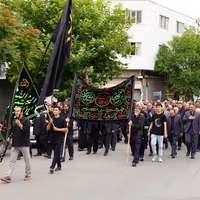
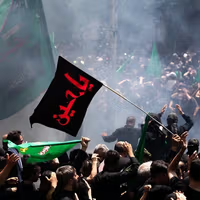
Amourning site set up near the place where Ali Khamenei was killed has been shut down after shroud-wearing ultra-hardliners turned it into a three-day sit-in, exposing a widening rift inside Iran’s loyalist camp over how to use the slain leader’s memory.
The site, known as Ravagh Keshvardoust, had been turned into a shrine-like space in central Tehran for prayer, mourning and ritual gatherings after Khamenei’s killing. In Iranian religious architecture, a ravagh usually refers to a covered hall or portico attached to a shrine. In this case, the term was being used for a temporary devotional space around the site of Khamenei’s death.
According to Jamaran, a news outlet close to the family of the Islamic Republic’s founder Ruhollah Khomeini, organizers closed the site after a group of kafan-poushan, or shroud-wearers, arrived from Mashhad on Ashura (June 25) and occupied the space under the banner of “avenging the blood of the slain leader.”
A photo shared on social media appears to show tanks and other military vehicles deployed inside Baghdad’s Green Zone during a dawn raid targeting officials and lawmakers in a widening anti-corruption operation on June 28, 2026.
Iraqi security forces arrested dozens of officials in Baghdad on Sunday, including figures linked to Shia parties close to Iran, sources told Iran International, in a sweeping operation tied to a corruption case involving alleged smuggling of Iranian oil.
A source in Baghdad told Iran International that over 30 Iraqi officials had been arrested so far in the operation.
The source said the move followed the recent visit of Tom Barrack, US President Donald Trump’s special envoy, to Iraq and his meeting with newly appointed Prime Minister Ali al-Zaidi.
A journalist in Baghdad told Iran International that the arrests included current and former members of parliament.
The journalist said the process was easier because parliament is in its summer recess. Under normal circumstances, legal steps against a sitting lawmaker require parliamentary procedures over immunity, but the recess has made the process less politically exposed.
Iran International has learned from sources in Baghdad that some of those arrested are officials affiliated with Shia parties close to Iran.
Iraqi media have confirmed that the brother of former Prime Minister Mohammed Shia al-Sudani is among those detained.
A joint force from Iraq’s Counter Terrorism Service, the army and other security bodies began the operation before dawn Sunday in Baghdad’s Green Zone and several other areas of the capital.
The Green Zone is the heavily fortified district that houses Iraq’s parliament, government offices, foreign embassies and the residences of senior political figures.
The operation is said to be linked to the corruption case of Adnan al-Jumaili, a former senior Oil Ministry official detained last month.
Iraqi and regional media have reported that al-Jumaili’s testimony led to arrest warrants against a wider network of officials.
The case is politically sensitive because it is linked not only to corruption but also to allegations involving the smuggling of Iranian oil, a long-running sanctions-evasion channel that has drawn increasing US pressure on Baghdad.
Iraqi Foreign Minister Fuad Hussein and Iranian Foreign Minister Abbas Araqchi attend a press conference in Baghdad, Iraq, June 28, 2026.
Public reports on the scale of the operation have varied, but Shafaq News, citing well-informed sources, said 43 officials, politicians, businessmen and lawmakers were detained in the first phase of the crackdown. Asharq Al-Awsat earlier cited an Iraqi official as putting the number at 38.
Reuters, citing security and legal sources, described the raids as the start of a broader anti-corruption campaign ordered by Zaidi, who took office in May and has promised to confront corruption and armed groups operating outside state authority.
Zaidi’s government is preparing for closer engagement with Washington, while the United States has pressed Baghdad to curb Iran-backed militias, tighten control over weapons and prevent Iraqi territory from being used by groups aligned with Tehran.
The raids also came on the same day Iranian Foreign Minister Abbas Araghchi visited Baghdad for talks with senior Iraqi officials, amid heightened regional tensions and renewed attacks involving Iran, the United States and Persian Gulf states.
Iran’s Supreme Leader Mojtaba Khamenei called on the judiciary on Sunday to pursue domestic and international legal cases over deaths and damage from US-Israeli strikes Iran.
In a message marking Judiciary Week, he said the judiciary must follow up on “the crimes of international criminals, arrogant powers and global aggressors,” especially in 2025 and 2026.
“What is certain is that the criminals must be seized by the collar and brought to justice for their criminal acts,” he said.
He also called for judicial reforms, saying people should see results in faster case processing, stronger rulings, easier access to justice and tougher action against corruption.