• العربية
  • فارسی
Brand
  • Iran Insight
  • Politics
  • Economy
  • Analysis
  • Special Report
  • Opinion
  • Podcast
  • Iran Insight
  • Politics
  • Economy
  • Analysis
  • Special Report
  • Opinion
  • Podcast
  • Theme
  • Language
    • العربية
    • فارسی
  • Iran Insight
  • Politics
  • Economy
  • Analysis
  • Special Report
  • Opinion
  • Podcast
All rights reserved for Volant Media UK Limited
volant media logo

Iran defense ministry warns enemies to accept ceasefire

Jun 11, 2026, 12:59 GMT+1

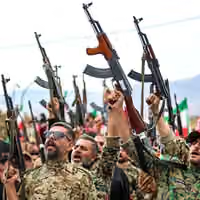
Iran’s defense ministry spokesperson said on Thursday that Tehran’s enemies must accept a ceasefire and halt hostile actions on all fronts.

Reza Talaeinik said Iran’s armed forces were at the highest level of readiness with backing from the country’s defense industry.

“Any crossing of the Islamic Republic’s red lines by the enemy will face a decisive, regret-inducing and harsh punitive response,” he said.

Banner

Spotlight

  • How Nourabad Mamasani became an early flashpoint of Iran’s January bloodshed

    How Nourabad Mamasani became an early flashpoint of Iran’s January bloodshed

  • As prices soar, Iranian diets shrink to survival level
    VOICES FROM IRAN

    As prices soar, Iranian diets shrink to survival level

  • Military escalation overshadows US-Iran peace efforts

    Military escalation overshadows US-Iran peace efforts

  • Iranian teens say rising costs turn simple wishes into distant dreams
    VOICES FROM IRAN

    Iranian teens say rising costs turn simple wishes into distant dreams

  • Faith in diplomacy further dented by Iran-Israel exchange
    INSIGHT

    Faith in diplomacy further dented by Iran-Israel exchange

  • 'Nothing is over':  Iran-Israel conflict enters a new phase
    ANALYSIS

    'Nothing is over': Iran-Israel conflict enters a new phase

Banner
•
•
•

More Stories

UK minister says new state-threat bill could pave way for IRGC designation

Jun 11, 2026, 12:45 GMT+1
UK minister says new state-threat bill could pave way for IRGC designation
100%
A general view of The Houses of Parliament in London

A UK minister said new state-threat legislation could give the Home Secretary power to act against hostile state-backed threats, as lawmakers pressed the government over the IRGC, Iran-linked proxy groups and threats to UK-based journalists and Jewish communities.

Home Office minister David Hanson, said the government wanted the bill passed so the Home Secretary could make judgments on state threats and take action that, if approved by both Houses of Parliament, could lead to sentences of up to 14 years for those convicted.

“We are trying to put in place a framework for legislation where we can act on any potential state threat,” Hanson told the House of Lords.

He added: “The Government condemns antisemitism and is very much aware of the Iranian state threat.”

Lord Henry Bellingham welcomed the legislation and said “the use of these proxies, behind which obviously countries like Iran are hiding, are doing untold harm.”

He said the issue was “not just the IRGC,” pointing also to the Iran-linked Harakat Ashab al-Yamin al-Islamiya, which he said had claimed responsibility for recent antisemitic attacks.

  • UK to toughen stance on Iran foreign influence operations

    UK to toughen stance on Iran foreign influence operations

Hanson said any future designation would be for the Home Secretary to assess once the bill becomes law, adding: “We take the threats from Iran extremely seriously and we will continue to monitor that.”

Lord John Cryer said the bill was welcome but overdue, citing the case involving an attack on Iran International journalist Pouria Zeraati and saying IRGC proxies and agents had targeted British Jews and Jewish institutions.

  • UK court hears alleged money trail in Iran International journalist stabbing trial

    UK court hears alleged money trail in Iran International journalist stabbing trial

Lord Stuart Polak urged ministers to look beyond the IRGC itself and examine “what’s going on in the charity world here,” saying money was being raised in Britain, including British taxpayers’ money, “towards helping the IRGC.”

Hanson said Britain had already sanctioned more than 550 Iranian individuals and organizations, including the IRGC in its entirety, and had placed Iran under the Foreign Influence Registration Scheme.

“What this power will do will give the Secretary of State, if passed by both Houses, an additional power to take action against any state threat the Secretary of State deems to be a threat to the United Kingdom,” he said.

US says it disabled third tanker over Iran blockade breach

Jun 11, 2026, 12:33 GMT+1

US forces disabled a Guinea-Bissau-flagged oil tanker in the Sea of Oman on Wednesday after it violated a blockade against Iran by trying to transport Iranian oil, US Central Command said on Thursday.

CENTCOM said a US aircraft fired two Hellfire missiles into the engine room of the MT Jalveer after the crew repeatedly failed to comply with US directions.

It said the Jalveer was the third commercial vessel disabled by US forces this week, after the Palau-flagged MT Marivex and MT Settebello.

CENTCOM said US forces had disabled nine non-compliant vessels, redirected 135 ships that complied and allowed 42 vessels carrying humanitarian aid to pass since the blockade began on April 13.

War damage adds new strain to Iran’s blackout-prone power grid

Jun 11, 2026, 12:22 GMT+1

Iran’s parliament research arm warned the country’s power grid could face a 13,640-megawatt summer peak deficit, about 17% of projected demand and roughly a third of the country’s average 2024 electricity load, as war damage deepens chronic power shortages.

The Parliamentary Research Center said in a report on summer electricity supply that the gap between supply and demand at peak consumption is projected to reach 13,640 megawatts under a realistic scenario.

The scale is large even by Iran’s recent blackout standards. The report projects maximum simultaneous supply at about 68,420 megawatts, while peak network demand is expected to exceed 81,000 megawatts. That means the shortfall would amount to nearly one-fifth of available supply at the moment of greatest pressure.

Continue reading

US strikes on ‘clear aggression’ against sovereignty, deputy FM says

Jun 11, 2026, 12:09 GMT+1

Iran’s deputy foreign minister said on Thursday that new US strikes on Iran were another act of “clear aggression against sovereignty, territorial integrity, political independence and national security” of the country.

Kazem Gharibabadi rejected description of the attacks as self-defense, saying it had no legal effect and that military aggression could not be legitimized by wording.

He said Iran’s armed forces would defend the country and that the consequences of what he called illegal and dangerous actions would fall on the United States and any party involved in or assisting them.

War damage adds new strain to Iran’s blackout-prone power grid

Jun 11, 2026, 11:35 GMT+1
War damage adds new strain to Iran’s blackout-prone power grid
100%
A pharmacy in Tehran operating under gas-powered lighting during a power blackout

Iran’s parliament research arm warned the country’s power grid could face a 13,640-megawatt summer peak deficit, about 17% of projected demand and roughly a third of the country’s average 2024 electricity load, as war damage deepens chronic power shortages.

The Parliamentary Research Center said in a report on summer electricity supply that the gap between supply and demand at peak consumption is projected to reach 13,640 megawatts under a realistic scenario.

The scale is large even by Iran’s recent blackout standards. The report projects maximum simultaneous supply at about 68,420 megawatts, while peak network demand is expected to exceed 81,000 megawatts. That means the shortfall would amount to nearly one-fifth of available supply at the moment of greatest pressure.

Iran’s electricity consumption has grown steadily for decades, reaching about 347 terawatt-hours in 2024. Its summer peak demand reached around 80,000 megawatts that year, according to official data presented by Iran’s grid management company, showing how close this year’s projected demand is to the country’s recent record levels.

The figures also show why headline power-plant capacity can be misleading. Iranian officials have said installed generation capacity has crossed 100,000 megawatts, but the parliamentary report’s estimate of usable simultaneous supply is far lower, reflecting fuel limits, plant outages, grid constraints and war-related damage.

War damage reshapes electricity balance

The report said the recent war changed both sides of Iran’s electricity balance. Self-supplied power plants taken offline by the conflict removed 4,800 megawatts from supply and disrupted production chains at major industries. At the same time, lower activity in petrochemical and steel sectors reduced part of industrial demand.

That temporary reduction may ease pressure during parts of the summer, but it also points to a fragile balance: if industrial activity recovers, demand for both electricity and gas could rise again.

The report warned that damage to energy infrastructure had reduced gas production capacity to around 600 million cubic meters per day, raising concerns beyond the summer and into the winter, when gas shortages often force power plants, factories and households to compete for supply.

  • Rampant electricity outages take toll on frustrated Iranians

    Rampant electricity outages take toll on frustrated Iranians

Reduced demand from the petrochemical and steel sectors is expected to keep summer gas consumption between 590 million and 600 million cubic meters a day, easing immediate pressure on power plants.

But the report cautioned that any recovery in industrial output could again strain gas supplies available for electricity generation.

The assessment also warned of a growing evening problem. Solar generation is concentrated during daylight hours, while Iran’s demand often rises again at night as households use cooling systems.

Consumption control seen as key solution

Without stronger demand management, the report said, the country could face larger nighttime shortages than in previous years.

Iran has long faced recurring power cuts, especially in summer, when air conditioning, water demand and industrial consumption push the grid toward its limits.

Sanctions, aging infrastructure, heavy subsidies, underinvestment and management failures have left the system with little margin when temperatures rise.

The report argued that demand control may be more effective than relying only on new power plants.

It estimated that around 60% of summer hours would see electricity shortfalls below 6,000 megawatts, while about 82% of shortage hours would remain below 10,000 megawatts. That means much of the deficit could be reduced through better operation of existing facilities, higher utilization rates and targeted cuts in peak demand.

The center said eliminating most of the imbalance through new generation alone would require roughly 8,000 megawatts of additional capacity.

Instead, it recommended broader demand-side measures, including efficiency improvements, demand response programs, shifting consumption patterns and load-adjustment contracts.