UK court hears alleged money trail in Iran International journalist stabbing trial
Police officers walk outside the Woolwich Crown Court in London, Britain, September 26, 2025.
The trial over the stabbing of Iran International presenter Pouria Zeraati turned to the alleged money trail behind the attack, with prosecutors describing payments routed through a west London construction company and relatives of one defendant.
Woolwich Crown Court on Thursday was told that Nandito Badea, 21, and George Stana, 25, received thousands of pounds through payments linked to Hemroc Ltd, a company based in Park Royal, west London, which was incorporated in 2020 and listed its business as the construction of domestic buildings.
Badea and Stana are accused over the March 2024 stabbing of Zeraati outside his home in Wimbledon, southwest London. They deny the charges.
Prosecutors allege the attack was carried out by criminal proxies acting on behalf of the Islamic Republic, an allegation Iran’s embassy in London has called “baseless.”
Prosecutors said Hemroc had links to another company, Besuch Ltd, which operated “unlicensed restaurants and cafes” and traded under the name Tehran Lounge.
The court was told a man named Constantin Matache was a director of the company and that Hemroc made 183 payments totaling £80,540 to Stana’s sister, Florina, with the reference “loan.”
Florina then made 130 payments to Stana, who mainly passed the money on to others but used some for food, travel, cash withdrawals and other spending, retaining £1,330, prosecutors said.
Badea received 78 payments from Florina, the court heard. Prosecutors said he used the money for daily expenses and payments to Hotel Lily in West Brompton, where the men stayed while conducting surveillance, retaining £8,312.
Earlier in the trial, jurors were shown CCTV that prosecutors said captured the alleged getaway after Zeraati was stabbed three times in the leg in broad daylight.
The court has heard the defendants flew in from Romania and spent about a month carrying out surveillance near Zeraati’s home. On the day of the attack, prosecutors allege, Andrei grabbed Zeraati from behind while Badea stabbed him and Stana waited in a side road as the getaway driver.
The men later took a taxi to Heathrow Airport, changed clothes and boarded a British Airways flight to Geneva, the court was told.
Police found the car two days later. Arrest warrants were issued on October 3, and all three men were arrested in Romania on December 4. Badea and Stana were extradited to Britain 13 days later. Andrei could not be extradited because he was subject to domestic proceedings in Romania.
Iranian authorities in 2022 labeled Iran International a terrorist organization and said anyone working with the broadcaster would be deemed a threat to national security.
That year, posters were put up in Tehran featuring pictures of several journalists, including Zeraati, under the heading “Wanted: dead or alive.”
The court has also heard that police provided armed security for Iran International’s offices in Chiswick in 2022, and that the broadcaster later moved to Washington for a period after being told its employees could not be adequately protected in the UK.
The trial is continuing. The defense case is expected to begin next week.
In a separate case earlier this month, a trial date was set for three defendants charged over an alleged arson incident near Iran International’s studios in northwest London. That trial is scheduled to begin on January 25 next year at the Central Criminal Court.
Rising inflation in Iran has pushed households to buy even basic food items in installments, reshaping consumer habits.
Official figures published this year showed point-to-point inflation climbing above 73%, sharply increasing the cost of household essentials compared with the previous year. Food prices rose particularly fast, with some staples more than doubling in price.
The shift has extended installment payments beyond traditionally expensive products such as refrigerators and washing machines to groceries and supermarket packages, according to local media reports.
Chain stores and smaller retailers now advertise food, hygiene products and household supplies with payment plans spread over several months.
File photo of shoppers browsing goods inside a supermarket in Iran.
“When even basic necessities are sold in installments, it clearly reflects the pressure inflation has placed on household finances,” Tehran-based Eghtesad News wrote in a report published on Thursday.
Second-hand market expands
The inflation surge has also accelerated demand for second-hand appliances, furniture and electronics as many households move away from buying new goods outright.
A Tehran mother identified only as Maryam told the outlet she bought a used refrigerator for roughly half the price of a new one after concluding the retail cost was no longer manageable.
“It is better to take some risk and buy second-hand than pay the heavy cost of a new product all at once,” she said.
Negin, a university student whose classes are now held online rather than in person, needed a laptop to continue her studies. Faced with soaring prices, she settled for a lightly used second-hand laptop. “This option allowed me to continue my studies without taking out a loan,” she said.
File photo of second-hand household appliances displayed for sale in Iran.
Vendors in electronics and appliance markets also reported higher demand for used goods, with some sellers describing increases of between 40% and 60% compared with previous years.
Food and housing costs squeeze budgets
Economists and local observers say the change reflects deeper structural pressure on household budgets as spending on food, housing, utilities and services consumes a growing share of monthly income.
Annual inflation has surpassed 53%, according to official data, while prices for dairy, meat, rice, cooking oil and eggs have climbed sharply.
The report said many consumers now view installment purchases and second-hand goods not as cheaper alternatives, but as the only practical way to maintain daily living standards under prolonged inflationary pressure.
Alghadir hospital was already one of the clearest windows into Iran’s January massacre. Now, after a public campaign by Iran International, families and witnesses have come forward with more names tied to the same corridors, storage rooms and rear courtyard.
Iran International has now identified 21 people whose bodies were taken to Alghadir or whose final hours passed through the hospital, including 12 cases detailed in this report.
The accounts add to the record of two nights in which the east Tehran hospital became a transfer point for the wounded and the dead.
On January 8 and 9, witnesses said the streets around Alghadir saw heavy gunfire as security forces opened fire on protesters around Haft Hoz, Tehranpars and Nezamabad.
Inside the hospital, the accounts describe a place where people came for treatment or shelter, only to face the reach of the crackdown inside the wards.
Nights when Alghadir became a crime scene
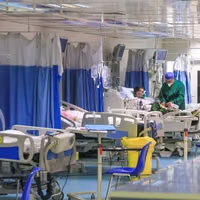
According to accounts received by Iran International, security forces not only obstructed treatment for wounded protesters brought to Alghadir, but in some cases shot injured people, blocked medical care and moved bodies to storage rooms and the hospital’s rear courtyard.
Witnesses and informed sources said doctors, nurses and other medical staff continued trying to save the wounded despite pressure and threats. They treated protesters in operating rooms, hallways, ambulances and hospital rooms.
One witness said several young protesters entered the hospital to escape security forces chasing them during the demonstrations. Security forces later entered the hospital, closed the doors and fired tear gas inside.
According to the witness, some hospital workers hid protesters in bathrooms and wards, and dressed them in medical clothing to keep security forces from identifying them.
A member of the medical staff said that when more than 70 wounded protesters were brought to the hospital, security forces shot and killed four injured people in front of nurses trying to treat them.
A body taken from home
Sources familiar with the events told Iran International that security forces seized the body of a medical student who had been transferred to Alghadir on January 8 and have never told his family where he was buried.
His family had initially taken the body home to Boumehen, east of Tehran, hoping to prevent authorities from confiscating it and to bury him secretly.
Hours later, security forces found the family’s address using the student’s national identification card, which had been left inside his bloodied jacket. Officers raided the home, used tear gas and took the body away as relatives pleaded with them to leave it behind.
Sources said the family has received no information since then about where he may have been buried.
Iran International is withholding the student’s identity for security reasons.
A courtyard of bodies
A witness who sent video and information to Iran International said Alghadir’s rear courtyard had become a holding and transfer area for the bodies of protesters killed on January 9.
The witness, who had been hit by shotgun pellets during the previous day’s protests, returned to the hospital the next morning for treatment. He said he entered the building to the sound of families crying and shouting.
He walked toward the rear courtyard and morgue area, where he saw blood on the ground and several bodies nearby. Many families were gathered around the hospital grounds, but security forces pushed them away.
After some time, he said, bodies were loaded into pickup trucks and families were told to continue searching at Behesht Zahra cemetery.
“Most of the bodies I saw in the hospital courtyard belonged to people under 30 years old, and there was even the body of a child around 12 or 13 years old among them,” the witness said.
Amirparsa Ashkbous: A student in a blue blanket
Amirparsa Ashkbous was 21 and in his final term studying microbiology. Before joining the January 8 protests, he had sent an audio message criticizing those ignoring calls to gather while people his age were preparing to risk arrest or death.
Iranian slain protester Amir Parsa Ashkbous
According to information received by Iran International, Amirparsa joined protests around Haft Hoz with friends and was shot in the neck by a sniper.
His body was later placed in a blue blanket in the rear area of Alghadir hospital.
A video obtained by Iran International showed his mother searching for his body at the hospital.
Friends described him as kind-hearted and deeply interested in football.
Hossein Naseri: ‘I go for the next generation’
Hossein Naseri, born in 1952, told people around him before joining the January 9 protests that he was not afraid for himself.
“I am at ease about the safety and welfare of my children, and it does not matter what happens to me,” he said, according to relatives.
“I am going to the protests for a better future for the next generation.”
Slain protester Hossein Nasseri
When others urged him to wear a mask to protect himself from security forces, he replied: “Let me be sacrificed for you young people.”
Naseri was shot on his second night at the protests. The bullet hit a main artery in his leg. People at the scene drove him to Alghadir hospital, and sources said he was still alive when he arrived.
As the wounded were being brought in, security forces raided the hospital, forcing the person who had taken Naseri there to flee.
Four days later, Naseri’s wife found his body alone at Kahrizak morgue.
Relatives said he was buried without a normal funeral while his two children, both outside Iran, still did not know what had happened to their father.
Ali Rouzbahani: Buried in bloodied clothes
Ali Rouzbahani, 36, from Lorestan province, was killed on January 8 and his body was taken to Alghadir hospital.
Slain protester Ali Rouzbahani
Sources said that when his family came to collect him that evening, a hospital worker warned them to remove the body the same night before security forces could seize it.
The family secretly transported him to Lorestan and buried him without a public funeral. He was not placed in a shroud. He was buried in the bloodied clothes he had been wearing when he was killed.
Pouria Gholamali: Driven by economic hardship
Pouria Gholamali, 32, worked in Tehran’s computer market. Relatives said the rising dollar and the deep recession in the market had affected his life and work, and pushed him toward the protests.
Slain protester Pouria Gholamali
He was killed near Haft Hoz on January 8 by gunfire from government forces. His body was later left in Alghadir’s rear courtyard.
People close to him said he loved nature and spent much of his free time traveling.
Mohammad Talebi Toroghi: Shot in the head
Mohammad Talebi Toroghi, 35, was shot during the January 8 protests in the Haft Hoz area.
Slain protester Mohammad Talebi
Sources said the bullet struck him in the back of the head. His body was taken to Alghadir hospital and later handed over to his family.
Talebi Toroghi was born in Tehran and was the son of a man killed in the Iran-Iraq War.
Sources described him as a martial artist, a professional motorcyclist and someone deeply interested in riding.
Shahabeddin Sameni: Found after hours of searching
Shahabeddin Sameni, born in 1979, was shot in Nezamabad neighbourhood on January 8, according to sources familiar with the case.
Slain protester Shahabeddin Sameni
Sources said a live bullet was fired at his head from above Narmak Mosque.
His family searched hospitals and other centers for hours before finding his body around 2 a.m. on January 9 in Alghadir’s rear courtyard.
Sameni had a child who was a university student. Sources said that despite his stable financial situation, he had joined protesters in the streets.
After his death, security forces put heavy pressure on his parents to accept that their son had been a Basij member.
The Foundation of Martyrs contacted the family several times, but his father refused. He was later threatened with the confiscation of property.
Peyman Chinisaz: Left in storage for days
Peyman Chinisaz, 53, was from Bandar Anzali. He was shot in the stomach on January 8 in Tehran’s Nezamabad neighborhood and taken to Alghadir hospital.
Slain protester Peyman Chinisaz
A source close to the family said his relatives did not know his fate for several days. When they first went to the hospital, they were told he was not there.
His body, the source said, had been kept for five days in one of Alghadir’s storage rooms.
The family believes Chinisaz was left without proper care after reaching the hospital and died from bleeding.
He was married and had three children, a son and two daughters.
Mohsen Shahmohammadi: Died after two weeks in coma
Mohsen Shahmohammadi, born in 1988, was shot during the January 8 protests near Tehranpars First Square.
Slain protester Mohsen Shahmohammadi
The bullet struck his abdomen and kidneys. He was transferred to Alghadir and remained in a coma for about two weeks.
Sources said his condition was critical from the time he was wounded until his death. He died on January 23 from the severity of his injuries.
Shahmohammadi was unmarried.
Hamidreza Haghparast: Died from blood loss
Hamidreza Haghparast, from Rasht, was shot near Haft Hoz during the January 8 protests.
Slain protester Hamidreza Haghparast
The bullet struck his genital and groin area, leaving him severely wounded.
Sources said Haghparast was left for a long time first on Haft Hoz street and then at Alghadir hospital. He died from severe bleeding and lack of timely care.
Haghparast’s body was not released to his family for four days. Sources said officials made the release conditional on “council approval” and a written pledge from the family.
Haghparast, born in Rasht, was his mother’s only companion and breadwinner. He was buried on January 11 at Bagh-e Rezvan cemetery in Rasht..
Abolfazl Najafi-Aroun: Family forced to pay for burial
Abolfazl Najafi-Aroun, 25, was shot with three live rounds on the evening of January 8 near Tirandaz intersection in Tehranpars.
Slain protester Abolfazl Najafi
He was taken to Alghadir and underwent surgery. Family members and people close to him said he remained conscious for several hours after the operation and even spoke with those around him. A short time later, the family was told he had died.
Relatives said authorities did not allow him to be buried in Behesht Zahra. They said the family was charged 10 billion rials, about $5,555, for a burial permit in Robat Karim, near Tehran. The amount, they said, was separate from the cost of the bullets.
People close to Najafi-Aroun described him as warm-hearted, loyal and loved by friends and relatives.
Hosseinali Sarani: Family paid to recover body
Hosseinali Sarani, 44, was from Aliabad-e Katul in Golestan province. He was transferred to Alghadir after being shot on January 8.
Slain protester Hosseinali Sarani
Relatives said the family received his body after one week.
They said they were forced to pay 5 billion rials, about $2,780, to recover it.
Hani Ganji: Family received wrong body
Hani Ganji, 49, was shot from behind at close range in Tehranpars on the evening of January 8. He was taken to Alghadir and died from severe bleeding.
Slain protester Hani Ganji
After pressure from authorities and after signing a pledge, his family received a body and took it to a workshop in Pardis, Boumehen.
The next day, when no doctor agreed to issue a death certificate, the family took the body first to the Pardis police station and then, with a police letter, to Kahrizak.
When the family went to Behesht Zahra for the funeral and burial, they discovered they had been given the wrong body.
After hours of searching, they were finally able to recover Hani’s body and bury him late that day.
A growing record
The 21 people identified by Iran International are not a full list of those taken to Alghadir hospital.
They are the names recovered so far from one hospital, in one part of Tehran, after two nights of killing.
The first report showed Alghadir as a place where the massacre became visible: the overflowing morgue, bodies in storage rooms and the rear courtyard, and families searching through blankets and body covers.
The new accounts show something else as well: how that record is still growing, one witness, one family and one name at a time.
Iranian authorities and pro-government activists are promoting marriage through matchmaking stalls at nightly rallies, even as many young people delay starting families because of deepening economic hardship and rising living costs.
The initiative drew renewed attention after a video circulated online this week showing a couple marrying at one of the gatherings, turning a state-backed rally into a showcase for a policy goal many young Iranians say has become unaffordable.
Fars News, an outlet close to the Islamic Revolutionary Guard Corps, reported that matchmaking booths had been set up at rallies in Tehran, allowing young men and women to register for introductions under what organizers call “easy marriage.”
The report said some visitors had already completed initial registration, with organizers collecting basic personal information before matching applicants by age, education and religious beliefs.
A couple in a mass wedding ceremony during a pro-government rally in Iran
“Families come here looking for a good future for their children,” a woman overseeing one of the stalls said in comments published by Fars. “We try to make marriage easier by reducing expectations.”
She said the gatherings were a suitable venue because “family is one of the country’s core cultural values,” adding that men had registered in greater numbers than women.
The campaign comes as Iranian officials warn of falling marriage and birth rates, even as economists and sociologists point to inflation, unemployment, housing shortages and declining purchasing power as major reasons many young people delay family life.
Official statistics show marriage rates falling sharply over the past decade as the average age of marriage rises, especially in large cities where housing and living costs have surged.
Economic pressure collides with state messaging
The campaign also reflects a broader push by the Islamic Republic to frame marriage as a cultural and ideological priority despite worsening economic conditions that many young Iranians say make long-term commitments difficult.
State-linked media and religious institutions have increasingly promoted simpler weddings, lower dowries and earlier marriage as officials try to reverse Iran’s demographic decline.
Military vehicles decorated for a wedding convoy drive through Tehran during a pro-government rally.
At the same time, online platforms offering temporary religious unions – known in Shiite jurisprudence as sigheh – continue to operate openly across messaging applications and websites, creating what critics describe as a parallel market built around legally sanctioned short-term relationships.
An investigation by Iran International previously found Telegram channels advertising “Islamic marriage services” that arranged fixed-term unions in exchange for payments, with some operators presenting the arrangements as religiously approved alternatives to prohibited sexual relationships.
The investigation found some services demanded payments for introductions alone, while others offered monthly arrangements with fees varying according to age, location and education level.
The booths turn ideological rallies into platforms for state-backed social messaging. Organizers told Fars they urge young people to lower expectations and marry earlier.
Critics say the campaign ignores the economic pressures keeping many Iranians from marriage, including stagnant wages, high rents and uncertainty about the future.
A young Iranian woman’s account of temporarily caring for an infant under a state welfare program sparked debate across Persian-language social media this week over child privacy, foster care and the use of vulnerable children in online content.
Sara Kanaani, a social media influencer, documented what she described as “40 days of motherhood” after taking custody of a baby through Iran’s Mizban temporary foster care scheme run by the State Welfare Organization.
State-affiliated outlets including IRNA and Hamshahri newspaper amplified the story with emotional coverage focused on the woman’s attachment to the child and the separation that followed.
Images of Kanaani without mandatory hijab also circulated through state media, drawing further attention online.
Foster care program under spotlight
The Mizban program, launched in 2023, allows children from welfare institutions to be placed temporarily with approved families or individuals while remaining under state supervision.
Unlike adoption, custody under the program is limited in duration and does not transfer permanent parental rights.
The Iranian influcencer sits beside a baby placed through Iran’s Mizban temporary foster care program.
Iran’s Welfare Organization says applicants are assessed for financial stability, mental health and caregiving capacity before approval.
Similar foster care systems exist in many countries, where temporary family-based care is generally viewed by specialists as preferable to institutional care for infants and young children.
The controversy intensified after critics accused Kanaani of turning the experience into a sustained social media project through daily videos, emotional posts and photographs of the child.
Some users questioned whether a child unable to consent should become part of a personal online brand or public campaign.
Others raised concerns after Kanaani discussed details about the infant’s biological mother in social media posts.
Wider criticism follows media coverage
Psychologists and child welfare advocates also debated the emotional impact of repeated attachment and separation during infancy.
Some specialists argued temporary family care can still benefit children when conducted under stable and professionally supervised conditions.
Others pointed to a lack of public information about oversight, caregiver training and welfare standards in Iran’s implementation of the program.
Photos published and later removed by Iranian state media showed an influencer with a baby placed through Iran’s Mizban temporary foster care program.
Part of the attention surrounding the case focused on Kanaani’s status as a single woman.
Iranian law permits unmarried women over 30 to adopt girls under certain conditions, though couples remain prioritized in most custody arrangements.
Critics also questioned the role of state media, saying the extensive coverage reflected efforts to promote emotionally driven narratives centered on women, family and social solidarity during a period of economic and social strain in Iran.
Iranian officials’ recent comments about Supreme Leader Mojtaba Khamenei are aimed at showing he remains in charge and will ultimately decide whether Tehran accepts a deal with the United States to end the war, the Financial Times reported on Thursday.
The report said officials had begun speaking more openly about Khamenei’s condition amid speculations that the Islamic Revolutionary Guards were effectively running decision-making.
“They are projecting that there’s no change . . . the supreme leader was the apex of the system and is still the apex,” Vali Nasr, a former US official and professor at Johns Hopkins University was quoted as saying. “And that he’s alive, functioning and in control.”
He added that the guards were also seeking to project that “they are not running the show and [Khamenei is] not just a figurehead.”
The report referred to remarks by Iran’s President Masoud Pezeshkian and Mazaher Hosseini, a senior official in the Supreme Leader’s office.
Pezeshkian said on earlier this month that he had met with the Supreme Leader, offering a first public account of him meeting Mojtaba Khamenei since he suffered severe wounds at the start of the Iran war on February 28.
Hosseini said later that Mojtaba Khamenei suffered minor injuries to his kneecap, back and behind his ear in the airstrikes that killed his father and wife, insisting he is now in “full health” and dismissing reports of a serious head injury as “lies.”