• العربية
  • فارسی
Brand
  • Iran Insight
  • Politics
  • Economy
  • Analysis
  • Special Report
  • Opinion
  • Podcast
  • Iran Insight
  • Politics
  • Economy
  • Analysis
  • Special Report
  • Opinion
  • Podcast
  • Theme
  • Language
    • العربية
    • فارسی
  • Iran Insight
  • Politics
  • Economy
  • Analysis
  • Special Report
  • Opinion
  • Podcast
All rights reserved for Volant Media UK Limited
volant media logo

UK to toughen stance on Iran foreign influence operations

Mar 4, 2025, 14:37 GMT+0Updated: 11:28 GMT+0
Supporters of Iran's Islamic Revolutionary Guard Corps (IRGC) with a banner in central London, UK, June 2022

Britain will put Iran's intelligence and security establishment on the highest tier of a foreign influence watchlist, security minister Dan Jarvis told parliament on Tuesday, toughening London's stance on perceived political interference by Tehran.
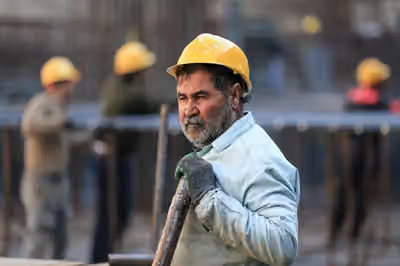
The upgrading of Iran to the highest tier of the United Kingdom's Foreign Influence Registration Scheme (FIRS) due to be rolled out in the summer ratchets up tension between the nuclear-armed security council member state and the Islamic Republic.

Under the designation, Iran and anybody acting on its behalf would be deemed a potential security threat and compelled to register their activities in the UK. Not doing so would potentially incur a five-year prison sentence.

"We will place the whole of the Iranian state, including Iran's intelligence services, the IRGC and MOIS (Ministry of Intelligence), on to the enhanced tier of the new foreign influence registration scheme," Jarvis told parliament.

Jarvis was referring to the Islamic Revolutionary Guard Corps, a paramilitary organization at the heart of the Iranian establishment which oversees foreign operations including aid to militant groups Hamas, Hezbollah and the Houthis.

Pointing to threats from Iran, he mentioned that in December 2023, a Chechnya-born individual was sentenced to three and a half years in jail by a British court for collecting information for terrorist purposes. He had been arrested earlier that year in a Starbucks near Iran International’s premises after being spotted filming the broadcaster’s building in West London.

"The national protective security authority and counter-terrorism police will continue to provide protective security advice and support to individuals and organizations threatened by the Iranian regime and its criminal proxies, including Persian-language media organizations and their employees," Jarvis told the parliament.

The UK and European states have so far stopped short of following the United States in designating the IRGC a terrorist organization.

According to an announcement by UK counter-terrorism police in 2023, UK security forces foiled 15 kidnapping and murder plots against British or UK-based targets deemed Tehran's enemies.

Jarvis said that since 2022, 20 Iranian-backed plots putting the lives of British citizens or UK residents at risk had been foiled, adding that the number of state-level investigations run by MI5 had jumped by 48% in the past year.

"It's clear that these plots are a conscious strategy of the Iranian regime to stifle criticism through intimidation and fear," he noted.

Journalism watchdog Reporters Without Borders said last year that Tehran was carrying out "systematic targeting of journalists reporting on Iran from abroad, in an effort to silence them."

"London, home to major Persian-language broadcasters, has been a hotspot for such attacks because of the large number of Iranian journalists based there," the group added.

The British government last month denied funding an Iranian influence network in Western countries, rejecting remarks by a Swedish-Iranian scholar who said his involvement in the initiative was backed by the UK government.

Most Viewed

Iran negotiators ordered to return after internal rift over Islamabad talks
1
EXCLUSIVE

Iran negotiators ordered to return after internal rift over Islamabad talks

2
ANALYSIS

US blockade enters murky phase as tankers spoof signals and buyers hesitate

3
ANALYSIS

Why the $100 billion Hormuz toll revenue is a myth

4

US tightens financial squeeze on Iran, warns banks over oil money flows

5
ANALYSIS

US blockade targets Iran oil boom amid regional disruption

Banner
Banner

Spotlight

  • Hardliners push Hormuz ‘red line’ as US blockade tests Iran’s leverage
    INSIGHT

    Hardliners push Hormuz ‘red line’ as US blockade tests Iran’s leverage

  • Ideology may be fading in Iran, but not in Kashmir's ‘Mini Iran'
    INSIGHT

    Ideology may be fading in Iran, but not in Kashmir's ‘Mini Iran'

  • War damage amounts to $3,000 per Iranian, with blockade set to add to losses
    INSIGHT

    War damage amounts to $3,000 per Iranian, with blockade set to add to losses

  • Why the $100 billion Hormuz toll revenue is a myth
    ANALYSIS

    Why the $100 billion Hormuz toll revenue is a myth

  • US blockade targets Iran oil boom amid regional disruption
    ANALYSIS

    US blockade targets Iran oil boom amid regional disruption

  • Iran's digital economy battered by prolonged blackout
    INSIGHT

    Iran's digital economy battered by prolonged blackout

•
•
•

More Stories

Putin agrees to mediate between Iran and US - Russian state media

Mar 4, 2025, 13:34 GMT+0

Russian President Vladimir Putin has agreed to mediate nuclear talks between Washington and Tehran, Russian state-owned outlet Zvezda cited the Kremlin spokesman as saying on Tuesday.

Trump conveyed his administration’s interest in engaging Iran to President Vladimir Putin in a phone call in February, according to a report by Bloomberg earlier, adding that the talks would also cover Tehran's support for armed militant groups.

"Russia believes that the United States and Iran should resolve all problems through negotiations,” Kremlin spokesman Dmitry Peskov said on Tuesday, adding that Moscow “is ready to do everything in its power to achieve this.”

Putin's foreign policy adviser Yuri Ushakov said Iran was among the issues discussed at recent Russia-US negotiations in the Saudi capital, Riyadh. Both sides had agreed to meet separately to discuss the issue, he added.

Asked about potential Russian mediation between Tehran and Washington, Iran's foreign ministry spokesperson said offers of assistance from various nations were natural.

"Given the importance of these matters, it is expected that numerous parties will express goodwill and a willingness to assist with various issues," spokesperson Esmaeil Baghaei said during a televised press conference in Tehran on Monday. "Therefore, it is natural for countries to offer aid when deemed necessary."

Talks, not war

British newspaper the Daily Telegraph cited an Iranian official in Tehran saying Trump's blowout with Ukrainian President Volodymyr Zelenskyy at the White House last week had made Iran wary of engagement with the volatile US leader.

“Officials from the Kremlin contacted the supreme national security council and said Putin wants to mediate and he’s ready to facilitate direct talks between Iran and America,” the official was quoted as saying.

“They said Trump wants to talk and is preferring it over war but, here, there is a big uncertainty around it after what happened in the White House last week.”

The Trump administration last week stepped up pressure on Ukraine into accepting a deal to end the war. The proposal broadly seeks peace in exchange for Ukraine ceding captured territory to Russia.

According to sources familiar with the discussions who spoke with Bloomberg, US and Russian officials, including Secretary of State Marco Rubio and Foreign Minister Sergei Lavrov, discussed Washington's interest in Russian assistance with Iranian issues during a February 18 meeting in Riyadh.

Subsequently, Russia's Lavrov shared details of the US meeting with his Iranian counterpart, Abbas Araghchi, during a meeting in Tehran, as Araghchi confirmed in a televised press conference.

However, Araghchi later claimed that Lavrov had not conveyed a message from the United States during his Tehran visit, and that no such message was anticipated.

Earlier this month, President Donald Trump announced the revitalization of sanctions under his “maximum pressure” policy. He underlined that his main demand is for Iran never to acquire nuclear weapons.

Last month, Supreme Leader Ali Khamenei said Trump cannot be trusted—pointing to his withdrawal from the Obama-era nuclear deal during his first term—and added that Iran would not be pressured into negotiations.

President Masoud Pezeshkian said last week that despite his own belief in the value of engaging with the US, he would align with Khamenei’s stance as long as Washington maintains economic sanctions on Iran.

Iranian actress summoned to court as celebrities remain under pressure

Mar 4, 2025, 12:04 GMT+0

Iranian actress Chakameh Chamanmah said authorities have summoned her to the judiciary without pressing charges eight months after she was banned from leaving the country following her return to Iran.

Following the summons, Chamanmah said that while no official charges have been mentioned, she would appear before the judiciary with her lawyer.

She said she has been subjected her to repeated interrogations without a judicial order since her return to the country out of what she called love for her homeland.

The young actress was stopped at Tehran's Imam Khomeini Airport upon arrival, where her passport was confiscated and she was given an instant travel ban.

Since then, she said, "I have been repeatedly interrogated and questioned by various security agencies without a judicial order and, in some cases, faced mistreatment and insulting behavior.

"While government officials constantly talk about the return of Iranians abroad, from the moment I returned to my homeland, I have not been allowed even a single day to live in peace."

Chamanmah's summons comes just days after the directors and lead actors of My Favorite Cake, an Iranian film that premiered at the Berlin International Film Festival, went on trial in a court in Tehran, alongside other members of the production team.

Iran's entertainment stars have been among scores placed under such punishments as travel bans alongside the likes of sports figures in the wake of the 2022 uprising, many of whom having supported the Woman, Life, Freedom protests.

Other punishments included pay freezes, fines and sackings, causing a surge of stars fleeing the country.

Iran rejects talks under Trump's maximum pressure as political shake-up continues

Mar 4, 2025, 09:10 GMT+0

Iran will not engage in negotiations under maximum pressure, government spokesperson Fatemeh Mohajerani said in a press briefing, pushing back against interpretations that Tehran categorically refuses talks under sanctions.

"The phrase 'we do not negotiate under sanctions' is not accurate; rather, we 'do not negotiate under maximum pressure,'" she said.

Her remarks came as Supreme Leader Ali Khamenei ruled out direct talks with Donald Trump, who reinstated severe sanctions last month. The US president defended his approach, saying reports of a planned military strike on Iran were greatly exaggerated and that he preferred a deal.

Iranian President Masoud Pezeshkian has said he supported negotiations but has aligned with Khamenei’s decision against engaging in talks. Addressing parliament on Sunday, he said his initial stance had been for diplomatic engagement but deferred to the Supreme Leader's position.

"Negotiation is a voluntary act," Mohajerani said. "No one can force another person to sit at the negotiating table."

Amid mounting political shifts, Mohajerani dismissed concerns that recent resignations and dismissals could fracture government unity.

"Impeachment or resignation of an individual does not take us away from national unity in solving people's problems," she said, referring to the ousting of Vice-President Mohammad Javad Zarif and Economy Minister Abdolnaser Hemmati.

Zarif, known for his role in the 2015 nuclear deal, tendered his forced resignation on Sunday, though Pezeshkian has not accepted it. Mohajerani confirmed that "one side of a resignation is its acceptance, which has not yet been granted by Pezeshkian."

Zarif later wrote on X that he stepped down following a meeting with Iran’s judiciary chief, who advised him to "return to the university to prevent further pressure on the government."

With economic concerns mounting, Mohajerani acknowledged the challenges but stressed that solutions would take time. "The country's economic issues did not emerge overnight and will not be resolved overnight either," she said.

Iran’s parliament impeached Economy Minister Hemmati on Sunday, bringing his tenure to an end after lawmakers blamed him for the country’s worsening economic crisis.

The vote followed a heated session in which Hemmati defended his record while critics pointed to the surging exchange rate and rising inflation, blaming him for its worsening since coming to office.

Iranian woman dies after hijab gets caught in escalator in Tehran

Mar 4, 2025, 08:41 GMT+0

A woman in Tehran died after her veil became entangled in an escalator, marking the latest fatal accident linked to country's mandatory hijab laws.

The incident took place in eastern Tehran's Damavand Street last Thursday, according to a report by Tehran-based Didban News website.

Although the report referenced other incidents involving malfunctioning and poorly maintained escalators, it noted that the direct cause of this woman's death was her hijab getting caught.

The case is not the first time Iran’s compulsory hijab rules have been linked to fatal accidents involving women.

On November 7, 2021, Iranian media reported that 21-year-old Marzieh Taherian died at a spinning workshop in Semnan, northern Iran, after her headscarf became caught in a machine, pulling her head inside.

On June 5, 2023, a 26-year-old female worker at a plastic injection molding workshop in the northeastern Iranian city of Neyshabur, lost her life when her veil became entangled in a machine, dragging her into it.

The incidents highlight the potential safety risks associated with mandatory hijab in workplaces and public spaces.

On Monday, UN rights chief Volker Turk urged Iran to permanently repeal its hijab laws and end along with all other laws and practices that discriminate against women and girls.

However, despite multiple fatalities in recent years, and repeated calls from rights groups and UN officials, Iranian authorities continue to enforce mandatory hijab laws on women and girls.

Gutted cabinet, rejected US overtures put Iran's Pezeshkian in tough spot

Mar 4, 2025, 08:11 GMT+0
•
Behrouz Turani

After Iranian hardliners ousted two key aides and rejected his hopes for talks with the United States, the young presidency of relative moderate Masoud Pezeshkian appears to be at a low ebb.

Economy Minister Abdolnaser Hemmati was impeached by Parliament while Vice President for Strategic Affairs Javad Zarif resigned under pressure last week.

Hardliners accused Hemmati of failing to curb rising prices, inflation, and the devastating devaluation of Iran’s rial, while Zarif faced criticism over his family members' US citizenship. Pezeshkian had strongly defended both men.

The key question in Iranian newspapers on Monday was, "Will hardliners stop here?" Some outlets predicted that attacks on Pezeshkian and his government would continue.

Political commentators speaking to Persian-language media outside Iran said that anyone in Pezeshkian's position would have resigned almost immediately.

Inside Iran, however, commentators remained silent or were too intimidated to voice opinions that could be seen as undermining the government's integrity or sowing discord among officials.

What media, commentators, and politicians in Iran did not say was that Hemmati was impeached for economic problems rooted in Supreme Leader Ali Khamenei’s refusal to negotiate with the United States to address Iran’s chronic economic crisis. While many have acknowledged in recent months that US sanctions are the primary driver of Iran’s economic hardships, they have consistently avoided blaming Khamenei for the situation.

Even Pezeshkian and Hemmati, who detailed Iran’s deep economic problems in their speeches at the Majles, avoided explicitly naming Khamenei as the culprit. However, Pezeshkian made it clear: "I wanted to negotiate with the United States, but Khamenei forbade negotiations, and therefore, I said we won't negotiate."

That statement alone was damning. Pezeshkian was desperately trying to convey to the nation that the suffering was not his fault. From Khamenei’s perspective, shifting the blame to the economy minister helped absolve the Supreme Leader of responsibility for prolonging the country’s financial hardships.

With Khamenei dominating the country's political and media landscape, Pezeshkian has little room to further defend himself. He is likely to be left isolated, facing intensified attacks from hardliners who oppose his presidency and have never hidden their desire to unseat him.

The pro-reform website Fararu quoted former government spokesman Ali Rabiei as saying, "Pezeshkian has more difficult days ahead of him."

Other reformists, including cleric Mohammad Ali Abtahi, a former aide to President Mohammad Khatami, criticized Pezeshkian for his attempts to unify with hardliners. Abtahi argued that Pezeshkian appointed ultraconservatives to key positions in his government without securing their support for his administration.

Tehran's former mayor Gholam Hossein Karbaschi, who is currently the proprietor of centrist Ham Miham daily, wrote: "The hardliners will be further emboldened if Pezeshkian does not object and keeps giving concessions to ultraconservatives."

Karbaschi advised Pezeshkian that "There should be a limit to the idea of national reconciliation." He added that Hemmati's impeachment was a factional move and is not likely to bring about any improvement in the country's economic situation." He explained that the "ultraconservatives always held a grudge against Hemmati since June 2021 when he was competing with ultraconservative figureheads Saeed Jalili and Ebrahim Raisi as presidential candidate and questioned their understanding of the country's economy."

Referring to "the failure of national reconciliation as Pezeshkian's main project," proreform Rouydad24 warned the Iranian President: "Reconciliations with others in power has failed. Think of reconciling with the people."