• العربية
  • فارسی
Brand
  • Iran Insight
  • Politics
  • Economy
  • Analysis
  • Special Report
  • Opinion
  • Podcast
  • Live TV
  • Iran Insight
  • Politics
  • Economy
  • Analysis
  • Special Report
  • Opinion
  • Podcast
  • Live TV
  • Theme
  • Language
    • العربية
    • فارسی
  • Iran Insight
  • Politics
  • Economy
  • Analysis
  • Special Report
  • Opinion
  • Podcast
  • Live TV
All rights reserved for Volant Media UK Limited
volant media logo

Iran cleric says hijab should not divide wartime mobilization

May 23, 2026, 10:35 GMT+1
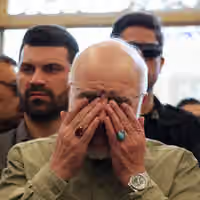
People gather at a farewell ceremony for Iran's national soccer team ahead of their departure to the 2026 World Cup, in Tehran, Iran, May 13, 2026.

A senior Iranian cleric said women without proper hijab should not be excluded from wartime gatherings, while Nour News, affiliated with Iran’s Supreme National Security Council, called for reason and moderation over ideological confrontation.

Ayatollah Mohammad Javad Fazel Lankarani said Iranians should not be divided by issues such as hijab when the country and Islam were under threat.

He said the issue of hijab remained a religious duty, but argued that it would be wrong to tell women without proper hijab not to attend nightly gatherings organized in support of the war effort.

“When the country itself and the foundation of Islam are in danger, we should not deal with second- and third-tier issues... we should not ask the man who has taken up a weapon and entered the field whether he prays or not, let alone raise the issue of hijab,” Fazel Lankarani said.

The comments came as Nour News, affiliated with Iran’s Supreme National Security Council, published an essay calling for a return to “reason and moderation” in Iranian public life.

Marking the day honoring the philosopher Mulla Sadra, the outlet argued that Iran needed a form of rationality that sees religion “not as a tool of control, but as a light for illumination.”

The essay criticized what it described as emotional and irrational forms of religiosity, as well as currents that reject religion entirely in the name of modernity.

It said Iran needed dialogue instead of conflict, and a reinterpretation of tradition rather than either blind imitation or outright rejection.

The shift does not amount to a formal retreat from policies such as mandatory hijab, but it reflects a growing recognition inside parts of the system that ideological confrontation at home could weaken the wartime unity authorities are trying to preserve.


Most Viewed

With the war quieting, Iran's hijab crackdown gathers pace again
1

With the war quieting, Iran's hijab crackdown gathers pace again

2
ANALYSIS

Turkey’s gas pivot leaves Iran with fewer cards to play

3
INSIGHT

Ghalibaf's hunger warning sparks hardline backlash over showing weakness

4

Iran leaders sound economic alarms under Trump’s Economic D-Day

5

Trans woman prisoner says she was raped in Iran Intelligence Ministry detention

Banner
Banner
Banner

Spotlight

  • Ghalibaf's hunger warning sparks hardline backlash over showing weakness
    INSIGHT

    Ghalibaf's hunger warning sparks hardline backlash over showing weakness

  • Iran crude loadings plunge to one-seventh of pre-war level as blockade bites
    ANALYSIS

    Iran crude loadings plunge to one-seventh of pre-war level as blockade bites

  • Turkey’s gas pivot leaves Iran with fewer cards to play
    ANALYSIS

    Turkey’s gas pivot leaves Iran with fewer cards to play

  • Can Iran's fragile economy survive Trump's 'Economic D-Day'?
    ANALYSIS

    Can Iran's fragile economy survive Trump's 'Economic D-Day'?

  • The unlikely return of European diplomacy in the Iran-US conflict
    ANALYSIS

    The unlikely return of European diplomacy in the Iran-US conflict

  • For Iranian journalists, exile can last a lifetime
    OPINION

    For Iranian journalists, exile can last a lifetime