• العربية
  • فارسی
Brand
  • Iran Insight
  • Politics
  • Economy
  • Analysis
  • Special Report
  • Opinion
  • Podcast
  • Iran Insight
  • Politics
  • Economy
  • Analysis
  • Special Report
  • Opinion
  • Podcast
  • Theme
  • Language
    • العربية
    • فارسی
  • Iran Insight
  • Politics
  • Economy
  • Analysis
  • Special Report
  • Opinion
  • Podcast
All rights reserved for Volant Media UK Limited
volant media logo
PODCAST

Trump’s strongest leverage over Tehran may run through Beijing

Negar Mojtahedi
Negar Mojtahedi

Iran International

May 22, 2026, 21:50 GMT+1
Xi Jinping and Donald Trump walk together during a previous U.S.-China meeting amid growing tensions over trade, sanctions and Beijing’s economic ties to Iran.

The Trump administration’s most powerful pressure point against Tehran may not lie in military action but in China’s deep financial and energy ties with Iran, a former US Treasury sanctions official told the Eye for Iran podcast.

Max Meizlish, a senior research analyst at the Foundation for Defense of Democracies and a former US Treasury official focused on sanctions enforcement, said China may be the real pressure point against Iran as it buys most of Tehran’s oil, helps it evade sanctions and provides the economic oxygen keeping the Islamic Republic alive.

“There’s really no more important enabler of Iranian malign influence and Iranian sanctions evasion than China,” Meizlish told this week’s episode of Eye for Iran.

China buys roughly 90 percent of Iran’s oil exports — a revenue Meizlish says directly finances the Islamic Revolutionary Guard Corps (IRGC), Tehran’s ballistic missile programs and its regional proxy network.

“Chinese purchases of that oil are directly supporting the IRGC, the hardline elements of the Iranian regime,” he said. “All of that is funded and backed by China.”

His comments come as tensions rise over Iran’s efforts to exert greater control over the Strait of Hormuz, including reports that Tehran is exploring formalized transit systems and toll mechanisms for ships crossing one of the world’s most critical waterways.

But while global attention remains focused on Iran’s actions in the Persian Gulf, Meizlish argues Washington’s most effective pressure point may lie elsewhere: the financial networks helping Tehran survive economically.

One of the most significant, he says, is Hong Kong.

“If the United States really wanted to, it could bring a lot of pressure there by threatening to cut off all dollar access to Hong Kong as an entire jurisdiction,” Meizlish said.

He pointed specifically to Section 311 of the USA PATRIOT Act, a rarely used mechanism allowing Washington to effectively sever foreign banks from the dollar system by restricting correspondent banking access.

“When we think about Chinese sanctions evasion benefiting Iran, a lot of that money goes through Hong Kong,” he said. “Hong Kong is a global financial hub, and it relies on access to dollars to do that.”

Despite years of “maximum pressure” rhetoric from Washington, Meizlish argues the United States has yet to fully use the economic tools available to it.

“For all the talk of maximum pressure, maximum pressure has been a really effective bumper sticker,” he said. “We need to move from the period of bumper stickers into the period of behavior change.”

The hesitation, he argues, stems largely from fears of Chinese retaliation.

Beijing dominates the mining and processing of rare earth minerals critical to global manufacturing, electronics and defense industries. China could also retaliate against Western firms operating in the country or invoke anti-sanctions laws designed to punish compliance with US restrictions.

“There are a lot of steps that the Chinese could take,” Meizlish warned.

Still, he argues China may be more economically vulnerable than many policymakers assume.

“China’s banking sector is quite fractured. It’s quite vulnerable to economic coercion,” he said, pointing to bad debt, youth unemployment and the country’s prolonged housing crisis.

Meizlish also cited signs Beijing fears the consequences of secondary sanctions. After the United States sanctioned a Chinese “teapot refinery,” he noted, Chinese regulators reportedly warned banks not to extend loans to such firms over concerns they too could become targets.

“To me, all of that supports the idea that the US actually could bring a lot more pressure to bear right now because China is uniquely vulnerable to economic coercion,” he said.

For Meizlish, the broader question is whether Washington is prepared to absorb the economic costs of confronting Beijing more aggressively in order to weaken Tehran.

“We’re in the middle of potentially a once-in-a-lifetime opportunity to fully degrade the Iranian regime’s capacity to exert influence in the region,” he said.

But achieving that, he argues, would require moving beyond symbolic pressure campaigns toward far more aggressive financial enforcement targeting China itself.

“There’s no more important country to tackle than China,” he said. “And there are all these unique economic vulnerabilities that we should be taking advantage of.”

Most Viewed

The strange afterlife of Iran’s firebrand president
1
INSIGHT

The strange afterlife of Iran’s firebrand president

2

Hardliners attack Pezeshkian over talks and wartime candor

3
INSIGHT

Iran can build missiles but can't afford chicken

4
ANALYSIS

Why oil giant Iran struggles to supply gasoline

5

Iran officials seek to show Supreme Leader still in charge - FT

Banner
Banner

Spotlight

  • Trump’s strongest leverage over Tehran may run through Beijing
    PODCAST

    Trump’s strongest leverage over Tehran may run through Beijing

  • Pakistan continues quiet push to stop another Iran war
    ANALYSIS

    Pakistan continues quiet push to stop another Iran war

  • Iran scrambles for Omani back channel around the Hormuz blockade
    INSIGHT

    Iran scrambles for Omani back channel around the Hormuz blockade

  • From pulpits to parliament, why Iran’s officials speak in threats
    OPINION

    From pulpits to parliament, why Iran’s officials speak in threats

  • Why oil giant Iran struggles to supply gasoline
    ANALYSIS

    Why oil giant Iran struggles to supply gasoline

  • The strange afterlife of Iran’s firebrand president
    INSIGHT

    The strange afterlife of Iran’s firebrand president

•
•
•

More Stories

Pakistan continues quiet push to stop another Iran war

May 22, 2026, 20:07 GMT+1
•
Maryam Sinaiee

Pakistani top general Asim Munir’s trip to Tehran has fueled speculation about a possible temporary Iran-US agreement to end the war and resume broader talks, although Tehran says the high-profile visit does not necessarily mean a deal is close.

Munir’s visit on Friday follows days of lower-level negotiations that have reportedly narrowed some of the major disagreements between Tehran and Washington.

The Pakistani commander visited Tehran last month as well, where he held meetings with senior Iranian civilian and military officials.

Pakistan’s Interior Minister Mohsin Naqvi also traveled twice to Tehran and remained there on Friday as negotiations continued.

Iranian and Pakistani media reports described the visit as part of Islamabad’s broader mediation effort aimed at reducing tensions over Iran’s uranium enrichment program and the closure of the Strait of Hormuz.

Axios reported on Friday that Munir’s visit could represent a “final push” by Pakistan to secure a temporary agreement under which both sides would halt hostilities and continue negotiations for another 30 days over unresolved disputes, including Iran’s nuclear program.

Media speculation

However, expectations of an imminent breakthrough remain cautious.

An Iranian source close to the negotiations told the Arabic outlet Al-Araby Al-Jadeed that Pakistan’s interior minister had not delivered any new American proposal to Tehran and that reports about a finalized draft agreement were “media speculation.”

According to the source, “the visits by Pakistani officials to Tehran are aimed at strengthening Islamabad’s mediation role and preventing further escalation.”

Iran’s Foreign Ministry spokesman downplayed the significance of the Pakistani top general's trip to Tehran, saying, "Despite becoming more frequent, such exchanges are a continuation of the same diplomatic process. We cannot necessarily say we have reached a point where a deal is near."

“The differences between Iran and the United States are so deep and extensive that it cannot be said we must necessarily reach a result after a few rounds of visits or negotiations within a few weeks," Iran's foreign ministry spokesman Esmaeil Baghaei said on Friday.

Iranian outlet Farda News, considered close to parliament speaker Mohammad Bagher Ghalibaf who is leading Iran’s negotiating team, wrote that “Islamabad is not merely a messenger, but is playing a role beyond transmitting messages and below that of a direct negotiator.”

Pakistan, Iran’s eastern neighbor, has emerged over the past two months as the principal intermediary between Tehran and Washington.

Its mediation efforts accelerated after Islamabad helped broker a ceasefire on April 7. But the first round of direct talks between Iran and the United States failed to produce a lasting agreement, and recent weeks have shown signs of growing diplomatic deadlock.

‘Unprecedented progress’

Oman had previously served as the primary mediator. Talks between Tehran and Washington were underway in Muscat before US and Israeli strikes on Iran began on February 28.

At the time, Omani Foreign Minister Badr Albusaidi publicly said that “significant and unprecedented progress” had been achieved before diplomacy collapsed following the outbreak of war.

Unlike Oman, which largely positioned itself as a neutral intermediary, Pakistan enters the process with closer security ties to Saudi Arabia.

Some analysts argue this complicates Islamabad’s role. Pakistan signed a defense agreement with Saudi Arabia in 2025 committing both countries to support one another in the event of an attack. Iran repeatedly targeted Saudi territory during the war, raising questions among some observers about Pakistan’s neutrality.

London-based Amwaj Media wrote that the Islamabad-Riyadh defense pact demonstrates “the limits of Pakistan’s neutrality” in mediating between Iran and the United States.

Iranian state news agency IRNA described Pakistan’s primary concern as preventing the conflict from spreading beyond Iran into the wider region.

The report said Pakistan fears the war could spill into South Asia and destabilize its western border regions at a time when Islamabad is already managing tensions with India along its eastern frontier.

‘The limits of Pakistan’s neutrality’

At the same time, Pakistani officials appear to see strategic opportunities in successful mediation.

IRNA argued that if Islamabad helps secure a diplomatic settlement, it could strengthen Pakistan’s regional standing and deepen economic ties with a post-sanctions Iran.

“Honest mediation by Islamabad could elevate Pakistan’s position in a future Iran free from sanctions and transform it into an important partner,” IRNA wrote.

Pakistan’s mediation effort has also drawn support from China, one of Tehran’s closest strategic partners. Pakistani Prime Minister Shehbaz Sharif has confirmed that Islamabad’s diplomatic efforts are backed by Beijing.

Although Beijing has avoided taking on a direct mediation role, Chinese Foreign Minister Wang Yi recently said China supports Pakistan playing a “greater role” in resolving the conflict.

Iran scrambles for Omani back channel around the Hormuz blockade

May 22, 2026, 13:28 GMT+1
•
Farnaz Davari

A small port on Oman’s Musandam Peninsula has become part of Iran’s workaround to the maritime blockade in the Strait of Hormuz, traders say, as goods once routed through the UAE are shifted through costlier channels.

Before the war involving the United States, Israel and Iran, Khasab was better known to many Iranians as a stop on informal maritime routes used by fishermen, tourists and fast boats moving between Oman and Iran’s southern coast.

Among those boats were vessels known locally as shooti boats, a term borrowed from Iranian smuggling slang. In Iran, shooti usually refers to high-speed cars that carry untaxed or smuggled goods across long distances, often traveling in groups and avoiding stops.

Around Khasab, traders and locals use the same word for fast boats that make quick crossings to places such as Qeshm and other Iranian coastal points.

For years, the route was associated mostly with informal trade and small-scale smuggling. Iranian cigarettes, alcohol and hashish were moved from Iran to Oman, while consumer goods, home appliances and luxury items were brought back from Oman to Iran.

Iranian fishing boats around Khasab were also a familiar part of the area’s maritime landscape.

A port at the mouth of Hormuz

Khasab is the capital of Oman’s Musandam governorate, an exclave separated from the rest of Oman by the United Arab Emirates.

  • Rapid deterioration of Iran-UAE ties threatens a critical trade lifeline

    Rapid deterioration of Iran-UAE ties threatens a critical trade lifeline

Its geography gives it unusual importance: the port sits near the mouth of the Strait of Hormuz, about 35 kilometers from Iran, surrounded by dry mountains and fjord-like inlets that before the war were mostly associated with leisure boats and maritime tours.

The blockade has changed the function of the route.

With main passages in the Strait of Hormuz closed to Iranian ships and vessels linked to the Islamic Republic, Khasab has shifted from a local secondary route into one of several alternatives for moving goods into Iran.

  • Iran-UAE breakdown leaves Iranian expats in limbo

    Iran-UAE breakdown leaves Iranian expats in limbo

Cargoes that previously traveled through standard commercial channels and UAE ports are now, in parts of the transport network, being redirected through Oman and Khasab.

How the route works

A trader told Iran International that since the ceasefire, Iran-bound cargo is first carried from UAE ports to Khasab on vessels flying non-Iranian flags.

The goods are then unloaded at Khasab’s pier onto Iranian vessels, which take them to Iranian ports outside the main controlled routes.

A significant share of the movement is carried by landing craft, the trader said.

Those vessels are useful for the route because they can move through shallow waters and dock at smaller piers. Some can carry hundreds of tons of cargo, and in some cases close to 1,000 tons, including containers, vehicles and heavier freight.

The goods moving through Khasab are not limited to one category, according to trade sources.

They can include cars, spare parts, home appliances, consumer goods, hygiene products and some items linked to petroleum products.

Iranian vessels carrying goods from Khasab toward Iran (file photo)
100%
Iranian vessels carrying goods from Khasab toward Iran

A costly workaround

The route is significantly more expensive than Iran’s previous channels.

One trader told Iran International that moving goods through Khasab costs about six times more than the earlier route from the UAE to the southwestern port city of Khorramshahr.

Still, the trader said the higher cost has become one of the few remaining options for many businesses trying to continue operating.

Local officials in Iran have also referred to the growing use of Omani ports.

Khorshid Gazderazi, head of the Bushehr Chamber of Commerce, said on Thursday that the UAE had previously served as Iran’s main hub for exports and imports, but that after the war began and loading and container departures were disrupted, using Omani ports was placed on the agenda.

He named Khasab, Suwaiq, Shinas and Muscat among the ports being used to move goods.

Morad Zerehi, governor of Bandar Khamir in Hormozgan province, also announced a plan called “boat transport” for the “legal transfer of basic goods from Omani ports” to the county. 

A route advertised online

The shift is also visible on Iranian social media, where accounts selling goods have begun advertising the Oman route.

Some accounts have posted videos of goods being moved from Oman, presenting the route as proof that imports into Iran are continuing despite the war and maritime restrictions.

They market Khasab as a new way to bring goods into Iran and encourage customers to keep buying.

But the route also shows the limits of Iran’s workaround.

For traders, Khasab offers a way to keep goods moving. For Iran’s trade network, it is also a sign of how the blockade has pushed ordinary commerce into longer, more expensive and less predictable routes.

From pulpits to parliament, why Iran’s officials speak in threats

May 22, 2026, 11:59 GMT+1
•
Hossein Zoghi

Iran’s ruling establishment has increasingly turned to threats and combative rhetoric as it faces mounting economic problems at home and growing diplomatic strain abroad, expanding a wartime language into everyday governance.

Over recent months, hardline clerics, parliamentarians, military figures and diplomats have all adopted a similar tone in speeches, television appearances and social media posts: projecting strength through intimidation.

Pro-government religious speakers have threatened domestic critics during large religious gatherings.

Mahmoud Nabavian, a senior lawmaker on parliament’s national security committee, warned Persian Gulf Arab rulers that “none of their palaces would remain intact” in the event of conflict.

Foreign Minister Abbas Araghchi has spoken on social media of a “long and painful response” to Iran’s adversaries, while foreign ministry spokesman Esmail Baghaei has adopted similarly confrontational language in diplomatic briefings.

Judiciary chief Gholamhossein Mohseni Ejei has also framed Iran as unwilling to bow to outside pressure, while former Revolutionary Guards commander Hossein Kanaani Moghaddam openly described aggressive rhetoric as a method of confronting enemies.

The increasingly coordinated language across state institutions reflects what analysts describe as a deliberate political strategy rather than isolated remarks.

Religious tradition behind the rhetoric

The approach is rooted in a concept drawn from Islamic tradition that emphasizes victory through fear and intimidation.

The idea has historical and religious significance in parts of the Islamic Republic's revolutionary ideology and was widely used during the Iran-Iraq war in the 1980s.

At that time, religious singers and propagandists used emotional chants and battlefield slogans to encourage Iranian fighters and intimidate opponents.

Those performances were largely limited to military fronts and ideological ceremonies.

The same style has now spread into nearly every branch of the Iranian state.

Diplomats increasingly use the language of confrontation rather than negotiation. Members of parliament issue military-style warnings instead of focusing on legislation and economic policy. Judicial officials speak in ideological slogans rather than legal terms.

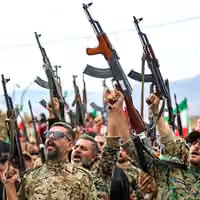
Men raise their fists during a pro-government gathering in Iran.
100%
Men raise their fists during a pro-government gathering in Iran.

Even Iran’s negotiating teams often use the same tone heard in hardline religious gatherings, blurring the line between diplomacy, domestic propaganda and military messaging.

Pressure at home and abroad

The shift reflects the Islamic Republic’s weakening position rather than growing confidence.

Iran continues to face severe economic difficulties, including soaring inflation, unemployment, currency depreciation and repeated public protests.

The government has also struggled to ease international isolation or achieve major diplomatic breakthroughs despite years of regional confrontation.

Therefore, the aggressive rhetoric has become one of the few remaining ways for the leadership to project authority both domestically and internationally.

The strategy appears aimed at two audiences simultaneously: foreign rivals, who are warned of military escalation, and the Iranian public, where activists, journalists and critics continue to face arrests, interrogations and pressure from security agencies.

But the tactic may also carry political costs. Constant threats can eventually signal weakness and anxiety rather than power, particularly to a population already frustrated by economic hardship and political restrictions.

For many Iranians dealing with inflation, internet disruptions and declining living standards, the increasingly dramatic language from officials has become less a source of fear than a sign of a leadership struggling to maintain control.

UK court hears alleged money trail in Iran International journalist stabbing trial

May 22, 2026, 11:32 GMT+1

The trial over the stabbing of Iran International presenter Pouria Zeraati turned to the alleged money trail behind the attack, with prosecutors describing payments routed through a west London construction company and relatives of one defendant.

Woolwich Crown Court on Thursday was told that Nandito Badea, 21, and George Stana, 25, received thousands of pounds through payments linked to Hemroc Ltd, a company based in Park Royal, west London, which was incorporated in 2020 and listed its business as the construction of domestic buildings.

Badea and Stana are accused over the March 2024 stabbing of Zeraati outside his home in Wimbledon, southwest London. They deny the charges.

Prosecutors allege the attack was carried out by criminal proxies acting on behalf of the Islamic Republic, an allegation Iran’s embassy in London has called “baseless.”

  • Iran International journalist stabbed at Tehran's behest, UK court told

    Iran International journalist stabbed at Tehran's behest, UK court told

Prosecutors said Hemroc had links to another company, Besuch Ltd, which operated “unlicensed restaurants and cafes” and traded under the name Tehran Lounge.

The court was told a man named Constantin Matache was a director of the company and that Hemroc made 183 payments totaling £80,540 to Stana’s sister, Florina, with the reference “loan.”

Florina then made 130 payments to Stana, who mainly passed the money on to others but used some for food, travel, cash withdrawals and other spending, retaining £1,330, prosecutors said.

Badea received 78 payments from Florina, the court heard. Prosecutors said he used the money for daily expenses and payments to Hotel Lily in West Brompton, where the men stayed while conducting surveillance, retaining £8,312.

Earlier in the trial, jurors were shown CCTV that prosecutors said captured the alleged getaway after Zeraati was stabbed three times in the leg in broad daylight.

The court has heard the defendants flew in from Romania and spent about a month carrying out surveillance near Zeraati’s home. On the day of the attack, prosecutors allege, Andrei grabbed Zeraati from behind while Badea stabbed him and Stana waited in a side road as the getaway driver.

The men later took a taxi to Heathrow Airport, changed clothes and boarded a British Airways flight to Geneva, the court was told.

Police found the car two days later. Arrest warrants were issued on October 3, and all three men were arrested in Romania on December 4. Badea and Stana were extradited to Britain 13 days later. Andrei could not be extradited because he was subject to domestic proceedings in Romania.

Iranian authorities in 2022 labeled Iran International a terrorist organization and said anyone working with the broadcaster would be deemed a threat to national security.

That year, posters were put up in Tehran featuring pictures of several journalists, including Zeraati, under the heading “Wanted: dead or alive.”

The court has also heard that police provided armed security for Iran International’s offices in Chiswick in 2022, and that the broadcaster later moved to Washington for a period after being told its employees could not be adequately protected in the UK.

The trial is continuing. The defense case is expected to begin next week.

In a separate case earlier this month, a trial date was set for three defendants charged over an alleged arson incident near Iran International’s studios in northwest London. That trial is scheduled to begin on January 25 next year at the Central Criminal Court.

Inflation pushes Iranians to buy food in installments

May 22, 2026, 09:47 GMT+1

Rising inflation in Iran has pushed households to buy even basic food items in installments, reshaping consumer habits.

Official figures published this year showed point-to-point inflation climbing above 73%, sharply increasing the cost of household essentials compared with the previous year. Food prices rose particularly fast, with some staples more than doubling in price.

The shift has extended installment payments beyond traditionally expensive products such as refrigerators and washing machines to groceries and supermarket packages, according to local media reports.

Chain stores and smaller retailers now advertise food, hygiene products and household supplies with payment plans spread over several months.

File photo of shoppers browsing goods inside a supermarket in Iran.
100%
File photo of shoppers browsing goods inside a supermarket in Iran.

“When even basic necessities are sold in installments, it clearly reflects the pressure inflation has placed on household finances,” Tehran-based Eghtesad News wrote in a report published on Thursday.

Second-hand market expands

The inflation surge has also accelerated demand for second-hand appliances, furniture and electronics as many households move away from buying new goods outright.

A Tehran mother identified only as Maryam told the outlet she bought a used refrigerator for roughly half the price of a new one after concluding the retail cost was no longer manageable.

“It is better to take some risk and buy second-hand than pay the heavy cost of a new product all at once,” she said.

Negin, a university student whose classes are now held online rather than in person, needed a laptop to continue her studies. Faced with soaring prices, she settled for a lightly used second-hand laptop. “This option allowed me to continue my studies without taking out a loan,” she said.

File photo of second-hand household appliances displayed for sale in Iran.
100%
File photo of second-hand household appliances displayed for sale in Iran.

Vendors in electronics and appliance markets also reported higher demand for used goods, with some sellers describing increases of between 40% and 60% compared with previous years.

Food and housing costs squeeze budgets

Economists and local observers say the change reflects deeper structural pressure on household budgets as spending on food, housing, utilities and services consumes a growing share of monthly income.

Annual inflation has surpassed 53%, according to official data, while prices for dairy, meat, rice, cooking oil and eggs have climbed sharply.

The report said many consumers now view installment purchases and second-hand goods not as cheaper alternatives, but as the only practical way to maintain daily living standards under prolonged inflationary pressure.