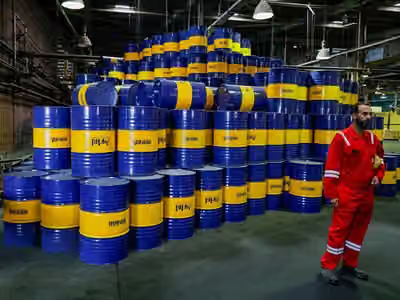
Former Industry Minister Mostafa Hashemitaba says the crisis is rooted not only in consumer markets but across the country’s collapsing production chain, from fertilizers to poultry farming.
Writing in Sharq on May 20, Hashemitaba said the price of a 50-kg bag of triple-phosphate fertilizer had jumped within months from three million rials to 70 million rials, a nearly 24-fold increase. Other fertilizers, he added, rose by more than 1,100 percent over the same period.
The result, he argued, has been the shutdown of farms and poultry operations, feeding directly into soaring prices for fruit, vegetables and meat.
A report published by Etemad described growing despair among Iranians struggling with job losses, displacement and rapidly rising living costs after the conflict.
Columnist Nayereh Khademi interviewed a 40-year-old university-educated man who said that after losing his job during the war, he briefly considered living in a cardboard box with his wife.
“What frightened me most was a future in which nothing was certain,” he said.
Another man described the horror of watching missile strikes destroy homes around him. When he realized his own house was still standing, he said he felt guilt rather than relief.
For many who lived through the attacks, the war’s aftermath brought a second shock: rapidly rising prices and shrinking access to basic necessities.
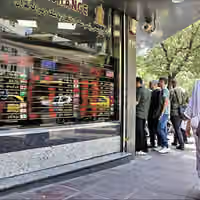
One resident interviewed by Etemad described it as “surreal” to walk past shops selling everyday goods that had suddenly become unaffordable.
Several Tehran newspapers reported last week that a kilogram of poultry meat had reached 1.5 million tomans, roughly one-tenth of an ordinary worker’s monthly salary.
Even some members of parliament, usually focused on rhetoric about national strength and resistance, publicly acknowledged the severity of rising food prices.
Hashemitaba contrasted the economic deterioration with what he described as unrealistic official ambitions elsewhere in the economy.
He recalled that in September 2023, then-President Ebrahim Raisi’s industry minister proudly showed him an electric vehicle and promised that 100,000 units would be produced by March. By spring, he wrote, it became clear that the display model was effectively the factory’s only output.
“How can a country that manufactures precision missiles fail to produce cars?” Hashemitaba wrote.
The worsening economic picture is also reinforcing arguments inside parts of Iran’s political establishment that some form of relief through negotiations with Washington may be unavoidable after months of war and financial turmoil.
While hardliners continue to frame diplomacy as resistance management rather than compromise, even some conservative figures have increasingly acknowledged the scale of economic pressure facing ordinary Iranians.
The strain is now extending beyond households. Cafés and restaurants in Tehran that once offered a temporary escape from political tensions and economic anxiety are also reportedly struggling to survive amid surging supply costs.
Government officials, including President Massoud Pezeshkian, who once tried to downplay the scale of the crisis, have increasingly acknowledged the depth of the country’s economic problems.
But hardline critics on Thursday attacked Pezeshkian simply for publicly recognizing the extent of public hardship—a reaction that underscored how disconnected parts of the political establishment appear from the realities facing many ordinary Iranians.