US-Iran agreement may be finalized within hours - Al Arabiya
Work is underway to finalize the text of an agreement between Washington and Tehran, and its completion may be announced within hours, Al Arabiya reported on Wednesday, citing sources.
The report said Pakistan’s army chief may visit Iran on Thursday to announce the final version of the agreement.
The report added that a new round of negotiations would be held in Islamabad after the Hajj season.
The comment section under an Iran post can look like a national mood but under a blackout well into its third month, it is often something narrower: a space shaped by whitelisted access, economic privilege, cyber operations and fear.
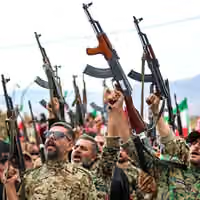
Iran’s streets and comment sections increasingly project the same official mood: unity, defiance and loyalty. Nighttime rallies supply the images – flags, portraits, organized crowds. Online, many Iran-related posts draw a parallel chorus of praise for the Islamic Republic, celebration of its military posture and attacks on critics, often alongside tributes to slain Supreme Leader Ali Khamenei and his still-unseen successor, Mojtaba Khamenei.
What the screen does not show is the pool of people removed before the argument even begins.
As Iran’s internet blackout pushes deeper into its third month, the question is no longer only what people are saying online.
It is who still has the connection, the permission, the protection or the incentive to say it.
A government-organized public wedding ceremony in Tehran, May 18, 2026
A public square with missing people
The latest crisis did not begin with one switch. During the January uprising, internet access was cut on January 8 and remained fully restricted until January 28. After US-Israeli strikes began on February 28, authorities imposed a new shutdown that has now moved toward its third month.
A normal comment section, however flawed, allows some collision between competing voices. A blackout changes the sample.
Many ordinary users are pushed onto restricted domestic services. Others ration expensive workarounds. Some businesses cannot reach customers. Students lose access to material. Families abroad struggle to maintain daily contact. At the same time, state-aligned users, approved institutions and privileged accounts remain visible on global platforms.
The asymmetry has not been hidden. In March, Iran’s government said it was providing special internet access to select users capable of promoting its messaging online. A government spokeswoman did not use the term “white SIM cards,” but said connectivity was being offered to “those who can better deliver the message.”
That is the controlled sample: not a country speaking freely, but a narrower population still able to speak outward.
Narrative laundering
The most revealing development is not only who receives access. It is what some people are asked to do to regain it.
Some Iranians whose SIM cards or internet access had been blocked over alleged online activity against the Islamic Republic said they were told to submit handwritten pledges, provide guarantors and publish pro-government content to restore access.
The notices asked for home and work addresses, bank account information, images of bank cards and links to social media accounts. They also instructed recipients not to publish content deemed harmful to the country’s “psychological, social or political security.”
Some were told to publish at least 20 posts supporting the Islamic Republic and send screenshots as proof.
The posts were not to be uploaded all at once. They had to be spaced out so the activity would appear natural.
Others were ordered to attend nighttime government rallies, photograph themselves carrying flags or images of the Supreme Leader, and provide identification documents from guarantors who would accept responsibility for any future “criminal activity.”
The detail about timing is small, but it carries the whole design. The aim is not merely loyalty. It is loyalty made to look organic.
This is where the street and the screen meet. Organized rallies produce images of public unity. Selective internet access and coerced posting can carry the same choreography into comment sections, reply chains and social platforms.
The state does not need every supportive post to be fake. It needs a system in which supportive voices are easier to see, dissenting voices are harder to hear, and some frightened users learn that getting back online may require a public performance of loyalty.
The access ladder
Iran’s internet is no longer simply available or unavailable. It has been sorted.
At the top are so-called white SIM cards, widely understood as privileged lines that allow largely unrestricted access for trusted insiders and state-aligned users. Below them are paid and limited services such as “Internet Pro,” presented by officials as a business necessity but described by many Iranians as a class-based system of digital inequality.
Reporting on material circulating among users described a four-level structure: white SIM cards, paid Internet Pro, costly VPN access and, for the majority, a restricted domestic network.
The economic filter is severe. Average monthly income in Iran is at around $100 to $200, while the minimum wage is typically below $100. Even official Internet Pro packages and VPN routes can be unaffordable, and black-market access has reportedly pushed prices far higher.
Access also carries political exposure. For those who can afford a connection, the risk is not only cost but traceability. A user may be able to post, but with the knowledge that the same system can block a SIM card, summon a guarantor, demand a pledge or turn an online comment into a legal file.
The older machine
Iranian state-linked online influence operations long predate the current blackout. Microsoft has reported that Iranian cyber-enabled influence activity has been a consistent feature of at least the last three US election cycles.
In January, the Foundation for Defense of Democracies identified what it described as a likely regime-linked influence operation on X during protests, using coordinated accounts to delegitimize dissent, intimidate protesters and reinforce official narratives.
The report said the network included at least 289 accounts posting identical Persian-language content, with behavior suggesting a hybrid of automation and human operation.
But the current phase adds a more intimate layer. Foreign influence operations impersonate a public from a distance. Domestic coercion can pressure the public itself.
The old shorthand of “bots” misses the range of actors now shaping the visible online picture: automated accounts, organized cyber operators, loyalists with privileged access, state-linked media networks, paid voices, and users pushed to perform approval to recover ordinary tools of daily life.
The silence around the noise
The missing side of Iran’s online debate is not abstract.
It is the online seller without customers, the student without class materials, the programmer without contracts, the family unable to make a routine call abroad, and the person with disabilities cut off from services or communities that made daily life more manageable.
Against that background, pro-government comment floods do not prove a national mood. They show that some people still have access, some have protection, some have instructions, and many others have been priced out, cut off or made cautious by fear.
There are genuine supporters of the Islamic Republic. But a system that restricts millions, grants selective access, monitors users, blocks SIM cards and tells some people to space out loyalty posts cannot produce a clean reading of public opinion.
When a government cuts off the people and leaves the microphone to loyalists, the comment section stops being a public square.
It becomes part of the stage.
The real story is not only in the roar under the post. It is in the conditions that made so many others unable to answer back – and in the citizens told that to return to the internet, they must first praise the power that cut them off.
Saudi Arabia urged Iran to seize what it called an opportunity to avoid further escalation after US President Donald Trump said he would give diplomacy a chance to end the war.
“The Kingdom of Saudi Arabia highly appreciates the US President Donald Trump's decision to give diplomacy a chance to reach an acceptable agreement to end the war, restore the security and freedom of maritime navigation in the Strait of Hormuz to its state prior to Feruary 28th, 2026, and address all points of contention in a way that serves the security and stability of the region,” Saudi Foreign Minister Faisal bin Farhan said on X.
“Saudi Arabia also highly appreciates the ongoing mediation efforts carried out by Pakistan in this regard,” he added.
“Saudi Arabia looks forward to Iran siezing the opportunity to avoid the dangerous implications of escalation, and urgently responding to the efforts to advance the negotiations leading up to a comprehensive agreement to achieve lasting peace in the region and the world,” he said.
Iranian parliament speaker Mohammad Bagher Ghalibaf took aim at US Vice President JD Vance on Tuesday by quoting from Vance’s memoir Hillbilly Elegy and warning that ordinary Americans would bear the cost of another Middle East war.
“We felt trapped in two unwinnable wars and a disproportionate share of fighters came from our neighborhood,” Ghalibaf wrote, citing a passage from the book.
“Hillbilly 2 incoming,” he added, accusing “broligarchs” and “beltway war merchants” of pushing the United States toward deeper conflict with Iran.
The unusual post appears to be appealing directly to anti-interventionist sentiment among parts of the American right.
Iran has consolidated de facto control over the Strait of Hormuz through military checkpoints, ship vetting, diplomatic arrangements and in some cases security fees for safe passage, Reuters reported, citing 20 sources including Asian and European shipping officials as well as Iranian and Iraqi officials.
The report said the Revolutionary Guards play a central role in a new multi-layered transit system that gives preference to ships linked to allies such as China and Russia, while other vessels may require government-to-government arrangements or payments to pass.
The report cited two European shipping sources as saying some vessels that aren’t covered by government-to-government deals are paying Iranian authorities upwards of $150,000 to secure safe passage through the Strait of Hormuz.
Ships are sometimes charged security and navigation fees, which vary according to cargo, the report added citing two senior Iranian officials.
“Not all countries are subject to these charges,” Reuters quoted of the Iranian officials as saying.
The report said vessels face inspections by armed IRGC patrol boats, route restrictions, transponder blackouts and possible delays during passage through the strait.
Germany’s domestic intelligence agency warned Iran could step up operations in Europe after the war, including against Jewish and Israeli institutions, Iranian dissidents and other perceived opponents, European news website Euractiv reported.
“The BfV (Bundesamt für Verfassungsschutz) assesses that, following the end of the war, the Iranian regime could deploy its intelligence services to track down and target opponents of the regime,” Euractiv quoted Germany’s domestic intelligence service as saying.
The agency said it was investigating people based in Germany who had traveled to Iran for military training or had “placed themselves in the service” of Iranian authorities.
Euractiv cited intelligence sources as saying several dozen people had left Germany for Iran and later worked on behalf of the regime, including two men from Hamburg who appeared in a propaganda video at a Basij checkpoint carrying assault rifles.
The BfV said Iranian intelligence services were willing to use methods amounting to state terrorism, ranging from threats and surveillance to preparations for attack plots. It said the threat to Jewish, Israeli and Iranian opposition targets in Germany “remains high.”