US says Iran offer insufficient, warns talks may continue ‘through bombs’
Iran's updated proposal for a deal to end the war is not a meaningful improvement and is insufficient for a deal, Axios reported citing a senior US official and a source briefed on the issue.
The US will have to continue the negotiations "through bombs" if Iran won't shift its position, the US official was quoted as saying.
The report said Tehran's new proposal includes more words on Iran's commitment not to pursue a nuclear weapon, but no detailed commitments about suspending uranium enrichment or handing over its existing stockpile of highly enriched uranium.
The US official quoted by Axios also said no sanctions relief will happen "for free" without reciprocal action by Iran, after Iranian state media claimed the US had agreed to waive Iran's oil sanctions during the negotiations.
Major differences remain between Iranian and US negotiating texts despite changes in Washington’s latest draft, the IRGC-linked Tasnim news agency reported citing an informed source close to Tehran’s negotiating team who accused the United States of “excessive demands” and “lack of realism.”
“Iran’s frozen assets must be returned to the Iranian people in a clear and definitive manner, and paper promises are of no use,” the source said, adding that disagreements remain over the release of the funds despite some US assurances.
The source also said Tehran was serious about demanding compensation from the United States over the March war. Washington, the source said, has spoken of establishing a development and reconstruction fund but remains far from Iran’s demands on the amount and other issues.
The source dismissed US demands on Iran’s nuclear program as “political excuses” and said Washington was still trying to link talks on ending the war to the nuclear issue.
“The Americans must understand that Iran will by no means agree to ending the war in exchange for nuclear commitments,” the source said.
The source added that Iran has no intention of building nuclear weapons and that the claim was “an excuse and deception” by the United States, saying Tehran’s latest text also emphasized that position.
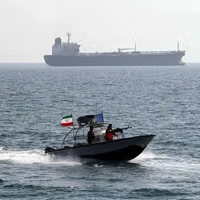
Iran’s newly announced Persian Gulf Strait Authority (PGSA) warned that any passage through the Strait of Hormuz without permission from Iranian authorities would be considered illegal.
"Navigation within the introduced boundaries of the Strait of Hormuz, which were previously determined by the Armed Forces and authorities of the Islamic Republic of Iran, is contingent upon full coordination with these entities, and passage without permission will be considered illegal," the PGSA said in a post on X Monday.
Alcatel Submarine Networks, the world’s largest cable-laying company, has paused subsea cable repair operations in the Persian Gulf after Iran demanded permits and “protection fees” for seabed infrastructure, maritime AI company Windward said on Monday.
Alcatel issued force majeure notices for Persian Gulf operations, effectively pausing repair crews in waters near the conflict zone, Windward said.
The pause comes as the IRGC has demanded foreign cable operators obtain Iranian permits and pay “protection fees” to maintain seabed infrastructure in Iranian territorial waters.
Of the dozens of submarine cables crossing the Persian Gulf, only two — FALCON and GBI — pass directly through Iranian territorial waters, according to telecommunications research company TeleGeography cited in the report.
Windward said the key risk was that damaged cables could remain unrepaired if repair vessels cannot safely enter or work in the area.
More than 300 UN experts, Nobel laureates, former senior officials and human rights advocates urged the United Nations to act against Iran’s rising use of executions in a letter organized by Justice for the Victims of the 1988 Massacre in Iran (JVMI) on Monday.
The signatories included former UN human rights rapporteur on Iran Javaid Rehman, former International Criminal Court president Sang-Hyun Song, Nobel Peace Prize laureates Jody Williams and Oleksandra Matviichuk, former Canadian justice minister Irwin Cotler and former Swiss president Ruth Dreifuss. Current UN Special Rapporteur on the Right to Privacy Ana Brian Nougrères also signed the letter.
Addressed to UN Secretary-General António Guterres, the letter said dozens of political prisoners and protesters had been executed since March following trials that failed to meet international standards. The group also urged the UN to establish an international accountability mechanism and press Tehran to halt executions and release political prisoners.
Nandito Badea and George Stana, two Romanian men accused of stabbing the Iran International journalist Pouria Zeraati near his home in Wimbledon in March 2024, appear at Woolwich Crown Court in London, Britain, May 18, 2026, in a courtroom sketch. / Courtesy of Reuters
British prosecutors said on Monday that a team of Romanian men who carried out a 2024 knife attack on Iran International TV presenter Pouria Zeraati in London were acting as proxies for Iran.
Zeraati was stabbed three times in the leg near his home in Wimbledon, southwest London, in late March 2024. He was discharged from the hospital two days later.
Nandito Badea, 21, and George Stana, 25, were arrested in Romania in connection with the attack, and were extradited to Britain on December 17, 2024. They were later charged with allegedly “wounding with intent to cause grievous bodily harm", a charge they denied at a preliminary hearing in London last year.
On Monday, prosecutor Duncan Atkinson told Woolwich Crown Court that “this was no robbery, no fight that got out of control, it was deliberate, planned violence to achieve what it did, that is serious injury to its target."
They had "committed a planned attack preceded by reconnaissance, and which was ordered by a third party acting on behalf of the Iranian state," he added.
Atkinson said Zeraati was an “obvious and readily identifiable target for violence” by proxies acting for Iran.
He said posters had been put up in Tehran in November 2022 featuring pictures of journalists including Zeraati under the heading “Wanted: dead or alive.”
Use of criminal gangs
“In recent years, since 2005, the Islamic Republic has turned less to its own operatives and increasingly to use proxies such as criminal gangs to meet their threatened violence on their behalf,” Atkinson said.
“That has included attacks on persons in this country who have become targets of Iranian intimidation and, effectively, terror,” he added.
Atkinson said Zeraati had been subjected to “extensive reconnaissance.”
He said Stana had been arrested a year earlier in the garden of Zeraati’s apartment with another man while in possession of latex gloves, scissors and a mask.
On the day of the attack, Badea and Andrei confronted Zeraati as he crossed the street from his home to his car, Atkinson said. Andrei held him while Badea stabbed him at the top of his thigh before they fled to a getaway car driven by Stana, the prosecutor added.
The men, who were motivated by money, dumped the car and some clothing before taking a taxi to Heathrow Airport and flying to Geneva, Atkinson said.
A third man accused of involvement, David Andrei, was arrested in Romania but is not involved in the trial.
The trial which began on Monday is expected to last more than two weeks.
In a separate incident last month, three defendants were charged over an alleged arson incident near Iran International’s studios in northwest London, with their trial scheduled to begin on January 25, 2027, at the Central Criminal Court.
In a statement, Iran International said the attack highlights increasing pressure on its journalists and their families, particularly following the recent war involving Iran.
The broadcaster said its staff and their relatives have faced threats and harassment, describing the situation as an effort to silence independent reporting.