• العربية
  • فارسی
Brand
  • Iran Insight
  • Politics
  • Economy
  • Analysis
  • Special Report
  • Opinion
  • Podcast
  • Iran Insight
  • Politics
  • Economy
  • Analysis
  • Special Report
  • Opinion
  • Podcast
  • Theme
  • Language
    • العربية
    • فارسی
  • Iran Insight
  • Politics
  • Economy
  • Analysis
  • Special Report
  • Opinion
  • Podcast
All rights reserved for Volant Media UK Limited
volant media logo
EXCLUSIVE

Iran's top security council holds meeting over fears of renewed protests

Apr 27, 2026, 18:55 GMT+1
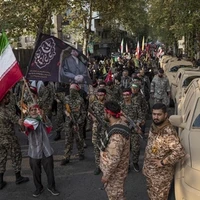
File photo shows Iranian protesters holding a pre-revolution flag of Iran during January uprising

Iran’s Supreme National Security Council has held a meeting to address growing concerns among security agencies over a possible resurgence of protests, sources familiar with the discussions told Iran International.

The meeting, chaired by Mohammad Bagher Zolghadr, was convened following internal assessments and intelligence reports warning of potential unrest in the coming days, the sources said.

According to information presented at the meeting, officials believe mounting economic hardship—driven by rising prices, unemployment, and damage to key industries such as petrochemicals and steel—could become the main trigger for renewed protests.

Security agencies reportedly presented a highly critical picture of Iran’s economy, highlighting widespread job losses linked to the shutdown of industrial units in the oil, petrochemical, and steel sectors, as well as the impact of prolonged internet disruptions.

Estimates shared during the meeting suggested that Iran’s economy may not be able to withstand more than six to eight weeks of a naval blockade. The blockade began on April 13, and around two weeks have now passed.

Another major concern raised was the near-total shutdown of production centers in key sectors, including oil, petrochemicals, and steel. According to the assessments, rebuilding these industries could take years.

Security officials also said internet shutdowns have left around 20% of the workforce dependent on online activity unemployed. They warned that, based on economic forecasts, an additional two million people could lose their jobs in the private sector by the end of spring.

In the financial sector, the closure of markets—including banks, the stock exchange, gold markets, and currency exchanges—has effectively halted economic activity, leaving real prices for goods unclear.

During the meeting, representatives of security bodies expressed particular concern over a possible call for protests by exiled Crown Prince Reza Pahlavi and the likelihood of his supporters taking to the streets.

Renewed protests inevitable

According to sources familiar with the meeting, security agencies concluded that public protests are inevitable, with the only uncertainty being the timing of their outbreak.

Calls for protests around International Workers’ Day have further heightened concerns among officials and were discussed during the council meeting.

Workers, retirees, teachers, and other wage-earning groups have repeatedly staged protests or issued statements over living conditions, delayed payments, job insecurity, and the suppression of independent labor organizations.

Ahead of International Workers’ Day, labor groups inside and outside Iran have again emphasized demands including wage increases, the release of detained labor activists, the repeal of repressive rulings, and the right to form independent unions.

Sources said members of the Supreme National Security Council believe that protests occurring during ongoing talks with the United States or following an extension of the ceasefire could pose a real risk to the survival of the Islamic Republic.

Iran has experienced several waves of protests, strikes, and civil disobedience in recent years, often driven by economic hardship, inflation, and widespread dissatisfaction with living conditions.

Authorities have responded with widespread internet disruptions, communication restrictions, deployment of security forces, and, in some cases, violent crackdowns.

The most brutal crackdown came on January 8 and 9, when at least 36,500 people were killed after millions of protesters held rallies across the country following a call by Pahlavi.

Most Viewed

The hidden target in US war on Iran may be China
1
PODCAST

The hidden target in US war on Iran may be China

2

UK releases man jailed for spying on Iran International in 2023 terror plot

3
INSIGHT

Unity or fracture? Tehran battles Trump’s narrative of disarray

4

Is the US blockade working? It depends who you ask

5

Iran nurses reject special internet access amid blackout

Banner
Banner

Spotlight

  • Iran football chief with IRGC past to visit Canada for FIFA event
    EXCLUSIVE

    Iran football chief with IRGC past to visit Canada for FIFA event

  • New intelligence exposes IRGC-linked network targeting Israeli, Western sites
    EXCLUSIVE

    New intelligence exposes IRGC-linked network targeting Israeli, Western sites

  • Is Ghalibaf becoming Iran’s Khrushchev?
    INSIGHT

    Is Ghalibaf becoming Iran’s Khrushchev?

  • Iran’s new military-led order may mean greater dangers abroad
    ANALYSIS

    Iran’s new military-led order may mean greater dangers abroad

  • The hidden target in US war on Iran may be China
    PODCAST

    The hidden target in US war on Iran may be China

  • Unity or fracture? Tehran battles Trump’s narrative of disarray
    INSIGHT

    Unity or fracture? Tehran battles Trump’s narrative of disarray

•
•
•

More Stories

New intelligence exposes IRGC-linked network targeting Israeli, Western sites

Apr 27, 2026, 17:17 GMT+1
•
Mojtaba Pourmohsen

New intelligence obtained by Iran International reveals the identities of operatives in an IRGC-linked espionage and assassination network, including a foreign cleric trained in Qom who allegedly coordinated attacks targeting Israeli and Western interests.

A European intelligence source provided Iran International with new details about the IRGC-linked espionage, sabotage and assassination network operating across several countries.

According to the source, the activities were overseen by an officer in the covert unit identified as Alireza Mohammadi, who allegedly operated under the alias Meghdad Hassani.

The source said Mohammadi recruited and directed individuals tasked with intelligence gathering, surveillance and reconnaissance against targets in Israel as well as US military installations in other countries.

 Alireza Mohammadi
100%
Alireza Mohammadi

According to information obtained by Iran International, one operative allegedly working under Mohammadi’s supervision is Elshad Hajiyev, a 37-year-old citizen of a neighboring country also known as Akram Haji-Zadeh.

Haji-Zadeh is said to have studied as a cleric at Al-Mustafa International University in Qom, an institution sanctioned by the US Treasury in 2020 for being "used as a recruitment platform by the IRGC-QF for intelligence collection and operations, including recruitment for the IRGC-QF-led foreign militias."

Elshad Hajiyev, a 37-year-old cleric also known as Akram Haji-Zadeh
100%
Elshad Hajiyev, a 37-year-old cleric also known as Akram Haji-Zadeh

The European intelligence source told Iran International that Haji-Zadeh played a leading role in a cell recently dismantled in a neighboring country. Mossad has separately announced that it dismantled what it described as an Iranian-linked network in one of Iran’s neighboring states.

According to the source, the network’s alleged targets included an oil pipeline, a synagogue, the Israeli embassy and prominent members of the Jewish community. In April 2024, Haji-Zadeh appeared twice as a guest on the television program Helal, broadcast on Iran’s Channel One and produced in cooperation with Al-Mustafa.

Israeli and Western intelligence officials have in recent years alleged that members or affiliates of Al-Mustafa have been involved in covert operations in countries including Senegal, Uganda and elsewhere in Africa.

A wider campaign against Unit 4000

The alleged disruption of the network comes amid what appears to be an escalating Israeli campaign against IRGC intelligence and sabotage units over the past six weeks.

These groups were reportedly overseen by Majid Khademi, head of IRGC Intelligence, who was killed on April 6 in what Israeli officials described as a targeted strike.

Last week, Mossad, Shin Bet and the Israeli military said they had killed Rahman Moghaddam, head of the Special Operations Department of the IRGC Intelligence Organization—known as Unit 4000—along with two other members of the unit in the early days of strikes on Iran.

Rahman Moghaddam
100%
Rahman Moghaddam

A source inside Iran told Iran International that Moghaddam—previously deputy coordinator of intelligence protection at Iran’s Ministry of Defense—was killed around midday on March 3 in a strike on a residential tower in Tehran’s Kowsar Complex on Artesh Boulevard.

Another senior figure, Mohsen Souri, who Israeli officials say was involved in training local cells outside Iran, was also reportedly killed.

Mossad and Shin Bet said they located his safe house and killed him along with other IRGC members in what they described as a precise intelligence operation. On March 30, Iranian state media outlets IRNA and Tasnim published footage of his funeral in Karaj without mentioning his alleged role.

Another alleged Unit 4000 operative, Mehdi Yekeh-Dehghan—known as “Doctor”—was also reportedly killed in a separate operation. Israeli officials say he was responsible for operations in Turkey and for transferring suicide drones to Cyprus.

According to intelligence cited by prosecutors in Turkey, Yekeh-Dehghan and another Iranian officer, Najaf Rostami, were linked to a network accused of planning surveillance and possible attacks on the US airbase at Incirlik.

On January 29, Turkish authorities arrested six people accused of spying for Iranian intelligence. One of them, Ashkan Jalali, was accused of attempting to smuggle armed drones to Cyprus through his companies.

In recent years, Israel has repeatedly claimed to have disrupted IRGC and Quds Force plots abroad through intelligence operations and targeted killings.

If confirmed, the latest allegations would suggest Israel’s recent campaign has extended beyond missile sites and military commanders into the covert infrastructure Iran has built overseas over years.

New intelligence exposes IRGC-linked network targeting Israeli, Western sites

Apr 27, 2026, 16:56 GMT+1

New intelligence obtained by Iran International reveals the identities of operatives in an IRGC-linked espionage and assassination network, including a foreign cleric trained in Qom who allegedly coordinated attacks targeting Israeli and Western interests.

A European intelligence source provided Iran International with new details about the IRGC-linked espionage, sabotage and assassination network operating across several countries.

According to the source, the activities were overseen by an officer in the covert unit identified as Alireza Mohammadi, who allegedly operated under the alias Meghdad Hassani.

The source said Mohammadi recruited and directed individuals tasked with intelligence gathering, surveillance and reconnaissance against targets in Israel as well as US military installations in other countries.

Continue reading

100%

Is Ghalibaf becoming Iran’s Khrushchev?

Apr 27, 2026, 04:06 GMT+1
•
Mehdi Jedinia

Reports that Mohammad Bagher Ghalibaf may have been sidelined from Iran’s negotiations with the United States have revived an old question from Soviet history: can an insider reform a rigid ideological system without becoming one of its casualties?

Ghalibaf may be emerging not as Iran’s Mikhail Gorbachev, but as something closer to Nikita Khrushchev—an establishment figure attempting controlled change not to dismantle the Islamic Republic, but to preserve it.

The Majles speaker, a former IRGC commander with deep ties inside the security establishment, has in recent weeks appeared to sit at the center of Tehran’s debate over diplomacy or confrontation.

Supporters of diplomacy see negotiations as a way to stabilize the system and prevent further confrontation with the West. Hardline factions warn that concessions would undermine the ideological foundations of the Islamic Republic.

US President Donald Trump, intentionally or not, has helped fan the flames by publicly portraying Iran’s leadership as divided, echoing the way Washington’s rivalry with the Soviet Union often intensified internal debates in Moscow.

The comparison with Gorbachev has appeared before in Iranian politics. During the reform movement of the late 1990s, President Mohammad Khatami was frequently described as “Iran’s Gorbachev.”

Hardliners used the label to attack him, while parts of the opposition embraced it in the hope that his reforms might accelerate the system’s collapse.

In reality, neither Khatami nor his allies accepted that role. Their reforms were framed as an effort to strengthen the Islamic Republic rather than dismantle it. More importantly, the structure of power at the time made a Gorbachev-style transformation nearly impossible.

Supreme Leader Ali Khamenei held ultimate authority and maintained the balance between rival factions, limiting both reformist ambitions and hardline overreach.

The conditions today are markedly different. Iran has endured direct external military pressure, and the legitimacy of the system has been shaken by recent protests. A younger generation appears deeply alienated from the ideological foundations of the state.

At the same time, the supreme arbiter who once managed factional competition no longer appears able—or willing—to impose the same discipline.

In such circumstances, change may come not from a reformist outsider but from a figure embedded within the system itself. Ghalibaf fits that description. His background in the IRGC, his political experience, and his connections across multiple factions give him a platform few others possess.

Yet any move toward accommodation with Washington provokes resistance from ideological loyalists who view compromise as betrayal, even as warnings grow that without meaningful change the system could buckle under pressure from abroad and deepening discontent at home.

Here the Soviet analogy becomes harder to ignore.

Khrushchev’s reforms were intended to strengthen the Soviet system, not dismantle it. But attempts to modernize rigid structures often produce consequences their architects cannot control.

In 1964, Khrushchev was quietly pushed aside by his colleagues and officially “retired due to old age and ill health.”

If Iran’s leadership ultimately chooses a path of limited reform to preserve the state, Ghalibaf could still emerge in such a role. But if the system rejects even controlled adaptation, he may instead become an early casualty of its resistance to change.

Iran’s new military-led order may mean greater dangers abroad

Apr 27, 2026, 02:40 GMT+1
•
Shervin Shahrestani

The Islamic Republic that has emerged from the killing of Iran's Supreme Leader Ali Khamenei may prove more operationally aggressive than the one it replaces, analysts say.

Dominated by the Revolutionary Guards, the leadership in Tehran may be less constrained by theology and more driven by revenge.

This is an assessment by analysts tracking the post-war power shift in Tehran, as a string of attacks on Jewish and Israeli targets have taken place since the Feb. 28 US-Israeli strikes. 

Across Europe, an Iran-linked group calling itself Harakat Ashab al-Yamin al-Islamia has claimed several attacks, including the targeting of Jewish volunteer ambulances in London, a synagogue in Belgium and a synagogue and Jewish school in the Netherlands. 

In Azerbaijan, an alleged Iranian plot targeting the Israeli embassy in Baku and Jewish community sites was foiled by authorities. 

Danny Citrinowicz, a senior researcher at the Institute for National Security Studies in Tel Aviv, says the post-Ali Khamenei Islamic Republic is likely to become more operationally aggressive, with sleeper cells and lone-wolf attacks posing a growing threat to Tehran’s adversaries.

"Lone wolves are a bigger threat," Citrinowicz told Iran International, referring to the act of an individual committing a violent act alone without a direct order.

"You just need to create the atmosphere," Citrinowicz said. "It will lead to someone saying, I'm going to do something." 

Citrinowicz describes the Islamic Republic in 2026 as "Iranian Revolution 3.0" — its third iteration since 1979 — in which a military junta has taken control of the founding doctrine of clerical rule, Velayat-e Faqih, with the IRGC dominating all meaningful decisions.

It is a regime that has demonstrated, through the foreign fighters it brought in to suppress its own population during the January 2026 uprising, that it harbors sizable loyal support outside its borders. 

"The regime will try to present itself as a continuation of Ali Khamenei's regime," Citrinowicz said.

Yet the IRGC-dominated leadership still faces a limitation in its power, inheriting a government whose revolutionary appeal has long outlasted its domestic popularity. 

Iran International reported that around 800 members of Iraqi militia groups — including Kataib Hezbollah and Harakat al-Nujaba — entered Iran days before the January 2026 crackdown that killed tens of thousands of protesters.

Proxy Shia forces from Turkey, Afghanistan and Pakistan have also been reported inside Iran. 

The Pakistani contingent — the Zainabiyoun Brigade — is an armed wing rooted in Tehran's ideological network, drawn from South Asia's Shia communities. But one militia is only part of the picture.

Simon Wolfgang Fuchs, an associate professor at the Hebrew University of Jerusalem, describes Lahore-based cleric Jawad Naqvi as running a sprawling and sophisticated Shia seminary operation in Lahore, Pakistan. 

The seminary produces Qom-trained scholars, high-quality social media content, and an explicit political model.

"He's really someone who says we have to implement the Iranian model in Pakistan," Fuchs told Iran International. Naqvi's political model draws inspiration from Hezbollah, Fuchs argues — a Shia minority that embraced Velayat-e Faqih and came to dominate Lebanon's political field.

"The vision and the boldness to simply claim that you could also dominate the state is definitely there," Fuchs said, though he cautioned the comparison has limits — Pakistan's Shia community has no history of armed resistance. 

"Iran's efforts to gain a following as the legitimate leader of the Shia (community) has paid off somewhat in South Asia," said Cliff Smith, a fellow at the Middle East Forum who visited Indian-administered Kashmir and documented Iranian influence on the ground.

"The idea of Iran is stronger outside its borders than it is inside." 

India, home to between 20 and 40 million Shia — the second-largest such population after Iran — has received less scrutiny than its neighbour. 

Smith observed during time spent in Kashmir that New Delhi had effectively tolerated Iranian influence among the Shia community, calculating it served as a useful counterweight to Sunni radicalism from Pakistan.

The wave of protests and unrest that was seen in India following Khamenei's killing has prompted a reassessment, according to Smith. 

"I had one of those people tell me, when they had seen the riots and demonstrations after Khamenei’s death, that I was right. We should have paid attention to this sooner," he said, recalling a contact at an Indian think tank. 

Abhinav Pandya of India's Usanas Foundation argues the blind spot runs deeper than Kashmir, as Iran's influence among Indian Muslims is not confined to Shia communities.

India is home to around 200 million Muslims — the world's third-largest — and Pandya argues the Indian security establishment has been too focused on the Sunni threat to register how deeply the Islamic Republic's influence has taken root among the country's Shia groups. 

"The biggest misunderstanding is that most of the jihadist problem comes from the Sunni Muslims, and the Shias — they don't need to bother about them, Shias are completely loyal," Pandya said.

"So far Shia Muslims have not majorly participated in any terrorist activity... But partly this understanding is problematic." 

For Citrinowicz, the killing of Khamenei —a figure seen as much as a religious leader as a political one — risks transforming Iran's conflict with the US and Israel into something far harder to contain. 

“The killing of him is potentially opening some sort of religious war that I think that we have to make sure it won't expand between the Shias and the state of Israel," he said.

Citrinowicz also warned of an increase in Iranian terror activity abroad. "While they have this kind of capabilities and shared communities all over the world, especially in places like India, definitely we'll see an uptick."

Unity or fracture? Tehran battles Trump’s narrative of disarray

Apr 26, 2026, 21:57 GMT+1
•
Maryam Sinaiee

Assertions by US President Donald Trump that Iran’s leadership is divided, and Tehran’s increasingly coordinated effort to deny it, have thrust the issue of unity to the center of the standoff between the two countries.

Trump has repeatedly cast Iran’s leadership as fractured and disorganized. In one post, he wrote: “Iran is having a very hard time figuring out who their leader is! They just don’t know!” describing “infighting” between “‘Hardliners,’ who have been losing BADLY on the battlefield, and the ‘Moderates,’ who are not very moderate at all.”

In a separate interview, he said: “They’re all messed up. They have no idea who their leader is… we took out, really, three levels of leaders.”

As speculation spread, President Masoud Masoud Pezeshkian sought to set the tone in a social media post declaring: “In Iran there are no ‘hardliners’ or ‘moderates.’ We are all Iranians and revolutionaries.”

The message was reposted verbatim by senior officials across the political and military establishment, including judiciary chief Gholam-Hossein Mohseni-Ejei, Vice President Mohammad-Reza Aref, senior advisers, and the Supreme National Security Council, underscoring the coordinated nature of the response.

Mohseni-Ejei went further in a separate post, directly attacking Trump and calling the labels “hardliner” and “moderate” “fabricated and hollow terms” borrowed from Western political literature.

The messaging blitz from Tehran followed the collapse of negotiations in Islamabad and reports that parliamentary speaker Mohammad Bagher Mohammad Bagher Ghalibaf—who led Tehran’s delegation there—may have stepped down from the negotiating team, fueling speculation over internal disagreements about talks with Washington.

Reports first circulated by Israel’s Channel 12 claimed Ghalibaf resigned following interference by the Islamic Revolutionary Guard Corps. Other reports suggested he was reprimanded for trying to include Iran’s nuclear program in discussions with the United States.

Hardline lawmaker Mahmoud Nabavian appeared to confirm tensions in a leaked audio recording, saying the team had discussed the nuclear issue “against the Supreme Leader’s position” and calling it a “strategic error.”

Saeed Saeed Jalili, widely rumored to be a possible replacement for Ghalibaf, struck a similar note while avoiding the exact phrasing, emphasizing “the unity of all segments of the nation” under the Supreme Leader.

The Supreme Leader’s official account also weighed in, warning that enemy “media operations” were aimed at undermining national unity and security.

Some analysts see Trump’s comments as deliberate pressure. Reformist journalist Ahmad Zeidabadi argued Trump was trying to “create division and conflict within the structure of the government” to present any eventual deal as “his complete victory.”

Ali Afshari, a US-based political analyst, described the remarks as “psychological warfare aimed at disrupting the cohesion of the opposing side.”

Yet even as officials insist on unity, conflicting signals from Tehran have deepened public uncertainty over negotiations and the future of the war.

Hardline lawmaker Ali Khezrian said the resumption of war was “inevitable” and claimed Iran had halted all communication with Washington.

Despite publicly dismissing reports of Ghalibaf’s resignation, parliament communications chief Iman Shamsaei said no new round of negotiations had been scheduled.

Journalist Saeed Agenji, meanwhile, insisted Ghalibaf still held “the helm of negotiations and domestic management of the country.”

Zeidabadi warned that mixed messaging over negotiations, ceasefire, agreement and even the ultimate goals of the war had left ordinary Iranians confused, risking reinforcing exactly the perception of disarray Tehran is trying to deny.