• العربية
  • فارسی
Brand
  • Iran Insight
  • Politics
  • Economy
  • Analysis
  • Special Report
  • Opinion
  • Podcast
  • Iran Insight
  • Politics
  • Economy
  • Analysis
  • Special Report
  • Opinion
  • Podcast
  • Theme
  • Language
    • العربية
    • فارسی
  • Iran Insight
  • Politics
  • Economy
  • Analysis
  • Special Report
  • Opinion
  • Podcast
All rights reserved for Volant Media UK Limited
volant media logo

Is the US blockade working? It depends who you ask

Apr 27, 2026, 01:25 GMT+1
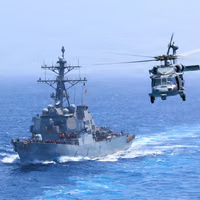
Guided-missile destroyer USS Rafael Peralta enforces the US blockade on Iranian ports against an Iranian-flagged ship, in this CENTCOM handout dated April 24, 2026

Recent tracking data suggesting Iran is still moving millions of barrels of crude despite a US naval blockade has raised fresh questions about the effectiveness of Washington’s effort to choke off Tehran’s oil exports.


TankerTrackers.com on Sunday cited satellite images that it said showed Iran loaded at least 4.6 million barrels of crude at export terminals in recent days, with another four million barrels appearing to have crossed the US blockade line.

The figures suggest Tehran retains at least some ability to keep oil flowing despite a US naval blockade launched nearly two weeks ago and repeated claims from Washington that the operation is crippling Iran’s maritime trade.

How effective has the blockade been?

US Central Command has portrayed the blockade as increasingly effective.

In its latest update on April 25, CENTCOM said US forces had “redirected” 37 vessels since the blockade began against ships entering or departing Iranian ports on April 13.

US forces have also expanded enforcement beyond the Persian Gulf, intercepting or seizing tankers in the Indian Ocean and Arabian Sea suspected of carrying Iranian crude.

Washington has framed the operation less as a hermetic seal than an economic squeeze. US officials argue the blockade’s effectiveness should be measured by whether Iran’s revenues are being cut.

Independent maritime trackers, however, paint a more complicated picture.

How is Iran still moving oil?

Shipping intelligence firm Lloyd’s List Intelligence reported this week that at least 26 vessels linked to Iran, including 11 oil and gas tankers and two very large crude carriers, have sailed in and out of Iranian ports since the blockade began.

The Financial Times, citing cargo tracking firm Vortexa, reported the figure could be as high as 34 Iran-linked tankers bypassing the blockade line in the Strait of Hormuz, including six outbound tankers carrying around 10.7 million barrels of crude.

Vortexa has also identified multiple fully laden tankers slipping past US warships. Bloomberg reported that a wider flotilla may have moved roughly nine million barrels around the blockade in recent days.

Iran’s so-called shadow fleet has long relied on tactics such as switching off AIS transponders, spoofing vessel locations, conducting ship-to-ship transfers, relabeling cargoes and using front companies to disguise ownership and destinations.

Since the blockade began, shipping analysts have observed vessels “going dark” near Iranian terminals before reappearing beyond the enforcement line.

Others have hugged coastal routes or moved through narrow shipping lanes where interception becomes more politically and operationally difficult.

What impact is the blockade having?

Even so, the blockade appears to be having an impact.

Traffic through the Strait of Hormuz has dropped sharply from normal levels, insurers have raised premiums, and some buyers have reportedly delayed or canceled purchases amid legal and logistical uncertainty.

Higher freight rates and longer voyages are also increasing costs for Iranian exports and for customers, chiefly in China.

The longer the blockade persists, the greater the chance Iran faces storage bottlenecks at export terminals or is forced to shut in production.

For now, the blockade appears to be functioning less as an impenetrable wall than as a bottleneck: slowing, complicating and raising the cost of Iran’s oil trade without stopping it entirely.

That may be enough for Washington to claim success and enough for Tehran to claim survival.

Most Viewed

Iran uses migrant smuggling routes to place operatives in Britain - Telegraph
1

Iran uses migrant smuggling routes to place operatives in Britain - Telegraph

2
PODCAST

Is Iran using the US war to accelerate executions and silence dissent?

3

Ukraine moves to aid US in Iran war after striking Tehran-Moscow supply link

4

Trump weighs major Iran strikes as more regional states enter the war

5

Nearly half of Iranian internet users angry over conflict outage, ISPA poll finds

Banner
Banner
Banner

Spotlight

  • Iran is living through America’s 2022 inflation shock almost every month
    ANALYSIS

    Iran is living through America’s 2022 inflation shock almost every month

  • Is Iran using the US war to accelerate executions and silence dissent?
    PODCAST

    Is Iran using the US war to accelerate executions and silence dissent?

  • Tehran braces for possible new phase of war
    INSIGHT

    Tehran braces for possible new phase of war

  • Cafés close, tolerance ends: Iran’s post-war shift on compulsory hijab
    INSIGHT

    Cafés close, tolerance ends: Iran’s post-war shift on compulsory hijab

  • Iran bears biggest economic cost of Hormuz closure
    ANALYSIS

    Iran bears biggest economic cost of Hormuz closure

  • Russia’s gasoline imports add pressure to Iran’s strained fuel market
    ANALYSIS

    Russia’s gasoline imports add pressure to Iran’s strained fuel market