• العربية
  • فارسی
Brand
  • Iran Insight
  • Politics
  • Economy
  • Analysis
  • Special Report
  • Opinion
  • Podcast
  • Iran Insight
  • Politics
  • Economy
  • Analysis
  • Special Report
  • Opinion
  • Podcast
  • Theme
  • Language
    • العربية
    • فارسی
  • Iran Insight
  • Politics
  • Economy
  • Analysis
  • Special Report
  • Opinion
  • Podcast
All rights reserved for Volant Media UK Limited
volant media logo

Ex-CIA director says Iran erred by expanding attacks to Persian Gulf states

Mar 3, 2026, 09:45 GMT+0Updated: 12:39 GMT+0
Smoke rises from a burning building hit by an Iranian drone strike in Seef district, Manama, Bahrain, February 28, 2026.

Iran made a strategic error by expanding its attacks beyond US and Israeli targets to include Persian Gulf states, a move that could pull more countries into the war, former CIA Director David Petraeus told Iran International in an interview on Monday.
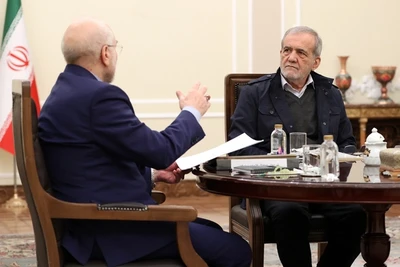

“I think that is a big miscalculation on the part of Iran,” Petraeus told 24 with Fardad Farahzad Show, arguing that striking Arab countries that had sought to avoid direct involvement could push them to contribute more directly to regional defense efforts.

US and Israeli forces, Petraeus said, have already “dramatically degraded” Iran’s retaliatory capabilities, though he cautioned it was too early to determine whether the decline in attacks over the past 12 to 24 hours signaled a lasting shift.

“I think it's premature at this point to judge whether or not that will degrade further or if the volume can pick back up,” he said.

Coalition dynamics shift

Petraeus said Tehran’s decision to target regional states – including those that did not allow their bases to be used for operations – may alter the strategic calculus across the Persian Gulf.

Many countries in the region, he said, are already contributing to an integrated air and missile defense network that includes US-supplied Patriot and Terminal High Altitude Area Defense systems, along with naval assets and aircraft capable of intercepting incoming projectiles.

While he stopped short of predicting expanded offensive participation, Petraeus said additional Western powers could also align more closely with the effort. “I’m confident they are all taking part in the defensive efforts that are ongoing,” he said.

Uncertain path to political change

Addressing whether military pressure could lead to political transformation inside Iran, Petraeus said any lasting shift would depend primarily on internal fractures within the security forces and leadership.

“The sad reality in such cases often is that the most guys with the most guns and the most willing to be brutal to the people prevail,” he said, cautioning against assumptions that external air campaigns alone can bring about regime collapse.

Petraeus described exiled Prince Reza Pahlavi as a symbolic presence who has outlined a transition toward an elected government rather than dismantling all existing institutions.

Ultimately, he said, momentum would hinge on whether influential insiders conclude that continued confrontation has become unsustainable, shaping not only Iran’s future but the broader balance of power across the Middle East.

Most Viewed

Iran International says it won’t be silenced after London arson attack
1

Iran International says it won’t be silenced after London arson attack

2
VOICES FROM IRAN

Hope and anger in Iran as fragile ceasefire persists

3

US sanctions oil network tied to Iranian tycoon Shamkhani

4

Iran halts petrochemical exports to supply domestic market

5
INSIGHT

How Tehran bends its own red lines to boost state rallies

Banner
Banner

Spotlight

  • Hardliners push Hormuz ‘red line’ as US blockade tests Iran’s leverage
    INSIGHT

    Hardliners push Hormuz ‘red line’ as US blockade tests Iran’s leverage

  • Ideology may be fading in Iran, but not in Kashmir's ‘Mini Iran'
    INSIGHT

    Ideology may be fading in Iran, but not in Kashmir's ‘Mini Iran'

  • War damage amounts to $3,000 per Iranian, with blockade set to add to losses
    INSIGHT

    War damage amounts to $3,000 per Iranian, with blockade set to add to losses

  • Why the $100 billion Hormuz toll revenue is a myth
    ANALYSIS

    Why the $100 billion Hormuz toll revenue is a myth

  • US blockade targets Iran oil boom amid regional disruption
    ANALYSIS

    US blockade targets Iran oil boom amid regional disruption

  • Iran's digital economy battered by prolonged blackout
    INSIGHT

    Iran's digital economy battered by prolonged blackout

  • Iranians face war with fear, joy and hope

    Iranians face war with fear, joy and hope

•
•
•

More Stories

Post-Khamenei Iran: Succession race widens as decentralized system sustains war

Mar 3, 2026, 09:15 GMT+0
•
Negar Mojtahedi

The killing of Iran’s Supreme Leader Ali Khamenei has triggered celebrations among many Iranians, but analysts say the moment marks not an endpoint but the beginning of a new and highly consequential chapter for the Islamic Republic.

Despite the historic symbolism of his death, the system Khamenei built was designed to withstand precisely this kind of shock.

Power in Iran was never concentrated solely in one man, but embedded across military, political and security institutions capable of functioning even in the absence of a supreme leader.

“The Islamic Republic is not a one-bullet state,” Behnam Ben Taleblu told Iran International, arguing that one of Khamenei’s lasting achievements was institutionalizing authority across the regime.

Iran’s defense and repression capabilities remain dispersed across the country’s provinces, allowing missile launches, drone operations and internal security functions to continue despite leadership losses.

The Islamic Republic has continued firing missiles and drones despite the elimination of senior figures, showing the Islamic Revolutionary Guard Corps can sustain operations through a decentralized chain of command.

Decentralized power

Behind the scenes, however, the question of succession is fast becoming the Islamic Republic’s central uncertainty.

Jason Brodsky of United Against Nuclear Iran said power has become “diffuse,” now resting formally with a three-person interim leadership council while multiple political and clerical figures compete for influence.

“There used to be a centralized address for the final decision-making. Now there’s a wider array of people. So it’s flatter," said Brodsky.

Potential candidates, he said, include members of the interim leadership structure such as Alireza Arafi and Chief Justice Gholam Hossein Mohseni Ejei, as well as other clerical figures outside the council.

Brodsky pointed to Hassan Khomeini – grandson of the Islamic Republic’s founder – alongside conservative clerics including Mohammad Mahdi Mirbagheri, Mohsen Araki and Mohsen Qomi as individuals to watch.

At the same time, senior political figures such as Ali Larijani and Parliament Speaker Mohammad Bagher Ghalibaf remain influential actors shaping decision-making during the transition.

“With Khamenei and his family gone, that really leaves the succession race wide open,” Brodsky said.

Analysts say Tehran may delay formally appointing a new supreme leader during wartime, as any successor would immediately become a high-value military target.

On Tuesday, a member of Iran’s Assembly of Experts said choosing a new supreme leader would not take long, adding the body would make its decision based on religious criteria and its own judgment rather than individual preferences or political factions. Ali Moalemi added the body would select a person similar to Khamenei.

Attacking neighbors: Why?

Externally, Iran appears determined to widen the confrontation rather than retreat. Alex Vatanka of the Middle East Institute said Islamic Republic leaders are likely to regionalize the conflict in an effort to increase pressure on Washington and its partners.

“They will stay in this fight as long as they can,” Vatanka said, adding that Tehran is attempting to “put pressure on Trump” by expanding instability beyond its borders.

Events across the Persian Gulf suggest that escalation is already underway. Iranian officials have threatened to target shipping through the Strait of Hormuz, while an oil tanker was reportedly struck and forced to halt transit.

US-allied Persian Gulf states are bearing the brunt of retaliatory strikes.

In the United Arab Emirates, missiles and falling debris struck civilian areas in Dubai and Abu Dhabi, damaging luxury hotels, high-rise apartment towers and airport infrastructure – locations never designed to withstand ballistic missile or drone attacks.

Similar attacks and interceptions were reported in Bahrain and near Doha, as Iran targeted countries hosting US military forces, signaling a shift from purely military targets to economic and civilian centers across the Persian Gulf.

Attacks on regional energy infrastructure forced shutdowns at major Saudi and regional oil and gas facilities, sending global oil prices sharply higher.

US Central Command confirmed four American service members were killed following Iranian attacks in the region, while US forces struck Iranian naval and missile assets.

Speaking at the White House on Monday, US President Donald Trump signaled Washington is preparing for a longer campaign than initially anticipated.

“From the beginning, we projected four to five weeks, but we have capability to go far longer than that, we’ll do it,” Trump said, dismissing suggestions the United States might seek a quick exit.

“I don’t get bored.”

He framed the operation as a decisive effort to eliminate what he called “the intolerable threats posed by this sick and sinister regime,” insisting the United States would continue operations “whatever it takes.”

If Tehran had hoped escalation would shorten the war, early signals from Washington, Brodsky said, suggest the opposite may be unfolding.

Brodsky said much of Iran’s response is continuing through pre-planned wartime contingencies.

“A lot of the decision-making right now is essentially on autopilot,” he said, adding that the Revolutionary Guards’ decentralized structure allows operations to continue even amid leadership losses.

Even so, analysts say the balance of military power remains heavily tilted against Tehran, raising questions about how long the Islamic Republic can sustain simultaneous external confrontation and internal strain.

While scenes of celebration followed news of Khamenei’s death inside Iran, many Iranians recognize that removing one leader does not automatically dismantle a system built over more than four decades on repression.

"The bravery of the Iranian people and the sacrifice of the Iranian people. Too much blood has been spilled for historical opportunities to be missed. And I think no one knows that better than the Iranian people," said Taleblu.

“The question now is whether there is a plan for the day after,” said Vatanka.

Iran's oil weapon may rattle markets but not alter the war

Mar 3, 2026, 03:50 GMT+0
•
Dalga Khatinoglu

Iran has shown it can disrupt regional energy flows. What remains far less clear is whether it can use that leverage to shape the outcome of the conflict in its favor.

Over the past several days, Iranian missiles have targeted three oil tankers and several oil and gas facilities in neighboring countries while also obstructing maritime traffic through the Strait of Hormuz.

The immediate market reaction was sharp but limited. On Monday, Brent crude surged more than 8 percent to $79 per barrel. Yet this level remains well below earlier projections tied to a potential full closure of the Strait of Hormuz.

So far, Tehran has failed to generate sufficient pressure on Washington by attacking tankers and regional energy infrastructure. On March 2, following two drone strikes on its gas facilities, Qatar announced a temporary suspension of liquefied natural gas (LNG) production.

The Strait of Hormuz accounts for roughly 20 percent of global LNG trade and a similar share of global oil and petroleum product consumption.

Last year, over 80 percent of the crude oil and LNG passing through the strait was destined for Asian markets. Still, Qatar’s LNG suspension triggered a 45 percent surge in European gas prices—underscoring the fragility of global energy interdependence.

Why haven’t oil prices spiked further?

The muted market response, despite near-disruptions to Hormuz transit, has several structural explanations.

First, according to the International Energy Agency, global oil markets were already oversupplied last year. If tanker disruptions in the Strait of Hormuz persist over the medium term, however, market conditions could tighten considerably.

Second, Saudi Arabia and the United Arab Emirates possess alternative pipeline routes capable of bypassing the strait. Combined, these pipelines can transport an additional 2.6 million barrels per day to global markets. This represents about 40 percent of their normal crude exports but remains a significant mitigating factor.

Iran has previously demonstrated its willingness to target critical infrastructure. In 2019, it struck Saudi facilities in Ras Tanura and the Abqaiq oil processing hub—located roughly 55 miles away—which is connected via a 1,200-kilometer pipeline to the Red Sea. On March 2, Iran again targeted the Ras Tanura refinery.

Thus far, however, Tehran has not attacked the Saudi and Emirati pipelines designed to bypass Hormuz. Should it do so, oil prices would likely rise again—but probably not to levels that would trigger severe market dislocation given current supply buffers.

Inventory data reinforce this point. OECD members—including the United States, the European Union, the United Kingdom, Japan and Canada—hold commercial oil stocks of about 2.8 billion barrels. These reserves provide weeks of supply flexibility in the event of temporary disruption.

Iran itself reportedly holds around 200 million barrels of oil in floating storage in Asian waters and could continue deliveries to Chinese buyers for several months.

Taken together, these factors suggest that in the short term Iran’s oil weapon is unlikely to prove an effective instrument for destabilizing global markets or compelling Washington to halt its military operations.

Tehran’s apparent objective may instead be to pressure US-aligned Arab states into urging Washington to cease its attacks.

This strategy, however, carries significant risks. On March 1, Saudi Arabia signaled it would respond to Iranian attacks and placed its armed forces on heightened alert. Continued escalation could push the kingdom and other Arab states to join the US-Israeli military campaign.

The risk of a protracted conflict

US and Israeli officials have indicated that operations against Iran could continue for several weeks. The key question is whether Tehran can sustain a prolonged war of attrition.

Around 70 percent of Iran’s non-oil trade passes through ports that depend on access via the Strait of Hormuz. While Tehran may be able to disrupt the strait in the short term, sustained interference would disproportionately harm its own economy.

Thus far, the United States and Israel have not targeted Iran’s oil facilities or broader industrial and economic infrastructure, and they may prefer to avoid doing so. But that could change if Iran continues attacking regional energy assets and obstructing Hormuz transit.

Any such escalation could severely damage the country’s already fragile economy.

Another possible countermeasure would be the formation of an international coalition to secure maritime traffic through the Strait of Hormuz—effectively neutralizing Tehran’s leverage over global energy trade.

Finally, it is important to note that the Islamic Republic faces a severe domestic legitimacy deficit. Further weakening of the state could increase the likelihood of widespread unrest similar to the protests of January 2026, potentially raising the prospect of regime collapse from within.

All in all, Iran’s oil weapon appears structurally constrained. While capable of generating volatility, it is unlikely to deliver decisive strategic leverage.

IAEA says no damage at Iran nuclear sites, envoy says Natanz was hit

Mar 2, 2026, 09:45 GMT+0

The UN atomic watchdog said on Monday it has no indication that Iran’s nuclear facilities were damaged in recent military attacks, even as Tehran’s ambassador to the agency said the Natanz enrichment site was targeted a day earlier.

“Regarding the status of the nuclear installations in Iran, up to now, we have no indication that any of the nuclear installations, including the Bushehr Nuclear Power Plant, the Tehran Research Reactor or other nuclear fuel cycle facilities have been damaged or hit,” Rafael Grossi, Director General of the International Atomic Energy Agency, told an emergency meeting of the Board of Governors.

“Efforts to contact the Iranian nuclear regulatory authorities through the IEC continue, with no response so far. We hope this indispensable channel of communication can be reestablished as soon as possible,” he added.

  • IAEA says cannot assure Iran’s nuclear program is exclusively peaceful

    IAEA says cannot assure Iran’s nuclear program is exclusively peaceful

The agency’s Incident and Emergency Centre, Grossi said, was fully operational and coordinating with regional safety networks. “So far, no elevation of radiation levels above the usual background levels has been detected in countries bordering Iran,” he said.

Warning against strikes on nuclear facilities

Armed attacks on nuclear sites, Grossi said, carry risks that extend beyond national borders.

“Let me again recall past General Conference resolutions that state that armed attacks on nuclear facilities should never take place and could result in radioactive releases with grave consequences within and beyond the boundaries of the State which has been attacked,” he said.

He urged restraint by all sides. “Consistent with the objectives of the IAEA, as enshrined in its Statute, I reiterate my call on all parties to exercise maximum restraint to avoid further escalation,” Grossi added.

The IAEA chief also said negotiations over Iran’s nuclear program must start again. “To achieve the long-term assurance that Iran will not acquire nuclear weapons and for maintaining the continued effectiveness of the global non-proliferation regime, we must return to diplomacy and negotiations,” he said.

Iran envoy cites Natanz

Separately, Reuters reported that Iran’s ambassador to the IAEA said the United States and Israel attacked Iranian nuclear facilities on Sunday. Asked which facility was struck, the ambassador replied “Natanz,” according to Reuters.

The Natanz nuclear facility is Iran’s main uranium enrichment site and has long been central to international concerns about Tehran’s nuclear activities.

Grossi added that while no radiological release has been detected, the situation remains serious. “Let me underline that the situation today is very concerning. We cannot rule out a possible radiological release with serious consequences,” he said.

Iran calls for IAEA condemnation

During the session, Iran’s ambassador to the IAEA, Reza Najafi, called on the agency to condemn the attacks on Iran’s nuclear facilities.

He rejected that Iran is seeking nuclear weapons, calling them “completely false.”

Najafi said Iran’s response would continue, adding that such measures would remain in place as long as what he described as “aggression” continues.

Israel has no fixed end date for Iran operation, FM says

Mar 2, 2026, 09:08 GMT+0

Israel and the United States have set no timeline for their joint military campaign against Iran, Israel’s foreign minister said on Sunday, describing the strikes that began on Saturday as an effort to weaken the country’s leadership.

Speaking to Euronews, Gideon Sa'ar said the operation would continue without a fixed end date.

“So there is no time like the operation there. There is no timeline that you're looking at. There is no timeline of this operation. Now, we hadn't gave to ourselves timeline,” Sa’ar said.

“Naturally, we want it to be as short as possible. This is clear. But we didn't put to ourselves any timeline,” he added.

Sa’ar described the campaign as coordinated fully with Washington.

“It’s not that they [the United States] support us. They are working with us hand in hand, working together to achieve the same goals we are. It's, it's a, it's a mutual operation,” he said.

Minister urges Iranians to shape future

Sa’ar framed the offensive as aimed at countering what he described as long-term threats to Israel while opening space for change inside Iran.

“I also tell the Iranian people they have an opportunity now. They have an opportunity to regain their freedom, which was denied by this murderous regime that repressed them so cruelly. And I hope they will be able to do it,” he said.

Sa’ar said Israel would not attempt to choose Iran’s next leadership.

  • Iranians react with joy and disbelief to Khamenei's death

    Iranians react with joy and disbelief to Khamenei's death

“We are not, we are not intervening with who will be the next leader of Iran. That will be decided by the Iranian people themselves, hopefully in like free elections, that's the best thing that can happen,” he said.

“Our only requirement is that anyone who will be in power will not work to eliminate the state of Israel. This is enough for us,” he added.

Sa’ar confirmed that the strikes resulted in the killing of Iran’s Supreme Leader Ali Khamenei, whom he said directed repression at home and backed armed groups hostile to Israel.

Residents watch as a large plume of smoke rises over Tehran following Israeli-US strikes (undated).
100%
Residents watch as a large plume of smoke rises over Tehran following Israeli-US strikes.

“He was the supreme leader of Iran but it was a mega terrorist personally gave order for terror actions around the world,” Sa’ar said.

Sa’ar rejected criticism that the operation violates international law.

“This is totally justified by international law because international law justifies self-defense and someone who is… swearing and acting in order to eliminate another state. This state shouldn't wait until it will happen,” he said.

Duration uncertain

Sa’ar declined to predict how long the campaign would last.

“I don't want to be a prophet and to say how many days we are decisive to reach,” he said.

  • Khamenei is dead: The dictator a nation longed to see gone

    Khamenei is dead: The dictator a nation longed to see gone

The Israeli military said on Sunday it would mobilize 100,000 reservists as strikes continue.

Sa’ar argued that any political shift in Iran would depend on domestic will rather than outside orchestration.

“Something is the most important thing here is connected to the will of the Iranian people. It's not something you can orchestrate from outside when you don't have a real will of the Iranian people,” he said.

CIA helped pinpoint Khamenei gathering before Israeli strike – NYT

Mar 1, 2026, 09:09 GMT+0

The CIA helped identify a Saturday morning gathering of Iran’s top leaders in Tehran, including Supreme Leader Ali Khamenei, before Israel carried out a strike that killed him and other senior officials, The New York Times reported.

Citing people familiar with the operation and officials briefed on the intelligence, the newspaper said the agency had tracked Khamenei for months and passed “high fidelity” intelligence on his location to Israel ahead of the attack.

According to the report, US and Israeli officials adjusted the timing of their planned strike to take advantage of intelligence that senior political and military figures would gather Saturday morning at a leadership compound housing the offices of the supreme leader, the presidency and the Supreme National Security Council.

Israel had assessed that those present would include Mohammad Pakpour, commander in chief of the Islamic Revolutionary Guard Corps; Defense Minister Aziz Nasirzadeh; Admiral Ali Shamkhani, head of the Military Council; Majid Mousavi, commander of the IRGC Aerospace Force; and Deputy Intelligence Minister Mohammad Shirazi, among others.

The operation began around 8 a.m. Tehran time, when fighter jets took off armed with long-range precision munitions. About two hours later, in Tehran, missiles struck the compound.

Senior national security officials were in one building, while Khamenei was in another nearby structure, the report said.

An Israeli defense official said in a message reviewed by the newspaper that the strike was “carried out simultaneously at several locations in Tehran,” adding that Israel achieved “tactical surprise” despite Iranian preparations for war.

Iran’s state news agency IRNA confirmed on Sunday the deaths of some of the senior military figures Israel said it had killed, including Shamkhani, Pakpour, and Nasirzadeh.

Last June, as plans were underway to strike Iran’s nuclear facilities, President Trump said the United States knew where Khamenei was hiding and could have killed him.