When the whistle blows for halftime at MetLife Stadium on Sunday, July 19, football's first-ever World Cup halftime show will begin – an 11-minute spectacle curated by Coldplay's Chris Martin, headlined by Madonna, Shakira, Justin Bieber, BTS and Burna Boy, with conductor Gustavo Dudamel and the PS22 Chorus.
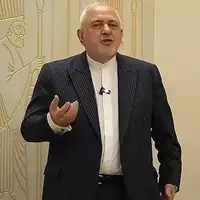
And if the past week's frenzy in the Persian-speaking world is to be believed, somewhere in that lineup will stand Bijan Mortazavi, the Iranian violin virtuoso, with his famous white violin.
The story first surfaced through Persian-language music outlets, which reported that FIFA had selected Mortazavi for a live performance during the final's interval.
Skepticism followed almost immediately. FIFA's official announcements listed the marquee names but made no mention of the 68-year-old Iranian, and veteran music journalists would only call it the closest rumor to reality.
Then Mortazavi himself all but ended the debate. He posted a photograph alongside Chris Martin and Gustavo Dudamel, describing an "excellent and fruitful" first rehearsal with the New York Philharmonic, an image Coldplay fan accounts quickly carried around the world.
FIFA has yet to publish his name. But artists do not rehearse with the show's musical director and its conductor by accident, and reports say he will perform one of his instrumental works, with a solo passage on the white violin that has been his visual signature for three decades.
The news set Persian social media alight. Posts declaring "It's confirmed" drew hundreds of thousands of views within hours, and the pride quickly turned pointed.
Users contrasted an artist whose albums are still denied release permits inside Iran standing on the world's biggest stage, while the officials who ban his music watch from a country at war and in crisis. Others noted the bitter symmetry: Iran's team went home; Iran's music reached the final.
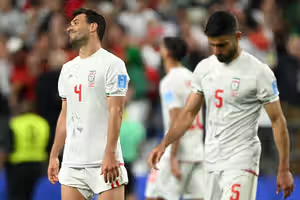
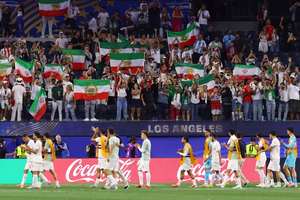
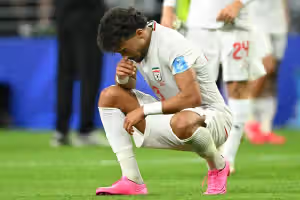
That symmetry stings because the national team's bond with its own public has frayed. After the side's elimination – three draws in three games – many Iranians described the failure less as a sporting loss than as a verdict on players seen as siding with the government during the nationwide protests, with defender Ramin Rezaeian's name recurring most often.
Unlike past tournaments, the matches drew few public gatherings inside Iran, and some openly welcomed the exit. When Shoja Khalilzadeh's late goal against Egypt was ruled offside by five centimeters, users linked it mockingly to his past pledge to dedicate goals to the Supreme Leader.
For millions of Iranians, representation has quietly migrated from the federation's badge to individuals in the diaspora, and Mortazavi embodies that shift.
Born in Sari in 1957, he began violin at three, trained in Tehran under masters including Parviz Yahaghi, and – in a fitting twist – played as a youth goalkeeper, part of Iran's junior national football setup, before music won out.
He left Iran after high school, studied in England, moved to the United States in 1979 and settled in California, where his blend of Persian melody and Western pop made him the best-known Iranian violinist in the world. In 1994 he became the first Iranian artist to headline Los Angeles' Greek Theatre.
He may not be the only Iranian at MetLife on Sunday. Alireza Faghani – born in Kashmar and the first man to referee at four men's World Cups – is widely reported as FIFA's leading candidate to take charge of the final itself.
Faghani left Iran for Australia in 2019, a move linked to his support for the protest movement, and now officiates under the Australian flag. State media in Tehran has attacked him – even censoring footage of him receiving his 2025 Club World Cup final medal – while many Iranians claim him proudly as their own.
No World Cup has ever had a halftime show. Shakira's "Waka Waka" in 2010, Ricky Martin's "La Copa de la Vida" in 1998 and Jung Kook's Qatar 2022 performance all belonged to the ceremonies, never to the final's interval.
Which means that if Mortazavi walks out on Sunday, he will not just be the first Iranian on a World Cup final stage. He will be part of the first such stage ever built.
If FIFA's final appointments hold, Sunday could end with an Iranian raising a violin at halftime and another raising the whistle for kickoff – two men who left, on the one stage the country's team could not reach.
Millions inside Iran will likely watch them the way they watch most things now: on any screen but state television's.