• العربية
  • فارسی
Brand
  • Iran Insight
  • Politics
  • Economy
  • Analysis
  • Special Report
  • Opinion
  • Podcast
  • Iran Insight
  • Politics
  • Economy
  • Analysis
  • Special Report
  • Opinion
  • Podcast
  • Theme
  • Language
    • العربية
    • فارسی
  • Iran Insight
  • Politics
  • Economy
  • Analysis
  • Special Report
  • Opinion
  • Podcast
All rights reserved for Volant Media UK Limited
volant media logo
INSIGHT

As Tehran debates, Iran's south lives the war

Behrouz Turani
Behrouz Turani

Iran International

Jul 15, 2026, 17:30 GMT+1
A screen-grab from a video published by citizen journalist Vahid Online, purporting to show the aftermath of a US strike on Iran's southeastern port city of Chabahar, July 15, 2026

A week of heavy fighting has left parts of Iran’s southern coast looking unmistakably like a war zone. Yet in Tehran, many still struggle to believe the country is at war.

Watching explosions on television and social media from hundreds of kilometers away, many see the confrontation with the United States as another familiar cycle of pressure that may yet give way to negotiations.

Fatemeh Rajabi, the news anchor who first reported the U.S. strikes on ports and military sites in southern Iran on the YouTube program Hasht-e Shab, says many in the capital find it difficult to grasp that a war is unfolding along the northern shores of the Persian Gulf — the region they casually refer to as “down under.”

Reporter Ali Pakzad, who visited the area during the strikes, says missiles hit targets from Abadan near the Iraqi border to Chabahar and Saravan near Pakistan.

He described damaged fishing vessels, battered ports and communities whose livelihoods have been shattered by attacks documented in the program’s footage.

That contrast lies at the heart of an investigative report by journalist Mira Ghorbanifar in Toseh Irani, titled The South in the Fire of War and Ashes of Ceasefire.

Ghorbanifar writes that explosions now puncture the dawn along Iran’s southern coast. Smoke rises from damaged docks, charred dhows lie abandoned, and fish markets once full of noise now speak only of “a war for which no one has yet chosen a definite name.”

While officials speak of “understandings,” “ceasefires” and “crisis management,” she argues, people in Iran’s south are grappling with damaged infrastructure and disrupted shipping, trying to adapt to what increasingly resembles a war of attrition.

She also asks whether the so-called Islamabad Understanding still exists. Is the fighting along Iran’s southern coast part of the same hundred-day conflict, or the start of a new phase of controlled escalation? And can both sides return to negotiations before crossing a point of no return?

The concerns extend well beyond independent journalists.

Government-aligned newspapers have increasingly questioned whether Iran can sustain a prolonged confrontation while struggling to protect civilians and critical infrastructure.

Moderate daily Sharq describes the country’s predicament as “structural and accumulated,” arguing that damaged infrastructure, naval disruption and collapsing logistics have left even minor shocks capable of triggering major crises.

Centrist Etemad warns that public trust has eroded while the state remains unprepared for cascading emergencies.

Economic newspapers have echoed those warnings.

Jahan Sanat argues that Iran’s deterrence is steadily weakening under sustained pressure, while Donya-ye Eghtesad says military decisions are increasingly driven by political necessity rather than strategic advantage, leaving the country more vulnerable in a prolonged conflict.

Washington-based analysts Mohammad Ghaedi and Farzin Nadimi have voiced similar concerns in interviews with Persian-language media abroad.

Ghaedi argues that Iran’s governing system “has repeatedly refused to learn from past mistakes,” pointing to what he sees as a widening disconnect between insulated decision-makers and citizens bearing the costs of conflict.

Nadimi says Iran is confronting the United States at “a moment of maximum structural fragility,” with deterrence eroding and escalation driven more by political necessity than strategic advantage.

“Iran is not in a position to manage a prolonged conflict,” he warns, adding that every new attack “burns away another part of Iran’s deterrent capability.”

Even hardline media have shown hints of concern. Resalat recently urged Iran to “rebuild its defensive capacity” after recent military losses — a rare acknowledgement from a conservative newspaper that the country’s deterrence has been weakened.

For now, the divide remains striking. In Tehran, politicians and commentators continue to debate negotiations, ceasefires and diplomatic understandings.

Along the southern coast, many residents have already stopped asking what to call the conflict. They are simply living through it.

Most Viewed

Trump reinstates Iran naval blockade, notifies Congress of renewed fighting
1

Trump reinstates Iran naval blockade, notifies Congress of renewed fighting

2

Mossad recruited Ahmadinejad for Iran regime-change plot - report

3
ANALYSIS

Why so few Iranians have jobs despite low unemployment

4
INSIGHT

Iran risks its most valuable Arab partner over Hormuz

5

Iran parliament drops two hardline critics of US talks from security panel posts

Banner
Banner
Banner

Spotlight

  • As Tehran debates, Iran's south lives the war
    INSIGHT

    As Tehran debates, Iran's south lives the war

  • Two Iranians at the World Cup final – and neither represents the Islamic Republic

    Two Iranians at the World Cup final – and neither represents the Islamic Republic

  • One flight, two chokepoints: why Iran wants an air bridge to Yemen
    ANALYSIS

    One flight, two chokepoints: why Iran wants an air bridge to Yemen

  • Iran parliament drops two hardline critics of US talks from security panel posts

    Iran parliament drops two hardline critics of US talks from security panel posts

  • Iran risks its most valuable Arab partner over Hormuz
    INSIGHT

    Iran risks its most valuable Arab partner over Hormuz

  • Why so few Iranians have jobs despite low unemployment
    ANALYSIS

    Why so few Iranians have jobs despite low unemployment

•
•
•

More Stories

Two Iranians at the World Cup final – and neither represents the Islamic Republic

Jul 15, 2026, 13:27 GMT+1
•
Arash Sohrabi
100%
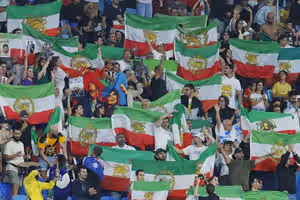
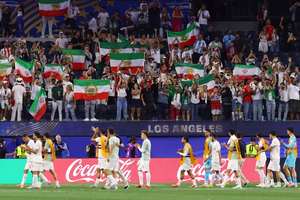
Iranian fans during the Team Melli match against New Zealand at Los Angeles Stadium, Inglewood, California, on June 15, 2026

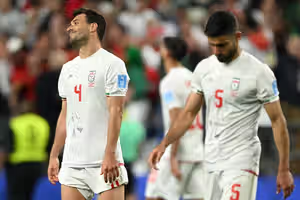
Iran's national team exited the World Cup in the group stage, yet two Iranians may still command Sunday's final: an exiled violinist on the halftime stage and the referee tipped for the whistle. Neither arrives representing the Islamic Republic.

When the whistle blows for halftime at MetLife Stadium on Sunday, July 19, football's first-ever World Cup halftime show will begin – an 11-minute spectacle curated by Coldplay's Chris Martin, headlined by Madonna, Shakira, Justin Bieber, BTS and Burna Boy, with conductor Gustavo Dudamel and the PS22 Chorus.

And if the past week's frenzy in the Persian-speaking world is to be believed, somewhere in that lineup will stand Bijan Mortazavi, the Iranian violin virtuoso, with his famous white violin.

The story first surfaced through Persian-language music outlets, which reported that FIFA had selected Mortazavi for a live performance during the final's interval.

Skepticism followed almost immediately. FIFA's official announcements listed the marquee names but made no mention of the 68-year-old Iranian, and veteran music journalists would only call it the closest rumor to reality.

Then Mortazavi himself all but ended the debate. He posted a photograph alongside Chris Martin and Gustavo Dudamel, describing an "excellent and fruitful" first rehearsal with the New York Philharmonic, an image Coldplay fan accounts quickly carried around the world.

FIFA has yet to publish his name. But artists do not rehearse with the show's musical director and its conductor by accident, and reports say he will perform one of his instrumental works, with a solo passage on the white violin that has been his visual signature for three decades.

The news set Persian social media alight. Posts declaring "It's confirmed" drew hundreds of thousands of views within hours, and the pride quickly turned pointed.

Users contrasted an artist whose albums are still denied release permits inside Iran standing on the world's biggest stage, while the officials who ban his music watch from a country at war and in crisis. Others noted the bitter symmetry: Iran's team went home; Iran's music reached the final.

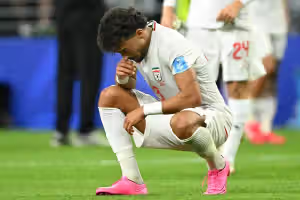
That symmetry stings because the national team's bond with its own public has frayed. After the side's elimination – three draws in three games – many Iranians described the failure less as a sporting loss than as a verdict on players seen as siding with the government during the nationwide protests, with defender Ramin Rezaeian's name recurring most often.

  • Iran’s lion-and-sun flag at center of FIFA row before 2026 World Cup

    Iran’s lion-and-sun flag at center of FIFA row before 2026 World Cup

  • Iran bows out of World Cup amid flags, Pride and protest

    Iran bows out of World Cup amid flags, Pride and protest

Unlike past tournaments, the matches drew few public gatherings inside Iran, and some openly welcomed the exit. When Shoja Khalilzadeh's late goal against Egypt was ruled offside by five centimeters, users linked it mockingly to his past pledge to dedicate goals to the Supreme Leader.

For millions of Iranians, representation has quietly migrated from the federation's badge to individuals in the diaspora, and Mortazavi embodies that shift.

Born in Sari in 1957, he began violin at three, trained in Tehran under masters including Parviz Yahaghi, and – in a fitting twist – played as a youth goalkeeper, part of Iran's junior national football setup, before music won out.

He left Iran after high school, studied in England, moved to the United States in 1979 and settled in California, where his blend of Persian melody and Western pop made him the best-known Iranian violinist in the world. In 1994 he became the first Iranian artist to headline Los Angeles' Greek Theatre.

  • Can Iranians cheer Team Melli without cheering the state?

    Can Iranians cheer Team Melli without cheering the state?

  • Citizens tell Iran football team it lost the public long ago

    Citizens tell Iran football team it lost the public long ago

He may not be the only Iranian at MetLife on Sunday. Alireza Faghani – born in Kashmar and the first man to referee at four men's World Cups – is widely reported as FIFA's leading candidate to take charge of the final itself.

Faghani left Iran for Australia in 2019, a move linked to his support for the protest movement, and now officiates under the Australian flag. State media in Tehran has attacked him – even censoring footage of him receiving his 2025 Club World Cup final medal – while many Iranians claim him proudly as their own.

No World Cup has ever had a halftime show. Shakira's "Waka Waka" in 2010, Ricky Martin's "La Copa de la Vida" in 1998 and Jung Kook's Qatar 2022 performance all belonged to the ceremonies, never to the final's interval. 

Which means that if Mortazavi walks out on Sunday, he will not just be the first Iranian on a World Cup final stage. He will be part of the first such stage ever built.

  • Thumbs up: Iranian football referee's pose alongside Trump stokes ire

    Thumbs up: Iranian football referee's pose alongside Trump stokes ire

If FIFA's final appointments hold, Sunday could end with an Iranian raising a violin at halftime and another raising the whistle for kickoff – two men who left, on the one stage the country's team could not reach.

Millions inside Iran will likely watch them the way they watch most things now: on any screen but state television's.

How Tehran made the most of Trump's Hormuz proposal

Jul 15, 2026, 04:10 GMT+1
•
Maryam Sinaiee
100%
U.S. President Donald Trump reacts as he speaks to the media on the day of a NATO leaders' summit in Ankara, Turkey, July 8, 2026.

Donald Trump's short-lived proposal to charge cargo transiting the Strait of Hormuz has handed Tehran an unexpected argument: that Washington itself briefly accepted the principle that securing the strategic waterway could justify collecting fees.

Trump abandoned the proposal within hours after discussions with regional leaders. But before doing so, Iranian officials and commentators seized on it as implicit validation of a position Tehran has long advanced.

The debate began after Trump announced on Truth Social that the United States would collect a 20% charge on all cargo passing through the Strait of Hormuz to cover the costs of securing one of the world's most volatile maritime corridors.

Iranian Foreign Minister Abbas Araghchi responded in English, arguing that the country responsible for ensuring safe passage through the strait is entitled to compensation.

"Whoever provides secure and safe passage of commercial vessels through the Strait of Hormuz should be compensated for this service," he wrote. "Twenty percent is, of course, too much. We will be fair."

Tehran claims vindication

Hardline commentator Ehsan Hosseini argued that Trump's proposal undermined critics inside Iran who had insisted charging ships would violate international law.

"Trump says he will charge a 20% fee for ships passing through the Strait of Hormuz — roughly $15 per barrel of oil. Yet there are people in Iran's Foreign Ministry who insist that charging transit fees violates international law," he wrote.

Mostafa Faghihi, editor of the centrist Entekhab website, reached a similar conclusion, arguing that Trump had effectively legitimized Iran's longstanding position by presenting the charge as a security fee. He predicted many countries would nevertheless resist such a policy, potentially undermining Washington's own strategic interests.

Reformist journalist Ahmad Zeidabadi offered a different interpretation.

"I doubt Trump seriously intends to implement it," he wrote on Telegram. "More likely, he wants to encourage other countries to join the United States in confronting Iran in the Persian Gulf."

Zeidabadi also suggested Trump may have been attempting to undermine Iran's own proposal by making governments more wary of transit charges generally and linking any US withdrawal of the idea to a similar concession by Tehran.

Iran's Khatam al-Anbiya Central Headquarters, meanwhile, avoided commenting directly on the proposed fee but rejected the broader premise that Washington could organize maritime traffic through Hormuz.

It warned that any attempt by US forces to direct shipping outside routes designated by Tehran and without coordination with Iran's armed forces would face "strong resistance."

Iranian media presented the statement as a forceful response to Trump's announcement.

International pushback

The United Kingdom, Australia and Brazil rejected the proposal, arguing that international shipping through the Strait of Hormuz should remain free from transit charges.

The International Maritime Organization (IMO) also dismissed the proposal, saying it had no legal basis under international law.

"We have always been consistent on our stance on fees—IMO stands firmly against charging fees for passage through straits used for international navigation," an IMO spokesperson said.

Online reactions reflected the same divide.

Some critics of the Iranian government argued that Trump's proposal differed fundamentally from Tehran's because Washington described it as payment for escort and security services rather than a transit toll.

One user wrote: "This isn't a toll. It's an escort fee for ships because of the insecurity we created ourselves. We've handed Trump exactly the justification he needed by repeatedly using the Strait of Hormuz as a negotiating tool."

Trump's proposal survived for only a few hours. But its political afterlife may prove longer.

By arguing that the power securing Hormuz was entitled to compensation, Trump handed Tehran a rhetorical opening to defend its own claims—even though neither country has convinced the world that one of its most important waterways can be treated as a source of unilateral revenue.

One flight, two chokepoints: why Iran wants an air bridge to Yemen

Jul 15, 2026, 02:58 GMT+1
•
Negar Mojtahedi
100%
An Iranian Mahan Air flight lands in Sanaa airport in this screen-grab from a video by Houthi television Al-Masirah, July 13, 2026

An Iranian plane landing in Houthi-controlled Yemen looked like an oddly minor victory for Tehran. But it may have been the opening move in an effort to rebuild the allied force capable of threatening a second global maritime chokepoint alongside the Strait of Hormuz.

As the US-Iran memorandum of understanding unravels and the confrontation shifts toward the Strait of Hormuz, renewed fighting in Yemen is raising a broader question: is Tehran preparing another source of maritime pressure at Bab al-Mandab?

Hezbollah and Hamas have been severely weakened by Israeli military operations. The Houthis, by contrast, remain armed, entrenched and positioned astride one of the world's busiest shipping lanes.

Even a credible threat to Bab al-Mandab could unsettle shipping, energy markets and global supply chains. For Iran, that threat alone may be valuable.

The fight over one airplane

The latest escalation followed Yemen's decision to block an Iranian aircraft carrying a Houthi delegation returning from the funeral of Supreme Leader Ali Khamenei in Tehran. Yemen's internationally recognized government accused Iran of attempting to enter its airspace without authorization.

The dispute quickly escalated. An attack damaged Sanaa International Airport's runway. The Houthis blamed Riyadh before targeting Saudi Arabia's Abha International Airport with missiles and drones.

Senior Houthi official Mohammed al-Bukhaiti later warned of what he described as a "siege" of the Kingdom and openly identified Bab al-Mandab as a strategic pressure point.

"The key thing here was the precedent," Chatham House fellow Thomas Juneau told Iran International. "Iran and the Houthis are trying to force open the air bridge between Tehran and Sanaa."

Iran has long supplied the Houthis through maritime smuggling routes stretching around Oman and the Horn of Africa. Those routes are slow, costly and vulnerable to interdiction.

A direct air bridge would dramatically improve Tehran's ability to move sensitive military components into Houthi-controlled territory. That is why one apparently ordinary passenger flight mattered.

Rebuilding the Houthis

Farzin Nadimi, a defense and security analyst at the Washington Institute, believes Iran's urgency reflects another problem: after years of Red Sea operations and repeated US and Israeli strikes, the Houthis are running low on some of their more advanced military capabilities.

"They are very much eager to help the Houthis rebuild their strategic inventory in order to be a viable player again," he said.

Nadimi suspects the aircraft may have been carrying critical weapons components, although there is no independent confirmation of its cargo.

Modern missile and drone forces depend less on complete weapons than on a steady flow of electronics, guidance systems, engines and other specialized components.

If the Houthis are running low, a direct air link would offer Tehran a faster and more reliable route to replenish those capabilities.

A second chokepoint

The strategic importance extends well beyond Yemen.

The dispute between Tehran and Washington is already centered on the Strait of Hormuz, where Iran has demonstrated the leverage that can be created by threatening one of the world's most important energy corridors.

A revitalized Houthi force capable of disrupting Bab al-Mandab would force Washington, Saudi Arabia and their regional partners to consider the security of two strategic waterways simultaneously.

"Iran, having demonstrated the extraordinary value for itself of closing the Strait of Hormuz, absolutely understands that if it closes both Hormuz and Bab al-Mandab at the same time, the effect would be magnified," Juneau said.

"The effect on the global economy, the ability to pressure the US, to pressure Saudi Arabia and to pressure all of their allies."

Juneau cautioned that neither Tehran nor the Houthis appear poised to close Bab al-Mandab in the near term. But the ability to credibly threaten it would give Iran another source of strategic leverage.

Yemeni-American researcher and author Fatima Abo Alasrar believes the latest confrontation was deliberately engineered by Tehran.

"I think, honestly, Iran has engineered this escalation," she said.

In her view, widening the potential cost of confrontation creates another avenue through which Tehran can shape future negotiations with Washington.

Saudi Arabia's red line

The confrontation also threatens to upset the fragile balance that has prevailed in Yemen since the 2022 truce.

Saudi Arabia has spent years trying to extricate itself from a costly war that increasingly looked unwinnable.

"It's really Saudi Arabia that's been absorbing a lot of the pain here," Juneau said.

The Houthis understood Riyadh's reluctance to return to full-scale conflict and repeatedly tested how far they could push.

The attempt to establish a direct air bridge between Tehran and Sanaa appears to have crossed a different threshold.

Saudi Arabia may still prefer de-escalation. But allowing Iran an easier route to replenish Houthi military capabilities would strengthen an armed group positioned directly on its southern border and potentially restore its ability to threaten Saudi cities, airports and energy infrastructure.

Alasrar described Saudi Arabia and the Houthis as pieces on a much larger geopolitical chessboard.

"Houthis and Saudis are almost like pieces on a chessboard that are fighting with each other right now," she said. "But it's Iran and the US that get to impose everything."

Whether the Houthis intend to launch a renewed campaign around Bab al-Mandab remains uncertain. Juneau cautions they are not simply Iranian proxies waiting for orders, while Nadimi expects de-escalation unless the wider US-Iran confrontation expands significantly.

Hormuz has already demonstrated the leverage created by maritime chokepoints. Iran may not even need the Houthis to close Bab al-Mandab. If it succeeds in rebuilding their capabilities, simply making the threat credible could become a source of strategic pressure in its own right.

US-Iran conflict converges on Hormuz

Jul 15, 2026, 00:46 GMT+1
100%
A projectile is fired during what the US Central Command (CENTCOM) said were strikes on Iran, in this screen grab taken from a handout video released on July 12, 2026

The war between the United States and Iran is increasingly being fought over control of the Strait of Hormuz, with both sides using the strategic waterway as a source of military and political leverage.

CENTCOM said its forces began another round of strikes at 3 p.m. ET against Iranian military assets it said had been used to attack commercial shipping in the strait. It added that US forces were preparing to resume the blockade of Iranian ports and coastal areas at 4 p.m. ET.

The IRGC responded by explicitly threatening regional energy exports, saying that as long as US “evil actions” continued, “not a single drop of oil and gas” would leave the region. It added that further US attacks would delay any reopening of the Strait of Hormuz.

Washington says the strikes are intended to protect commercial shipping and restrict Iranian maritime activity, while Tehran portrays control of the strait as a sovereign right and links its reopening to broader political and military conditions.

The latest operation followed a five-hour wave of US strikes on military sites in Bushehr, Chabahar, Jask, Konarak, Abu Musa and Bandar Abbas, according to CENTCOM.

Iranian media later reported explosions across southern Iran, including Bandar Abbas, Sirik, Ahvaz and Qeshm, while authorities said part of a power plant on Kish Island had been damaged.

At least three people were killed in a US strike in Hormozgan province, according to local officials after an environmental protection post and a fodder warehouse were hit.

As US strikes expanded along Iran’s coastline, Iranian attacks spread across the Persian Gulf.

Kuwait said an Iranian strike hit one of its naval vessels, injuring four service members. Its armed forces also reported intercepting one ballistic missile, five cruise missiles and 33 drones, while falling debris damaged civilian and critical infrastructure.

Bahrain sounded warning sirens after its air defenses intercepted Iranian aerial attacks. The IRGC claimed it had struck US military infrastructure in Bahrain and Kuwait and said it had also targeted a US air base in Jordan with ballistic missiles.

The maritime front widened in parallel. Two crude tankers operated by ADNOC Logistics and Services were hit by projectiles while transiting the Strait of Hormuz.

One Indian crew member was killed and several others were injured, prompting India to summon Iran’s deputy ambassador and lodge a formal protest.

A separate tanker reported being hit by a missile off Oman, while Stolt Tankers said one of its vessels was struck by an unidentified external device, causing a fire in its engine room.

Iranian leaders reinforced the military message with competing claims over the strait. Vice President Mohammad Reza Aref said it was natural for Iran to administer Hormuz while other countries retained the right to use it.

An army spokesperson said the waterway would reopen only under arrangements acceptable to Iran’s armed forces.

Washington, meanwhile, framed the blockade and strikes as measures to keep Hormuz open to non-Iranian shipping.

President Donald Trump said no country or entity should charge vessels for passage and declared the strait open to all traffic except ships traveling to or from Iranian ports or carrying Iranian cargo.

The growing confrontation triggered diplomatic and economic alarm.

Oman called for respect for international law and freedom of navigation, while India and New Zealand summoned senior Iranian diplomats. The Gulf Cooperation Council and several Arab states condemned attacks on commercial vessels and regional countries.

Oil prices climbed as markets assessed the risk of prolonged disruption through the waterway, which carries a significant share of global energy exports. Major shipping companies also rejected proposals for transit fees or restrictions in international waters.

The war that began over Iran’s nuclear program is increasingly being fought over control of the world’s most important shipping lane.

Persian Gulf startup hubs hold firm despite Iran war - Bloomberg

Jul 14, 2026, 11:45 GMT+1
100%

The Iran war has yet to trigger an exodus of entrepreneurs from the Persian Gulf, but falling investment, rising costs and slower funding are beginning to test the region’s heavily financed startup strategy, Bloomberg reported on Tuesday.

Abu Dhabi, Dubai, Riyadh and Doha have spent years trying to build globally competitive technology sectors through sovereign wealth, tax incentives, accelerator programs and direct investment.

Despite attacks in the region and renewed fighting between the United States and Iran, founders have largely remained in the region and government-backed programs continue to attract applicants.

None of the 27 companies selected for the February intake of Hub71, Abu Dhabi’s startup program, withdrew after the conflict began, according to Bloomberg. The program’s latest cohort also received a similar number of applications and was the first made up entirely of companies from outside the United Arab Emirates.

The financial effects, however, may not yet be fully visible. Middle East and North African startups raised $1.35 billion in the first half of 2026, down more than 20% from a year earlier, according to data platform Magnitt. The number of deals fell even more sharply to 214, while second-quarter activity dropped to its lowest level in at least two years.

“I don’t believe that the impact of the war has come into the numbers yet, that will come in Q3 and Q4,” Magnitt chief executive Philip Bahoshy told Bloomberg TV, adding that investors were already shifting their attention from early-stage companies toward more established businesses.

Some startups are also facing higher fuel, shipping and insurance costs, worsening cash flow and longer delays in receiving payments. Bloomberg cited one investor as saying that a sovereign investor withdrew a $1 million commitment from a funding round when the war began.

Regional governments are continuing to spend heavily. Hub71 offers successful applicants $140,000 in investment and incentives, while Qatar expanded its Fund of Funds program from $1 billion to $3 billion before the conflict. Startup Qatar has awarded more than $51 million to 45 companies, including 11 since the fighting began.

The Persian Gulf’s startup markets remain smaller than established centers in the United States, Europe and Asia, with limited late-stage financing, technology listings and specialist talent. But founders and investors told Bloomberg that access to capital, lower costs and government support continued to outweigh the risks for many companies.