• العربية
  • فارسی
Brand
  • Iran Insight
  • Politics
  • Economy
  • Analysis
  • Special Report
  • Opinion
  • Podcast
  • Iran Insight
  • Politics
  • Economy
  • Analysis
  • Special Report
  • Opinion
  • Podcast
  • Theme
  • Language
    • العربية
    • فارسی
  • Iran Insight
  • Politics
  • Economy
  • Analysis
  • Special Report
  • Opinion
  • Podcast
All rights reserved for Volant Media UK Limited
volant media logo

CIA helped pinpoint Khamenei gathering before Israeli strike – NYT

Mar 1, 2026, 09:09 GMT+0
People walk near a mural featuring an image of Iran's Supreme Leader Ali Khamenei as people gather after Khamenei was killed in Israeli and US strikes on Saturday, in Tehran, Iran, March 1, 2026.

The CIA helped identify a Saturday morning gathering of Iran’s top leaders in Tehran, including Supreme Leader Ali Khamenei, before Israel carried out a strike that killed him and other senior officials, The New York Times reported.
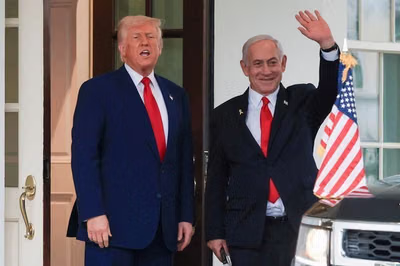
Citing people familiar with the operation and officials briefed on the intelligence, the newspaper said the agency had tracked Khamenei for months and passed “high fidelity” intelligence on his location to Israel ahead of the attack.

According to the report, US and Israeli officials adjusted the timing of their planned strike to take advantage of intelligence that senior political and military figures would gather Saturday morning at a leadership compound housing the offices of the supreme leader, the presidency and the Supreme National Security Council.

Israel had assessed that those present would include Mohammad Pakpour, commander in chief of the Islamic Revolutionary Guard Corps; Defense Minister Aziz Nasirzadeh; Admiral Ali Shamkhani, head of the Military Council; Majid Mousavi, commander of the IRGC Aerospace Force; and Deputy Intelligence Minister Mohammad Shirazi, among others.

The operation began around 8 a.m. Tehran time, when fighter jets took off armed with long-range precision munitions. About two hours later, in Tehran, missiles struck the compound.

Senior national security officials were in one building, while Khamenei was in another nearby structure, the report said.

An Israeli defense official said in a message reviewed by the newspaper that the strike was “carried out simultaneously at several locations in Tehran,” adding that Israel achieved “tactical surprise” despite Iranian preparations for war.

Iran’s state news agency IRNA confirmed on Sunday the deaths of some of the senior military figures Israel said it had killed, including Shamkhani, Pakpour, and Nasirzadeh.

Last June, as plans were underway to strike Iran’s nuclear facilities, President Trump said the United States knew where Khamenei was hiding and could have killed him.

Most Viewed

Iran negotiators ordered to return after internal rift over Islamabad talks
1
EXCLUSIVE

Iran negotiators ordered to return after internal rift over Islamabad talks

2
EXCLUSIVE

Iran’s central bank warns economy may take 12 years to rebuild after war

3
INSIGHT

Iran's digital economy battered by prolonged blackout

4
ANALYSIS

US blockade enters murky phase as tankers spoof signals and buyers hesitate

5
PODCAST

Iran-US ceasefire nudges sidelined Arab states toward Israel, expert says

Banner
Banner

Spotlight

  • Hardliners push Hormuz ‘red line’ as US blockade tests Iran’s leverage
    INSIGHT

    Hardliners push Hormuz ‘red line’ as US blockade tests Iran’s leverage

  • Ideology may be fading in Iran, but not in Kashmir's ‘Mini Iran'
    INSIGHT

    Ideology may be fading in Iran, but not in Kashmir's ‘Mini Iran'

  • War damage amounts to $3,000 per Iranian, with blockade set to add to losses
    INSIGHT

    War damage amounts to $3,000 per Iranian, with blockade set to add to losses

  • Why the $100 billion Hormuz toll revenue is a myth
    ANALYSIS

    Why the $100 billion Hormuz toll revenue is a myth

  • US blockade targets Iran oil boom amid regional disruption
    ANALYSIS

    US blockade targets Iran oil boom amid regional disruption

  • Iran's digital economy battered by prolonged blackout
    INSIGHT

    Iran's digital economy battered by prolonged blackout

•
•
•

More Stories

Explosions reported across Persian Gulf as Iran retaliates US, Israeli attacks

Feb 28, 2026, 10:05 GMT+0

Explosions were reported across parts of the Persian Gulf on Saturday after Iran’s Revolutionary Guards launched multiple waves of regional attacks, prompting several countries to activate air defense systems.

Air raid sirens sounded in Kuwait, the United Arab Emirates, Qatar and Bahrain in the early hours, news agencies reported.

Iran’s Guards said they had begun an operation dubbed “True Promise 4.”

In Qatar, a government official told Agence France-Presse that air defenses intercepted an Iranian missile, adding that US-made Patriot systems destroyed the projectile.

Qatar hosts the Al Udeid Air Base, the largest US military installation in the region. Qatar’s Interior Ministry later said the attack caused no damage.

Bahrain said a facility linked to the US Navy’s Fifth Fleet had been targeted in a missile attack, according to a statement carried by the country’s national communications center, without giving further details.

Kuwait’s military said it had dealt with missiles in its airspace, state news agency KUNA reported.

Jordan’s military said it had shot down two ballistic missiles targeting the country.

Residents in Abu Dhabi told AFP they heard loud explosions, and the UAE state news agency said one person was killed after Emirati forces intercepted Iranian missiles.

The UAE condemned the attack as a “flagrant violation” of its sovereignty and international law and said it reserved the right to respond.

Explosions were also reported in Riyadh, Saudi Arabia’s capital, according to AFP. Saudi authorities did not immediately comment.

Israel, United States strike Islamic Republic, targeting heart of regime

Feb 28, 2026, 08:33 GMT+0
•
Negar Mojtahedi

Israel, acting in coordination with the United States, launched strikes in Iran on Saturday, hitting multiple targets as explosions were reported in Tehran and other cities.

Among the most significant reported targets was the office complex of Supreme Leader Ali Khamenei in central Tehran. Reuters, citing Iranian officials, said Khamenei was not at the location at the time of the strike, though this could not be independently confirmed.

Videos circulating online appeared to show black plumes of smoke rising from an area associated with the Supreme Leader’s headquarters — long considered the symbolic and operational center of the regime’s authority.

Footage shared on social media also showed some Iranians reacting with disbelief and celebration, with witnesses heard laughing and referring to the site as the “leader’s house,” while others were seen thanking Israel as strikes unfolded.

Explosions were reported across Tehran and multiple Iranian cities early Saturday, including Tabriz, Qom, Karaj, Khorramabad, Kermanshah and Ilam, as Israeli officials confirmed a preemptive operation aimed at dismantling what they described as imminent threats posed by Iran’s missile and military infrastructure.

Iranian state media said the southern port city of Bushehr was also attacked, though it remains unclear whether nuclear-related facilities were damaged.

Israeli authorities said the operation, named “Lion’s Roar,” had been planned for months and carried out in coordination with Washington.

A US official confirmed American participation through air and sea strikes, with the US Air Force involved, though details regarding targets and damage assessments remain limited.

Iran’s Civil Aviation Organization closed the country’s airspace for six hours following the strikes.

Semi-official news agency ISNA reported that thousands of members of the Islamic Revolutionary Guard Corps were killed or wounded in attacks on military installations.

US President Donald Trump said Washington had begun what he described as “major combat operations,” framing the action as a defensive effort aimed at preventing Iran from advancing its nuclear and long-range missile programs.

“Our objective is to defend the American people by eliminating imminent threats from the Iranian regime,” Trump said in a video message, adding that the United States would ensure Iran does not obtain a nuclear weapon.

Shortly after the strikes, the Israeli military said missiles were launched from Iran toward Israeli territory, triggering air raid sirens across northern Israel as air defense systems attempted interceptions — an early indication of Tehran’s retaliation.

An Iranian official told Reuters the country’s response would be “crushing,” raising fears the confrontation could rapidly expand into a broader regional conflict.

Inside Iran, authorities began restricting communications as the attacks unfolded.

Internet monitoring group NetBlocks reported national connectivity dropping to roughly 54 percent of normal levels, while Iranian media said mobile networks and messaging services were being disrupted. Several Iranian news websites were also reportedly hacked amid wider cyber activity.

The escalation comes only weeks after security forces carried out a nationwide crackdown in which tens of thousands of Iranians were killed — widely described as one of the worst massacres in the modern history of the world.

The strikes now unfold against a backdrop of deep internal anger and unprecedented pressure on the ruling establishment.

Exiled crown prince Reza Pahlavi called on Iranians to prepare to return to the streets, describing the Islamic Republic as nearing collapse while urging citizens to remain calm and await further instructions.

Trump announces major US combat operation in Iran

Feb 28, 2026, 08:33 GMT+0

US President Donald Trump said on Saturday that American forces had begun “major combat operations” in Iran, launching what he described as a massive and ongoing campaign to eliminate nuclear and missile threats from the Iranian regime.

“Our objective is to defend the American people by eliminating imminent threats from the Iranian regime,” Trump said in a video address, accusing Tehran of decades of attacks against US forces and allies and of continuing efforts to rebuild its nuclear program.

Trump said the operation would target Iran’s missile capabilities, naval forces and what he called its “terrorist proxies,” vowing to “destroy their missiles and raze their missile industry to the ground” and to “annihilate their navy.”

He said the United States would ensure that Iran never obtains a nuclear weapon.

The president cited past attacks blamed on Iran or its proxies, including the 1983 Marine barracks bombing in Beirut and assaults on US forces in Iraq, and accused Tehran of backing militant groups across the region.

Trump acknowledged that US casualties were possible, saying American service members could be at risk as the operation unfolds. He said his administration had taken steps to minimize threats to US personnel in the region.

In a direct appeal to Iranian security forces, Trump urged them to lay down their weapons, warning they would face “certain death” otherwise.

He also addressed the Iranian public, telling them to remain sheltered during the strikes and saying “the hour of your freedom is at hand.”

'Your time is up': EU lawmaker says negotiations with Tehran must end

Feb 28, 2026, 04:39 GMT+0
•
Negar Mojtahedi

A senior member of the European Parliament is calling for a fundamental shift in Europe’s approach toward Iran, arguing that continued negotiations with the Islamic Republic are no longer defensible after Tehran’s deadly crackdown on protesters.

Daniel Attard, a Maltese Member of the European Parliament who serves as Vice-Chair of the European Parliament’s Delegation for Relations with Iran, urged European governments to move beyond statements of concern and adopt concrete political and economic measures against Tehran, he said in an interview on Eye for Iran podcast.

“Responsibility to protect is not just a slogan, it is a commitment,” Attard said. “When a regime turns on its own people, when the regime kills its own people to stay in power, sovereignty cannot be used as a shield.”

Rising tensions amid military buildup

Attard’s remarks come as tensions surrounding Iran continue to escalate, with Washington increasing its military posture in the region.

In recent weeks, US naval assets, including aircraft carrier strike groups and advanced fighter aircraft have been repositioned closer to the Middle East, a move analysts say is intended to deter further escalation while signaling readiness should diplomacy fail.

The heightened military presence coincides with ongoing diplomatic talks in Geneva and growing concern in Europe over Iran’s ballistic missile program, which US officials warn could eventually threaten both European territory and American forces abroad.

Against that backdrop, Attard argued Europe cannot remain a passive observer.

“The time for negotiation is over,” he said. “We should be decisive, we should show leadership, we should match the courage of the people of Iran — the students, the women, the youth, the elderly — who have showed great courage.”

A full-spectrum pressure strategy

Attard outlined what he described as a comprehensive pressure strategy targeting the regime politically, economically and diplomatically.

“We need to halt all trade incoming from Iran either directly or indirectly,” he said. “Iranian embassies are still operating like it was business as usual in Europe. So we need to be more decisive. No more business as usual — be it politically, be it economically, and be it diplomatically.”

The European Parliament has already pushed for the designation of Iran’s Islamic Revolutionary Guard Corps (IRGC) as a terrorist organization, a step Attard described as “very long overdue.” But he stressed that enforcement now matters as much as designation.

“We should enforce those sanctions without any possibility of any loopholes,” he said.

He added that EU member states have the authority to take further steps immediately.

“Governments can decide to close or to restrict severely the operation of Iranian diplomatic embassies within the Union. This is something which member states can actually do, and they can do it right now.”

Europe’s credibility at stake

Attard acknowledged that divisions among EU member states and competing geopolitical interests have slowed action in the past but warned that Europe’s credibility now depends on consistency.

“We cannot claim to defend human rights if we look away to what’s happening on the streets of Iran,” he said. “Our credibility demands consistency.”

He expressed confidence that pressure from lawmakers would continue to grow.

“As long as the Iranian regime thinks it can silence its people, we will echo and amplify their voices,” Attard said.

Message to Iranians and to Tehran

Addressing Iranians directly, Attard praised protesters’ resilience and framed their struggle as one rooted in universal values.

“Your courage is seen and we shall not look away,” he said. “This is a fight about universal values — human rights, dignity and equality.”

His message to Iran’s leadership was considerably shorter.

“My message is clear,” Attard said. “Your time is up.”

Family receives body of protester missing 50 days with signs of violence

Feb 27, 2026, 21:47 GMT+0

The body of a protester who disappeared during the demonstrations in Tehran last month has been returned to his family nearly fifty days later, according to information collected by Iran International from relatives and witnesses.

The victim, Vahid Lazer Monouchehri, had gone missing since widespread protests on January 8,9.

His body was handed over to relatives on Thursday with marks of gunfire and blows from a butcher’s cleaver, the family said.

Manouchehri was buried the following day under tight security in the village of Lazerban near Tonekabon, in Iran’s northern Mazandaran province.

Born on April 14, 1985, Monouchehri was a father of one and originally from Lazerban but had been living alone in Tehran. His family says they were unaware that he had taken part in the protests.

“There was no idea exactly when, where, or under what circumstances Vahid was killed,” the family said.

On Thursday, the Kahrizak forensic medical center contacted the family and asked them to travel to Tehran to collect their son’s body.

When they asked about the cause of death and why they were being contacted only after such a long delay, they say they were told: “There are many bodies here and we don’t know; just come and take the corpse.”

After arriving at Kahrizak, the family received the body along with a death certificate stating that the cause of death was “respiratory failure.”

Before handing it over, however, security officials required them to sign a written pledge not to present any account of his death other than the explanation given in the certificate.

The family then transported the body to his hometown. As it was being washed and prepared for burial, they say they discovered clear signs of severe violence: bullet wounds on his back, deep cuts to his side and a head riddled with shotgun pellets.

“It seems he was shot in the back, fell to the ground, and then officers shot him in the head at close range and hacked his body with a butcher’s cleaver,” a source close to the family said.

“The injuries make clear that the cause of death was not respiratory failure, but a state-ordered killing.”

The family also reported that the heart and kidney areas had been surgically opened and crudely stitched with large sutures. It remains unclear by whom or under what circumstances the procedure was carried out.