• العربية
  • فارسی
Brand
  • Iran Insight
  • Politics
  • Economy
  • Analysis
  • Special Report
  • Opinion
  • Podcast
  • Iran Insight
  • Politics
  • Economy
  • Analysis
  • Special Report
  • Opinion
  • Podcast
  • Theme
  • Language
    • العربية
    • فارسی
  • Iran Insight
  • Politics
  • Economy
  • Analysis
  • Special Report
  • Opinion
  • Podcast
All rights reserved for Volant Media UK Limited
volant media logo

Petition tells Iran hardliners: Fight the US war yourselves

Niloufar Goudarzi
Niloufar Goudarzi

Iran International

Jul 16, 2026, 14:25 GMT+1Updated: 15:28 GMT+1
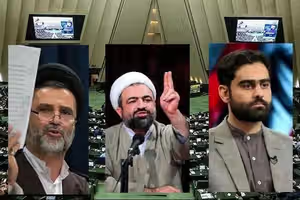
Iranian lawmakers Hamid Rasaei and Amirhossein Sabeti.

Nearly 100,000 people signed a petition within a day urging members of Iran’s ultraconservative Paydari Front to visit the southern war zone, reflecting anger at hardliners who oppose talks with Washington while remaining far from the fighting.

The petition, hosted on the Iranian platform Karzar, calls on prominent Paydari figures, including lawmakers Hamid Rasaei and Amirhossein Sabeti, to travel to the southern cities of Sirik and Bandar Abbas, where residents have faced repeated attacks during the conflict.

Its authors said such a visit would help the politicians "better understand the realities on the ground" and avoid decisions that could endanger civilians.

Challenge to hardline rhetoric

The petition says residents of southern Iran have lived under "direct and around-the-clock threats" while military personnel and civilians alike face fears of further attacks and damage to critical infrastructure.

It argues that politicians who have called for a wartime posture should experience those conditions themselves, saying a field visit could lead to "more realistic decision-making" and greater solidarity with local communities.

The Paydari Front is one of Iran's most hardline political factions and has been among the strongest opponents of negotiations with the United States. Its lawmakers have repeatedly criticized President Masoud Pezeshkian, Parliament Speaker Mohammad Bagher Ghalibaf and Foreign Minister Abbas Araghchi over diplomacy with Washington.

Earlier this week, parliament removed two of the bloc's most outspoken critics of negotiations from senior positions on the National Security and Foreign Policy Committee, reflecting growing tensions within Iran's conservative establishment over the handling of the conflict.

Southern anger

The petition has coincided with growing criticism on Persian-language social media over the burden borne by southern Iran, where much of the fighting has been concentrated.

In a video posted on Instagram, a comedian and influencer from southern Iran accused officials of downplaying attacks on the region. He said that when Tehran and other parts of the country came under attack, authorities described them as missile and drone strikes, but now that the south was bearing the brunt of the fighting, incoming rockets were being referred to simply as "projectiles."

"They've sanitized the language," he said. "It's as if a four- or five-year-old neighbor's child has thrown a stone at someone." He added: "You may not have the courage to call it what it is, but at least have some humanity. Don't treat southerners differently from everyone else."

Journalist Azadeh Mokhtari wrote on X that southern Iran was "the beating heart of Iran's economy," saying its ports were vital to imports, cargo handling and supplying much of the country.

Another X user argued that the Islamic Republic had turned large parts of the southern coastline into military zones and missile sites while residents continued to struggle with poverty despite the region's strategic importance and natural wealth.

A third wrote that Iranians should not pretend there was no war simply because the attacks were concentrated in the south. "Southern Iran is an inseparable part of this country," the post said. "Its pain is the pain of all Iran."

Unity message meets political divisions

The petition emerged as Iran's Press Supervisory Board instructed media outlets not to highlight political or factional disputes, urging them instead to avoid content it said could harm national cohesion or amplify social divisions.

The guidance told outlets to avoid "highlighting political and factional differences," "reproducing internal disputes" and publishing material that could undermine public unity.

Iran ranks among the world's lowest countries for press freedom, according to Reporters Without Borders, which says state repression continues to weigh heavily on independent journalism.

Most Viewed

Trump says Iran power plants, bridges could be hit next week
1

Trump says Iran power plants, bridges could be hit next week

2
ANALYSIS

One flight, two chokepoints: why Iran wants an air bridge to Yemen

3

Two Iranians at the World Cup final – and neither represents the Islamic Republic

4

US-Iran conflict converges on Hormuz

5
INSIGHT

Iran hardliners cry foul as Ghalibaf camp gains ground

Banner
Banner
Banner

Spotlight

  • Leaked presidency report shows how Iran plans to manage record public anger
    INSIGHT

    Leaked presidency report shows how Iran plans to manage record public anger

  • Wave of Iran plots drove UK action against IRGC, terror law tsar says
    EXCLUSIVE

    Wave of Iran plots drove UK action against IRGC, terror law tsar says

  • As Tehran debates, Iran's south lives the war
    INSIGHT

    As Tehran debates, Iran's south lives the war

  • Two Iranians at the World Cup final – and neither represents the Islamic Republic

    Two Iranians at the World Cup final – and neither represents the Islamic Republic

  • One flight, two chokepoints: why Iran wants an air bridge to Yemen
    ANALYSIS

    One flight, two chokepoints: why Iran wants an air bridge to Yemen

  • Iran parliament drops two hardline critics of US talks from security panel posts

    Iran parliament drops two hardline critics of US talks from security panel posts

  • Iran risks its most valuable Arab partner over Hormuz
    INSIGHT

    Iran risks its most valuable Arab partner over Hormuz

  • Who are the Islamic Republic’s ‘Super-Revolutionaries’ challenging Tehran

    Who are the Islamic Republic’s ‘Super-Revolutionaries’ challenging Tehran

  • The Paydari Party: Iran’s ultra-hardliner powerhouse explained

    The Paydari Party: Iran’s ultra-hardliner powerhouse explained

•
•
•

More Stories

Leaked presidency report shows how Iran plans to manage record public anger

Jul 16, 2026, 12:07 GMT+1
•
Arash Sohrabi
100%

A confidential report by Iran's presidency, leaked this week, records the highest public anger ever measured in any country and finds that nine in ten Iranians want change. Its advice to the leadership: manage the anger, not its causes.

The document, titled "What Iran Wants" and obtained by IranWire, was written by Ali Rabiei, a former intelligence ministry official and government spokesman who now advises President Masoud Pezeshkian on social affairs. It is built on a survey conducted in April and May by the ARA research center and was circulated among senior officials in June.

Its timing matters. The survey was taken in the aftermath of the January protests, in which security forces killed tens of thousands of demonstrators within days, and during a war with the United States that has already claimed the life of Supreme Leader Ali Khamenei. Through all of it, state television has filled its evenings with images of packed squares and chants of revenge.

The report is the government's private mirror, and it shows something else entirely. Given four options for the country's future, only nine percent of respondents chose keeping things as they are; the rest split between reform, deep reform, and changing the system outright.

The document discloses no methodology, and official polling in Iran is conducted among respondents who have every reason to fear giving an honest answer to a state questionnaire.

Sociologist Saeed Paivandi, who reviewed the full report for IranWire, called its findings broadly plausible despite those gaps. In practice, that means each figure below is best read as a floor, not a ceiling. Whatever the government's own instrument records, the reality is unlikely to be milder.

The angriest country ever measured

The report's starkest finding is a number without precedent. Gallup's global emotions index has never recorded a national anger rate above 47 percent, a figure that belonged to Chad. Rabiei's survey puts Iran at 63.6 percent, up twelve points since December, the month before the massacre.

The document itself acknowledges the record, placing Iran above every country Gallup has measured for both anger and grief.

Iran had appeared in those global rankings before, alongside war-scarred states like Iraq and Afghanistan. It has now left them behind.

No war, no surrender

On the confrontation with Washington, the surveyed public fits neither of the stories told about it: the nation baying for battle that state television broadcasts, or the one ready to capitulate that some in Washington count on.

Asked the best course in the current crisis, 44.3 percent chose preserving the ceasefire and continuing negotiations, roughly double the share that favored ending the talks and preparing for war.

  • As Tehran debates, Iran's south lives the war

    As Tehran debates, Iran's south lives the war

Barely one in ten would accept all American conditions, and about two-thirds oppose a complete shutdown of uranium enrichment.

Yet this is not trust in the men at the table. Fewer than a third of respondents expressed high confidence in Iran's new negotiating team, and nearly half the country reports serious fear of another round of war.

What emerges is a population that rejects both another war and a capitulation, and trusts neither the diplomats nor the generals conducting either.

A society in freefall, and the myth of the rallying nation

The emotional data reads like a casualty report. Half the country reports hopelessness, up eight points since December.

Nearly 48 percent report sadness and depression, 45 percent chronic fear and anxiety. Despair runs highest among the young and the educated, the very people a state would need to rebuild anything.

  • Hardline rallies turn Iran’s streets into pressure front against US talks

    Hardline rallies turn Iran’s streets into pressure front against US talks

The same pages quietly dismantle the leadership's central wartime claim: that the nation has closed ranks behind it.

By the government's own count, 47 percent of Iranians never attended a single one of the nightly wartime rallies that state television presents as proof of unity. In Tehran, 61 percent stayed away.

Rabiei concedes that a much-promoted volunteer registration drive for national defense underperformed, and attributes the reluctance to people's fear of being judged.

It is an official admission that even gestures of patriotism have become politically fraught. The report's own data explains why: Iranians overwhelmingly separate defending their country, which a majority say they would do if attacked again, from defending the Islamic Republic.

  • Iran faces region’s harshest mix of wartime contraction and inflation

    Iran faces region’s harshest mix of wartime contraction and inflation

Proud, secular, and packing

The most quietly radical section concerns who Iranians say they are. National pride is rising. More than 85 percent express pride in being Iranian, and the share who identify first as "Iranian" rather than "Iranian Muslim" has grown since the war, most sharply among the young.

Religious observance, the Islamic Republic's ideological foundation, is collapsing under the same roof.

In 1975, four years before the revolution, 79 percent of Iranians said they fasted through Ramadan. By 2023 it was 42 percent. This year it is roughly 30.

And the pride does not translate into staying. A third of Iranians say they would emigrate if they could, including nearly half of everyone under thirty and half of the university-educated. People are not leaving Iran, the report effectively concludes; they are leaving its future.

A manual for management

What makes the document remarkable is less its data than its purpose. Rabiei's recommendations to the leadership contain no political change at all.

Officials should do a better job convincing people that sanctions, not mismanagement, caused their misery; state television should show a more inclusive face; the ration cards should continue. This, even as the report's own respondents name official incompetence, ahead of sanctions, as the main cause of their problems.

One recommendation stands out: state bodies should avoid policies that put them in confrontation with society.

That instruction has a visible form on Iran's streets, where enforcement of the small rules of daily life has gone relatively quiet. Many Iranians read the leniency less as tolerance than as triage, a state conserving its strength for a collision it can see coming.

Independent surveys suggest the private picture is, if anything, generous. The Netherlands-based GAMAAN institute, polling Iranians beyond the reach of official questionnaires, has found large majorities opposed to the Islamic Republic's continuation altogether.

Rabiei reaches for an older vocabulary to describe what his numbers show: a society trapped in the present, unable to desire its past or picture its future. The term he borrows, "presentism," was coined by an Iranian scholar to describe the national mood in 1975.

Four years later, that society produced a revolution.

Inflation leaves Iranian pensioners unable to cover basic costs

Jul 16, 2026, 11:13 GMT+1
100%
An elderly couple walks through a public park in Iran.

Iranian pensioners say their monthly income no longer covers basic living expenses, with many forced to seek additional work as inflation continues to erode their purchasing power.

“The pension is only enough to cover the equivalent of 13 days of basic work,” one woman receiving her late husband's pension told Iran International, describing monthly payments as far below the cost of supporting her family.

Other retirees also told Iran International that decades of contributions to the social security system have left them with pensions insufficient to meet basic expenses.

Several said that after 35 years of paying into the system, they now receive around 220 million rials ($117) a month, an amount they say does not even cover rent in many parts of the country.

The average monthly income in Iran is approximately $150 to $200, depending on fluctuations in the open market currency rate. This level of income falls far short of the cost of living, which requires around $385 to $400 per month to afford basic necessities like food and housing.

  • Retirees stage nationwide protests over unpaid pensions, rising prices

    Retirees stage nationwide protests over unpaid pensions, rising prices

“Last year my husband's pension was 90 million rials ($48). This year it has increased by about 22% to 110 million rials ($58),” another woman supporting her two children told Iran International.

Many said they have turned to driving for ride-hailing services or other informal work after retirement to supplement their income.

Official data show year-on-year inflation for food and beverages has remained above 130% in recent months, placing further pressure on households already struggling with rising living costs.

Pension system under growing strain

The financial hardship described by pensioners reflects broader strains on Iran's retirement system, which has faced mounting funding shortages and growing concern over the sustainability of pension funds.

Mostafa Salari, head of the Social Security Organization, said on July 13 that the organization faces an 820 trillion rials ($436 million) funding gap to pay pension arrears for the first two months of the Iranian year and is also struggling to finance July payments.

100%
An elderly couple sits on a park bench in Iran.

The government has also moved to raise the retirement age as it seeks to ease pressure on the pension system, a step that has drawn criticism from labor advocates.

Economists have for years warned that demographic pressures, underfunding and broader economic problems have left Iran's pension funds increasingly vulnerable.

In 2022, Sajjad Padam, then director-general for social insurance at the Ministry of Labour and Social Welfare, warned that even selling three million barrels of oil a day without sanctions would not be enough to resolve Iran's pension crisis, underscoring the depth of the structural challenges facing the country's retirement system.

Iran hardliners cry foul as Ghalibaf camp gains ground

Jul 16, 2026, 03:58 GMT+1
•
Maryam Sinaiee
100%
An Iranian lawmaker waves a red flag of 'revenge' during a parliamentary session in Tehran, July 14, 2026

Iran's hardliners suffered a setback after losing key posts on parliament's National Security and Foreign Policy Committee, highlighting growing conservative divisions over talks with Washington and the leadership of Speaker and lead negotiator Mohammad-Bagher Ghalibaf.

Iran's parliament had not held regular public sessions since the outbreak of the recent war, with the suspension reportedly ordered by the Supreme National Security Council.

The legislature reconvened on Monday after briefly meeting in late May to elect its presiding board, when Ghalibaf secured a seventh consecutive term as speaker.

During the committee's internal leadership election on Monday, Mahmoud Nabavian lost his position as first deputy chairman, while Ebrahim Rezaei was removed as spokesperson.

Both are among parliament's most outspoken opponents of engagement with Washington and frequent critics of Ghalibaf.

The outcome shifted the committee's balance toward lawmakers seen as more supportive of diplomacy, triggering an angry reaction from the hardline camp.

The IRGC-affiliated Fars News Agency questioned the legitimacy of the vote on Tuesday, describing the election as "shrouded in ambiguity." It quoted an unnamed committee member as saying a fresh ballot would be held to determine whether Alaeddin Boroujerdi or Ebrahim Azizi would chair the committee.

The reform-leaning Rouydad24 news website described the result as "a sign of a shift in the balance of power in one of parliament's most important committees," saying it was likely to influence parliament's approach to foreign policy and national security in the coming months.

It added that parliament's reopening had restored an important platform for critics of President Masoud Pezeshkian's government and opponents of negotiations with Washington, allowing them once again to use speeches, questioning sessions, impeachment motions and legislative initiatives to challenge government policy.

‘A coup’

Hardline activists have portrayed the parliamentary suspension and committee reshuffle as part of Ghalibaf's effort to sideline the ultraconservative Paydari Front.

Despite its vocal presence, the Paydari Front remains a minority even within the conservative-dominated parliament. In May's election for parliament's presiding board, the faction's candidate received just 29 votes against Ghalibaf's 235.

International relations researcher Abolfazl Bazargan criticized the reshuffle, writing that the committee changes were "not a strategic disaster but a soft coup against the country's security."

The vote also prompted a wave of criticism on social media. One user on X wrote: "Parliament reopened twice—once for him to become speaker again, and once to remove his opponents. You're the dictator."

More say on Hormuz

The committee reshuffle came as lawmakers sought to assert parliament's role in negotiations with Washington and policy toward the Strait of Hormuz.

On Tuesday, parliament received a bill titled the Strategic Action for Ensuring Security and Sustainable Development of the Strait of Hormuz and the Persian Gulf. Backed by 180 of the 290 lawmakers, it would tighten parliamentary oversight of the government's diplomatic decisions.

Lawmakers also called for the immediate establishment of a special committee to review negotiations with the United States and oversee implementation of conditions set by Supreme Leader Mojtaba Khamenei.

Committee chairman Ebrahim Azizi, who retained his post and is regarded as close to Ghalibaf and the traditional conservative camp, defended the initiative on X.

"The Islamic Consultative Assembly stands firm on the country's red lines, especially the management of the Strait of Hormuz," he wrote. "This is only the first step. The next measures will keep our enemies awake at night."

Foreign policy analyst Fereydoun Majles told the Fararu news website that the proposal should be viewed primarily as a political signal.

"The parliamentary initiative should be analysed mainly as a political message," he said. "It seeks to demonstrate that Iran still possesses important geopolitical tools and that regional equations cannot be designed without taking Tehran's interests into account."

"Hard power and soft power complement one another; they are not substitutes," he concluded.

Wave of Iran plots drove UK action against IRGC, terror law tsar says

Jul 15, 2026, 21:04 GMT+1
•
Azadeh Akbari
100%
Members of Iran's Revolutionary Guards Corps (IRGC) march during an annual military parade.

Britain's decision to create a new legal framework targeting Iran's Revolutionary Guards was driven less by political pressure than by the scale of alleged Iranian activity on British soil, according to Jonathan Hall, the UK government's independent reviewer of terrorism laws.

"There’s been a lot of pressure for some time to do something about the activities of the Revolutionary Guard Corps," Jonathan Hall KC told Iran International.

But while political calls to act had grown louder, he said the more important factor was the number of alleged Iranian plots disrupted by Britain's intelligence services and the public concern they generated.

"If you listen to what the director general of MI5 has been saying, there's been an extraordinary number of plots in the last few years that the intelligence services have had to disrupt and deal with," Hall said.

The government says MI5 identified at least 20 potentially lethal Iran-backed plots against people in Britain over the course of a year. It says the IRGC has used proxies and criminal networks to target Iranian dissidents and members of the Jewish community overseas.

Terrorism law 'never suitable'

Hall said the government had wanted to take stronger action against the IRGC but could not simply proscribe it under the Terrorism Act 2000 because the legislation was never designed to apply to the military or intelligence institutions of another state.

"The Terrorism Act was never suitable," Hall said. "It was never designed to deal with state bodies."

The Terrorism Act allows the government to proscribe organizations, making membership and various forms of support criminal offences. Hall said Parliament had never intended those powers to be used against the official institutions of foreign states.

The home secretary commissioned Hall in December 2024 to examine whether Britain's counterterrorism powers could be adapted to address state threats. His review concluded that they could not and instead recommended creating a separate designation regime under national security legislation.

"So rather than proscribing the IRGC or any other state body under the Terrorism Act, there's now a new piece of legislation," he said.

The National Security (State Threats) Act 2026 received royal assent on July 8, amending the National Security Act 2023 to allow the home secretary to designate bodies involved in foreign power threat activity where necessary to protect the UK's safety or interests.

The government laid draft regulations before Parliament on July 13 to designate the IRGC, the Iran-linked Islamic Movement of Companions of the Right and Russia's GRU Volunteer Corps. The House of Commons approved the regulations on Wednesday, while the House of Lords is due to consider them on Thursday.

The designations cannot take effect without the Lords' approval.

Targeting paid proxies

Hall said the primary aim of the new framework is to deter people in Britain from accepting money to conduct surveillance, violence or other activities on behalf of the IRGC.

"We know that the way that the Iranian regime operates in the UK is usually through proxies," he said. "These are individuals obviously willing to take money to carry out certain conduct."

He said the legislation could apply to someone paid to conduct reconnaissance outside the home of a television journalist, follow and stab an Iranian dissident or set fire to a synagogue.

A person could face prosecution if they knew, or should reasonably have known, that their conduct was likely to assist the IRGC.

"It's about credibly saying to people who might take £500, £1,000 or whatever to do that sort of thing: you are at risk of committing a National Security Act offence," Hall said.

"The desire is that people should be deterred. And, of course, if they do carry out that sort of proxy activity, they will then go to prison for a long time and be convicted under an exceptionally serious piece of legislation."

The law creates offences relating to supporting or assisting a designated body, or receiving a material benefit from one, carrying maximum prison terms of 14 years.

People convicted of espionage, sabotage or foreign interference carried out for, on behalf of, or with the intention of benefiting a designated body could face life imprisonment. Prosecutors would also no longer have to establish a separate foreign-power connection in every case.

Conscripts not criminalized

Hall said the legislation deliberately avoids creating a criminal offence of membership in a designated state body, partly to avoid penalizing Iranian men who had to complete military service in IRGC units.

"This conscription point was quite influential on me when I did my analysis," he said.

Hall said membership of a proscribed terrorist organization could be criminalized because an individual generally chooses whether to join or remain in such a group. That approach would be inappropriate for someone compelled to serve in a state institution.

"That obviously wouldn't be right in the case of someone who's got no choice about whether they are a member of a state body," he said.

Asked whether the law could affect Iranian men required to complete military service in IRGC units, Hall replied: "The answer is this law doesn't apply in any way."

Protecting communities targeted by the IRGC

Hall said the new measures are intended to make it riskier for IRGC proxies to target journalists, Iranian dissidents and members of the Jewish community in Britain.

"It's not just about finances," he said. "What it does is it provides a little bit extra."

"From the perspective of journalists and dissidents and Jews in the UK, the point actually is to make it more risky for proxies to act and to make it tougher for them to operate."

Prime Minister Keir Starmer said the government would not allow foreign states to use Britain to spread fear, division and violence, while Home Secretary Shabana Mahmood said the new powers would make it easier to prosecute people carrying out hostile activities on behalf of Iran, Russia and other foreign actors.

The government has cited alleged IRGC-linked plots targeting two Iran International journalists in Britain as an example of the activity the new framework is intended to address.

It also says the Islamic Movement of Companions of the Right claimed responsibility for seven attacks against sites linked to Jewish and Israeli communities and Persian-language media between March and May, with members of the IRGC's Quds Force "almost certainly" directing the group's activities across Europe.

For Hall, however, the legislation's purpose is ultimately straightforward: to close a gap in British law by giving authorities a tool specifically designed to tackle hostile state organizations—something he says terrorism legislation was never intended to do.

As Tehran debates, Iran's south lives the war

Jul 15, 2026, 17:30 GMT+1
•
Behrouz Turani
100%
A screen-grab from a video published by citizen journalist Vahid Online, purporting to show the aftermath of a US strike on Iran's southeastern port city of Chabahar, July 15, 2026

A week of heavy fighting has left parts of Iran’s southern coast looking unmistakably like a war zone. Yet in Tehran, many still struggle to believe the country is at war.

Watching explosions on television and social media from hundreds of kilometers away, many see the confrontation with the United States as another familiar cycle of pressure that may yet give way to negotiations.

Fatemeh Rajabi, the news anchor who first reported the U.S. strikes on ports and military sites in southern Iran on the YouTube program Hasht-e Shab, says many in the capital find it difficult to grasp that a war is unfolding along the northern shores of the Persian Gulf — the region they casually refer to as “down under.”

Reporter Ali Pakzad, who visited the area during the strikes, says missiles hit targets from Abadan near the Iraqi border to Chabahar and Saravan near Pakistan.

He described damaged fishing vessels, battered ports and communities whose livelihoods have been shattered by attacks documented in the program’s footage.

That contrast lies at the heart of an investigative report by journalist Mira Ghorbanifar in Toseh Irani, titled The South in the Fire of War and Ashes of Ceasefire.

Ghorbanifar writes that explosions now puncture the dawn along Iran’s southern coast. Smoke rises from damaged docks, charred dhows lie abandoned, and fish markets once full of noise now speak only of “a war for which no one has yet chosen a definite name.”

While officials speak of “understandings,” “ceasefires” and “crisis management,” she argues, people in Iran’s south are grappling with damaged infrastructure and disrupted shipping, trying to adapt to what increasingly resembles a war of attrition.

She also asks whether the so-called Islamabad Understanding still exists. Is the fighting along Iran’s southern coast part of the same hundred-day conflict, or the start of a new phase of controlled escalation? And can both sides return to negotiations before crossing a point of no return?

The concerns extend well beyond independent journalists.

Government-aligned newspapers have increasingly questioned whether Iran can sustain a prolonged confrontation while struggling to protect civilians and critical infrastructure.

Moderate daily Sharq describes the country’s predicament as “structural and accumulated,” arguing that damaged infrastructure, naval disruption and collapsing logistics have left even minor shocks capable of triggering major crises.

Centrist Etemad warns that public trust has eroded while the state remains unprepared for cascading emergencies.

Economic newspapers have echoed those warnings.

Jahan Sanat argues that Iran’s deterrence is steadily weakening under sustained pressure, while Donya-ye Eghtesad says military decisions are increasingly driven by political necessity rather than strategic advantage, leaving the country more vulnerable in a prolonged conflict.

Washington-based analysts Mohammad Ghaedi and Farzin Nadimi have voiced similar concerns in interviews with Persian-language media abroad.

Ghaedi argues that Iran’s governing system “has repeatedly refused to learn from past mistakes,” pointing to what he sees as a widening disconnect between insulated decision-makers and citizens bearing the costs of conflict.

Nadimi says Iran is confronting the United States at “a moment of maximum structural fragility,” with deterrence eroding and escalation driven more by political necessity than strategic advantage.

“Iran is not in a position to manage a prolonged conflict,” he warns, adding that every new attack “burns away another part of Iran’s deterrent capability.”

Even hardline media have shown hints of concern. Resalat recently urged Iran to “rebuild its defensive capacity” after recent military losses — a rare acknowledgement from a conservative newspaper that the country’s deterrence has been weakened.

For now, the divide remains striking. In Tehran, politicians and commentators continue to debate negotiations, ceasefires and diplomatic understandings.

Along the southern coast, many residents have already stopped asking what to call the conflict. They are simply living through it.