New US sanctions target Iran's security chief, upping diplomatic ante
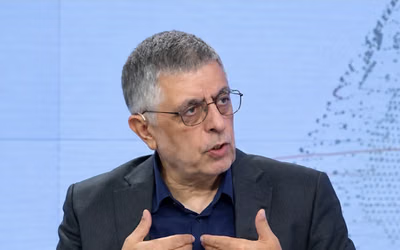
Ali Larijani, the head of Iran's Supreme National Security Council, pays condolences for a Revolutionary Guards commander assassinated by Israel in this file photo.
The United States sanctioned Iran's influential security chief on Thursday along with top military officers it accused of being behind a deadly crackdown on protests, ramping up Washington's standoff with Tehran as it weighs a potential attack.
The designation of Larijani cites his affiliation to the Iranian Supreme Leader Ali Khamenei. Elevated to leadership of Iran's Supreme National Security Council last year, he is a veteran security and political insider of the theocracy.
Larijani, the treasury said in a statement, was "one of the first Iranian leaders to call for violence in response to the legitimate demands of the Iranian people."
"LARIJANI, Ali (Arabic: علی لاریجانی) (a.k.a. LARIJANI, Ali Ardeshir), Tehran, Iran; DOB 03 Jun 1958; POB Najaf, Iraq; nationality Iran; Additional Sanctions Information - Subject to Secondary Sanctions; Gender Male; Passport D10010646 (Iran) expires 05 Sep 2027 (individual) [IRAN-EO13876] (Linked To: KHAMENEI, Ali Husseini)," the entry on the US Treasury Department's website read.
Other sanctions targeted top officers in Iran's Islamic Revolutionary Guard Corps including provincial commanders.
The Treasury also added 13 entities to its Specially Designated Nationals (SDN) list, including Fardis Prison and companies allegedly linked to US-sanctioned Iranian trade in the United Arab Emirates, Singapore and the United Kingdom.
“The United States stands firmly behind the Iranian people in their call for freedom and justice,” said Secretary of the Treasury Scott Bessent said in a statement.
“At the direction of President Trump, the Treasury Department is sanctioning key Iranian leaders involved in the brutal crackdown against the Iranian people. Treasury will use every tool to target those behind the regime’s tyrannical oppression of human rights.”
The United States is moving a carrier strike group toward the Persian Gulf as President Trump has mooted attacking the country for its killing of protestors.
"Elements of Iran’s Islamic Revolutionary Guard Corps (IRGC) have even attacked wounded protesters in one hospital in Ilam Province, firing tear gas and metal pellets into the hospital grounds and assaulting patients, family members, and medical workers," the treasury added.
•
•
"The officials sanctioned today—and their organizations—bear responsibility for the thousands of deaths and injuries of their fellow citizens as protests erupted in each of these provinces."
European airlines avoided Iranian and Iraqi airspace on Thursday, Reuters reported citing flight-tracking data, despite Iran reopening its skies after a brief closure a day earlier amid fears of possible US military action.
"KLM is currently avoiding Iranian airspace as a precaution—a route we already rarely use. Last night's closure of Iranian airspace therefore had no effect on our operations," a KLM spokesperson was quoted as saying.
Iran closed its airspace for nearly five hours on Wednesday before reopening it, but airlines continued to take alternative routes.
British Airways’ owner IAG said BA flights to Bahrain were canceled through January 16. Wizz Air said avoiding Iran and Iraq could force some westbound flights from Dubai and Abu Dhabi to make refueling and crew-change stops in Cyprus or Greece.
Germany issued new guidance on Wednesday cautioning its airlines against entering Iranian airspace, after Lufthansa adjusted Middle East operations.
Carriers diverted over Afghanistan and Central Asia or used longer routings to reduce operational risk, according to Reuters.
US President Donald Trump signaled on Tuesday that he was leaning toward a military strike on Iran when he said Iranian protesters should keep up the demonstrations and that “help is on its way.”
Trump said on Wednesday he had been informed that the killing in Iran has stopped and Tehran would not execute any of the protesters.
At least 12,000 people have been killed in Iran in the largest killing in the country's contemporary history, much of it carried out on January 8-9 during an ongoing internet shutdown, senior government and security sources told Iran International.
Uncertainty over Iran’s direction deepened on Wednesday as unrest at home coincided with mixed signals across the region, with military movements and diplomatic steps raising the risk of a broader conflict.
US officials said Washington began withdrawing some personnel from military facilities in the region, describing the move as a precaution as tensions rose.
The drawdowns came as the United States weighed its response to unrest inside Iran and after repeated warnings from Tehran that any US strike would be met with retaliation against American bases in neighboring countries.
US President Donald Trump struck an ambivalent tone, telling reporters he was monitoring the situation closely and suggesting reports of killings inside Iran were easing. He said he had received what he described as “a very good statement” from Iran, while stopping short of ruling out military action.
Privately, officials and diplomats from several countries said they remained concerned that US intervention was still possible, with some suggesting there was a limited window in which action could occur.
Regional governments, including Qatar, confirmed adjustments tied to heightened tensions, while Britain also reported precautionary measures involving its personnel.
Britain said it had closed its embassy in Tehran, citing security concerns, adding to signs of diplomatic retrenchment as foreign governments reassessed their presence in Iran amid the unrest.
Inside Iran, the leadership has sought to project control in what officials describe as the most serious unrest in decades. Iranian authorities have blamed foreign enemies, particularly Israel and the United States, for fueling violence, while insisting calm has returned after what they describe as a brief but intense period.
In a combative television interview with Fox News, Iranian Foreign Minister Abbas Araghchi rejected allegations that Iranian security forces carried out mass killings of protesters. He said the violence stemmed from clashes with what he called foreign-backed “terrorist elements,” and portrayed the unrest as part of a wider conflict imposed on Iran.
“There was fighting between our security forces and terrorist elements,” Araghchi said, dismissing accounts of widespread repression as misinformation and accusing Israel of trying to draw the United States into war.
Human rights groups outside Iran have reported high casualty figures, while an internet blackout has restricted independent verification on the ground. The information gap has fueled uncertainty, with competing narratives from Iranian officials, foreign governments and activists.
Iran has also intensified contacts with regional states in recent days, officials said. Tehran has urged neighboring countries to prevent any US military action, warning that American bases in the region would be at risk if Iran were attacked. Direct communication between Iranian and US officials remains suspended, they added.
Despite the scale of the unrest and mounting external pressure, Western officials have said Iran’s security apparatus appears intact and the government does not look on the brink of collapse. Iranian state media has broadcast images of funerals and rallies that it presented as evidence of continued public support for the Islamic Republic.
Any US military action against Iran risks falling short if it mirrors past “one-off” strikes without sustained political and economic pressure, analysts warned during an Iran International Insight town hall on Wednesday amid mounting fears of a US attack.
US President Donald Trump signaled on Tuesday that he was leaning toward a military strike on Iran when he said Iranian protesters should keep up the demonstrations and that “HELP IS ON ITS WAY.”
At least 12,000 people have been killed in Iran in the largest killing in the country's contemporary history, much of it carried out on January 8-9 during an ongoing internet shutdown, senior government and security sources told Iran International.
Joel Rayburn, a senior fellow at the Hudson Institute, and Robert Satloff, the Executive Director of the Washington Institute, believe that limited military action by the United States may briefly punish Tehran's abuses but is unlikely to stop violence unless it is followed by a broader campaign.
“In April 2017, the president responded to Bashar al Assad's use of chemical weapons by doing airstrikes. We did not follow that up with a maximum pressure campaign or a political campaign,” Rayburn said. “One year later, he used them again.”
Rayburn argued that the lesson from Syria was clear: “We can’t do this just by one-off military strikes. They have the impact, but we have to have a campaign and we have to use all the tools at our disposal.”
“We can’t just do something and move on,” he said. “If the objective is to stop the killing, then the tools have to stay in place until that objective is met.”
Satloff said he does not like the notion of a strike. "A strike sounds like something that you do and then you’re done and that you can then turn to whatever next international problem is on your agenda.”
He said the current moment presents a more direct test for the Trump administration. “Will the president’s actions bring an end to the carnage? That’s the key right now.”
Trump said on Wednesday he had been informed that the killing in Iran has stopped and Tehran would not execute any of the protesters.
Satloff cautioned against reading too much into claims that violence inside Iran may have eased.
“If indeed the killing has stopped… terrific,” Satloff said during the town hall moderated by Behnam Ben Taleblu, the senior director of the Iran Program at the Foundation for Defense of Democracies (FDD).
“But if the killing continues tomorrow, the day after, then that tweet will mean nothing and the president will know it.”
He said the 2017 strikes on Syria imposed a cost but did not fundamentally change the regime’s behavior until they were paired later with broader sanctions and diplomatic isolation.
“It was only after the second time that the US government and our allies finally said… we have to have a campaign,” Rayburn said.
Joel Rayburn, a senior fellow at the Hudson Institute
Satloff argued that Iran presents a different but related challenge, because Trump has explicitly framed his objective as stopping the killing of civilians.
“This is somewhat different than partial punishment and partial deterrence,” he said, adding that Iran now represents “a much more visible, tangible test.”
Beyond strikes: cyber, communications
Both speakers stressed that military force is only one option, and not necessarily the first one Washington should use.
Satloff argued the US should focus on “leveling the playing field” between protesters and the Iranian security apparatus.
“Let’s find some way to shut down their communications so that they can’t talk to themselves and orchestrate this nationwide crackdown,” he said. “We have ways of shutting down the communication system employed by the regime.”
Rayburn said the administration could immediately escalate non-military pressure by fully restoring what he described as the president’s early-term directive to reimpose maximum pressure on Iran.
“There is no reason not to be fully implementing the maximum pressure campaign,” he said. “That hasn’t been fully implemented yet. It can be.”
Rayburn added that Iran is now “in an even more brittle state” than during Trump’s first term.
“They are not resilient to that kind of pressure,” he said. “I think the Iranian regime wouldn’t survive that.”
'Narrow targets, civilian risks, and credibility'
While emphasizing non-kinetic options, Satloff outlined what he would recommend if military action became unavoidable.
If violence continued, he said, US action should be tightly focused on security forces responsible for repression.
“I would target very specifically the barracks and the facilities of the IRGC and the Basij,” Satloff said, while warning that civilian casualties could quickly undermine US credibility.
Robert Satloff, the Executive Director of the Washington Institute
“I think we have to be very careful to avoid civilians,” he said, noting that past strikes in the region showed how quickly public perception can turn when non-combatants are killed.
The United States launched airstrikes against three Iranian nuclear facilities in June in the middle of a 12-day war between Iran and Israel.
The Israeli strikes began after Tehran ignored a 60-day deadline set by President Trump to reach a deal over its disputed nuclear program.
Iranian authorities have significantly expanded the presence of security forces across multiple cities, tightening control to prevent further protests in what some residents inside Iran described as a 'de facto curfew.'
Multiple sources told Iran International that patrols and checkpoints were ubiquitous, with increased police and military deployments across urban centers, particularly in major cities.
In Tehran, daily life has slowed markedly, with many shops closed and streets quieter than usual.
Residents said movement, communications, healthcare activity, and access to educational institutions are under tight government control, describing the capital as subdued and tense, with people avoiding unnecessary travel or gatherings.
"It's like a de facto curfew," one Tehran resident said.
In Karaj, residents said that because of the dense presence of security forces, people cannot even speak comfortably with one another. Similar conditions have been reported in multiple parts of the country.
The expanded security footprint follows what rights groups and media outlets describe as a bloody crackdown on the protests.
Iran International reported on Tuesday that at least 12,000 people have been killed nationwide since the unrest began, while CBS News, citing an Iranian official, said the death toll could be as high as 20,000.
Tehran rejected those figures on Wednesday, dismissing them as claims spread by what it called “Mossad-backed” media.
‘Help on the way’
On Tuesday, US President Donald Trump urged Iranians to remain in the streets and take over state institutions, telling protesters that “help is on the way,” while exiled prince Reza Pahlavi has also called on Iranians to continue demonstrations.
The calls from abroad for sustained protest appear to be colliding with a harsher reality on the ground—at least for now.
In Shiraz, sources said security conditions intensified earlier this week, with additional military units deployed and new restrictions imposed on movement. Local notices outlining the presence of armed forces and limits on traffic circulated in the city, though no nationwide emergency measures have been formally announced.
In Sanandaj, residents reported an expanded security presence beginning earlier this week, including personnel they described as speaking Arabic rather than Persian.
Similar observations have been reported by sources in other western regions, though the identities and affiliations of the forces could not be independently verified.
Some protesters and observers alleged that forces affiliated with the Islamic Revolutionary Guard Corps, including Afghan and Iraqi recruits, have been mobilized and organized at specific locations, including a mosque in Tehran’s Gholhak district.
Iranian authorities have not commented on these claims.
Some personnel at the US military’s Al Udeid Air Base in Qatar were advised to leave by Wednesday evening, Reuters reported, as Iran warned regional countries that it would strike US bases on their soil if Washington attacks Iran.
Al Udeid is the largest US base in the Middle East, housing around 10,000 troops. Ahead of US air strikes on Iran in June, some personnel were moved off US bases in the region.
Earlier in the day, Iran warned regional countries that it will strike US military bases on their soil if Washington attacks Iran, a senior Iranian official told Reuters, after President Donald Trump threatened to intervene amid nationwide anti-government protests.
"Tehran has told regional countries, from Saudi Arabia and the UAE to Turkey, that US bases in those countries will be attacked if the US targets Iran," the official said, adding that Iran had asked those governments to try to prevent any US attack.
Also on Wednesday, Turkey’s foreign minister spoke by phone with his Iranian counterpart and stressed "the need for negotiations to resolve current regional tensions," a Turkish foreign ministry source told Reuters.
Trump said on Tuesday that he has cancelled all meetings with Iranian officials amid the brutal crackdown on protesters, telling Iranians "help is on its way."
"Iranian Patriots, KEEP PROTESTING - TAKE OVER YOUR INSTITUTIONS!!! Save the names of the killers and abusers. They will pay a big price," Trump said in a post on his Truth Social account.
"I have cancelled all meetings with Iranian Officials until the senseless killing of protesters STOPS. HELP IS ON ITS WAY. MIGA [Make Iran Great Again]!!!" he added.