US strikes on Iran won’t work without follow-through, experts say
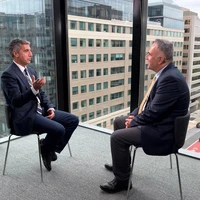
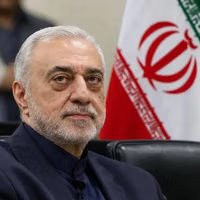
Robert Satloff (left), Joel Rayburn (center) and Behnam Ben Taleblu
Any US military action against Iran risks falling short if it mirrors past “one-off” strikes without sustained political and economic pressure, analysts warned during an Iran International Insight town hall on Wednesday amid mounting fears of a US attack.
US President Donald Trump signaled on Tuesday that he was leaning toward a military strike on Iran when he said Iranian protesters should keep up the demonstrations and that “HELP IS ON ITS WAY.”
At least 12,000 people have been killed in Iran in the largest killing in the country's contemporary history, much of it carried out on January 8-9 during an ongoing internet shutdown, senior government and security sources told Iran International.
Joel Rayburn, a senior fellow at the Hudson Institute, and Robert Satloff, the Executive Director of the Washington Institute, believe that limited military action by the United States may briefly punish Tehran's abuses but is unlikely to stop violence unless it is followed by a broader campaign.
“In April 2017, the president responded to Bashar al Assad's use of chemical weapons by doing airstrikes. We did not follow that up with a maximum pressure campaign or a political campaign,” Rayburn said. “One year later, he used them again.”
Rayburn argued that the lesson from Syria was clear: “We can’t do this just by one-off military strikes. They have the impact, but we have to have a campaign and we have to use all the tools at our disposal.”
“We can’t just do something and move on,” he said. “If the objective is to stop the killing, then the tools have to stay in place until that objective is met.”
Satloff said he does not like the notion of a strike. "A strike sounds like something that you do and then you’re done and that you can then turn to whatever next international problem is on your agenda.”
He said the current moment presents a more direct test for the Trump administration. “Will the president’s actions bring an end to the carnage? That’s the key right now.”
Trump said on Wednesday he had been informed that the killing in Iran has stopped and Tehran would not execute any of the protesters.
Satloff cautioned against reading too much into claims that violence inside Iran may have eased.
“If indeed the killing has stopped… terrific,” Satloff said during the town hall moderated by Behnam Ben Taleblu, the senior director of the Iran Program at the Foundation for Defense of Democracies (FDD).
“But if the killing continues tomorrow, the day after, then that tweet will mean nothing and the president will know it.”
He said the 2017 strikes on Syria imposed a cost but did not fundamentally change the regime’s behavior until they were paired later with broader sanctions and diplomatic isolation.
“It was only after the second time that the US government and our allies finally said… we have to have a campaign,” Rayburn said.
Joel Rayburn, a senior fellow at the Hudson Institute
Satloff argued that Iran presents a different but related challenge, because Trump has explicitly framed his objective as stopping the killing of civilians.
“This is somewhat different than partial punishment and partial deterrence,” he said, adding that Iran now represents “a much more visible, tangible test.”
Beyond strikes: cyber, communications
Both speakers stressed that military force is only one option, and not necessarily the first one Washington should use.
Satloff argued the US should focus on “leveling the playing field” between protesters and the Iranian security apparatus.
“Let’s find some way to shut down their communications so that they can’t talk to themselves and orchestrate this nationwide crackdown,” he said. “We have ways of shutting down the communication system employed by the regime.”
Rayburn said the administration could immediately escalate non-military pressure by fully restoring what he described as the president’s early-term directive to reimpose maximum pressure on Iran.
“There is no reason not to be fully implementing the maximum pressure campaign,” he said. “That hasn’t been fully implemented yet. It can be.”
Rayburn added that Iran is now “in an even more brittle state” than during Trump’s first term.
“They are not resilient to that kind of pressure,” he said. “I think the Iranian regime wouldn’t survive that.”
'Narrow targets, civilian risks, and credibility'
While emphasizing non-kinetic options, Satloff outlined what he would recommend if military action became unavoidable.
If violence continued, he said, US action should be tightly focused on security forces responsible for repression.
“I would target very specifically the barracks and the facilities of the IRGC and the Basij,” Satloff said, while warning that civilian casualties could quickly undermine US credibility.
Robert Satloff, the Executive Director of the Washington Institute
“I think we have to be very careful to avoid civilians,” he said, noting that past strikes in the region showed how quickly public perception can turn when non-combatants are killed.
The United States launched airstrikes against three Iranian nuclear facilities in June in the middle of a 12-day war between Iran and Israel.
The Israeli strikes began after Tehran ignored a 60-day deadline set by President Trump to reach a deal over its disputed nuclear program.