Israel says it killed senior IRGC Quds Force commander in Lebanon
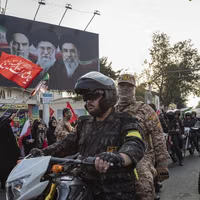
File photo of Iran's Revolutionary Guards
The Israeli military said on Thursday it killed a senior operative in Iran’s Revolutionary Guards Quds Force (IRGC-QF) in a joint operation with the country's intelligence agency in northeast Lebanon.
“In a joint operation by the IDF and the Shin Bet, Hussein Mahmoud Marshad al-Jawhari, a key operative in the Operations Unit of the Iranian Quds Force, was eliminated,” the Israel Defense Forces (IDF) said in a statement posted on X.
"(al-Jawhari) operated under the Iranian Revolutionary Guards and was involved in terror activities directed by Iran against the State of Israel and security forces," the statement added.
The IDF said he was involved in “advancing terrorist attack plans against the State of Israel in the Syria–Lebanon arena.”
It added that al-Jawhari was a key operative in Quds Force’s Unit 840, which the IDF described as “the unit that directs and is responsible for Iranian terrorist activity against the State of Israel.”
The Quds Force, the external arm of Iran’s Revolutionary Guards, conducts overseas operations to support allied groups and advance Tehran’s strategic interests.
Lebanon’s state news agency had earlier reported that two people were killed when an Israeli drone struck a vehicle near the Syrian border.
A report by Israel Hayom, citing Israeli officials, said al-Jawhari was killed alongside another operative, identified as Majed Qansoua.
A US-backed ceasefire agreed last November halted more than a year of fighting between Israel and Iran-backed Lebanese group Hezbollah and called for the group to disarm.
Both Israel and Hezbollah have since accused each other of violating the ceasefire.
Israel has been carrying out strikes in Lebanon on an almost daily basis, which it says are aimed at preventing Hezbollah from rebuilding.
Iran, a longtime sponsor of Hezbollah, has rejected international and domestic calls for the group to disarm, arguing that continued Israeli actions justify its armed presence.
A second former Afghan security commander opposed to the Taliban has been killed in Iran in under four months, raising concerns among Afghan ex-military figures living in the country.
On Wednesday, former Afghan police general Ikramuddin Sari was shot dead by masked assailants near his home in Tehran, according to sources close to him.
He was attacked alongside an associate near their residence in southern Tehran and died while being transferred to hospital, the sources told Afghanistan International.
Sari, a former police commander in Baghlan and Takhar provinces, fled to Iran after the Taliban returned to power in 2021. Reports in recent months had suggested Iranian police had detained and questioned him, though no official explanation was given.
Former Afghan police general Ikramuddin Sari
Taliban's 'extraterritorial assassinations'
The killing follows the September shooting of Maroof Ghulami, a political and military figure close to veteran anti-Taliban leader Ismail Khan. He was killed by gunfire in the religious city of Mashhad.
People close to both men have blamed the Taliban for their deaths, according to Afghanistan International.
The attacks, an Afghan military source said, signal the start of what he described as Taliban “extraterritorial assassinations,” adding that the group has repeatedly threatened to target opponents abroad.
Senior Taliban official Mohammad Nabi Omari has previously said the group could kill opponents outside Afghanistan “with as little as 500 Pakistani rupees,” while Saeed Khosti, a former spokesperson for the de facto Taliban Ministry of Interior, warned two years ago that hundreds of volunteers were ready to target critics overseas.
Iranian authorities have remained publicly silent on Sari’s killing. Tehran has also provided no detailed update on the investigation into Ghulami’s death.
Iranian police said in September they arrested three suspects in that case but later released two, offering no clarity on affiliations.
A source familiar with the investigation told Afghanistan International that the remaining suspect was a Taliban operative, a comment not confirmed by Iranian authorities.
Calls for accountability
Sari, originally from Kapisa province, was regarded as a professional officer who served as police commander in Nuristan, Baghlan and Takhar, and as an adviser to Afghanistan’s interior ministry.
In Iran, he acted as an informal representative for former Afghan soldiers, advocating for their rights, opposing deportations and openly criticizing the Taliban.
The National Resistance Front of Afghanistan (NRF), led by Ahmad Massoud, called on Iran to conduct a “transparent, serious and independent” investigation, describing Sari’s killing as a “targeted terrorist act.”
Former Afghan police general Ikramuddin Sari
The Jamiat-e Islami Afghanistan, led by Salahuddin Rabbani, also condemned the killing and urged Iranian authorities to identify those responsible.
Iran, which has handed Afghanistan’s embassy in Tehran and the consulate in Mashhad to the Taliban, has faced growing criticism for failing to protect Afghan dissidents on its soil even as it seeks closer ties with the Taliban-led administration.
Israeli security services said on Thursday they had arrested an Israeli citizen on suspicion of spying for Iran, including photographing the home of former prime minister Naftali Bennett, in what authorities described as part of stepped-up Iranian intelligence activity.
The Shin Bet domestic security agency and Israeli police said prosecutors would indict 40-year-old Vadim Kupriyanov, a resident of Rishon Lezion, in the Lod District Court on espionage-related charges.
According to the investigation, Kupriyanov was detained earlier this month after he was seen taking photographs near Bennett’s residence in the central Israeli city of Ra’anana. Police said he used a car-mounted camera and had been in contact with an Iranian handler for about two months.
Security officials said Kupriyanov carried out a range of surveillance and security-related tasks in exchange for payment, a pattern they said mirrors other recent cases involving Israeli citizens recruited by Iranian intelligence.
Bennett responded to the arrest by saying Iran’s efforts to harm him would not deter him from public life.
Earlier this month, Iran-linked hackers said they breached Bennett’s Telegram account and published personal data they said was taken from his phone. Bennett said the matter was being handled by authorities.
The arrest is the latest in a series of espionage cases Israeli officials have attributed to Iran. In recent weeks, Israeli authorities have announced the detention of several individuals – including Israeli citizens and foreign workers – accused of gathering intelligence on sensitive sites, ports or senior figures in exchange for money, often paid digitally.
Israeli security agencies say Iran has intensified recruitment efforts through social media and other online channels amid heightened tensions between the two longtime adversaries.
Israel lacks the capacity to fight a prolonged war with Iran, an Iranian daily affiliated with the Islamic Revolutionary Guards Corps wrote, saying that any renewed conflict would be far costlier and longer than a previous 12-day confrontation.
“Israel does not have the capacity for an intense war of attrition or for confronting a major power like Iran, and it is clear that another war would not end in 12 days as the previous one did,” Javan wrote in an analysis on Wednesday.
The 12-day war between Iran and Israel in June 2025 was a brief but intense conflict. It began with extensive Israeli airstrikes on Iranian military and nuclear facilities.
The United States became militarily involved mid‑conflict. On June 22, US Air Force and Navy forces carried out coordinated strikes on three Iranian nuclear facilities – Natanz, Fordow and Isfahan – in an operation codenamed Operation Midnight Hammer, using B‑2 bombers and submarine‑launched missiles, marking the first US offensive against Iranian territory in decades. Iranian forces fired missiles at US assets in Al Udeid Air Base in Qatar, after those strikes.
The conflict ended with a US and Qatari-mediated ceasefire, but it caused significant casualties, infrastructure damage.
Israeli rhetoric, the paper said, has shifted from threats of decisive victory to language of caution and warnings about the costs of renewed conflict.
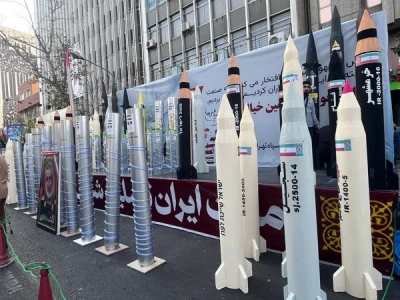
Air strikes, according to Javan, failed to halt what it called Iran’s “distributed and self-sufficient” military production. The paper also argued that the previous fighting severely strained Israel’s multilayer missile defense systems.
“Israeli officials are now openly speaking of the ‘real threat’ posed by Iran’s missiles and warning that without preventive action Iran could reach annual production of thousands of missiles,” the paper said.
Focus shifts from battlefield to society
Javan framed the change in tone as evidence that the military option has lost credibility, writing that the inability to control the consequences of war has weakened Israel’s long-standing doctrine of absolute military superiority.
Rescuers work at the site of a damaged building, in the aftermath of Israeli strikes, in Tehran, Iran, June 13, 2025.
“War in the contemporary world is not merely a military confrontation, but a test of social capacity, political cohesion and national resilience,” the paper wrote, arguing that internal divisions, political strains and reliance on external support limit Israel’s ability to endure a prolonged conflict.
The article concluded that future confrontation will be shaped as much by narratives and domestic resilience as by missiles and air defenses.
Russian President Vladimir Putin told US President George W. Bush in 2001 that Iran was seeking nuclear weapons but that Moscow would not assist Tehran in acquiring sensitive technologies, according to a newly released memorandum of their first face-to-face meeting.
“There is no doubt they want a nuclear weapon. I’ve told our people not to tell them such things,” Putin said during a restricted session with Bush on June 16, 2001, referring to Iranian inquiries directed at Russian experts, according to the declassified memorandum of conversation.
The remarks appear in notes taken during a one-on-one meeting at Brdo Castle in Slovenia, held shortly after Bush took office, and come amid broader discussions between the two leaders on missile proliferation, non-proliferation and Iran’s regional role.
Putin told Bush that Iranian specialists were pressing Russian experts on what the memo described as “sensitive matters,” but said he had ordered Russian officials not to share information related to nuclear weapons or missile technology.
“I will restrict missile technology to Iran,” Putin said, according to the document, while acknowledging that some Russian actors were interested in profiting from cooperation with Tehran.
Bush, for his part, raised concerns that weapons transfers to Iran could threaten both US and Russian security.
A sample of the document
The memo shows the US president sought Moscow’s cooperation on non-proliferation, warning that Iranian access to advanced weapons or delivery systems would be destabilizing.
The exchange also touched on US policy toward Tehran. When Putin suggested Washington might be moving toward improved relations with Iran, Bush rejected that notion.
“That’s not true. Congress makes that completely impossible now,” Bush said, pointing to legislative constraints on any normalization of US-Iran relations even at the start of his presidency.
Putin countered that European states, including Germany, were expanding financial ties with Iran, mentioning a credit line extended by Berlin and arguing that trade in conventional weapons was treated by some countries as a commercial matter.
The document shows that Iran featured repeatedly in the discussion as a proliferation concern alongside North Korea, with Putin portraying Moscow’s engagement with Tehran as constrained by history, geography and security pressures on Russia’s southern borders.
The memorandum was produced as part of a US government record of the meeting and later released through the National Security Archive following a Freedom of Information Act request.
Israeli strike scenario in 2005 and Natanz as a potential target
A separate memorandum of conversation dated September 16, 2005 depicts Bush and Putin discussing how Iran’s enrichment and reprocessing capabilities could be redirected toward a weapons program, and how escalating disputes could narrow options toward military action.
In that Oval Office meeting, US officials stressed that the core concern was not civilian nuclear power but Iran’s ability to master the fuel cycle.
“Our concern is Iran’s ability to reprocess and enrich,” Secretary of State Condoleezza Rice said, adding that such capabilities “would be dangerous and could be turned to a military program.”
Putin argued that an immediate referral of Iran’s file to the UN Security Council could push Tehran to accelerate its program, warning that pressure could reduce outside visibility and control.
“Our concern is that immediate referral will lead Iran to take the North Korean route,” Putin said.
He then raised the question of military action and the uncertainties surrounding it: “If they are indeed striving for nuclear weapons, then we will have lost control over what is happening in Iran. Then we need to do something. What? Strike? Who does that? Where? What targets? Are you sure of the information you have?”
Bush told Putin he saw diplomacy as the priority but said military action could not be fully ruled out, and he framed Israel as the actor most likely to consider a strike if it judged Iran was nearing a nuclear capability.
“The military option stinks, but we can’t take it off the table,” Bush said. “If Sharon feels he needs to strike Iran, all hell will break loose,” he added referring to then prime minister Ariel Sharon.
In the same 2005 conversation, Bush explicitly mentioned Iran’s Natanz enrichment site as a possible Israeli target while emphasizing Washington was not selecting targets on Israel’s behalf. “If they think there’s enriching at Natanz, that’s one. But we aren’t doing the targeting for Israel.”
The 2005 memo also reflects proliferation concerns tied to external networks. Putin pointed to evidence suggesting Pakistani-origin material had been found in Iranian centrifuges, and Bush referenced discussions with then Pakistani President Pervez Musharraf about transfers linked to Abdul Qadeer Khan’s network.
“As far as I understand, they found uranium of Pakistani origin in the centrifuges,” Putin said, to which Bush responded that it involved undeclared material and constituted a violation: “Yes, the stuff the Iranians forgot to tell the IAEA about. That’s a violation.”
Bush happy with Russia’s fuel-for-no-enrichment approach
A third memorandum, dated April 6, 2008, shows Iran continuing to feature in US-Russian talks in the context of nuclear cooperation safeguards, alleged illicit procurement, and the question of Iranian enrichment.
In that meeting in Sochi, Rice told Putin the United States had focused on resolving what she described as a sensitive issue involving Iran, including concerns about illicit assistance. “We needed to resolve an issue with Iran,” Rice said.
Putin said, “Everything is under control there. Sometimes there are instances of cooperation they're trying to pursue in a clandestine manner that's not apparent to the government. We will find them and they will be punished.”
When Bush asked where the questionable activity was occurring, Rice answered directly: “Arak.”
Putin said Russian authorities were monitoring for unauthorized cooperation driven by profit motives. “There are people willing to earn a bit of money on this, but we identify those cases,” Putin said.
The 2008 memo also shows Bush praising Moscow’s approach of providing nuclear fuel for civilian power while pressing Tehran not to enrich domestically – an argument intended to test whether enrichment was needed for energy or indicative of weapons intent.
Bush described it as a practical non-proliferation framework: “Russia says, ‘Here’s the fuel, therefore you don’t need to enrich. If you do, it shows you don’t want civil nuclear power, you want more,’” Bush said.
Putin, recounting his own discussions with Iranian officials, questioned the timing of Iranian enrichment given long construction timelines for reactors, including Russia’s work at Bushehr. “You won’t complete a new plant for 15 years, so why are you building up enrichment now?” Putin said.
A cluster of former officials and pundits in Tehran has sought to downplay the likelihood of a US-backed Israeli strike on Iran, arguing that Washington has little appetite for such military action.
The claims have circulated amid growing public anxiety about escalation—concerns that have begun to ripple through Iran’s currency and gold markets.
“Trump is no longer interested in playing Netanyahu’s game,” Nameh News, a conservative outlet widely seen as close to Iran’s intelligence community, quoted Heshmatollah Falahatpisheh, the former head of parliament’s national security committee, as saying.
Falahatpisheh offered little evidence for the assertion, suggesting only that “all of Trump’s attention is currently focused on the Western hemisphere.”
Those assurances stand in contrast to remarks on Wednesday by Israeli Prime Minister Benjamin Netanyahu, who said Israel still needed to “settle accounts” with Iran, adding that while Israel did not seek confrontation, it remained alert to “every possible danger.”
Meeting in Mar-a-Lago
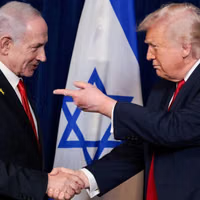
Netanyahu is set to meet Donald Trump next week, primarily to discuss the next phase of the Gaza conflict but also Iran’s nuclear standoff.
Nameh News introduced the interview by citing the upcoming meeting, asserting that it would have no impact on Tehran’s determination to pursue its nuclear and missile programs.
Falahatpisheh further argued that the Trump–Netanyahu meeting was intended mainly to shield Israel from broader US national security priorities, claiming Washington was no longer willing to spend resources on military operations outside the Western hemisphere.
As support, he cited US national security documents, noting that Iran was mentioned 17 times in 2024 but only three times in 2025.
‘US not interested’
The same day, the outlet quoted foreign policy analyst Ali Bigdeli, who echoed Falahatpisheh’s assessment almost verbatim.
“I do not assume that the United States is likely to enter an action against Iran to assist Israel,” Bigdeli said, while maintaining that the Trump–Netanyahu meeting would indeed focus on Iran. He warned of the possibility of a “surprise military attack” but concluded that a broader conflict between Israel and Iran remained unlikely.
A similar argument appeared in the reformist daily Arman Melli, which published an interview that day with political commentator Hassan Hanizadeh.
Hanizadeh said the United States was “not interested in taking part in a new war against Iran” and accused Netanyahu and Israeli media of amplifying regional instability for domestic political reasons.
Taken together, the remarks suggest a coordinated effort to reassure domestic audiences that war is unlikely, even as official rhetoric remains confrontational. Whether such messaging can ease public anxiety—and calm markets in Iran—remains an open question.