• Iran Insight
  • Politics
  • Economy
  • Analysis
  • Special Report
  • Opinion
  • Podcast
All rights reserved for Volant Media UK Limited
volant media logo
  • العربية
  • فارسی
Brand
  • Iran Insight
  • Politics
  • Economy
  • Analysis
  • Special Report
  • Opinion
  • Podcast
  • Iran Insight
  • Politics
  • Economy
  • Analysis
  • Special Report
  • Opinion
  • Podcast
  • Theme
  • Language
    • العربية
    • فارسی

India coast guard seizes three tankers in smuggling case, reports link vessels to Iran

Feb 8, 2026, 12:51 GMT
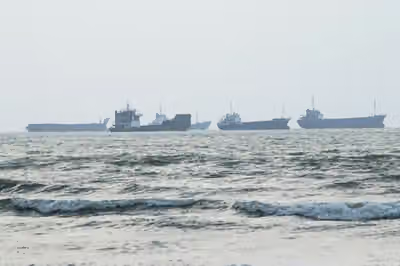
A photo released by India’s coast guard shows one of three tankers intercepted about 100 nautical miles west of Mumbai on February 6, 2026, and escorted to Mumbai for legal action.

India’s coast guard said it has seized three oil tankers in the Arabian Sea as part of what it described as a coordinated operation against an international oil-smuggling network, while tanker-tracking analysts and Iranian media said the vessels were linked to Iran.

In a statement posted on social media, the Indian Coast Guard said it intercepted three vessels about 100 nautical miles west of Mumbai on Friday after what it called “tech-enabled surveillance and data-pattern analysis.”

“The syndicate exploited mid-sea transfers in international waters to move cheap oil from conflict-ridden regions to motor tankers, evading duties owed to coastal states,” the coast guard said.

It added that sustained inspections, electronic data checks and crew questioning had revealed the network’s methods and links to what it described as a “global handler network,” and said the vessels were being escorted to Mumbai for further legal action.

The coast guard statement did not mention Iran, the ownership of the vessels, or any sanctions violations.

However, tanker tracking firm TankerTrackers said it had identified the three vessels as AL JAFZIA, ASPHALT STAR and STELLAR RUBY, adding that the ships were under US sanctions. TankerTrackers said STELLAR RUBY was operating under the Iranian flag.

Iranian media separately reported that the three seized tankers were linked to Iran and were detained for alleged oil smuggling, saying the vessels had been sanctioned by the United States in 2025.

The Indian Coast Guard said the vessels were known for frequently changing their identities and said the operation proved India’s role as “a net provider of maritime security and guardian of the rules-based international order.”

Washington has accused Iran of using a so-called shadow fleet of tankers to evade US oil sanctions.

Neither Indian authorities nor Iranian officials have publicly commented on the reports linking the seized vessels to Iran.


Most Viewed

Trump says regime change in Iran will happen but not ‘immediately’
1

Trump says regime change in Iran will happen but not ‘immediately’

2
INSIGHT

Checkpoint attacks open new front in Iran war

3

Iran’s unseen new leader issues first message in writing

4
ANALYSIS

Iran raises ‘human shield’ fears by rallying supporters to the streets

5
EXCLUSIVE

Iran pays Lebanon parliament speaker $500,000 a month to maintain influence

Banner
Banner

Spotlight

  • Iran raises ‘human shield’ fears by rallying supporters to the streets
    ANALYSIS

    Iran raises ‘human shield’ fears by rallying supporters to the streets

  • Russia gains from Iran war but risks more if it drags on
    OPINION

    Russia gains from Iran war but risks more if it drags on

  • Allies rally, rivals brace after Mojtaba Khamenei’s rise
    INSIGHT

    Allies rally, rivals brace after Mojtaba Khamenei’s rise

  • Checkpoint attacks open new front in Iran war
    INSIGHT

    Checkpoint attacks open new front in Iran war

  • Power vs piety: Khamenei Jr inherits legitimacy dilemma of Iran's theocracy
    ANALYSIS

    Power vs piety: Khamenei Jr inherits legitimacy dilemma of Iran's theocracy

  • Can widening the war save Iran’s rulers?
    ANALYSIS

    Can widening the war save Iran’s rulers?

Tweet unavailable

•
•
•

More Stories

‘Australia stands with the people of Iran,’ senator says after Senate motion

Feb 6, 2026, 09:45 GMT

Australian Senator Raff Ciccone, Chair of the Parliamentary Joint Committee on Intelligence and Security and a co-sponsor of a bipartisan Senate motion condemning Iran’s crackdown on protests, said Australia was standing firmly with the people of Iran.

The Australian Senate on Thursday approved the motion, which cited killings, mass arrests and internet blackouts imposed on civilians during protests that began in late December. It also acknowledged the distress of Iranian-Australians unable to contact relatives in Iran.

In an interview with Iran International, Ciccone said the vote sent a clear message of unity across Australia’s political spectrum.

“Earlier today in the Australian Senate, myself and a number of other senators across the political spectrum came together in a sign of unity and national bipartisanship to send a very strong message that Australia and the Australian Senate stands very closely with the people of Iran,” he said.

The motion called on the Albanese government to work with international partners, including the United Nations, to support independent investigations into human rights violations, press for accountability, expand targeted sanctions and push for an end to violence and communications restrictions.

Ciccone’s comments followed new Australian sanctions imposed earlier this week on 20 individuals and three entities linked to Iran’s security apparatus.

“Since 28 December last year, the Iranian regime has responded to peaceful protests with extraordinary and horrifying violence against its own people,” Ciccone said, adding that authorities had tried to conceal the crackdown through internet and telecommunications blackouts.

He said his office had received hundreds of calls and emails from members of the Iranian-Australian community worried about family and friends.

“Members of the Australian Iranian community have watched these events unfold with profound anguish,” he said.

Ciccone urged Iranian authorities to halt attacks on civilians and said Australia would not stay silent.

“The attacks that are occurring on citizens has to stop, has to stop immediately,” he said. “Australia is very much by your side.”

Australian Senate passes motion condemning Iran protest crackdown

Feb 5, 2026, 09:53 GMT

The Australian Senate on Thursday passed a motion condemning Iran’s crackdown on nationwide anti-government protests that began in late December, citing killings, mass arrests and internet blackouts imposed on civilians.

The motion said senators noted “with grave concern” reports of indiscriminate killings of civilians, the targeting of women and children, mass arrests and internet and communications blackouts. It also acknowledged the distress felt by Iranian-Australians unable to contact relatives in Iran.

It called on the Albanese government to keep working with international partners, including the United Nations, to support independent investigations into human rights violations in Iran, press for accountability, expand targeted sanctions and push for an end to violence, executions and communications restrictions.

Labor Senator Raff Ciccone, one of the co-sponsors, said in a post on X that the Senate had condemned “the Iranian regime’s brutal repression of peaceful protesters” and reaffirmed Australia’s solidarity with the Iranian people and the Iranian-Australian community.

His comments followed earlier action this week, when Australia imposed new sanctions on 20 individuals and three entities linked to Iran’s security apparatus over the protest crackdown.

Speaking in the Senate earlier this week, Ciccone said he supported the government’s steps and voiced solidarity with Iranians protesting inside the country.

“Since 28 December last year, the Iranian regime has responded to peaceful protests with extraordinary and horrifying violence against its own people,” he told parliament.

He said authorities had tried to hide the scale of the crackdown. “The regime has attempted to conceal the scale of its brutality through nationwide internet and telecommunication blackouts,” he said.

Referring to the new sanctions, Ciccone said they targeted those responsible for repression, including figures linked to the Islamic Revolutionary Guard Corps. “These sanctions are not symbolic; they are targeted, deliberate and designed to impose real consequences on those responsible for repression and violence,” he said.

Ciccone also highlighted the impact on Iranians living in Australia. “Members of the Australian Iranian community have watched these events unfold with profound anguish,” he said, adding that many had relatives at risk.

“Australia’s message is clear: the use of violence against civilians, the silencing of dissent and the systemic denial of human rights will not be met with indifference,” he said.

Canadian activists urge probe into Iranian expats linked to repression

Feb 4, 2026, 15:05 GMT
•
Negar Mojtahedi

Human rights advocates in Canada are urging the country’s national police to gather evidence on Canadians linked to Iran’s repression apparatus after thousands of protesters were killed in January.

The call is directed at the Royal Canadian Mounted Police (RCMP) and centers on what is known as a “structural investigation,” an evidence-gathering process that could help lay the groundwork for future prosecutions of individuals linked to crimes against humanity.

“We know that there are a number of IRGC officials in Canada, and also a very large Iranian diaspora with substantial evidence they can provide to the RCMP,” said Brandon Silver, an international human rights lawyer and founding director of policy and projects at the Raoul Wallenberg Centre for Human Rights.

“The RCMP can initiate what’s called a structural investigation into crimes against humanity,”

The push comes amid mounting demands for accountability after Iran International’s Editorial Board confirmed that more than 36,500 Iranians were killed by security forces during the January 8–9 crackdown, the deadliest two-day protest massacre in history.

Advocates say Canada must ensure perpetrators cannot find refuge abroad — and that Iranian Canadians have a direct avenue to report evidence.

Nazanin Afshin-Jam, a member of the Iranian Justice Collective, said structural investigations would give Iranian Canadians a concrete pathway to come forward and begin the accountability process.

Calls from Parliament Hill

The renewed push followed a day of meetings and testimony in Ottawa, where Afshin-Jam appeared before the House of Commons Subcommittee on International Human Rights.

“Yesterday I was invited to testify before the subcommittee on international human rights to give an update on the human rights situation in Iran and to also provide some recommendations,” she said.

Afshin-Jam said the aim was to press Canada to move beyond statements of condemnation toward tangible action.

Pressure on the IRGC

Silver also urged Ottawa to expand sanctions against senior officials directing the repression.

“Sanction the architects of this repression, starting with the Ayatollah,” he said.

He argued that Canada should coordinate closely with allies as international pressure mounts on the Islamic Revolutionary Guard Corps.

Afshin-Jam said Canada has already taken significant steps in the past — including listing the IRGC and closing its embassy in Tehran — and should again lead among Western democracies.

Advocates said they were encouraged by signs of cross-party engagement in Parliament but stressed that the next step must be follow-through: evidence collection, sanctions enforcement, and coordinated international action.

Iran crypto volumes draw US probes into sanctions evasion - Reuters

Feb 3, 2026, 13:32 GMT

US investigators are examining whether cryptocurrency platforms were used to help Iranian officials and state-linked actors evade sanctions, a blockchain researcher told Reuters, as crypto use rose sharply in Iran amid currency weakness and political unrest.

Ari Redbord, global head of policy at TRM Labs, said the US Treasury is reviewing whether platforms allowed state-linked players to move money abroad, access hard currency or buy restricted goods.

Estimates of Iran’s crypto activity vary. TRM Labs estimated roughly $10 billion in Iran-linked crypto activity in 2025, compared with $11.4 billion in 2024. Chainalysis said Iranian wallets received a record $7.8 billion in 2025, up from $7.4 billion in 2024 and $3.17 billion in 2023. Researchers cautioned that crypto’s pseudonymous nature makes precise attribution difficult and limits the ability to form a complete picture.

Chainalysis estimated that about half of Iran’s 2025 crypto activity was linked to the Islamic Revolutionary Guard Corps (IRGC). TRM Labs said it has identified more than 5,000 addresses it labels as IRGC-linked and estimates the Guards have moved about $3 billion worth of crypto since 2023.

Iran’s largest exchange, Nobitex, told Reuters that around 15 million people in Iran have some crypto exposure, with many using digital assets as a store of value as the rial depreciates. Analysts said funds can be moved off Iranian exchanges to wallets and platforms elsewhere, complicating enforcement for US authorities.

In September, the US Treasury Department’s Office of Foreign Assets Control (OFAC) sanctioned two Iranian financial facilitators and more than a dozen individuals and entities based in Hong Kong and the United Arab Emirates for helping coordinate money transfers — including proceeds from Iranian oil sales — that it said benefited the IRGC-Quds Force and Iran’s ministry of defense.

“Iranian ‘shadow banking’ networks like these—run by trusted illicit financial facilitators—abuse the international financial system, and evade sanctions by laundering money through overseas front companies and cryptocurrency,” read the statement.

Britain sanctions Iran’s security apparatus over deadly crackdowns

Feb 2, 2026, 15:09 GMT

Britain on Monday imposed a new round of sanctions on Iranian officials and a state security body, targeting those it said were responsible for violent crackdowns on peaceful protests.

The British Foreign Office said it had sanctioned 10 individuals and the Law Enforcement Forces of the Islamic Republic for what it described as serious human rights violations, including the killing of protesters, torture, sexual violence, and sweeping restrictions on freedom of expression and peaceful assembly.

The measures include asset freezes, travel bans and director disqualification sanctions, which prevent those listed from holding senior positions in British companies.

Among those designated was Eskandar Momeni, who oversees Iran’s domestic security apparatus, provincial police chiefs Mohammad Reza Hashemifar and Ahmed Amini, senior IRGC commander Mohammad Zamani, judges Ahmad Darvish Goftar and Mehdi Rasakhi, and the businessman Babak Zanjani.

“The Iranian people have shown extreme courage in the face of brutality and repression over recent weeks simply for exercising their right to peaceful protest,” Foreign Secretary Yvette Cooper said in a statement. “

The reports and shocking scenes of violence that have been seen around the world are horrific,” she added.

British officials said the action followed similar measures imposed by the European Union and the United States as part of a coordinated effort to hold Iranian authorities accountable.

Last week, EU foreign ministers formally designated the Islamic Revolutionary Guard Corps as a terrorist organization, a move that prompted sharp retaliation from Tehran.

Iranian officials have routinely dismissed Western sanctions as politically motivated and deny responsibility for abuses.

On Sunday, Iran’s parliament speaker said the country would now consider the armies of EU member states “terrorist groups,” escalating an already tense standoff between Iran and Western governments.

The sanctions were announced as signs emerged that diplomatic contacts between Iran and the United States could resume.

An Iranian foreign ministry official said on Monday that Tehran was weighing terms for renewed nuclear talks, even as Washington has increased its naval presence in the region following last month’s deadly protest crackdown.