Khamenei gives green light to compact nuclear warheads - report
Iran’s Supreme Leader Ali Khamenei visits an exhibition of missile and drone systems operated by the Aerospace Force of the Islamic Revolutionary Guard Corps in Tehran, 2023.
Iran’s Supreme Leader approved the development of compact nuclear warheads for ballistic missiles in October, reversing years of restraint after Iran’s June war with Israel, the Italian Institute for International Political Studies said in a report on Wednesday.
“Our sources in Tehran now tell us that, in October, Khamenei decided to give the green light to the development of compact warheads for ballistic missiles,” the report said.
The report said Khamenei had previously blocked any move to enrich uranium to weapons-grade levels or to develop deliverable nuclear warheads, despite pressure from within Iran’s security establishment, particularly the Revolutionary Guards.
It said the June conflict with Israel marked a turning point, exposing weaknesses in Iran’s air defenses and allied forces, while highlighting the limits of its missile arsenal in a prolonged conflict.
“The only true deterrent that could save the Iranian regime in the event of a conflict against Israel and its US allies would be nuclear weapons,” the report said.
Enrichment still capped, for now
“At the same time, however, Khamenei would still not have authorised uranium enrichment beyond 60%,” the report said, adding that rumors persist of an undisclosed enrichment effort at a covert site not declared to the International Atomic Energy Agency.
It said Iran appears to be prioritizing warhead design over enrichment to reduce the risk of exposure to military strikes.
The report said that even if Iran chose to move quickly on enrichment, developing a deliverable warhead would take far longer.
“While enrichment to 90% would require only a few weeks if there were still enough working centrifuges, compact warheads remain a far more complex challenge,” it said, citing Pakistan’s experience in the 1990s, when years of testing and design work were needed before a viable compact warhead was achieved.
Missiles at core of deterrence
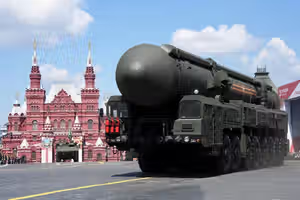
Iran’s focus on compact warheads is tied to its medium- and long-range missile force, which the report said proved decisive in forcing a ceasefire with Israel in June, even as Israel destroyed a significant number of Iranian missiles and launchers.
Recent contradictory reports over possible missile activity in Iran, later denied by state television, underscore the sensitivity around the country’s missile program and its role in deterrence.
The report said Iran could seek external assistance to shorten the timeline for developing compact warheads, noting persistent rumors within the Revolutionary Guards of cooperation with North Korea.
“Even access to previously tested warhead schematics would represent a major shortcut,” it said, while adding that cooperation beyond missile technology remains impossible to verify.
Iran has long said its nuclear program is peaceful and defensive, while Western governments accuse Tehran of keeping open the option of developing nuclear weapons.