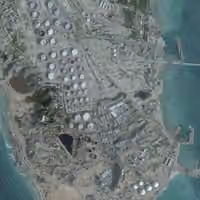
The Institute for Science and International Security (ISIS) reported that satellite images taken last weekend show activity at the Pilot Fuel Enrichment Plant (PFEP), a key facility at Natanz that was previously destroyed.
“Satellite imagery from December 13, 2025, shows that Iran placed panels on top of the remaining anti-drone structure, providing cover for the destroyed facility,” the think tank said.
Although the structure appears partially sealed, ISIS said that “a large hole remains in the middle where the drone cage was penetrated and damaged.”
The think tank said the new covering suggests Iran may be attempting to access the remains of the facility while shielding the activity from external observation.
“This indicates Iran wants to explore the rubble out of sight of prying eyes."
The PFEP is a sensitive site within the Natanz complex, historically used for advanced enrichment research and development.
According to ISIS, the facility “likely held several kilograms of highly enriched uranium,” a quantity that is small compared with Iran’s overall stockpile of nearly 400 kg but still significant.
The group said the material would be “not negligible” in the broader context of Iran’s nuclear capabilities.
Despite the apparent activity at PFEP, ISIS said it has not observed similar signs elsewhere at Iran’s main nuclear sites including the underground Fordow facility bombed by the United States in June.
Iran has long insisted that its nuclear program is for peaceful purposes, while Western governments and Israel say Tehran’s enrichment activities bring it closer to the capability to produce nuclear weapons.
The UN nuclear watchdog remains unable to access several of Iran's most sensitive nuclear sites following June strikes, International Atomic Energy Agency (IAEA) Director General Rafael Grossi said on Monday.
Grossi told Russia’s RIA Novosti that inspectors had returned to some facilities but were restricted to sites that were not damaged in the attacks.
“We are only allowed to access sites that were not hit,” he said, calling the resumption important but insufficient.
“These other three sites – Natanz, Isfahan and Fordow – are even more significant, since they still contain substantial amounts of nuclear material and equipment, and we need to return there.”