Iran cleric says Mashhad is for pilgrims, not leisure tourists
A view from the Imam Reza Shrine, the mausoleum of the eighth Imam in Shi’ite Islam, in Mashhad, the province of Razavi Khorasan
A senior Iranian cleric said the northeastern city of Mashhad should be treated primarily as a religious destination rather than a leisure tourism hub, arguing that recreational tourists should visit other provinces such as northern province of Mazandaran instead.
Ahmad Alamolhoda, the Supreme Leader’s representative in Razavi Khorasan province and Friday prayer leader in Mashhad, said the city’s identity was rooted in pilgrimage to the shrine of Imam Reza, one of Shi’ite Islam’s holiest sites.
“Mashhad is not a city for tourists; it is a city for pilgrims,” he was quoted as saying by Iranian media.
He cited comments attributed to some Arab visitors from Iraq who he said had indicated they might travel to Tehran and then head to the Caspian coast for leisure, which he said showed Mashhad’s role as a pilgrimage destination and the need to distinguish between religious tourism and recreational or historical tourism in other cities such as Isfahan or Shiraz.
Alamolhoda also addressed women’s attendance at sports stadiums, saying he had no religious objection in principle but favored designated seating areas for women separate from men to prevent behavior he said could lead to social “abnormalities.”
On the enforcement of Islamic dress codes, he cautioned against confrontational approaches toward women not wearing the hijab. Instead, he urged a compassionate approach, likening it to caring for an ill loved one, saying: “This is not good for you; don’t do it.”
Iranian Nobel Peace Prize laureate Narges Mohammadi, who was violently detained after attending a memorial service for a human rights lawyer, told her family she has been accused of cooperating with the Israeli government, according to her X account.
Mohammadi said during a brief phone call on Sunday night that she does not know which security agency arrested her, the post on her X account said.
She added that she was beaten with batons during the arrest on Friday and has since been taken to the emergency room twice due to the severity of her injuries.
Mohammadi and several other activists were arrested during a heated gathering of mourners attending a memorial ceremony for Khosrow Alikordi in the northeastern city of Mashhad.
Alikordi, a former political prisoner who represented jailed protesters, was found dead under unclear circumstances in his office in Mashhad last week, with fellow lawyers and activists questioning the official account of cardiac arrest and alleging possible involvement by security forces.
"Khosrow Alikardi was devoted to freedom and justice, but he never bowed his head to oppression," Mohamadi told attendees in a speech.
The Nobel laureate whose arrest sparked international outcry said during the phone call that she was attacked with repeated, heavy baton blows to the head and neck and was then violently detained.
"At the same time as the beating, she was threatened and told, “We will put your mother in mourning.”
The Norwegian Nobel Committee on Friday condemned her arrest and called on Tehran to "specify Mohammadi’s place of detention, ensure her safety and well-being and release her unconditionally."
Her foundation posted online that activists Sepideh Qolian, Pouran Nazemi, Hasti Amiri and Aliyeh Motalebzadeh were also arrested, among others.
Mashhad governor Hassan Hosseini told state media that the arrests were made for the detainees' safety as the crowd turned unruly.
"This was done to protect them, because in such circumstances other groups might also take confrontational action. For this reason, the prosecutor’s office intervened to ensure that no problems would arise for these individuals," he told state media.
A study on female genital mutilation (FGM) in Iran’s southern Hormozgan province finds the practice is sustained chiefly by family dynamics, gender stereotypes and local customs that often outweigh religious mandates.
Published by researchers at Islamic Azad University, the peer-reviewed paper appears in Social Problems of Iran (Autumn 2025) and uses grounded-theory interviews with 15 women (2022–23) to map causal drivers, intervening factors, strategies, and outcomes.
The authors report that cutting persists within kinship networks that link family honor to control over female sexuality, while misinformation and limited access to alternative medical or religious views reinforce continuity.
“The central category indicates the impact of religious and family institutions in the continuation and reproduction of the traditional pattern,” the paper said, adding that “local customs outweigh religious mandates, with religion serving more as a legitimizing discourse.”
They say women’s responses evolve from silence and avoidance in childhood to negotiation, alliance-building and seeking medical advice in adulthood, with education, urbanization and social-media advocacy widening pathways to change.
Reported outcomes include physical pain, reduced sexual satisfaction, traumatic recall and social withdrawal. “FGM causes physical, sexual or psychological harm or suffering to women.”
According to the paper, common misconceptions about the practice include beliefs that FGM preserves a girl’s “purity,” prevents immoral behavior or is a religious obligation.
“I had no idea what circumcision was until they did this to us,” said one 42-year-old participant.
Another woman described the experience as sudden and violent. “I was confused and completely unprepared. Like a chicken you grab to slaughter. Two female relatives held me down, tightly gripping my arms and legs, and then they took out the blade.”
FGM is practiced in several regions of Iran, particularly in western and southern provinces including Hormozgan, Kordestan, Kermanshah, West Azarbaijan, Ilam and Lorestan.
There is no comprehensive national data on its prevalence, but small-scale studies have reported varying rates across these areas.
The most common form documented in Iran is Type I FGM, involving partial or total removal of the clitoris or prepuce. Procedures are typically carried out by traditional midwives or elderly women using basic tools such as razor blades, often without anesthesia.
Iranian law does not explicitly criminalize FGM. There have been no known prosecutions, and official responses have largely been muted.
Iranian activist Masih Alinejad met Venezuelan Nobel Peace Prize laureate Maria Corina Machado in Norway, saying in a post on social media that Tehran menaced the South American country too.
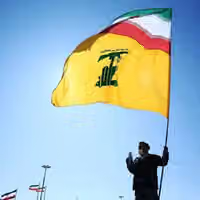
“The Islamic Republic has invaded Venezuela alongside its allies Russia and its proxy Hezbollah. To those who claim with outrage that Venezuela’s democratic opposition asked the US government to ‘invade,’ let’s be serious and deal in facts,” Alinejad wrote on X on Friday.
“The real and ongoing violation of Venezuela’s sovereignty is already happening. Iran’s regime, Hezbollah and their terrorist proxy networks are operating inside Venezuela, strengthening repression, corruption and criminal networks that serve dictators, not citizens,” she added.
Machado arrived in Oslo this week after her daughter accepted the Peace Prize on her behalf. The veteran opposition figure said the United States had facilitated her exit from Venezuela, where she had been living in hiding.
US forces have mounted the largest military buildup in the Caribbean since the 1962 Cuban Missile Crisis. The move appears to be a bid to pressure Venezuelan President Nicolas Maduro to resign after he declared victory in polls against Machado's allies last year even as pollsters found he had lost.
The administration of US President Donald Trump has been attacking alleged drug boats off Venezuela and in the Pacific, in strikes Democratic opponents and some human rights groups say violate the laws of war.
Trump and his military and legal leadership say the campaign is a legitimate operation against narco-terrorism led by Maduro, and US forces on Wednesday seized a tanker off Venezuela it said carried sanctioned Venezuelan and Iranian oil.
The Norwegian Nobel Committee said on Wednesday that Iran was among various forces backing Maduro.
“Authoritarian regimes learn from each other. They share technology and propaganda systems. Behind Maduro stand Cuba, Russia, Iran, China and Hezbollah — providing weapons, surveillance and economic lifelines. They make the regime more robust, and more brutal,” its chief Jorgen Watne Frydnes said.
“Opposition groups did not start the imprisonments in Belarus, the executions in Iran — or the persecution in Venezuela. The violence comes from authoritarian regimes, as they lash out against popular calls for change,” Frydnes added.
US Secretary of State Marco Rubio this month cast Venezuela as a regional launchpad for Iranian influence, describing Maduro’s government as a narcotics transit hub that hosts Iran’s Revolutionary Guards and its Lebanese ally Hezbollah
Little public evidence exists about the security relationship Venezuela has with Iran or its armed allies. Tehran and Caracas boosted ties under Maduro's predecessor Hugo Chavez, who cast himself as a bulwark against what he called American imperialism.
Machado said on Wednesday that their influence in Venezuela amounted to an invasion while not directly addressing whether she supported stepped up US military attacks on the country to bring about Maduro's downfall.
“Venezuela has already been invaded,” she said at a news conference alongside the Norwegian Prime Minister Jonas Gahr Store on Thursday.
“We have the Russian agents, we have the Iranian agents, we have terrorist groups such as Hezbollah, Hamas, operating freely in accordance with the regime. We have the Colombian guerrillas, the drug cartels.”
Iranian authorities said on Saturday they had detained 39 people at a memorial ceremony for a prominent rights lawyer in the holy city of Mashhad, confirming the number of arrests after videos showed anti-government and pro-monarchy slogans at the gathering.
The detentions took place during a seventh-day memorial ceremony that drew activists and supporters, some of whom later gathered outside the venue and chanted slogans including “Death to the Dictator” and phrases backing Iran’s pre-1979 monarchy, according to videos posted online.
The memorial was held for Khosrow Alikordi, a prominent rights lawyer and former political prisoner who represented detained protesters. He was found dead in his office in Mashhad last week. Supporters and fellow lawyers have questioned the official account of his death, while Iranian authorities say forensic examinations show he died of a heart attack.
“The seventh-day memorial was held with full cooperation of the responsible bodies,” Mashhad public prosecutor Hassan Hemmati-Far said, adding that authorities allowed funeral and memorial ceremonies to go ahead in Mashhad and the nearby city of Sabzevar.
He said the situation changed after the ceremony ended, when a gathering formed outside the mosque. Hemmati-Far said Javad Alikordi, the lawyer’s brother, along with Nobel Peace Prize laureate Narges Mohammadi and activist Sepideh Gholian, addressed the crowd from atop a vehicle.
“By making provocative remarks, they encouraged those present to chant norm-breaking slogans and disrupt public order,” Hemmati-Far said.
Authorities said police later intervened to manage the scene and that two officers were injured. Hemmati-Far said the incident led to the detention of 39 people.
Families, activists dispute official account
Families of some detainees and rights activists have disputed the authorities’ account, saying those arrested were subjected to violence during detention and have since been held without contact with relatives or access to lawyers.
According to family members, several detainees, including Mohammadi, were beaten during arrest. Mohammadi’s brother, Hamidreza Mohammadi, told AFP she was “beaten on the legs and grabbed by the hair,” adding that her past medical conditions made her detention a serious concern.
“Immediate and full access to medical facilities must be provided, independent and impartial complaints must be registered against those responsible for beatings, threats and insults, and all injured detainees must be sent without delay to forensic medical authorities,” the Narges Mohammadi Foundation wrote in a statement.
Authorities also said Javad Alikordi later left the scene but was arrested hours afterward after posting videos online that officials described as containing false statements.
Hemmati-Far said all detainees were being held in a legal detention facility and that investigations were continuing.
Rights groups and activists say at least several dozen people remain in detention in what they described as incommunicado conditions. Iranian authorities deny wrongdoing and say detainees’ rights are being respected.
Iran is facing growing shortages of vital medicines and could see a sharp deterioration in supplies within months if current conditions persist, an industry official said on Saturday.
“Right now, the crisis is not fully felt by society because the Food and Drug Administration is managing empty warehouses,” said Alireza Chizari, head of Tehran province’s association of medical and pharmaceutical equipment producers. “But if this situation continues, the drug supply will become disastrous within one or two months.”
Iran is currently short of around 20 highly critical hospital medicines, while in recent years the country has consistently faced shortages of 40 to 50 drugs, he said.
Chizari said the widening gap between household incomes and rising medicine prices would directly hurt consumption. “The damage caused by the difference between people’s income and the cost of medicines will certainly hit the drug market,” he said.
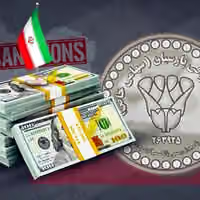
Iran’s pharmaceutical sector has come under strain from foreign exchange shortages, sanctions-related hurdles and rising costs. In recent weeks, Iranian media have reported shortages of some imported medicines, including brand-name anti-rejection drugs used by kidney transplant patients, with pharmacies in several cities halting distribution.
Medical specialists have warned that sudden switches from imported medicines to domestic alternatives can pose risks for a minority of high-risk patients, even though locally produced drugs work for most cases.
Drug prices, medical equipment and healthcare costs have surged by about 70% since the government removed a subsidized exchange rate for medicine imports earlier this year, according to domestic media. Insurance coverage has not kept pace with price rises, leaving patients to shoulder more of the cost.
Industry figures and lawmakers have warned that continued delays in foreign currency allocation, rising import and shipping costs and budget strains in insurance funds could deepen shortages in hospitals and pharmacies in the months ahead.